The Master and Margarita – a devilish concoction of imagery

The Master and Margarita – Complicite at the Barbican, until 07 April (Sold Out)

Few companies generate the same level of excitement before a new production as Complicite. There is a noticeable frisson of energy circulating the foyer before the audience takes it seat that is the result of a reputation for innovation and startling coup de theatre. It is a position that is very much deserved, as for three decades Complicite have pushed at the boundaries of the possible in both staging and story-telling; they have championed physical theatre and challenged the standardly linear model of naturalistic performances as a mechanism for exploring deeper metaphysical questions in their work.

This approach has been extraordinarily effective in tackling themes and stories that would otherwise be far too complex to bring to stage. Who else would have attempted A Disappearing Number, a play that shone a light on the 20th century mathematical genius, Ramanujan, and engaged the audience with the complexities of sting theory? Or attempted Mnemonic, a play that was part anthropological lecture told through the story of a corpse entombed in ice, part-character study of those involved in his later discovery and throughout an examination of memory and its mutability, fragmentation and unreliability.
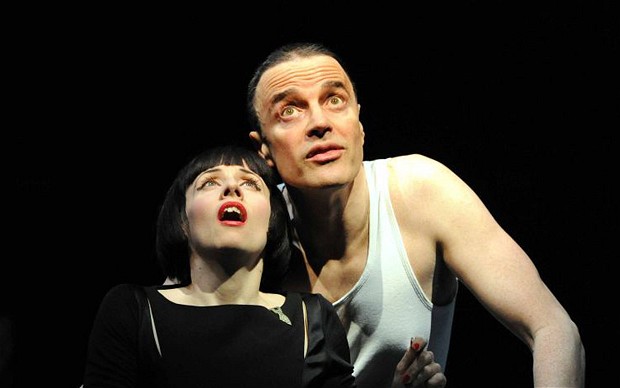
Mikhail Bulgakov’s 1930’s Soviet satire, The Master and Margarita, often held up alongside the greatest novels of the 20th century, has defeated visionaries from Polanski to Fellini. It’s digressive storylines and recursive plotting variously tells the story of the titular characters, The Master and Margarita, and the lengths they would go to for love, whilst also featuring the devil in the shape of Woland and a retinue of associates who wreak havoc on the Soviet literature establishment, whilst a dialogue between Pontius Pilate and Christ interweaves and informs the narrative throughout.
<Click her for the full review>

Around the Web

To fill the gap in the Civilian Theatre reviewing schedule (taking some respite before the Cultural Olympiad kicks off:

1) For those who like their reviews laced with a splash of acid then those good folk at West End Whingers are more than happy to oblige. They have cast their eye over Bingo and most appropriately have been to the Menier to see Abigail’s Party; a play that Civilian Theatre’s middle-class squeamishness means it cannot be endured:

2) Digital Theatre have been adding to their collection of downloadable plays, and now  Much Ado  About Nothing (with Tennant and Tate) and the wonderful David Suchet and Zoe Wanamaker headed production of All My Sons are both available in glorious HD. Given that top price tickets can set you back up to £65 then how about enjoying it in your own house with a glass of wine for £10?

3) Over at the Guardian, there is an editorial praising Stephen Sondheim to tie in with his lifetime achievement from the Critics Circle. Little needs to be said apart from…West Side Story, Gypsy, Company, Follies, A Little Night Music. Oh yes and Sweeny Todd, Merrily We Roll Along, Into The Woods and Sunday In The Park With George. The last remaining great American lyricist even if his career has slowed down dramatically in the last decade.

Here are a couple of clips from two of his most best-loved works:

4) Webcowgirl over at Life in the Cheap Seats discovers the perils of reviewing student shows. Student + Sarah Kane = Pretension – Original vision. As much as I admire Sarah Kane, there can be few artists that have had such a devastating effect on the originality and interest of drama students.

This week Civilian Theatre has been mostly…

…listening to Joseph and the Amazing Technicolor Dreamcoat (the Jason Donovan version naturally). Don’t judge me, blame the BBC’s fantastic The Story of Musicals, which does everything it says on the tin and more.

…watching Game of Thrones Season 1. Again. It’s all worth it for lines as amazing as…“The  next time you raise your hand to me will be the last time you have hands.”

God bless fans with time on their hands

…making my own Salt Beef thanks to Hugh F-W.

The mystery man and the problem play

Bingo – Young Vic, until 31 March

Edward Bond tends to write exactly the sort of plays that you would imagine a British Marxist growing up in a declining post-war England to write. Heavily influenced by Brecht, Bond’s writing operates with a rigidly mechanistic quality that wouldn’t seem out of place in a Soviet factory. There is a brutalism to life in Bond that may have reached its apotheosis in Saved and its infamous scene of a baby stoned to death. Saved, his second play, cemented Bond’s legacy due to the role it played in the battle to overturn the Lord Chamberlain’s Office right to censor works for the stage.

Deliberately challenging his audience and a notoriously prickly individual to work with, Bond has fallen from the public eye and in recent years has worked outside of the mainstream. However the Cock Tavern in Kilburn, now sadly closed, staged a number of older plays alongside new work in 2010 and the Lyric Hammersmith took on Saved in 2011 to suggest that we may finally be rehabiliting ourselves towards one of our most overtly political playwrights.

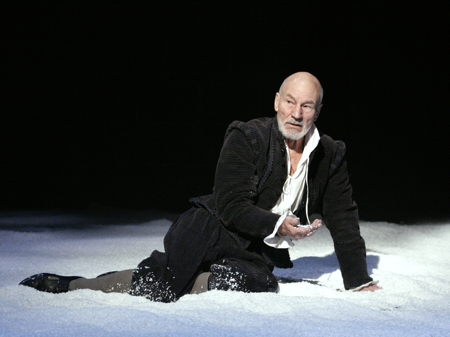
The Young Vic has continued this process with Bingo; it is seemingly an astute choice, one of Bond’s most accessible plays featuring Shakespeare as its central protagonist, and the casting of Patrick Stewart, who originally played the role in the 1970’s, guaranteed to bring in an audience that might otherwise avoid such austere fare.

Shakespeare retains central to Britain’s cultural heritage and represents the country’s main claim to a true cultural genius to rank alongside Da Vinci and Mozart. Those individuals that command an international agreement of their stature are rare indeed and whenever their legacy is challenged people have a tendency to react defensively.

<Click here for the full review>