Life: Lost and found

Missing – Gecko @ Battersea Arts Centre, until 21 March 2015 (tickets)

There are few elements of the theatrical world that Civilian Theatre feels less qualified to talk about than cutting edge contemporary dance. Any reviewer who fits shows into their free time will Bar and admirers. Credit Robert Goldeneventually reach a point when you accept there is only so much they can actually watch and, as a result, an element of self-selection may creep into what press shows are attended.

So it is entirely possible that –  had I read the programme notes for Gecko’s Missing more  closely rather than be seduced by the intriguing image that accompanies it –the words ‘critically acclaimed physical dance company’ may have registered and I wouldn’t have crossed London to make it to the Battersea Arts Centre to watch their show.

And what a fool I would have been.

Missing is an intelligent, beautiful show that speaks volumes even to the choreographically illiterate. It may not have transformed my overall impressions about contemporary dance but it has shown that the form can be used to tell a story just as clearly as through the use of words.

The difference between Gecko and other shows I have seen is that the performance lacks the abstraction that can leave the inexperienced scratching their heads. Previously I have been unable to translate a plot synopsis to what I have been watching but here the narrative progression was entirely clear and the company seemed focussed on not losing its audience. Scenes took place within established settings and the movements between performers seemed structured to reflect traditional conversations but with the added advantage that dance allows of allowing the text and subtext of character motivations to interweave in their actions.

There was also little of the po-faced seriousness that has been a marked feature of my previous encounters with contemporary dance. Whilst the topic itself was treated seriously, they also found the humour that can be mined out of the awkwardness of relationships. The fracture lines that marked Lily’s marriage were played to great comic effect in a simple scene showing how they were unable to sit comfortably together watching a film, whilst the meeting of her parents became a slapstick encounter made more poignant with the knowledge of how it would eventually disintegrate.

<<Continue to full review>>

Bedtime Stories

Fiction – Battersea Arts Centre, until 21 March 2015 (Tickets)

The Battersea Arts Centre welcomes David Rosenberg and Glen Neath back to the Council Chamber following the hugely successful production of Ring – an audio-hallucinatory adventure that married a highly technical sound design with an engagingly simple premise to create an extremely enjoyable, if difficult to classify hybrid of funfair chills, performance and radio play.

Clearly an advocate of the ‘if it’s not broken’ school, their latest production revisits much of the same ground. Again the audience are plunged into total darkness and listen through headsets. Again it is a brilliant opening that works better than you can imagine, even though you know precisely what is about to happen.

Very little beats the instant breath-catching horror of being unexpectedly plunged into complete darkness. It is the sort of oppressive darkness that is rarely experienced in urban areas – absolute, total black, where you begin to forget whether your eyes are open or closed.

And then, just as you are adjusting, the voices begin. And even awareness of what is to come can’t stop it from being a spine-chilling moment, your brain fooling you into thinking that you can feel warm breath on your neck as they whisper in your ear.

However to say much more about the plot would be to spoil the experience. It is enough to say that the programme notes refer to Rosenberg and Neath’s interest in dreams, the production attempts to create a collective experience of the shared dream space and the story itself twists and turns on dream logic.

Technically the show is more complex than Ring. The sound feels more layered and the effects more complex. Multiple voices work together more effectively and it is much easier to get a sense of distance as sounds move further away.

However as the science becomes increasingly apparent it is hard not to feel that they have lost something of Ring’s charm. It is a strange thing to say about an evening spent in pitch darkness listening to headphones but it felt that Fiction was a more solitary experience. The premise of Ring, the circular aspect and the actor moving around the room created a sense of inclusivity. Here, seated auditorium style, facing a giant screen – even if in darkness – felt very isolating and oddly impersonal.

<<Continue to full review>>

We came hoping for a new arcadia and instead ended up with Welwyn Garden City.

The Hard Problem – Dorfman Space @ National Theatre, until 27 May 2015 (Tickets)

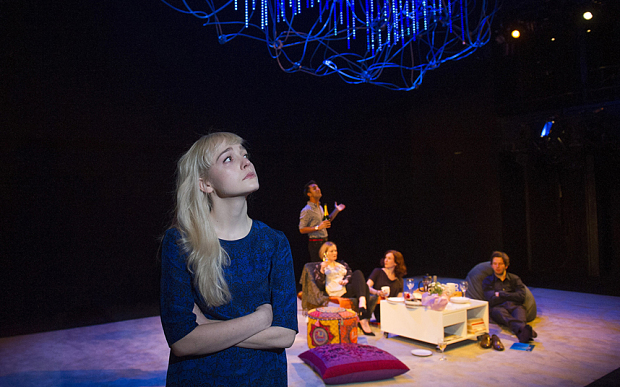
This production will be broadcast to cinemas on 16 Aprilthe_hard_problem398.jpg

The ‘hard problem’of the title refers to ‘consciousness’; a concept under assault from a battalion of neuroscientists laying claim to greater and greater certainty in their understanding of brain functionality as something that can be deconstructed to the micro-level of synapses, neurons and neurotransmitters. As neuroscience is in the ascendancy we are left with awkward questions over whether humans are left increasingly shackled by the tyranny of genetic determinism? Where does our freedom of thought – our freedom to act in ways contrary to the principles of evolutionary science – fit into the equation? In essence does the philosophical ‘mind’, as opposed to the functional ‘brain’, exist?

These are fascinating questions and truly weighty topics. It is the sort of subject we have come to expect from Tom Stoppard, who has demonstrated his formidable intelligence on countless occasions over the last forty years and in so doing has contributed some of Britain’s finest plays of the post-war era. This includes two genuine classics in Rosencrantz and Guildenstern are Dead and Arcadia and many others that found audacious approaches to create unabashedly literate drama enthused with a wit that refused to bow to the lowest common denominator.

Stoppard is 77 years old and it is his first new play for nine years. So perhaps the hard problem for the audience is reconciling itself to the idea that the play – quite possibly his last – is a bit of a dud. Critical reactions have been mixed and supported by an undercurrent of good will but, on reflection, can anyone seriously challenge the view that this is but a pale imitation of what has come before?

The play suffers primarily from a lack of drama. Things happen, time passes, the plot resorts to rather clichéd contrivances and one comes away finding it very difficult to care about any of it.

<<Continue to full review>>