Small family business yields little profit

A Small Family Business – Olivier @ National Theatre, until 27 August 2014

The National Theatre website currently advertises its revival of Alan Ayckbourn’s A Small Family Business as running until the 27 August 2014; given middling reviews and, more damagingly, the desolate swath empty seats all around, this now seems a trifle optimistic. One wonders if Ayckbourn has lost touch with his heartland and whether that distant sound is of Geoffrey Howe readying his poison pen.

If the above analogy seems tortured and meaningless in 2014 then try sitting through two and half hours of Thatcher-era satirical farce played, almost without exception, as if actors were being paid by the minute.A_Small_Family_Bus_2875957b
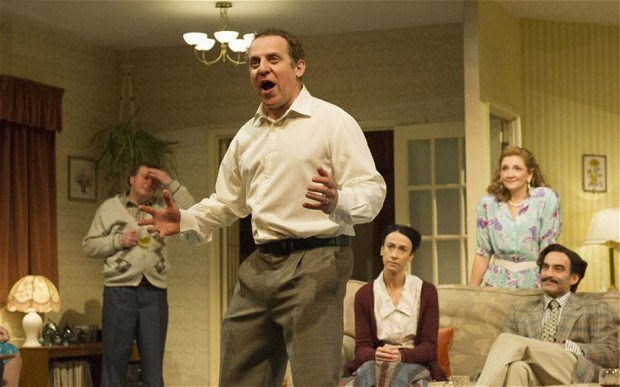
Astute readers may have gathered that A Small Family Business is not considered a success. There are many problems with the production but at its heart is the play. Ayckbourn is a fine dramatist – one whose reputation has grown as the subtle radicalism of his writing and staging has become ever more appreciated – but his work has always run the risk of being too identified with the period that he critiques.

Whereas writers like Pinter and Beckett examine the universal, Ayckbourn’s skill has always been the microscopic. He is one of the great observers; capable of skewering the social charade and unveiling the fissure lines that runs through society, the unspoken conventions of the British that permeates life and ensures everyone conforms to their class.
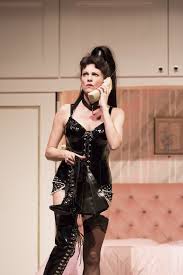
Family businessThe conclusion that can be drawn from A Small Family Business is that we have entered a period where his targets are no longer recognisable. It may be quarter of a century old but the world that Ayckbourn has pictured seems embarrassingly quaint; quintessentially English, it is not comforting in the same way that we relax into a Miss Marple and it is not a period piece in the way we might enjoy something by Noel Coward.

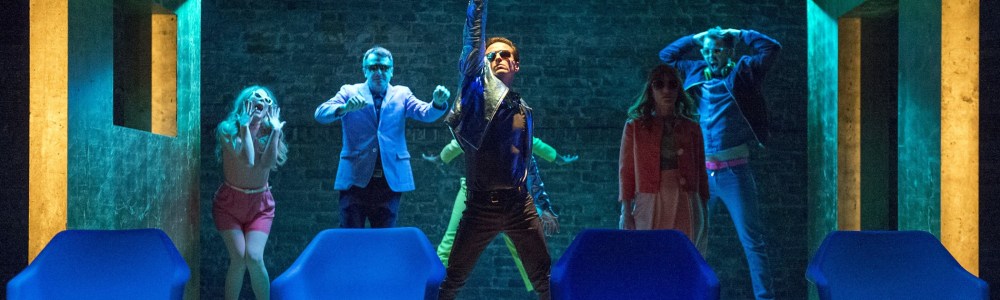
With the benefit of hindsight it does not seem like biting satire but instead offers a naïve view of the world. Living in an era where companies like Amazon pay £4.2 million in UK tax on generated sales of over £4 billion, it is hard not to recognise the scale of the ethical corruption of big business. In this work the idea that a small family concern needs to pay off a private detective to the tune of £50,000 does not really hit the mark. It is all a little reminiscent of Austin Power’s Dr Evil:


Indeed one of the more charmingly amusing ideas in the play is the idea that Britain has any small family-run businesses at all, let alone ones that aren’t riddled by corruption.
<<Continue to full review>>

Doing time with Birdland

Birdland – Royal Court Theatre, until 31 May 2014

There are few playwrights whose output is as prodigious as Simon Stephens; since 2010 he is credited against 15 works either as writer or adapter. He has built a fertile partnership with Katie Mitchell leading to a new translation of The Cherry Orchard arriving at the Young Vic in the autumn and, like Mitchell, he is highly feted abroad; working with Patrice Chéreau and Estonia’s Theatre NO99 on audience-challenging work that utilise multiple levels of abstraction and woozy dreamscapes to threaten the entire disintegration of narrative. However he is proved himself equally adept at producing crowd-pleasing adaptations and enjoyed great success with Mark Haddon’s A Curious Incident of the Dog in the Night–time and his translation of Ibsen’s A Doll’s House.

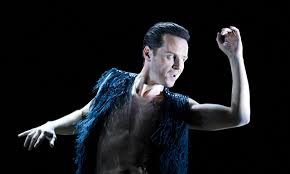
Andrew Scott in Birdland - Royal CourtAround Stephens’ swirls this air of the unknown, which makes any new work by him an enticing proposition. However this inability to pigeon-hole him has also led to him becoming one of Britain’s most divisive playwrights and Birdland is no exception to this.
What’s On Stage has pulled together how it has split the major newspapers, the blogging world has been generally united in criticism and it has been left to the always insightful Matt Trueman to attempt a passionate and cogent defence of the play.

Having been intrigued by Three Kingdoms and its radical Lynchian take on cross-border crime drama – possibly the only bright spot of the otherwise dire attempt to produce a theatrical ‘cultural Olympiad’ – Civilian Theatre has always been prepared to give Stephens a degree of slack. However it is troubling that flaws evident in Three Kingdoms crop up again in Birdland.

Three Kingdoms portrayal of female characters and sexual violence came very close to glorification rather than dispassionate reportage and whilst the work of multiple hands in the authorship of the piece made it hard to assign responsibility, it is depressing to see that three years later Stephens’ female characters remain ciphers for his fascination with charismatic men.

His work also remains far too long, Three Kingdoms was a punishing three hours whilst Birdland clocks in at an interval-less 110 minutes. It is slickly directed by Carrie Cracknall and the plot bounces along but as Andrew Scott’s rockstar Paul ends up in yet another European city, you do wonder if they could have shortened this endless tour by just a little.

It is down to the magnetic and compelling performance by Andrew Scott that the evening did not feel even longer. Whilst many of the audience may be drawn to this by his work in Sherlock (and one can see echoes of Moriarty in Scott’s dangerously charismatic Paul), he is no novice to the stage and took the lead in the (unfortunately woeful) Emperor and Galilean at the National. The snippet of Angels in America, shown as part of the National Theatre’s 50th birthday celebrations, also provided a chance to see an unusually intelligent and sensitive actor at work.

He turns Paul, on the surface a rather two-dimensional rockstar damaged by the sudden accumulation of wealth and fame, into a living creation. Scott finds a kernel of humanity within Paul’s increasingly disaffected personality; that part of his soul that led him to create the music that first brought him to people’s attention and which he is in the systematic process of destroying.

<<Continue to full review>>


Birdland Trailer


Read…people in defence of Birdland

Matt Truman

Michael Billington

The Other Bridge Project

Read…people criticising Birdland

Charles Spencer

Huffington Post

Cream of Vampire Soup

The-Testament-of-Mary-Fiona-Shaw-photocredit-Paul-Kolnik-copy-630x310

Breathing life into a statue: Fiona Shaw as Mary, Mother of God

The Testament of Mary – Barbican Theatre, until 25 May 2014

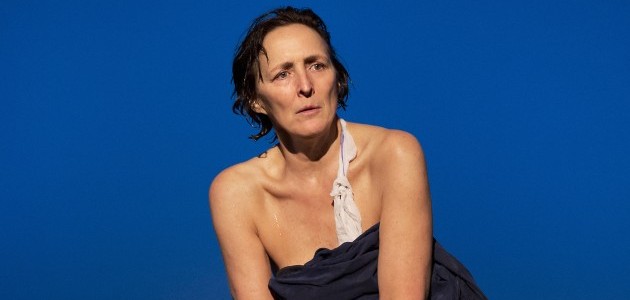
The Testament of Mary opens with a quite remarkable image that captures in tableau the vision of the director, Deborah Warner, the mesmeric focus of Fiona Shaw and the inspiration of set-designer Tom Pye; Fiona Shaw’s Mary is in her most recognisable garb, portrayed as a Raphaelite Madonna, but the seemingly tranquil pose is undercut a furious muttering, is it a liturgy or is it something more, which suggests that all may not be as it seems.

Shaw’s Mary presented in a Perspex box with the audience invited on stage to gawp at the figure within; this image hints not just towards Mary as one of art’s most famous faces but also towards the public spectacle of MaryMary as a carnival attraction, the figure of endless fascination.

There is something grotesque about the scene and it is hard not to think of visitors to P.T Barnum’s famous circus. The voyeuristic aspect is brought home by the vulture that sits and watches proceedings and reflects both on the way that the acolytes would feast upon Jesus’ legacy after his death and the role that we continue to play as audience members.

So begins this brilliant adaptation of Colm Tóibín’s novella that consists of a monologue from Mary reflecting upon her son and the events leading up to his death. Tóibín gives voice to Mary and presents a human relationship that deftly prizes open the centuries old fallacy presented by the Christian church of Mary as a form of virginal purity; this Mary is a mother, not just in name but also in deed.

Crown of thornsShaw embodies this earthy, human Mary. She is raw, alive and mourning the loss of Jesus as only a mother can. There is a humour amid her grief, thick and black, as she considers the impact her son had on others. Her Mary is Irish, this is both important and unimportant; what nationality should she be? She could be from anywhere but in making her Irish Shaw finds a folksy grounding and enables access to a natural informality in dialogue that can both raise the everyday to the state of the miraculous whilst grounding the miraculous in the everyday.

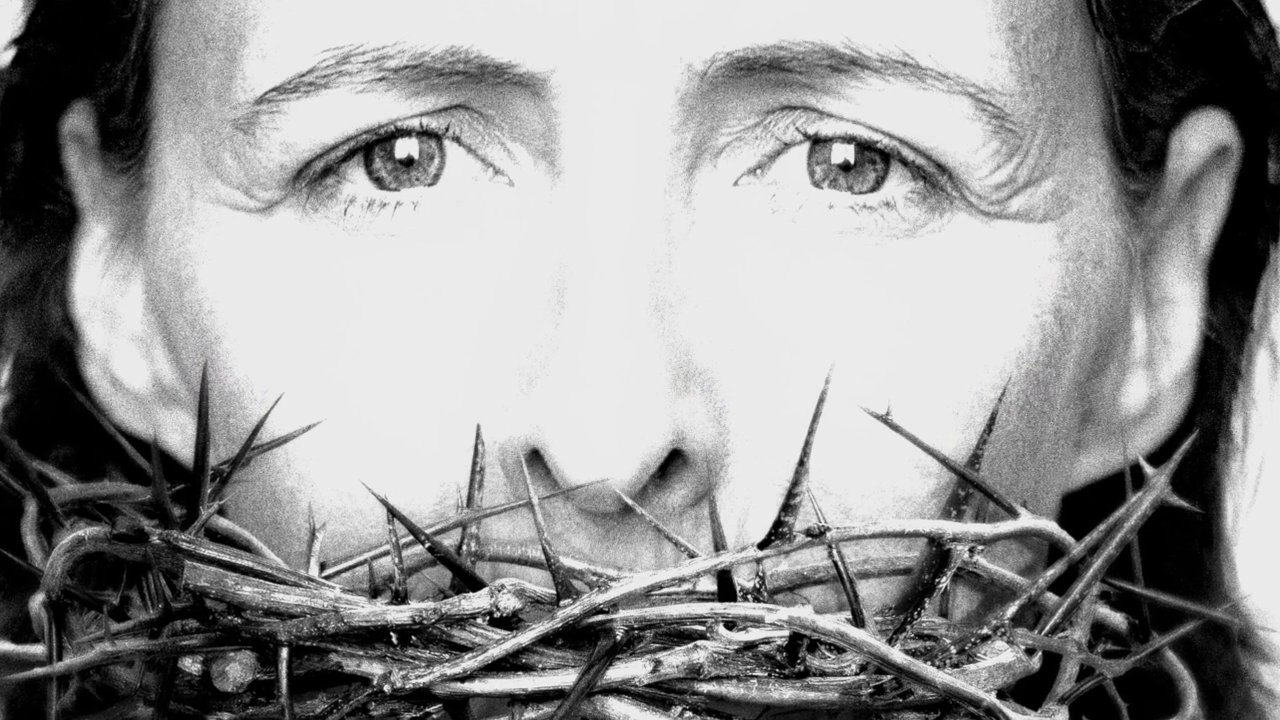
Running through the play is a strong feminist undercurrent that gives voice and power to the women in Jesus’ life. Advertising the play is an image of Mary gagged by a crown of thorns. It is a heavily symbolic image and suggests the fact that Mary, as woman and mother, is isolated in the aftermath of the crucifixion by those creating the mythology. One could argue that Shaw’s Mary is outlandishly modern but this critique seems misplaced, this is not being presented as history but as fable. Mary’s modernity is only as misplaced as the existence of miracles that she is so sceptical of.

Shaw’s Mary is no true believer – time and again we are pulled back to the central mother-son dynamic and, like many mothers, she cannot bring herself to trust her son’s friends and the actions that the ascribe to him. Her outsider status gives her an angle on to the famous miracles. The Lazarus myth is skewered quite brilliantly and demonstrates the horror that might accompany bringing someone back from dead. She is able to delve into the darkness of the story and the Lazarus that returns is closer to a zombie, reduced to wandering in a near-fugue state or sitting alone halfway between one world and the next.

<<Continue to full review>>


Watch the trailer

<p><a href=”http://vimeo.com/92254717″>The Testament of Mary – Trailer</a> from <a href=”http://vimeo.com/barbicancentre”>Barbican Centre</a> on <a href=”https://vimeo.com”>Vimeo</a&gt;.</p>


Read more

The Guardian

The Telegraph

Daily Mail

Independent

The descent into hell is easy but in the return a mighty labour lies

A View From The Bridge – Young Vic, until 07 June 2014

Considering the reputation that accompanies Ivo van Hove the first thing to be said about his production of Arthur Miller’s famous play is that it’s more restrained than might have been expected. This is not to suggest that it is performed in the shadows of the play’s reputation but rather that van Hove has created a singular work of such potency that despite stripping away external features and focusing View from the Bridge timesintently on the performances, it retains the power of the great naturalistic dramas.

Van Hove is a director that appears to relish the challenge of recasting great works in a new light; he is happy to cross cultural mediums and recent work includes the Antonioni Project, which re-enacted the Italian director’s films, and a highly-lauded adaptation of Strindberg’s Scenes from a Marriage. He has demonstrated a desire to bring new perspectives to classic works and this reached its peak with the hugely ambitious Roman Tragedies, which came to the Barbican in 2009. The production brought together Shakespeare’s roman plays and pulled them in to the modern era through an immersive multimedia spectacle that captured the increasingly symbiotic relationship between news and drama in the age of 24-hour reporting.

He is also happy working with the great American playwrights having previously staged Eugene O’Neill, Tennessee Williams in New York and now brings Arthur Miller to London. The influence of the director is clear from the moment the audience enters; Van Hove has used the flexibility of the Young Vic’s auditorium to physically conceal the entire set within a black box. Indeed the raising and eventual sealing of the stage suggests a symbolic entombing of the story and hints to its timeless nature.

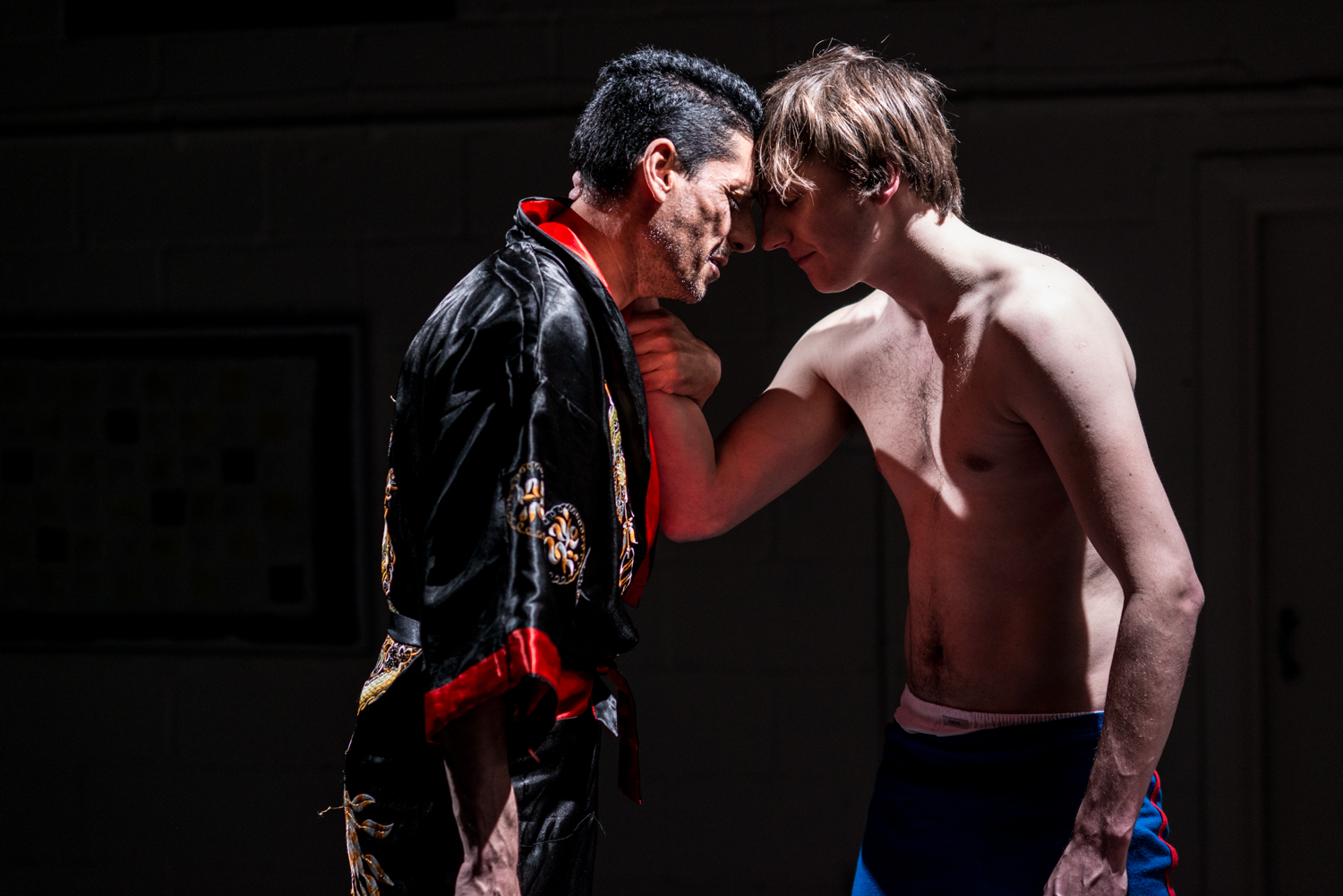
The production strips away all hints of naturalism from the setting. It exists as a stark, white rectangle surrounded by a glass bench. The only prop being a wooden chair that forms the essential test of strength between Eddie and Marco; van Hove recognises its significance and frames Marco holding the chair aloft in a moment of absolute stillness. It is reminiscent of a classical sculpture and is one of a number of markers that draw out the links to Greek tragedy that Miller hinted at within the text.

A View From The BridgeThe lack of a setting inevitably directs greater attention towards the actors, and they are uniformly excellent. Van Hove has drawn highly stylised performances out of his cast without losing the grounding in naturalism that is essential for demonstrating the characters’ humanity and for capturing the emotionally draining tragedy that lurks in the background throughout.

There is an expressionistic quality to the performances that adds a strand of universalism to the highly specific nature of the plot. Whilst the story of Italian migrants and working-class longshoremen places it within a time and place, this production leaves the audience in no doubt that the deeper themes are those that have always been with us.

It is anchored by a performance of exceptional power by Mark Strong as Eddie Carbone. He brings a natural physicality to the role that tells a story of sinewy strength rather than bullish power; the famous description of ‘eyes like tunnels’ is entirely apt for his Eddie, this is no knuckle-headed docker, but a man of complexity and internal conflict. We sense that behind those eyes is a torrent of raging emotions that he is intelligent enough to recognise but too inarticulate to express.

<<Continue to full review>>


Watch the Trailer

On Tidy Endings and Safe Sex 3, Photography by Jamie Scott-Smith, www.tenbyeight.co.uk

Living with a killer: relationships in a time of AIDS

On Tidy Endings / Safe Sex – Tristan Bates Theatre, until 17 May 2014

The ploy of drawing in an audience with left-field casting decisions is a high-risk strategy; it can take a production to a much wider community but it can also overwhelm the production itself. It is easy to see why actors are tempted to these roles; it gives them an opportunity to breakout of typecasting and open the door to a range of new possibilities, and for the audience it is always a pleasant surprise to see someone outside their comfort zone.

On Tidy Endings and Safe Sex 4, Photography by Jamie Scott-Smith, www.tenbyeight.co.ukWithout such free thinking how could we have got to the reinvention of Liam Neeson from Oskar Schindler to grizzled action hero or indeed, going the other way, the meta-masterpiece JCVD with everyone’s favourite head-kicking Timecop? When it goes wrong however it can be an excruciating; the very, very brief attempt to position Kiera Knightley as an action star (Domino, anyone?) is a particularly painful memory, but far more awful can be the attempt to become a cross-over star. Britney Spears in Cross Roads, Mariah Carey in Glitter? Pick from the unfathomably terrible Mr Nanny or Santa with Muscles starring everyone’s favourite 80’s wrestling superstar, Hulk Hogan.

It was with this knowledge lodged in mind that made going to see the Harvey Fierstein’s On Tidy Endings / Safe Sex with former Egghead, CJ de Mooi, at the Tristan Bates Theatre a slightly nerve-wracking experience – particularly as, with a central role in both plays, the night seems to be set-up as a showcase for his abilities.

Thanks to the strength of Fierstein’s writing, it can be reported that de Mooi does not overly dominate the night. A long-term, and highly successful, fixture on Broadway, Fierstein wrote the book for both La Cage aux Folles and Kinky Boots while his Torch Song Trilogy led to two Tony’s. A long-term champion of gay rights, On Tidy Endings / Safe Sex takes a personal and mature view of the impact of AIDS in a way that is wry and heartfelt without sliding into mawkish sentimentality.

Fierstein has said that Safe Sex represents a personal response to living in the time of AIDS and the character of Gerry can be viewed as a version of the writer reflected on stage. The play is lyrical, reflective and contains a strong monologue that captures a truly human perspective of what it was like to be living through the before- and after-times of the AIDS crisis. It is at this point we can begin to appreciate the huge transition that the illness pressed onto gay men everywhere; where equality movements created momentum for change, AIDS forced the issue and, in the most negative way, pushed sexuality into the mainstream and ensured that, for better or worse, a person’s sexual identity could never be a wholly private matter.

Within the monologue, de Mooi finally relaxes into the role. He has a naturally intense presence and for the opening 20 minutes his performance is constrained by a lot of tension, which worked with the physicality but detracted from the vocals. A flat delivery that was reminiscent of line-reading and an actor prodding and pressing at the edges of a new character detracted from his performance. Ghee tells Mead that the relationship is ‘the most intense passion I have ever felt’, which one might believe from the dialogue but not from the rather one-note performance.

Reaching the monologue a transition takes place and the tension floats away with the arrival of the heightened dialogue. Indeed the mood changed so dramatically that it raised a question mark over whether the whole On Tidy Endings and Safe Sex 5, Photography by Jamie Scott-Smith, www.tenbyeight.co.ukpiece, given its reflective, personal nature, would have been better suited to being a monologue. The conversation between Mead and Ghee never really takes flight and a number of absurd character switchbacks seem to aim somewhere between Woody Allen and screwball comedy but only serve to add to the sense that Safe Sex has arrived underdone, both in writing and rehearsing.
Returning after the interval, On Tidy Endings works hard to redress the balance. By some margin the stronger of the two pieces, it is a mature and painfully accurate study of modern relationships and the contested space that is left behind (and particularly when it is from a disease that has as many pejorative markers as AIDS). It reflects on the wider dynamics that causes society to skim over the new partner in favour of maintaining the illusion of the traditional marriage model, no matter how broken it was. The conversation, primarily a two-hander,between de Mooi’s Arthur and Deena Payne’s Marion is strong, adult drama and both actors bring out the raw human emotion that runs through the writing.

<<Continue to full review>>

012 Apple Line, Smashed (courtesy Ryoko Uyama)

The art of juggling / the juggling of art

Smashed – Gandini Juggling @ Udderbelly, until 18 May 2014

The last time I was in the big purple cow of the Udderbelly was very late one night after a few too many beers at the Edinburgh festival. It consisted of men in thongs, scantily clad women doing things with ping pong balls and a chainsaw. Luckily, Smashed, running as part of the Udderbelly Festival on the Southbank, is a very different affair.

011 Female Distract, Smashed (courtesy Ryoko Uyama)

011 Female Distract, Smashed (courtesy Ryoko Uyama)

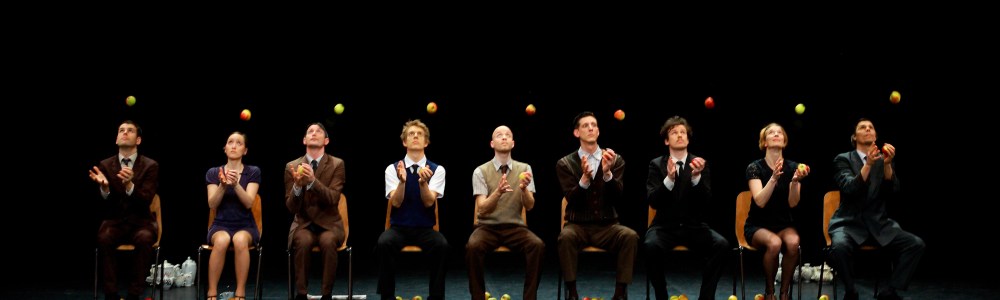
Performed by Gandini Juggling, a company formed over 20 years ago to fuse contemporary dance and mathematical notations in the field of juggling, Smashed is utterly (not udderly? – ED) delightful. It’s perhaps hard to imagine how an hour of juggling could keep you so entertained, but the constant variations in pace, theme, tempo and movement styles weave an intricate story between the performers and without a word you are embroiled in their loves, loses, competitions and seductions. Smashed falls somewhere between circus, contemporary dance, symbolist theatre and mime, but works hard to effortlessly fuse these strands to create a family friendly, entertaining and deeply likeable piece.

The company of 9 performers enter their apple strewn tea party all smiles and poised precision. But it is soon apparent that not all is going to go to plan, and with wit and extreme dexterity, proceedings literally start to fall apart. The speed and complexity with which the jugglers perform is astonishing, especially during the group routines, and the performers’ expressions and precise movement tell a playful story of gender politics and everyday power struggles.

The influence of Pina Bausch is clear to see throughout; short scenes investigating male and female interaction, scrutiny of bubbling personal tensions, intricate composition and concise choreography that is rich in symbolism, playful use of repetition and even the muted tones of the formal costumes and popular soundtrack. It’s a thoughtful tribute to her work.

Smashed is an entirely charming, intelligent and unusual performance, with a delicious spark of anarchy that is well suited to the Udderbelly cow. And there’s not a ping pong ball in site.


Watch some impressive jugglery-pokery action


This review was written by our roving review, Sarah Stewart. If you are interested in reviewing or writing articles for Civilian Theatre then please email civiliantheatre@gmail.com