Arriving at the Trafalgar Studios you may unwittingly feel that you have walked into the wrong venue given the amount of signage for what appears to be a rather bombastic Macbeth with a certain Mr McAvoy seeming to dominate events.
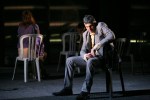
Take closer order and you will discover that their intimate studio space is currently playing host to a drama that packs an equally shocking emotional punch. However it is one that sets aside the grandiose Shakespearian tragedy and instead hits you unaware from its home within a destabilising, and ultimately disturbing, modern naturalism.
Jack Thorne is a very promising writer, whose previous credits have included co-writing Greenlandfor the National and adapting The Physicists at the Donmar. In Mydidae, Thorne demonstrates the knack of not just writing well-crafted naturalistic dialogue but also developing concepts where a surface simplicity artfully hides unexpectedly complex depths.
Setting a play in a bathroom is such an obviously winning idea that it begs the question why it hasn’t been explored to this level of precision before. Playwrights are constantly searching for new ways to shine a light onto the way people relate to each other and the bathroom as a location is one that throws up intriguing questions about the public/private nature of the space and the contested and malleable boundaries that are placed upon it.
Throughout the play this question of boundaries keeps reoccurring. We see the boundaries of David’s job constantly shift into the private. The boundaries of their relationship are seen to constantly dissolve and reform. The balance of power is a contested space between them and even the audience is challenged on the assumptions it makes.
It is telling that one of the opening images of the play is the invasion of Marion’s private world by David’s very public phone conversation. In the technologically connected modern world the public persona blurs the boundaries of what was traditionally accepted to be the private.
A person can no longer easily control their own private space outside of what exists internally. However Thorne shows how this world of connectedness does not necessarily lead to more openness. Whilst Marion and David believe they have shared everything, they have in fact used sharing as a mechanism for locking away what most needs communicating.
In the beginning we are full of a nervous expectation. In the end we are full of a crushing disappointment. In the middle we find a soufflé – an indulgent and elaborate work that looks more and more underwhelming as time goes by.
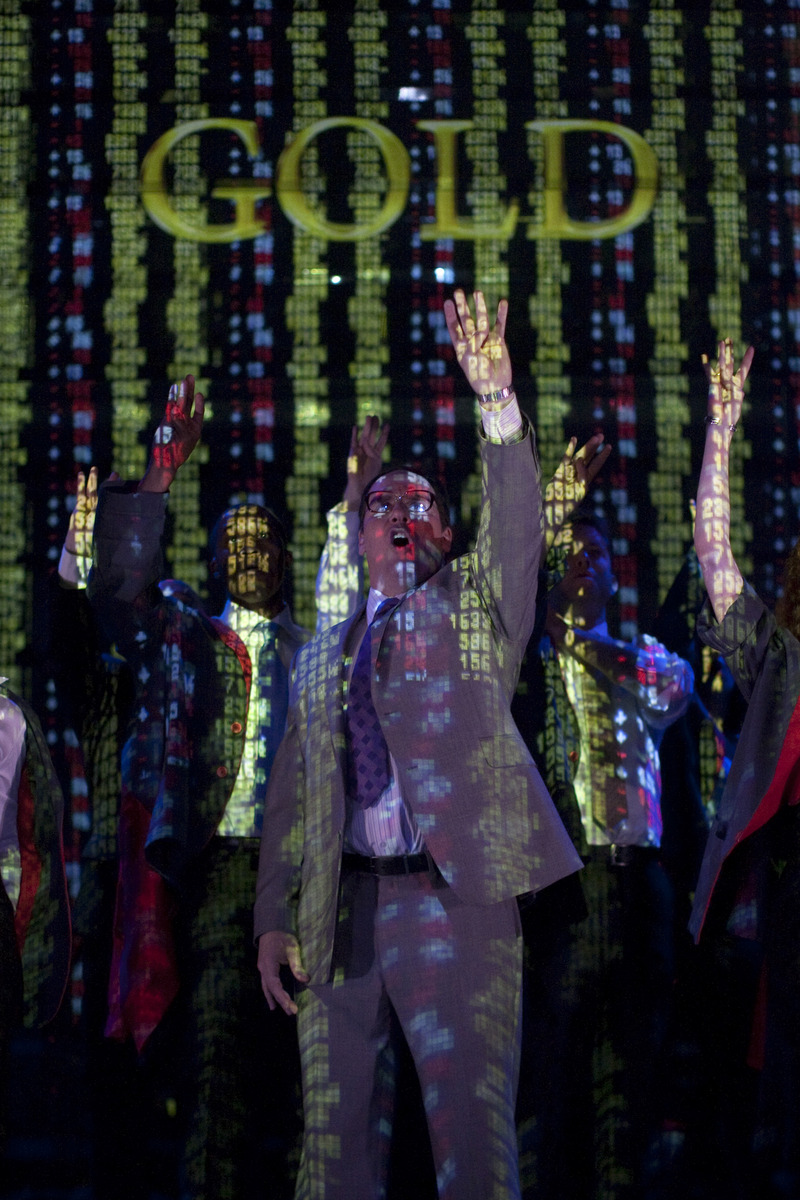
It is difficult to describe how many things are wrong with dreamthinkspeak’s attempt to weave inspiration from Leonardo Da Vinci’s ‘A Cloudburst of Material Possessions’ into a multi-stranded meditation on a world at a supposed crux of development and chaos.
It is difficult to describe because that would have entailed dreamthinkspeak feeling it was necessary to share any of their ideas with the audience rather than thinking that a hotchpotch collection of site-specific installations mixed with cod-philosophy and an imagined future that seemed startlingly reminiscent of a mid-1980’s episode of Tomorrows World was an acceptable substitute.
At the end of the audience’s ‘journey’ (even the word makes me cringe) you are handed a leaflet outlining the thinking behind what you have just seen. It is quite a useful addition if for no other reason than for the fact that it demonstrates that the cringingly pretentious claptrap that you have spent the last 70 minutes watching seem just as cringingly pretentious when written down.
‘John the Baptist…seems to be ever present. Is he pointing the way to The Second Coming, to our death, to the end-of-world, or is he a false prophet who leads us on then abandons us to an uncertain fate? Does the slightly strange man obsessed with lemons have the answers? He seems to be dreaming of a new kind of Eden. But is it a real or a comprised paradise? The final installation mixes the organic with rudimentary technology but is it really the way forward?”
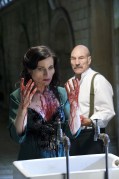
Théâtre de la Ville–Paris’ production of Ionesco’s Rhinoceros is practically faultless and it is with considerable surprise to discover that it has taken nearly nine years for it to have crossed the Channel; it is very rare for a near-decade old show to appear to contain so much vitality. It is an evening at the theatre that manages to achieve that rarest of blends – an exquisite play meeting an exceptional production. Over the last five years I can think of just two other productions that could lay claim to being of a similar calibre; Jez Butterworth’s Jerusalem anchored by Mark Rylance’s ‘Rooster’ Byron and Rupert Goold’s production of Macbeth with Patrick Stewart and Kate Fleetwood.
We are clearly operating in exulted company and it is perhaps telling that despite barriers of style, language and time the three productions share common traits. They all rely on a strong central male character who across the course of the narrative embarks on what we might recognise as an existential crisis that leads them to stand against the forces of change and modernity. To a greater or lesser extent they are the architects of their own downfall, as they each retain a strong moral code that is a major driver for action and embeds a sense of duty that can seem inexplicable to others, and that will cause them to follow a path that can only lead to isolation and destruction.
Each of the productions also share a perfectly pitched casting for its lead character; there is not one moment where Rylance doesn’t fully convince as Rooster, a man whose self-important sense of being part of a grander element of England’s narrative blinds him – metaphorically and eventually all too literally – to the modern culture of the nation. Stewart, as I have written before, captures the transition of Macbeth from the brutally effective soldier to his existential crisis point and onwards to an acceptance of predetermined resolution.
In Théâtre de la Ville–Paris’ production we have a central character of equally moral and dramatic weight. Serge Maggiani wonderfully captures the crumpled, unassuming and apathetic Bérenger;a paradoxical figure who is both an everyman and of such inconsequence that his friend, Dudard,feels mindful to provide him with a tie and gives him stern lectures on his social habits. Ionesco has caught in Bérenger a figure that everyone will recognise; the amiable friend who like a drink, and likes an argument alongside it.
Maggiani manages to bring alive a character that is by turns infuriating and charming, capable of great erudition but also a boorish drunk. There is weariness in his actions, a perpetual shrug on his shoulders as he lets life pass him by with a seemingly chronic disregard for the social conventions of those around him. Often striking a rather pathetic figure in sober company, his transformation is a reflection of Kantian virtue as it goes against our sense of his natural manner; where those around him, be they of stronger moral purpose or following a rationalistic instinct, choose to join the Rhinoceroses, Bérenger doggedly becomes the contrarian and rejects the easy path of transformation in favour of humanity.
Excellent news this week as Rupert Goold was announced the new artistic director of the Almeida Theatre, following Michael Attenborough hugely successful tenure. Now firmly established as one of the most influential theatres that bridge the gap between the West End and the regions, it is difficult to remember that 11 years ago the Almeida was running a sizable deficit and that Attenborough not only turned this on its head but did so whilst also almost doubling the number of new productions.
Rupert Goold has a challenge on his hands but the freedom of the role, and his own prior knowledge of the space through working on Headlong co-productions, allows him to enter on a firm footing. His own uniquely stylistic flair, as recognisable in theatre as Tarintino is in film, make the possibility of creative control over an entire programme a most enticing one proposition for the audience.
Goold’s Macbeth was praised to the heavens by critics on both sides of the Atlantic; brilliantly designed, blessed with the stand-out performance from Patrick Stewart’s illustrious career and one more than equalled by Kate Fleetwood’s splendid Lady Macbeth. Goold’s production manages to maintain the golden thread that so often eludes directors of style; every element contributes something to the whole enabling the sum to be so much greater than the parts. Most pleasingly, it is also available for anyone to see as it was expertly captured for theBBC; rather sickeningly Goold proves himself to be equally at home in this medium, and the transfer retains a spirit and vitality that was sadly lacking in the televised version of Hamlet with David Tennant.
The extent to which I think this is seminal viewing is the fact that I am prepared to suggest buying something from Amazon in order to do so – boycott be damned, it is just too good.
Rupert Goold is only the latest in a line of seat-swapping that has amounted to a seismic shift in the theatrical landscape. The last couple of years have come to feel like a pivotal moment for the next generation to pick up the baton from their predecessors. Coinciding with a new political landscape, we are seeing the emergence of a new wave of directors and producers who will be charged with guiding British theatre through the murky quagmire of reduced funding and a more oppositional approach to politics.
It is too early to say but it could mean a return to more overt political dramas. One of the problems of the Labour regime is that they remained difficult to criticise following the experience of almost twenty years of Conservative power – and even more so when they pumped more money into the cultural landscape than it had seen in years. Where Labour were criticised, most excoriatingly by David Hare, was on foreign policy, or more accurately their foreign policy in Iraq – less was said about interventions in Sierra Leone and Kosovo.
During the Labour years it is hard to think of many plays that really sought to tackle domestic policy until the financial meltdown made everyone realise how far the country had sleepwalked into inequality under the watchful eyes of a supposedly centre-left government. One can only hope that the shake-up can also dislodge the art of the politics and reveal a new generation of dramatists less concerned with the ‘I’ than the ‘We’.
The most high profile, and contested, position up-for-grabs was that to succeed Michael Boyd as Artistic Director at the Royal Shakespeare Company. Whilst the National Theatre has more power and money, it is hard to dispute the RSC still carries the most prestige – flying the flag for Shakespeare and under Boyd’s leadership emerging from the mire with a reinvigorated sense of self. It is questionable whether anyone other than Gregory Doran had a look in, and the press release is rather telling ‘‘Greg Doran is a perfect choice for the RSC and is well known to all our audiences. His long history with the Company[…]’. It contains every impression of wanting to promote from within and maintaining a sense of continuity in a company that has too often lost its focus. Gregory Doran is without doubt an exceptional director but could well be seen as a safe pair of hands. However is this a bad thing when dealing with Shakespeare? Every year there will be attempts to reinvent Shakespeare for the modern age, most will be terrible and a few will not. In many ways it is much harder to breathe life into more traditional staging that are more interested in the text than in assuming what Shakespeare may have meant the text to mean.
Continuing outside of London, but yet further North, the National Theatre of Scotland has announced that Laurie Sansom will take over from Vicky Featherstone – herself off to the Royal Court to keep the merry-go-round spinning. The National Theatres’ of Wales and Scotland are probably the most important, and successful, developments in British theatre over the last 15 years. Vicky Featherstone was a hugely influential part of that culture of success, and was instrumental in bringing the widely acclaimed Black Watch to the stage, and the hugely entertaining Alan Cumming one-man Macbeth.
It is a shame that her departure was partly overshadowed by claims of a parochial attitude among the Theatre’s management but one hopes that they Royal Court will be the chief beneficiary of the time that she has spent outside of London. As an added intrigue, the poaching of Lucy Davies from the National Theatre of Wales to be an executive director at the Royal Court means that both have suffered a significant loss of leadership and one hopes that a firm hand is kept on the rudder of both organisations.
And the final move, and probably the most written about, is that of Josie Rourke taking the reigns at the Donmar Warehouse. Already a year into the programme we have seen an interesting array of productions that, if not setting the world alight are at least suggestive of a non-confirmist mindset. Durrenmatt’s The Physicists is not a play that has aged gracefully but it is still good to see it revived, whilst an all-female Julius Caesar may have caught some predictable flak but it provides challenge and most importantly provides new insight into the group dynamic of political leadership that a traditional cast production cannot achieve. It does feel like we are still waiting for Rourke to stamp her authority on her tenure but it also feels like that production is not far away.
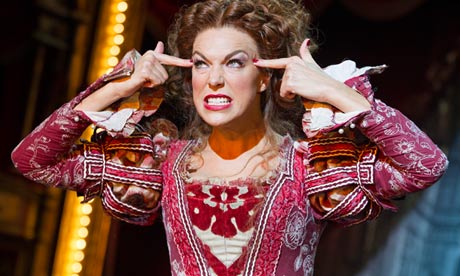
Having now seen two productions of Kiss Me, Kate, separated by more than twelve years, what immediately stands out is that it becomes far more rewarding experience if one arrives forearmed with a strong knowledge of The Taming of the Shrew. Cole Porter’s signature touches are mixed with a far more literate concept than would be expected from his back catalogue, and in doing so it becomes a musical that manages to both please and perplex,
Cole Porter thought of Kiss Me, Kate, along with Anything Goes, as one of his two perfect musicals and Trevor Nunn is a man who clearly thinks along similar wavelengths. Having been responsible for the National Theatre’s stunning revivial of Anything Goesin 2003, he also takes the reigns here and displays the assured hand of a man who is as equally at home in musical theatre as he is in Shakespeare. No mean achievement and one that pays dividends in bringing Porter’s screwball reinvention of Shakespeare’s lacerating take on gender politics to life.
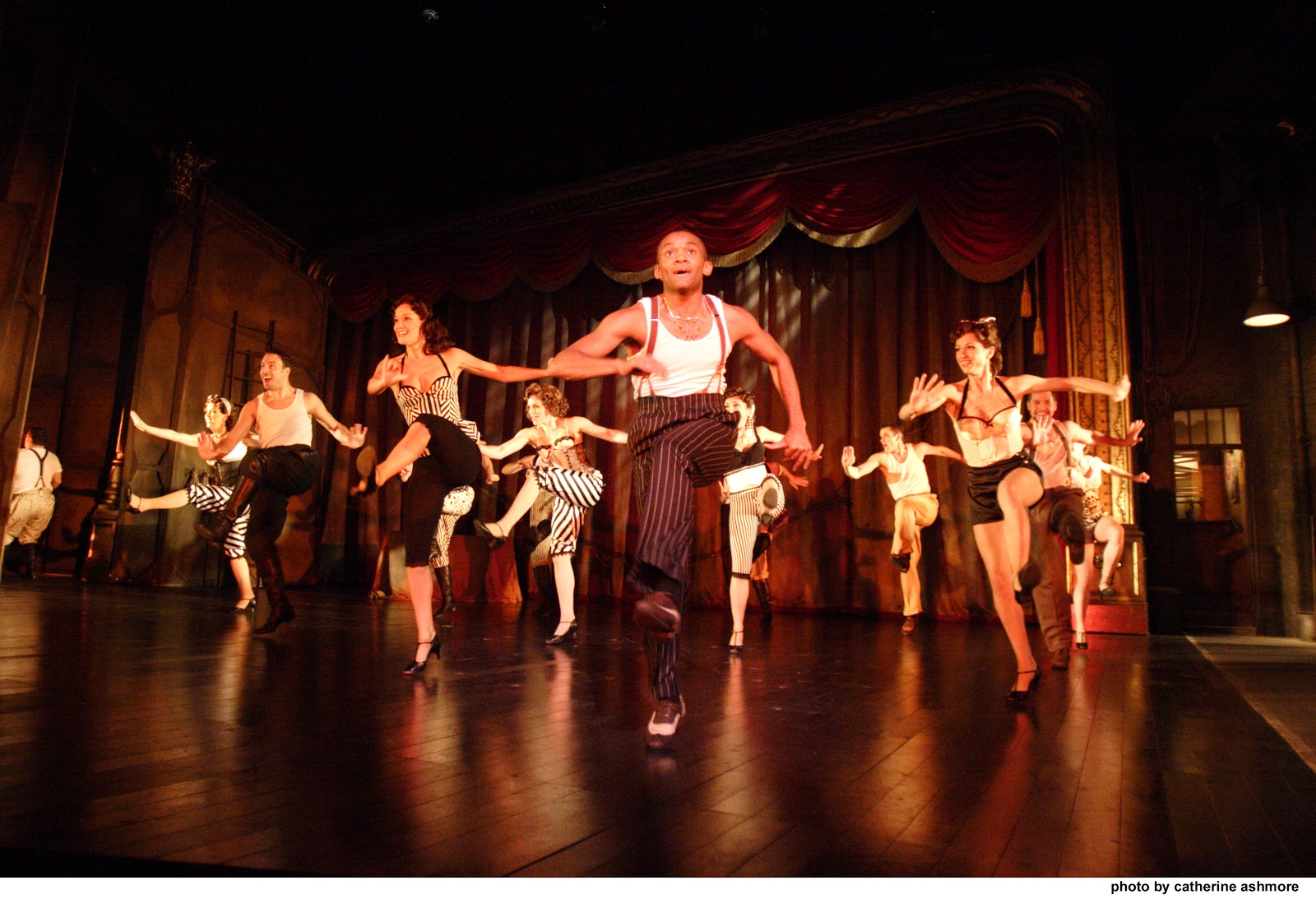
Not many musicals stand toe-to-toe with Anything Goes, and not many productions can match Nunn’s revival, which has so far proved to be one of the few great musical moments of the 21st century. It was the last of the great examples of chorus-line choreography, Crazy for You, Top Hat and Singin in the Rain being pale comparisons of the form. It also boasted fine central performances, particularly from John Barrowman as Billy Crocker. And of course it had Cole Porter at his irrepressibly brilliant best.
All of which is a roundabout way of pointing out that Kiss Me, Kate is not the equal to Anything Goes. Songs like Wunderbar, Brush Up Your Shakespeare and Kiss Me, Kate are mere shadows of It’s De-Lovely, You’re the Top and Anything Goes. There are occasionally moments where riffs and motifs feel repeated, and parts of We Open in Venice sound like a straight lift from Bon Voyage.
At his best Porter has a verbal dexterity that has only been matched by Stephen Sondheim, a lightness of phrase that can wrap a barb within the most delightful melody and an almost unparelled ability to produce rousing, climaxes that blend dance routines seamlessly with witty lyrics and show-stopping choruses.
Unusually Porter is strongest with the spoken dialogue rather than the music and lyrics. It is without doubt a very intelligent reworking of Shakespeare’s play. There is a level of meta-textual dynamism that is most unexpected from a musical written that was written in 1948 and ran for over 1000 performances. The play presents us with an off-stage version of Kate and Petruchio but also flips the action to show us both faithful, and unfaithful, renditions of the actual Shakespearean parts. Naturally action overlaps between off-stage and on, whilst fictional characters invade the world of the play-within-a-play all the while building to a suitably romantic ending.
I find watching up stand-up comedy an inherently stressful business. Presumably less stressful than for the person performing it, but as the lights go down I find myself with indentations in the middle of my palms where my fingernails have found themselves firmly embedded. Despite having seen plenty of dross in the theatre over the years – from my bad plays, to poor directors and awful actors – I never suffer from anything close to the paroxysms of fear that accompany watching comedy.
It must be something about the different expectations of the audience – a play can mean many things, even a ‘comedy’ does not necessarily lead an audience to assume they will be convulsing in fits of laughter. To put these differences into perspective – there are many who consider Chekov to be quite a comedic playwright. It is fair to say that we are talking about the bar being set at a very different level.
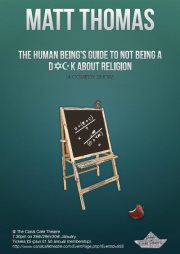
So a one-hour monologue that bills itself somewhere between a play, a stand-up routine and a lecture, and that is also about religion. Are we having fun yet? In the event my fears were mainly without merit; Matt Thomas’ ‘The human being’s guide to not being a dick about religion’ proved an adroit and confident piece that skipped between jokes, set-pieces and information without the slackness that often slips into a one-man show.
If we are to place it on the comedic spectrum we are closer to the introspective intelligence of a Stewart Lee or a Doug Stanhope (without the razor-sharp deliberate audience alienation) than the ‘mates down the pub’ sub-standard preening of a Michael Macintyre or John Bishop. However Matt Thomas treads carefully on unstable ground and whilst routines that ruminate on the allegorical nature of the parables or the importance of the contexualisation of language may sound like a comedy desert, they are located within set-pieces that come across as a Live at the Apollo routine with added smarts.
This is exemplified by the standout routine of the show that demonstrates, with some brilliantly tongue-in-cheek visual aids and examples that subvert mainstream comedy tropes, the difficulty in communication when you are arguing across different planes of emotional engagement. It is a nimble leap of a fertile mind that refreshes a relatively tired genre of comedy and places the rationalism vs faith argument within scenarios that are immediately obvious and, more importantly, funny.
 tragedy and instead hits you unaware from its home within a destabilising, and ultimately disturbing, modern naturalism.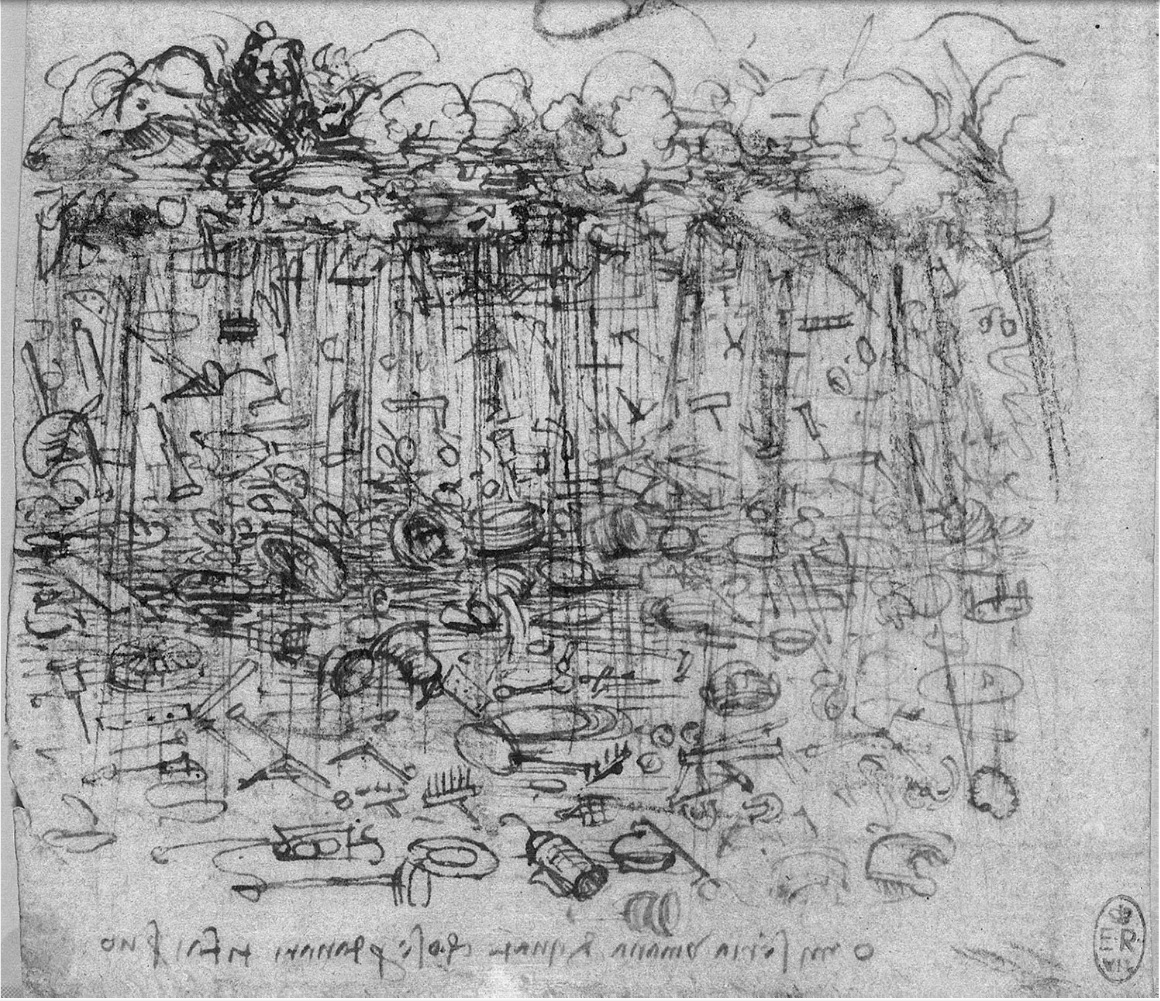

 Civilian Theatre