Taking the train to ‘El

The El Train – Hoxton Hall, until 30 December 2013

Sometimes the venue is everything when it comes to theatre. It is hard to imagine watching Eugene O’Neill’s three short plays – that make up The El Train – about life in the Bronx from the comfort of plush velvet seats Ruth Wilson  & Zubin Varla-steve-in-the-web-the-el-train-hoxton-hall-photo-marc-brenner-408on Shaftesbury Avenue.  Yet sat on rickety wooden seats in the cold, draughty Hoxton Hall, hemmed in by the elbows of your neighbours, and in the heart of what was once the heart of the East End slums, O’Neill’s histrionic melodramas about the perils affecting life among the forgotten beings to make a kind of sense.
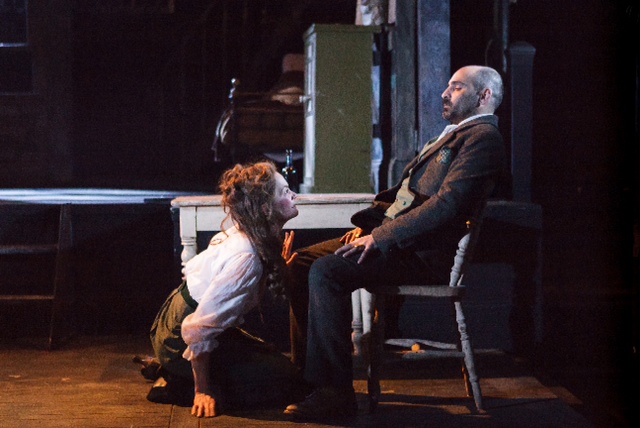
The atmospheric surroundings of Hoxton Hall is critical in making the whole concept of The El Train work at all. Outside in Hoxton and around Old Street – Britain’s ‘Silicon Roundabout’ – it is difficult to appreciate just what life would have been like for those living in the same streets a century before, and so the location helps to ease the audience back to a time when earnest members of the Fabian society would deliver lectures on a range of esoteric subjects because they truly believed in the moral purpose of education for the bettering of the life of the working man; indeed it comes as little surprise to discover that for over twenty years the venue was run by the Quakers and linked to the temperance movement.

The El Train is a good way of seeing O’Neill writing in the style that would see him win two Pulitzer prizes and become Nobel laureate. A passionate writer that does for the American poor what had previously been highlighted in the U.K through works by George Bernard Shaw and Charles Dickens, O’Neill can be exhausting in the long form but in 20 minutes bursts his style can be rather invigorating.

O’Neill tends to be venerated by theatre critics but in his full-length plays he is often to be endured as much as enjoyed. He is as melodramatic as Tennessee Williams but without the entertaining southern gothic that makes Baby Doll and The Glass Menagerie such lurid delights. His plays, like Long Day’s Journey Into Night, mark some of the first developments of the narratives that are now seen as the great American themes and which dominate American drama and literature to the present day. However O’Neill’s work seems to lack the stringent naturalism that propels Arthur Miller’s All My Sons and Death of a Salesman into the ranks of great drama.
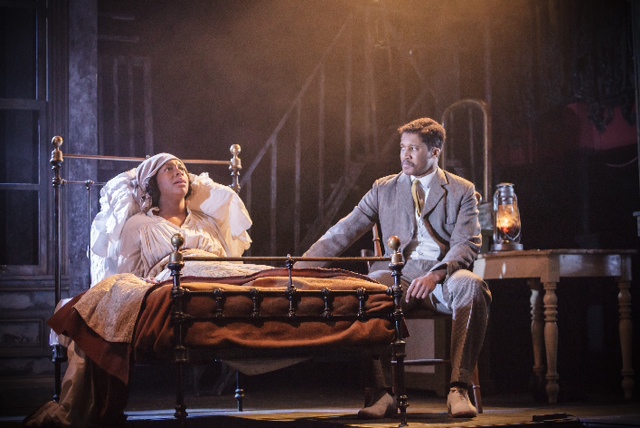
Nicola Hughes - Mammy Saunders and Simon Coombs-dreamy-in-the-dreamy-kid-the-el-train-hoxton-hall-photo-marc-brenner-837However in the short-form of The El Train one is reminded that there is nothing inherently wrong with melodrama as a dramatic style but it is in the application that it often falls apart. Placed in the hands of strong actors, who commit wholeheartedly to the concept rather than act against it, the moral force of the work begins to shine through. And Ruth Wilson, after her turns in Anna Christie and A Streetcar Named Desire at the Donmar Warehouse, has proved herself a very fine actor indeed.

Wilson is a magnificent presence in the first piece; a monologue about a frustrated housewife and her alcoholic artistic husband, and which is by some margin the strongest of the three. She captures the very essence of a human teetering on the edge, struggling to free herself from the binds placed on her by both her husband and her own sense of pride.

The real skill of Wilson’s performance is how she understands the limitations of O’Neil’s writing to a modern audience. She doesn’t try to force the language but instead inhabits the whole character; Wilson brings the part alive with a nervous tension that can be read through the way her hands struggle to knot the front of her apron or pick at the wood chipping off the kitchen table. The weight of the burden upon her can be felt through the way that the corner of her mouth begins to pull down as she lists her husband’s various failings, and in the rigidity of her body every time her husband makes noise offstage.

<<Continue to full review>>

A timeless – or should that be conservative – production

Henry V – Noel Coward Theatrebooking until 15 February 2014

So the Michael Grandage season draws to a close with Henry V; one of Shakespeare’s most popular plays and one that sees Grandage reunite with Jude Law following their Hamlet in 2009, itself a reminder of Law’s theatrical qualities – something that always feels at risk of being buried among the dead weight of his often mediocre Hollywood movies.

The cinema is a useful starting point for Henry V and possibly one reason why Jude Law was approached for the role, because the play itself is one that feels strangely uncomfortably suited to the stage and its ongoing Jude Law in Henry V, Noel Coward Theatrepopularity is perhaps more due to the rousing film versions of Olivier, Branagh and, more recently, Tom Hiddleston.

The main difficulty of staging Henry V lies in the fact that a large proportion of the plot is set directly in, and around, live battles. Fight scenes (between armies rather than individuals) are very difficult to recreate convincingly on stage.

The playwright or director is left with two choice; to attempt to find a way of portraying the battle on stage, something that is fraught with difficulty and which rarely emerges coherently or providing any sense of the brutality and terror of war, or to stage the battle offstage and intercut with appropriate scenes. Choosing the second option, as Shakespeare creates a problem in that the audience is always aware that the real excitement is happening elsewhere and it is a struggle to maintain focus.

Film has the advantage of having it both ways; jump-cuts can propel the action without the need for laborious changes of scene, the bewilderingly frenetic action of a medieval battle at ground level can be interweaved with a top-down view that allows the viewer to pick up the rhythm and flow of a wider military operation in progress. The editing room also allows for the surging music to flow through the veins and for the hero to be heard amidst the clamour of war.

The ability of this to manipulate the audience is abundantly clear in the music that underpins the fairly basic structure of Branagh’s St Crispin’s Day speech and amongst the pomp and pageantry captured in the Olivier’s classic version of 1944; two scenes that must rank amongst the most watched of any recorded Shakespeare.

And

The legend of Henry V, be it the battle of Agincourt or Shakespeare’s note that tells of ‘ten thousand French / That in the field lie slain’ against the English ‘Edward the Duke of York, the Earl of Suffolk /Sir Richard Ketly, Davy Gam, esquire:/ None else of name; and of all other men / But five and twenty’ [IV.viii], has laid deep roots in what it means to be English and serves to reinforce the enduring myth of the noble island standing up in the face of overwhelming odds to foreign foes.

Shakespeare’s quill is capable of casting long shadows over England’s history. The rehabilitation of Richard III is still a work in progress and Henry VI has no real place in our history following the magnificently succinct dismissal of his legacy in just four lines at the very end of Henry V: ‘Henry the Sixth, in infant bands crown’d King / Of France and England, did this king succeed; / Whose state so many had the managing, / That they lost France and made his England bleed’ [V.V]  

So Henry V, with its multi-purpose king who is at home walking among the common man and issuing rousing speeches to inspire the troops as he is seducing French princesses and charming ambassadors, was always likely to chime with the public. He may as well have come straight out of Geoffrey of Monmouth’s History of the Kings of Britain, lending a helping hand to Arthur as he attempts to pull Excalibur out of a handily placed stone.

Yet for all of this Henry V remains a very curious play, perhaps not in the sense of the grand complexity of King Lear or the later plays, The Tempest and Cymbeline, which play on a strange magical realism at odds with his earlier realism. In comparison Henry V has a plot of the utmost simplicity and which only touches on the psychological depths of his later work. However it is also structured in a way that is oddly obtuse and can test the patience of an unsuspecting audience; it is telling that Frank Kermode spoke of it as a ‘a play that is many respects unloveable but of cunning construction’.

<<Continue to full review>>

The power of art: an always timely reminder

The Scottsboro Boys – Young Vic, until 21 December 2013 (Day Seats and Returns only)

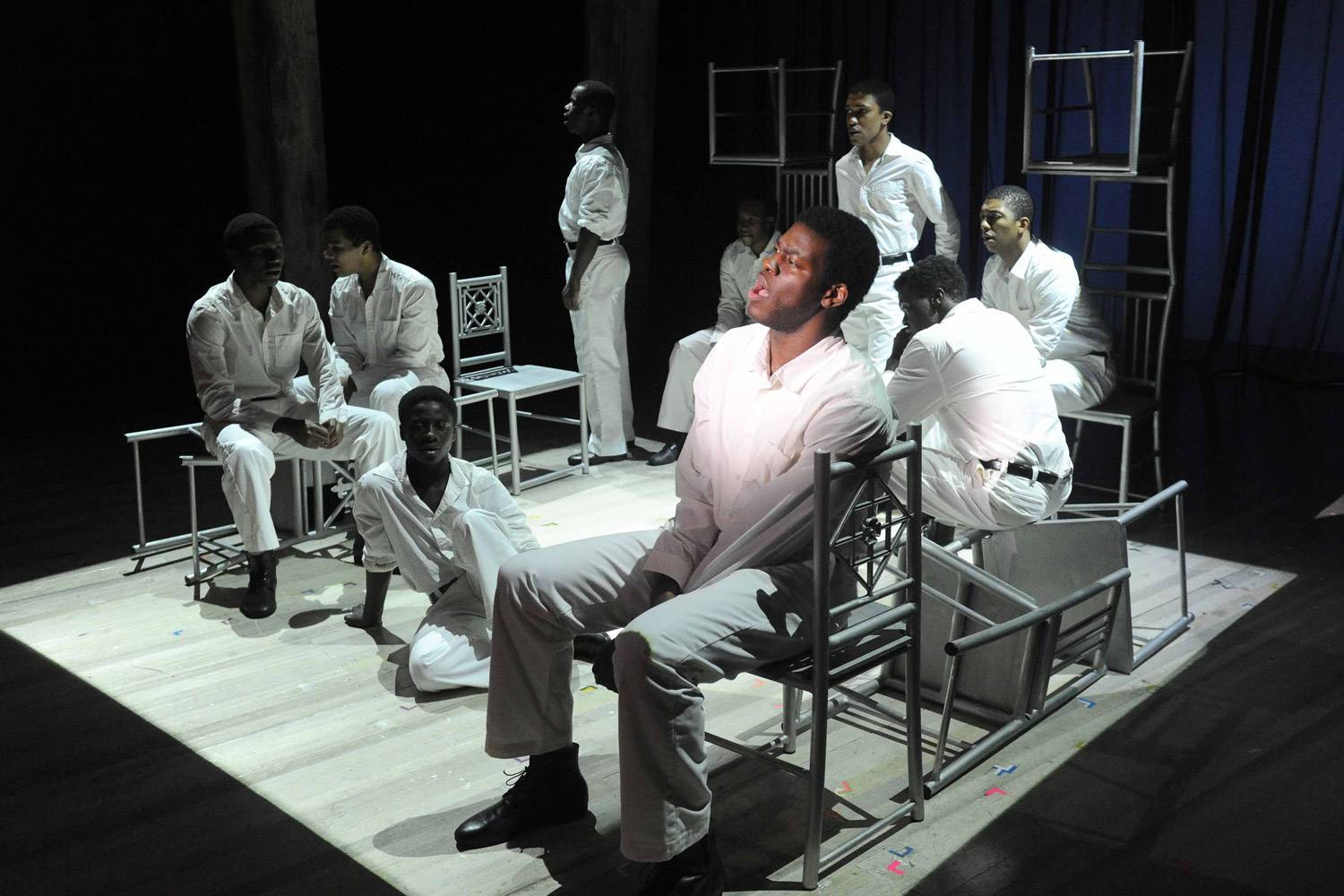
One only needs the barest grasp of American history to understand the incendiary effect Kander & Ebb’s The Scottsboro Boys was likely to have; a one sentence description ‘it is a musical about nine black men travelling The Scottsboro Boysthrough a 1930’s Alabamian town’ is enough to give significant pause.

Add in that it would take the form of a musical revue featuring a black minstrel show and a white southern host and one can begin to understand that The Scottsboro Boys is risky proposition, even by the standards of the team that brought Chicago, Cabaret and a musical interpretation of Manuel Puig’s modernist classic, Kiss of the Spider Woman to the stage.

When you have reinvented the musical, as they did with Chicago, and created a rival to Singing in the Rain as the greatest film musical, Cabaret, it is hard to imagine that the last blooming of creativity would be in the same league. This seems particularly true with the output of musical writers; one only needs to look at the careers of Cole Porter, Irving Berlin, Stephen Sondheim and even Andrew Lloyd-Webber to see a marked drop-off in the quality of their output as the years tick by.

However in the blend of tone and content that Kander & Ebb have brought to The Scottsboro Boys, they have managed to create a piece of theatre that, of all their work, comes closest to being seen as great art rather than great entertainment.

Technically it may not have the brilliance of Cabaret and it may not have the sheer enjoyment of a Fosse-choreographed Chicago, but what The Scottsboro Boys does, in a way not dissimilarto London Road, is to blow away the audience’s preconceptions and retains the force of a story that needs to be told being told in the only way that it can be. There is a coherence and understanding to the work, and a clear role, purpose and intent to the interplay of theatre, music and choreography which sits perfectly with characterisation and story.

The depressing thing is that The Scottsboro Boys was nominated for 12 Tony Awards and won none. In the same year The Book of Mormon was nominated for 14 Tony Awards, winning nine. The interesting thing is that both aim to cover very similar ground despite their plots being a world apart. In a not shocking turn of events, it seems that those giving out the awards got it totally wrong.

Both aim to utilise the time-honoured construct of Juvenalian satire to address prejudices in society, and whilst Trey Stone and Matt Parker’s humour, honed after fourteen years of South Park, takes swings at the big topics it often seems to confuse the scatological for the satirical. At times its views are surprisingly conservative, which perhaps is a reflection of the need to sell those expensive tickets on Broadway to out-of-towners coming across from Middle America. After all there are only so many wise-cracking, elitist New York liberals to sell tickets too.

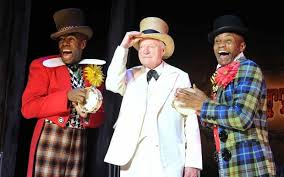
The ringmaster and his 'sidekicks'The Scottsboro Boys, on the other hand, is about as close as one can get to a modern example of this form of satire. It understands implicitly that the purpose of the technique is not to make the audience laugh but to provoke a reaction. Kander & Ebb are well aware of the power of humour to shock and use jokes like verbal hand grenades; the audience often confronted with the sight of two black men forced into playing the archetypal ‘uncle Tom’ roles for their entertainment and internally reconcile the fact that they have laughed at their ‘antics’. This is comedy operating at the very edge of tragedy, and it is all the more powerful for it.

<<Continue to the full review>>

Butterworth retains his Mojo (after nearly 20 years)

Mojo – Harold Pinter Theatre, booking until 25 January 2014

It is 18 years since Mojo made its debut at the Royal Court, and saw a 25-year old Jez Butterworth walking off clutching Olivier and Evening Standard awards and being hailed as an important new voice in British theatre. In 2013, four years after the brilliant Jerusalem cemented Butterworth’s reputation as a playwright of rare talent – one of the small band of writers who have left behind a play that will long outlive them – his early triumph has been revived for the West End.

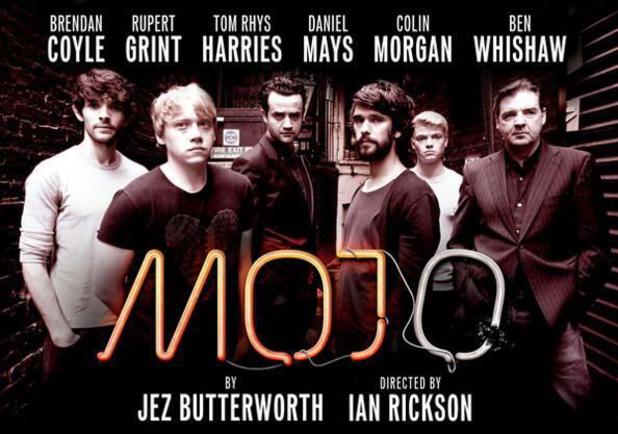
It is tempting to try and unpick the threads that brought Butterworth from Mojo to Jerusalem, to peer into the murky past and find the path that links then to now. However watching this starry, TV-friendly revival at the Harold Mojo - Full Cast, Daniel Mays, Rupert Grint, Ben Whishaw, Brendan Coyle, Colin Morgan, Tom Rhyss HarrisPinter Theatre, one is more struck by how there is little in the play that suggests a playwright of such talent that they would eventually produce a modern tragedy on a parallel with King Lear and The Cherry Orchard.

There is no doubting the quality of writing on display in Mojo. If somewhat unadventurous in scope, it is sparky and genuinely funny. Butterworth’s writes high farce that crackles with a tension that hints at an underlying danger; the best of which often revolve around Ben Whishaw’s live-wire Baby. Baby’s recurring ‘Kiss my pegs’ motif is the play’s standout moment and in these scenes it feels that Butterworth is channelling the shifting energy that make Pinter’s early plays seem preternaturally alive.

However there is no doubting  the figure that looms largest in the background of Mojo; David Mamet. There are points when it seems that Butterworth has actually set himself on a mission to create an anglicised Glengarry Glen Ross. Mojo is a play that has far more in common with Mamet’s 1984 Pulitzer-prize winning play than with the emerging voices of the new wave of British playwriting in the early 1990s.

With the hugely satisfying film adaptation coming out in 1992, it is hard to believe that it wasn’t Butterworth’s mind and what we have is a very British take on the classical muscular American model; a distilled, slightly quaint version of the American dream, all a world away from from the In-Yer-Face stylings of Mark Ravenhill and the rest of young playwrights determined to send shockwaves through British theatre

The set-up seems to be a deliberate homage to Mamet’s original play, with the entire piece being set in two locations. The first half is set in a cramped office room above a club, reflecting and intensifying the underlying tension; the cast trapped and prowling like caged animals, their arguments bouncing off the walls and creating a claustrophobic atmosphere of distrust and fear. The second half replaces this with the main club; a far more expansive set that seems to disappear into the wings. It is a setting where the characters appear to expand in the new-found space, dreams are made and plans set in motion, and Butterworth’s accompanying dialogue is given room to grow and breathe.

<<Continue to full review>>

Rufus Norris: New Artistic Director of the National Theatre

Congratulations to Rufus Norris on the news that he has been appointment to follow in the footsteps of NicholasRufus-Norris Hytner to become the next artistic director of the National Theatre. Generally seen as just about favourite for the role, he has clearly exuded a behind-the-scenes confidence that has outshone his relative lack of experience.

I have read more about his work than seen it – but what I have seen has been absolutely first rate, and whilst the National has looked to broaden its horizons in recent years it has always felt that it was just dipping its toe in the waters. With Norris in post it is perhaps time that the National will truly dive headlong in what it is to produce theatre in, and for, modern Britain.

Hytner has left some big shoes to fill – and clearly they decided not to fill them with more of the same, the National have also sidestepped the opportunity for a ‘big name’. However in all reality what chance did Daldry, Mendes and Branagh really have if they were not willing to forego their cinematic commitments? Watch the bun fight when Kevin Spacey steps down at the Old Vic; a theatre that has more than understood how a ‘celebrity’ name can be a huge draw, vastly outweighing any accompanying problems.

In leaving Norris the Shed space, Hytner’s has bequeathed an excellent legacy that will pay dividends. It gives him room, in those important early years, to work in a smaller, less pressurised space to develop innovative work that may be initially hard to put though the Olivier. It gives Norris breathing space whilst he sets about changing any internal negative attitudes to his direction, and to clear house where houses need clearing.

A couple of years down the line, we may be looking at a National that really does reflect Britain today, and whilst the lack of Shakespeare is a concern (or at least it is for the purists) but perhaps fresh eyes on the playwright is really what is needed.

Norris is an excellent choice and I can’t wait to see how he leaves his mark.

The Rehabilitation of Bertolt Brecht

The Resistible Rise of Arturo Ui –Duchess Theatre, booking until 07 Dec 2013

Leaving aside Shakespeare, Chekhov and Ibsen, the popularity of playwrights tends to wax and wane on the London stage; the recent reappraisal of Rattigan as someone unfairly cast aside by the Angry Young Men of the 1950s and the continuing absence of Bernard Shaw are two of the more obvious examples of the way a writer’s fortune remains tied to the whims of producers.

Arturo Ui Poster

The UK has also notably never quite embraced the rich vein of talent that exists in European theatre: Racine is rarely seen; Moliere, a mainly absent figure; and modern continental playwrights virtually non-existent. The thrall of Anglo-American naturalism and the rawness of the grand narratives of O’Neill, Williams and Miller continues to be preferred to the rather more metaphysical questions posed by the likes of Ionesco and Artaud.

Within this structure Brecht cuts a solitary figure, and has increasingly become something of the forgotten man of British theatre. Whilst his position, alongside Stanislavski, as one the pre-eminent figures in the development of modern theatrical practice is assured, it was Stanislavskian concepts that became the dominant mode of theatre and film; championed by Stella Adler and embodied in the work of a young Marlon Brando.

In comparison Brecht’s influence has seemingly ebbed away to the point where a new production of a Brecht play in the West End is something of an event. One must acknowledge that there are resource considerations to this; large casts can be ruinously expensive but that reality is built on the premise that Brecht is deeply unfashionable and cannot be considered an audience draw.

The irony’s that Brecht is perhaps the most American-looking of all the European playwrights. Stanislavski had little desire to cast his eyes across the Atlantic but to Brecht the new world and its eager embrace of democratic and technological progress chime with ideas that were central to his own theatrical philosophy.

arturo_ui_063_Henry_Goodman__Arturo_Ui__and_Michael_Feast__Roma_._The_Resistible_Rise_of_Arturo_Ui._Photo_by_Manuel_Harlan._4ffd4cb1ddfbbAt its heart was the development of an art form that would become pre-eminent for the first five decades of the 20th century: cinema. Silent cinema was the great leveller; reliant on music, gesture and simplified dialogue so it could appeal across the immigrant communities of America, these early pictures represented Brechtian techniques transposed to a medium that could truly be embraced by a mass audience.

It was within the world of cinema that Brecht found a way of telling the story of Hitler. The development of genre pictures – particularly the early gangster movies, starring the likes of James Cagney and George Raft – gave Brecht a mechanism with which the rise of an international dictator could be challenged in a way that did not need threaten the authorities directly and would also appeal to a mass audience.

This is not to say that Arturo Ui is dumbed down; the reverse is in effect true, Brecht is raising the genre picture above its humble origins. He may have gained a reputation as a didactic playwright with a sledgehammer touch but this is to ignore the craft taken over the formal structure of the play and the sly literary references liberally sprinkled throughout the text.

Arturo Ui could be enjoyed for the wonderful pastiche of Mark Antony’s oration at Caesar’s funeral and the knowing nods to pretty much every tragedy in the Shakespearian canon but it does more than this – it recognises the freedom of the theatre, in opposition to the limitations of cinema, to challenge the audience by upturning the established conventions of an entire genre.

<<Continue to full review>>