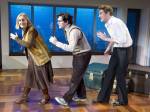
The Tragicomedy of Mac-beth; or how I learnt to stop whining and love the cuts to Arts Council funding

It is no secret that Civilian Theatre has long been troubled by the myopia and self-interest shown in the annual letter-writing campaigns to the Guardian and the Independent from the great-and-good decrying the scandalous cuts to Arts Council funding and how it will endanger the very lifeblood of the craft itself.  Whilst Civilian Theatre is not by nature a callous man and, unsurprisingly, would love to see theatre funded to the hilt in this country – with regional theatres prosperous, village halls packed to the rafters with touring companies and every worthy project that supports a vulnerable group given the financial sustenance they desperately need, it also can’t help but feel if these people of letters are looking rather closer to home for where they feel the funding should be going.

Alongside the cuts, the dramatic rebalancing of Arts Council funding towards more sustainable projects is something that has slipped under the radar. There will always be the need to finance some projects that have great worth but are unlikely to ever be sustainable, but there are plenty of other companies who seem to have grown fat on the years of plenty and seem to have given little thought to what might happen when the tap is turned off.

So what has happened? I don’t see any great decrease in the quality of productions, I don’t see any great decrease in the number of productions, we seem to be in a mini-golden age of playwrights who have broken out of the long shadow cast by Mark Ravenhill, Sarah Kane et al; Nick Payne, Lucy Kirkwood and Lucy Prebble have all put forward plays that don’t look to the past and that engage with the events of our time – be it Enron, Quantum Physics or China. Are we perhaps seeing the emergence of playwrights who can write truly international plays in global times? Time will tell but these are the people that are moving forwards rather than looking backwards.

And for those companies that have the most part always scraped by; who do theatre for the passion and for the possibility of that break. Some no doubt, funding unsecured, have fallen by the wayside, or accepted their fate is to be a strong amateur company (and there is no shame in that whatsoever). And then there are the dynamic and the proactive; the ones that are utilising every avenue to raise money to put on their shows; who are embracing the modern world in search of funding; who realise that a thousand smaller voices can make as loud a noise as one large one.

Which brings us back to the point of this post. My attention was drawn to The Tragicomedy of Mac-Beth. I have no idea if its good, if it will be good or if it has legs but that isn’t going to stop me dipping my hand in my pocket. And why not? Instead of wasting £20 on 5 pints of beer (yes, thanks London), why not help someone realise their dream, feel good about yourself and experience that smug sense of self-satisfaction when you see yourself listed in the programme?

Want to know more – check out more here

NB: It’s probably worth noting that Civilian Theatre (other than giving money) is no way linked to this production, or any of the companies involved.

Fleabag: A very modern heroine

Fleabag – DryWrite @ Soho Theatre, until 22 September 2013

In Fleabag, Phoebe Waller-Bridge has created a terrifying portrait of a person who embodies two of the major movements in modern society; the continuing reverberations of the feminist movement running headlong into society’s obsession with individualism and self-actualisation. It is of a person whose self-involved narcissism and belief in the right to be free to control one’s life-choices blinds them to any impact their actions may have on others. Fleabag continually rejects culpability for the paths she takes and even refines poor decisions into positive self-affirming actions. Fleabag is a 21st century manifestation of the id, rampant and uncontrolled.

It is also the funniest play that has hit London this year.

Rare is the playwright that truly captures the language of real life and turns it into something dramatically interesting. I have regularly extolled the virtues of Nick Payne for his skill in crafting modern, believable dialogue for his Fleabag - our eponymous anti-heroinecharacters; Waller-Bridge shares this talent whilst going further to infuse it with a poetic, heightened language that is rooted in the everyday.

It is startling to be confronted by a modern text that so positively drips with a love for sonorous language but yet doesn’t strive to root itself in the past. Every line feels written by someone with a deep respect for classical theatre but who understands that respect is best shown by not looking backwards and instead immersing yourself in the culture that surrounds you.

Monologues are as pure a form of theatre as it gets for writers and performers; there is no hiding place, the production rests and falls on the skill of the actor and the quality of language. Waller-Bridge spent a fair proportion of her last production, Mydidae, naked on stage so is better placed than most to quibble about the nature of exposure but Fleabag contains a ruthless emotional honesty that is shockingly, brutally, exposing.

Mydidae explored how removing our physical covering makes it easier to create a passage to the emotional core, whereas Fleabag removes all pretence and from its first moments delves into the deepest crevices of the mind of an independent, assured modern woman and probes it for cracks in the surface; the vulnerabilities that face all woman in an age of supposed liberation – political, economic, social and above all else, sexual.

For this is a monologue that is steeped in the current dialogues surrounding feminism and what it means to the generation that did not have to fight for it. It is here that Fleabag demonstrates the elements that have seen it be championed as one of the picks of the Edinburgh Fringe. It studiously avoids the polemics and instead displays its arguments through subtle highlighting of how hard-won equality under the law is still being undermined by socio-cultural norms.

©Richard Davenport 2013. 2nd August 2013. Edinburgh Fringe Festival. Phoebe Waller-Bridge in Fleabag at the Big Belly, Underbelly. Photo Credit: Richard DavenportWaller-Bridge’s Fleabag is a monster – a ravenous sexual entity that seemingly cannot discriminate between friend and conquest, desire and lust, attraction and obsession – but constantly the audience is reminded of how this may be viewed if the person delivering the monologue was a man.

The player/slut debate that Fleabag circles has been around for years and may seem like a hoary old trope but that doesn’t make it any less valid a reference point. A generation of woman have been brought up to believe that the battle has been won but changing the law does not lead to changing lives. The Twitter trolls and the campaigns over the increased use of sexualised imagery on the front covers of lads mags has shown that skirmishes continue.

Waller-Bridge’s Fleabag uses her body as a tool for her own personal gratification and talks in the frankest terms of an obsessive relationship with pornography. Does this debase her or does it set her free? Has she been enslaved by a masculine-fantasy of feminist equality – the idea that freedom to choose means becoming a hedonist to pleasure – or is she is a liberated self-actualised feminist who has rejected the traditional gender values of chastity and purity placed on woman by a patriarchal society?

<<Continue to full review>>

Buy the text from Nick Hern books here

…And happily ever after?

All’s Well That Ends Well – Royal Shakespeare Company, until 26 September 2013

One of the more curious of Shakespeare plays, All’s Well That Ends Well never seems to have sat comfortably with its audience. Even its title can be seen as one of Shakespeare’s playful jokes; riffing, as it does, on the fairy-tale narrative of ‘happily ever after’ despite those watching being left with serious question marks over the likelihood of the future joy to be shared between Helena and Bertram.

At its core All’s Well That Ends Well combines a number of fairy-tale tropes and applies them to the real-world. The healing of the king by someone of lower birth who is granted what their heart desires forms the play-logic that allows Helena, a ward of the Countess of Rossillion, to be granted the hand of Bertram, the Countess’ son.

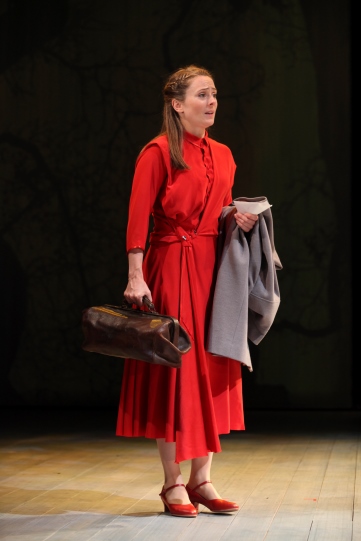
In the world of fairy-tale this would be the ideal marriage and Bertram, the prince, would realise that he loved the woman of lower-birth all along. However by placing the plot in a world where people are not shaped by archetypes, weJoanna Horton as Helena in All's Well That Ends Well. Photo by Ellie Kurttz see Bertram as little more than an indulged trustifarian who runs at the first sight of emotional commitment, who is used to bending the world to his whims and who believes honour is for the battlefield not the bedroom.

This may explain modern concerns with the play; that the resourceful, intelligent and determined Helena would seemingly humiliate herself and traipse across Europe for a man who clearly does not lover her.

It is on this point that Nancy Meckler’s production of the Royal Shakespeare Company comes into its own and in doing so helps to rehabilitate a play that, for its problems, contains, in Parolles, a comic creation of rare intelligence alongside two strong female roles that are pillars of wisdom and virtue.

Meckler’s production updates the plot to the early twentieth century and through this framing device we see the character dynamics in a whole new light. The fairy-tale plotting remains but within a world that is realistic to us.

The background is Europe at war and in Helena we feel any one of the millions of women who stepped into the roles left by men. Helena’s curing of the King of France is a reminder of the importance of women to the war effort and how they carried out job that before the War they would never have been allowed to do.

Bertram’s treatment of Helena and his dismissive rejection of the King’s statement that ‘Tis only title thou disdain’st in her, the which / I can build up’ [II.iii] reflects the wider disintegrating status of hereditary gentry. Bertram has truly never considered Helena within the context of a potential wife despite living in close proximity at court.

There is also a significant amount of comedic irony to a modern audience in his plea that ‘In such a business give me leave to use / The help of mine own eyes’ [II.iii]; it is clear that once the shoe is on the other foot, the male ego struggles with the concept of entering what is effectively a shotgun wedding.

<<Continue to full review>>


American am-dram gets an undeserved A-list treatment

Circle Mirror Transformation – Royal Court @ The Rose Lipman Community Centre, until 03 August 2013

There is a moment, possibly at the almost exact halfway mark, when Lauren (Shannon Tarbet) asks Marty (Imelda Staunton), ‘When do we do any real acting?’ Having watched this two hour, no interval production in stifling temperatures whilst sat in brutally unforgiving seats, it is a question that the audience may feel inclined to agree with. For all the virtues of bringing together a Grade A cast, one cannot escape the fact that this is Grade C play.

Circle Mirror Transformation - Imelda Staunton (credit and copyright Stephen Cummiskey, 2013)Annie Baker’s ‘Circle Mirror Transformation’ is set in a Vermont community acting class but it brings with it the self-empowered yippie culture of 1970’s west coast America. Marty, in her wool knit and chunky jewellery, is the very embodiment of the self-actualised individual. Schultz’s (Toby Jones) gift of a dream catcher is perhaps the most apt moment of the play, as there is little that sums up the vacuous, self-obsessed, false spirituality of the new age drama teacher than the appropriation of a native American child’s mobile.

Another Annie looms large over the production; for those lucky enough to have caught Annie Griffin’s (The Book Group) Coming Soon, this play pales in the face of the bleak, biting satire of the am-dram scene. Griffin has a talent for making you watch deeply unsympathetic character and feel real emotion at their travails.

Baker on the other hand cannot resist softening out the production and removing the acidity built out of competition that runs through am-dram up and down the country. It feels that Baker cannot let go of the baby boomer, new age, west coast inspired warmth. She introduces flawed characters and plot lines that create tension and division but doesn’t seem able to let them run naturally, and instead the guiding hand of the playwright is far to evident.

Criticisms of the play aside it must be stated that with a cast this good it really is hard to stop watching. The cast don’t just lift the play, they are the play and they are, in the most literal drama sense, at play. For anyone who has experienced the hermetically sealed world of amateur theatre there is an undeniable pleasure in watching professional actors go through the same exercises that you will have done many times over.

<<Continue to full review>>

Britten: Mann and Boy

Death in Venice – English National Opera, Colliseum

English National Opera’s revival of Deborah Warner’s exquisite production of Benjamin Death in Venice - English National OperaBritten’s final opera is a masterclass in creating something accessible out of source material that can only be described as forbidding. A number of references have made reference to the austerity of Britten’s score but Edward Gardner’s conducting, allied to Warne’s vision, gives the piece a lightness of touch that it is impossible to avoid being drawn in to Britten’s deft recasting of Thomas Mann’s novella.

Whilst Death in Venice would be seen as something for Britten aficionado’s only, the sheer excellence of the production again casts into question the reasoning behind booking the revival for so few performances. If the ENO truly wants to widen its audience base, and encourage people to see operas outside of their comfort zone, then they have to allow people the chance to roll-up on the basis of reviews. However once again when the reviews went to print there were less than five performances remaining; it seems unlikely a hit will rarely cross over into the mainstream with this kind of scheduling.

It was ever thus, and carping should not distract from the magnificence of the production. Aschenbach is a demanding lead; on-stage for almost the entire running time and with the lion share of the libretto there is little scope for variation in tone. However, John Graham-Hall holds the stage with an acutely painful performance of an author dragged from an ascetic dedication to his craft as he becomes increasingly besotted with Tadzio, the son of a Polish family who shares his hotel.

Sam Zaldivar’s Tadzio gives a silent performance of extreme sensual grace and beauty. Kim Brandstrup’s choreography allows Zaldivar to imbue Tadzio with a lithe naturalness that flows through the character and counterbalances Aschenbach’s increasingly halting vocal. Zaldivar has a fluidity of motion that conveys a come hither playfulness that never fully escapes a sense of the mocking. For Graham-Hall’s Aschenbach, this noxious combination, reflected in the increasingly unhealthy Venetian air, comes to a head with the explosive ‘I love you’ that brings the interval on a wonderfully dramatic high.

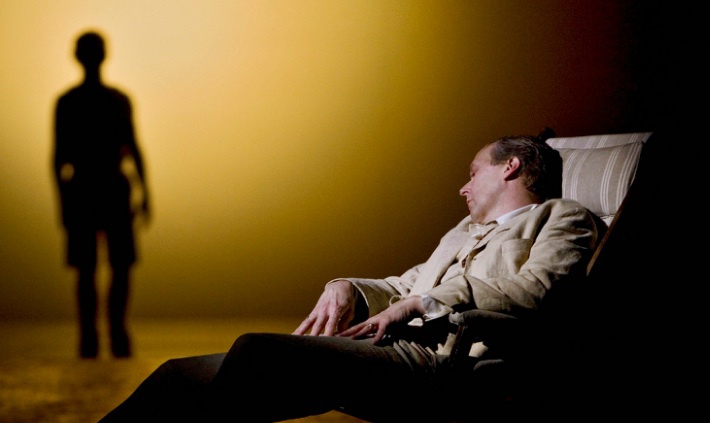
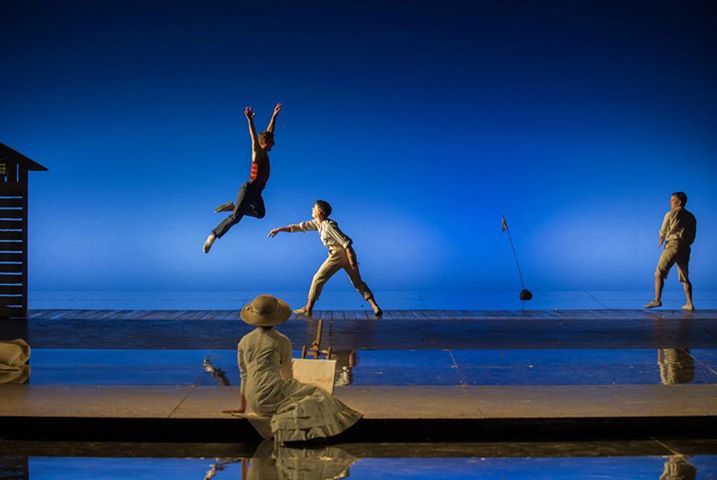
The Pan-like Tadzio in Death in VeniceFor inspiration Warner appears to have sprinkled the fairy dust of Peter Pan over Tadzio. This is most evident in the final image of the play – with Aschenbach sprawled on the stage, Tadzio is seen in silhouette framed against a huge moon. It is a most fertile avenue for Warner to explore, as Mann’s novella explores the relationship of an author’s increasing obsession, chaste or otherwise, with a young boy. Written in 1912 and based on a real life child, it is hard not to think of J.M Barrie’s creation of Peter and Wendy in 1904, and his own questionable attachment to the Llewellyn Davies children.

Britten himself cannot have been unaware by the allusion when writing the opera. It is his final piece and one that wrestles with questions that, to his biographers, Britten had been troubled with for much of his life. It is a story that does not attempt to paint its lead as hero or anti-hero, but rather as a flawed human that is worthy of, at best, pity.

Death in Venice is a story of how obsession leads to tragedy, but even in this it is an indirect tragedy. Aschenbach dies not because of Tadzio – it is not a recasting of the Narcissus and Echo myth– but because his obsession blinds him to the wider danger of the foul air. Peter Pan is an appropriate representation as he is emblematic of an intoxicating sense of the eternal. However this eternality can never be shared and those around him – no matter how they chase it – are destined to grow old and eventually die. .

Peter Pan naturally echoes Pan, the Greek god. It is unclear whether Barrie overtly acknowledged the reference point but Pan had been revived by the Romantics by the time that Peter Pan was created. They share a mischievous spirit born out of a desire to play that can transcend into a darker malevolence; it is something that we see in Pan’s actions of those that refuse his love, and it is echoed in Peter’s attempt to make Wendy believe that her family have forgotten her.

<<Continue to full review>>

Merrily we roll out of the theatre

Merrily We Roll Along – Harold Pinter Theatrebooking until 27 July 2013

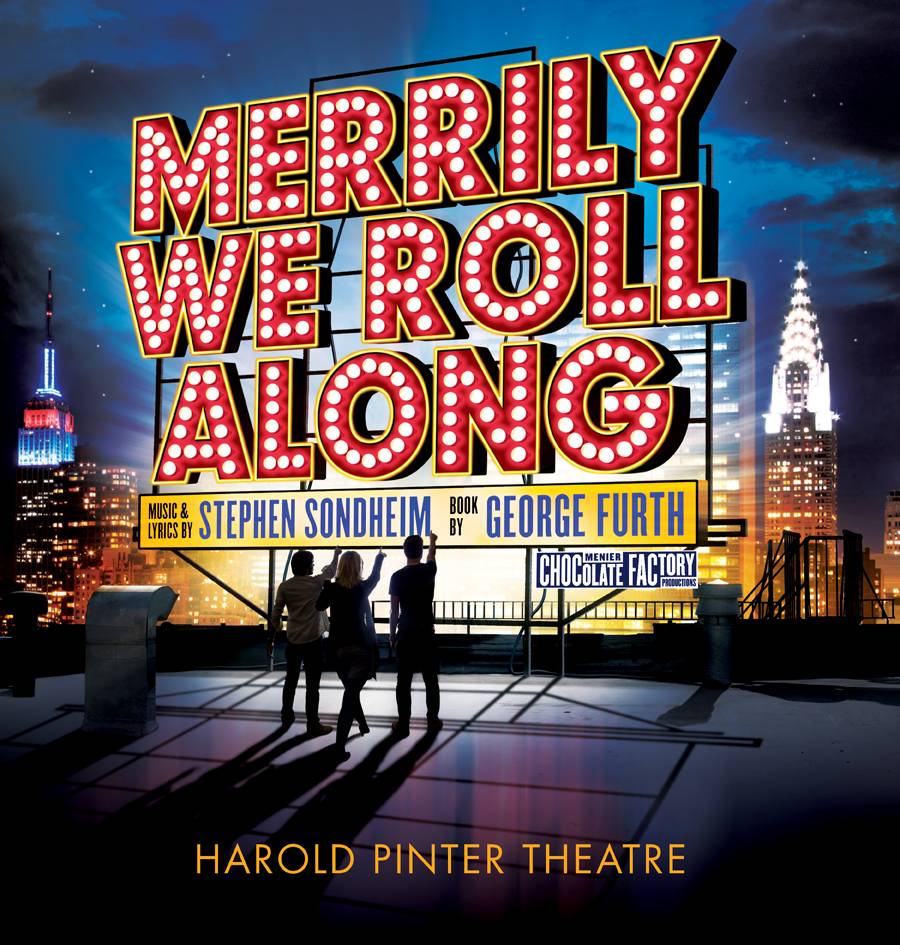
Among otherwise level-headed people musical theatre remains a peculiarly divisive form of popular culture. There are many of who would happily sit through two and a half hours of magic-soaked love stories in the forests Merrily We Roll Along - Harold Pinter Theatreoutside of Thebes, or will extol the merits of a Turner-prize winner whose contribution to the artistic world is to create soundscapes under Glaswegian bridges.

However present them with a Pulitzer Prize winner who has written musicals as diverse as an examination of the life of pointillist painter, George Seurat; or the gore-spattered grand guignol of the demon barber of Fleet Street; or even an unpicking of the psychological darkness at the heart of the Grimm Brothers’ fairytales, and they will raise their eyebrows and silently mouth the words ‘jazz hands’.

Watching productions like Merrily We Roll Along act as a constant reminder why such narrow-minded viewpoints need to be challenged. Certainly the landscape of musical theatre has changed markedly since Stephen Sondheim made his career by writing the lyrics for Bernstein’s West Side Story. The rise of Andrew Lloyd-Webber that introduced pop-sensibilities and extravagant staging to Broadway couldn’t be further away from the nuanced lyrics and subtle melodies that encapsulate the magic of Sondheim.

The divide only got greater in the last two decades, as the rise of the mega-musical from Mamma Mia! to We Will Rock You saw a new way for theatre producers to cash-in; tapping into the recognition factor of proper bands set against a licence to perform them in a sub-par way with a witless plot under the banner of ‘musical theatre’ – surely as lowest common denominator entertainment goes these productions are right up there with ‘X-Factor’ and ‘Britain’s Got Talent’.

Merrily We Roll Along Trio

The Menier Chocolate Factory must be applauded for setting itself against the tide and producing a string of Sondheim revivals that remind us that there are people out there who see no distinction in artistic merit between a ‘play’ and a ‘musical’. In bringing us A Little Night Music, Sunday in the Park with George and now Merrily We Roll Along – transferred to the West End – the Menier has proved time and again that there is a space for intelligent, difficult musicals that can be both commercial and critical hits.

Merrily We Roll Along, a notorious flop when it opened, has taken two decades to gain similar levels of acclaim to what are seen as Sondheim’s masterpieces. However the intervening years have only served to increase its relevance to the audience. Charlie’s bitterness at Franklyn’s desire to follow the money and to leave ‘proper’ writing behind him only seems more familiar to a theatre-scene where, despite writing the lyrics for the commercial smash-hit of Matilda, Tim Minchin finds it difficult to raise any funding for a musical that isn’t based on an existing concept.

<<Continue to full review>>