Science under the microscope in Durrenmatt’s The Physicists

The Physicists – Donmar Warehouse, until the 21 July 2012 

Thomas Midgley Jr is not a name near to many people’s lips when asked about the most important scientific innovators of the twentieth century. Seemingly destined to be remembered solely as a speciality question in a pub quiz would appear a strange fate for a man whose contributions to science shaped the world and led him to being described as having a ‘greater environmental impact on the planet than any single organism in history’.
It is then unfortunate for Thomas Midgley Jr that the impact described was both an accidental consequence of his inventiveness and wholly negative in almost every conceivable aspect; for Thomas Midgely Jr is the man who came with the idea of adding lead to petrol. Not content with this world health hazard, his second invention was close to catastrophic, as he found a way to improve the process of refrigeration through a compound called Freon. In so doing he successfully managed to invent CFCs.

One can only imagine that after those two disastrous attempts at improving the world, poor Thomas Midgely Jr would have a great deal of sympathy for Johann Wilhelm Möbius, the scientist at the centre of Dürrenmatt’s farcical satire that poses questions on the burden of responsibility on scientists and the ability of state to understand and manage scientific developments. Indeed Möbius is so concerned with the potential capacity for destruction in his inventions that he decides it is better to feign insanity so that he is able to work on pure physics well away from the overbearing hand of the state.

Dürrenmatt wrote The Physicists in 1961, prefiguring the Cuban Missile Crisis but at a time when tensions between the Soviet Union and the West were reaching a new peak. The horrors of Hiroshima and Nagasaki remained fresh in the mind 15 years on, as societies across the world lived in the shadow of two countries committed to the real-politics of mutually assured destruction.

Charles Spencer, writing in The Telegraph, challenges the play’s value forty years on. It is a reasonable point at a time where the conflict between superstates has faded and the prospect of nuclear war has receded to be replaced by a more existential threat of individual extremists, dirty bombs and cyber-warfare. Josie Rourke’s production is never quite able to square this circle and throughout there remains the nagging sensation that one is watching a period piece; a very well-crafted and carefully staged absurdist drama that is fascinating but ultimately as clinical and sterile as its setting.

That is not to say that it cannot be enjoyed on its own merits. The quality is to the level that has come to be expected from a Donmar production. John Heffernman is superb in capturing the duality of Möbius’ character; drawing out the dignified trauma of being self-aware enough to understand that his brilliance can never realise its potential in a world where it will be handled by those with power but no understanding, but Heffernman also reveals the arrogance that afflicts many geniuses and causes them to underestimate the skill of the opponents, in this case hastening the final tragic denouement.
<<Continue to full review>>

Shakespeare’s Cymbeline finally turned into a true work of art

Cymbeline – Barbican Theatre

The Ninagawa Company, under the stewardship of Yukio Ninagawa, has built up a fearsome reputation in world theatre. They stand as the equal of any post-war company from Joan Littlewood’s Theatre Workshop through to Chicago’s Steppenwolf, whilst stylistically they are as uniquely identifiable as anything from Peter Brook or Simon McBurney.

Famed for his Shakespeare, Yukio Ninagawa has turned his attention to one of the most problematic plays in the Bard’s canon; Cymbeline. It is a difficult play to love and one that comes packaged with all kinds of traps for a modern audience. The plot winds and winds and seems unsure of what it wants to be, containing elements of romance, farce and tragedy. It has simplistic plot devices, like cross-dressing and misidentification, reminiscent of earlier plays but also contains the heavily allegorical language and non-human elements, in this case Jupiter descending on an eagle, that place it alongside The Winter’s Tale and The Tempest as one of the later plays.

Frank Kermode described the play as a tragi-comic romance and suggests that it may have been an in-joke for audiences who would have had a much better understanding of the text and references to earlier plays. None of which makes it any easier for a modern audience to unpick the complexities of the plot.

Luckily going to see a Ninagawa production is to have your visual senses wrapped in cotton wool and taken on a journey where the simplicity of images masks the masterful craftsmanship working behind the scenes. The technical understanding of balance is superbly illustrated again and again throughout the evening; light and shade, simplicity and complexity, the tonality is in harmony so that everything works towards the whole and the audience is never aware of the mechanics. Like other Japanese traditions that have bewitched Europeans over the years, from woodcuts to sushi, the skill rests on the ability to hide an incredible complexity behind a deceptively simple front.

It is difficult to fairly assess the skill of the actors without speaking Japanese and since the production leans so heavily on the visual, the rest of this review will take a radical detour and will look to provide a sense of the evening through the images it has left behind.

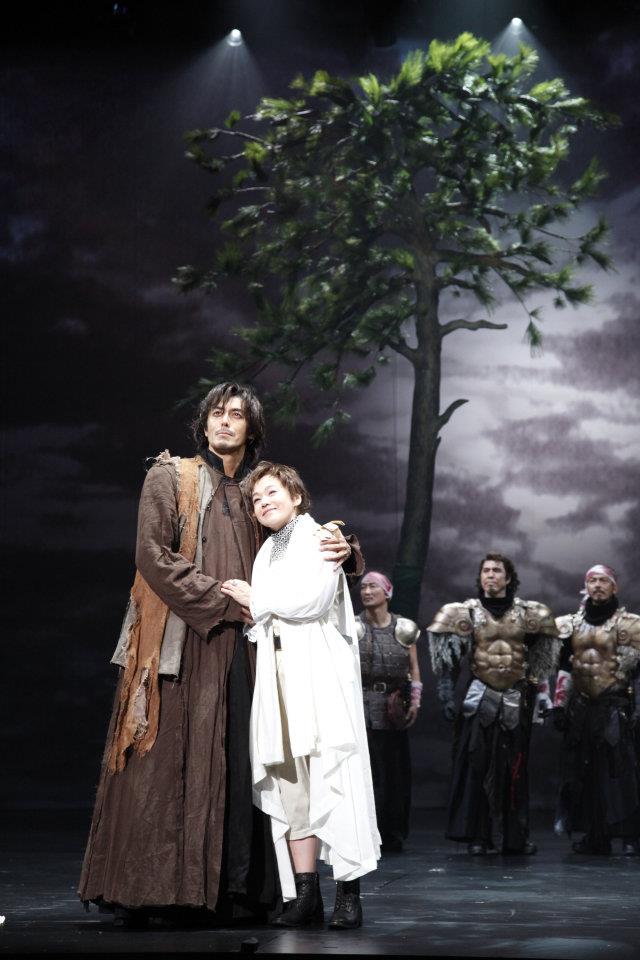
You can choose any one of a number of plot strands to call the centre of Cymbeline. Above we see the romance at the heart of the play, that of Posthumus and Imogen, as they are parted and again as they are reunited. As is traditional in Shakespeare the lovers must face many barriers before finally winning through in the end. However the play is made problematic, particularly to a modern audience, by the fact that Posthumus acts in such an unreasonable manner for much of the play, doubting his wife’s fidelity almost as soon as he leaves England before hiring his servant to murder her. That kind of level of trust does not always lead to happy relationships.

As the beating heart of the play, Hiroshi Abe, as the exiled Posthumus, and Shinobu Otake’s Imogen, bring the romance to life despite spending most of the play separated. They draw out the character traits despite the language barrier, with Hiroshi embodying the stoic and duty-bound Posthumus,  accepting of the State’s decision to banish him before later preparing to sacrifice himself in realisation at the fate he believes he inflicted on Imogen.

<<Continue to the full review>>

Around Town: Next Week in London

The lack of an update for over a week is a sign that Civilian Theatre has been taking a well-earned break following the enduring trauma experienced by watching Babel. However the reviewing season kicks off again in earnest next week with three plays lined up, each of which I am quietly confident about.

Antigone has the enticing prospect of Christopher Ecclestone returning to the National Theatre after a 22-year absence. Performing in one the great plays of the classical era, Ecclestone has the craggy and worn features that seem ideally suited to play Creon, a man who has spent years charged with the responsibility of holding together the state over and above any call to personal desires. He is one of our great character actors who actually appears in a lot less work than you probably remember but whose appearance is usually a clue that we are going to be watching some quite special – he is superb as Derek Bentley in Let Him Have It; one of those rare films where you can feel the anger of injustice bubbling through every scene, and equally good in the seminal 90’s TV series, Our Friends in the North.   

The Physicists will be the next play under Josie Rourke’s tenure at the Donmar. Having scored a big hit with The Recruiting Officer but perhaps underwhelmed slightly for many with Making Noise Quietly, Rourke will be looking to come back strongly with Durrenmatt’s The Physicists. It is hard to think of a playwright, or indeed style, that has fallen more out favour in recent years than Durrenmatt’s slightly avant-garde, philosophical work. However I can remember being absolutely blown away by a production of The Visit and the staging possibilities that such a play open’s up. When you take time to sit back and survey London’s theatrical landscape do you realise the striking absence of such originality- even if plots and narrative can still remain freewheeling and anarchic, there is a sense that dramatically everything looks a little a bit conservative. Admittedly Complicite are still pushing boundaries but, for all the positive reviews, plays like Laura Wade’s Posh appear very formal in style. One hopes that a strong production of The Physicists will help start getting director’s to re-embrace the experimental in formal settings rather than feeling that experimental necessarily means site-specific pieces and audience engagement. Time was when director’s used a theatre to recreate an atmosphere, currently it feels that the audience aren’t trusted to suspend our disbelief and will only understand that we are in an abattoir if we see real cows hanging off hooks around us.

The Ninagawa’s Company production of Cymbeline at the Barbican promises to finally kick start what has been so far a rather disappointing World Stage Festival. Little more needs to be said about Babel, and Three Kingdoms, whilst interesting, did not set the world alight with a mixture of fantastic ideas and, at times, incoherent structure. Having previously missed all of Ninagawa’s English productions, I am tremendously excited by a company that has a global reputation for Shakespeare and a history of producing visually spectacular tableaux that meld together Shakespearian storytelling with traditional Japanese techniques. Cymbeline is a particualarly interesting choice of play, as it is one of Shakespeare’s more problematic narratives and seems to be one that is alighted on more frequently by companies that often take an angle slightly askance of the traditional – the last major London production being Kneehigh’s version at the Battersea Arts Centres, which included all its usual visual flair but perhaps provided a little too much fun over substance.

Stills from Ninagawa’s Cymbeline

This slideshow requires JavaScript.

Six of the Best: Scathing Babel Reviews

With the dust beginning to settle around the remains of the ill-fated Tower, it only remains to pick through the rubble for some choice quotes from a set of reviewers who have acted with a singularity of purpose that one wishes might have applied by the eight partner companies behind Babel.

With hindsight it seems horribly inevitable that a production based on the story of the development of languages should be so inchoate in its own messages. Working together like a pack of wolves scenting blood, reviewers of all shapes and sizes have seized on its weaknesses in order to give all concerned a right kick in the Babels.

Given the general tone of respectable politeness that most of my peers exude the only reasonable explanation is some kind of Village of the Damned-style mind control. Tragic of course, but rather than waste the opportunity this humble reviewer has taken the opportunity to gather together the most scabrous, haranguing, bad-temperedly bilious reviews in one easy cut-out and keep article. So do please enjoy.

Six of the best

6. Michael Coveney, What’s On Stage

“The best part of it is the queuing outside (rather like on the first day of a Lord’s Test Match), the bar inside, the gathering in the Pleasance round the corner…”

Well it seems only fair that we kick off with one of the more positive reviews. It is true that a £3.50 for a decent sized cup of red wine, the bar on site proved to be remarkably better value than the eye-wateringly high prices that regularly empties the pockets of punters frequenting the Barbican.  The review does rather go downhill from there…

5. Charles Spencer, The Daily Telegraph

“…politically correct, dramatically inert and involves a great deal of tiresome queuing

Ok, scratch that, maybe not everyone liked the queuing.

4. Matt Trueman, Carousel of Fantasies

“…sickly stench of hippyish platitudes and synthetic good will”

Hmm, it really does seem that people were turned off by the do-gooding spirit of the whole affair. Perhaps audiences have become more cynical but I am sure that we weren’t the only ones expressing some sympathy with the guards, particularly when being forced to face protestors with sentiments that sounded like they were agreed by passing around a conch at a commune in the 1970’s.

3. Charles Spencer, The Daily Telegraph

“…we are instructed to “cherish the child that holds your hand.” At this point I thought I might throw up.”

Yes, there really was a backlash against the way the sentiment in the show is presented. Even our muesli-eating friends at the Guardian had problems with it being ‘too politically naïve, too lacking in complexity and texture’. If they hoped it might strike a chord with those issue-conscious Indy readers then, well, bad luck: making the schmaltzy declarations of our shared humanity […] shouted out at the end harder to swallow”.

=2. Eleanor Turney, A Younger Theatre / Michael Coveney, What’s On Stage

banal pomposity” / “self-conscious, low-level, intellectual sloppiness”

A tie for 2nd place as A Younger Theatre and What’s On Stage battle it out for the most succinctly elegant riposte. Turney wins on artful simplicity, whereas Coveney has the edge on bilious testiness.

And our winner is…

1. Matt Trueman, Carousel of Fantasies

“Only the spirit in which Babel was conceived saves it from being irredeemable. In its execution, it ranks as a failure on all fronts, most significantly on the grounds that it fans the very cynicism that it sets out to counter”

Umm, ouch. As an introductory paragraph this pretty much takes the biscuit. In most of the reviews it would take until the second or third paragraph before really laying into the production but Trueman sets his sights on the jugular from almost the first word. In fact the whole effect is magnified by the half-hearted attempt to inject some positivity by referring to the spirit of the production. I remember being in a rugby team walloped by over 100 points against our public school betters, apparently we could console ourselves in the fact we ‘played the game with spirit’. It didn’t console me then, and it shouldn’t console anyone now.

Tower of Babel crumbles to reveal evidence of shonky workmanship

Babel – Performed at Caledonian Park,  until May 20th 2012

When it was announced that a collaborative project involving Wildworks, integral to The Passion of Port Talbot; the Theatre Royal Stratford East, previously home to Joan Littlewood;  the Battersea Arts Centre, long-term supporters of Kneehigh and Punchdrunk; and the Young Vic, would focus on the story of Babel as part of the World Stages Festival there was a feeling that it could become the theatre event of 2012.

Involving a cast of over 300 and creating an immersive experience in the middle of London, Caledonian Park to be exact, Babel had the potential to create a truly gripping experience that would draw an audience together in a piece that would explore questions that have remained fundamental to human nature since the  birth of our earliest civilisations.

The story of Babel is a story of primeval humanity and the development of language. Primarily thought of as biblical, it has antecedents common to a number of ancient civilisations. This is not uncommon in origin stories, and Babel in particular touches on questions of a universal root language that is as central to modern linguistics today as it would have been to ancient thinkers. It is hard not to imagine an oral tradition passing the story of Babel down through the generations as an an answer to the question of how it came to pass that humanity, rooted in theistic societies, spoke with such a multiplicity of tongues?

It is a story that has many resonances with the modern day, particularly in a world where Twitter bridges culture and internet search engines can  translate web pages instantaneously. Perhaps after thousands of years humans are beginning to hurtle back towards a supposed original state where humans can converse across a universal language. The fact that Babel so singularly fails to address any of these questions is only the starting point of a troublingly flawed production.

In business circles, it is often felt that any negativity in performance appraisals should take the form of the infamous ‘shit sandwich’ – for those unaware of such a delicacy, it generally involves a criticism layered carefully between two positive statements. Unfortunately in the case of Babel, there is far too little of the positive to create a sandwich, at best you might be able to fashion some form of Danish Smørrebrød but even that appears optimistic.

<< Click here to continue to full review>>

Cillian Murphy mixes characters in stodgy Irish stew

Misterman – National Theatre, Selected dates until May 28 2012

Watching Cillian Murphy’s Thomas Magil, Inishfree’s one-man self-appointed morality committee, in Enda Walsh’s Misterman, I found myself transported back to two days previously to the Barbican where Cate Blanchett was the actor and Boho Strauss the playwright.  The parallels, as both plays hit London in the run-up to the Cultural Olympiad, perhaps reveal more about the process of staging a difficult play in the current climate than they reveal about the plays themselves.

The heavily-advertised cherry on top of each production is a bona fide Hollywood actor but not in the classic star mould that so often has the critics sharpening their knives. Both began their career in another country and grew up with one foot in the theatre rather than the Hollywood Hills. Neither has fully embraced the movie system despite Blanchett winning an Oscar for her role as Katharine Hepburn in Scorsese’s The Aviator; as close to embodying Hollywood royalty as it gets. Murphy has never embraced his potential leading man status whilst building a body of work that includes the huge Christopher Nolan blockbusters of the Dark Knight and Inception.

It is intriguing that in their return to stage both have chosen roles that focus almost exclusively on the isolation of the leading characters. Blanchett’s Lotte is a woman cast adrift from society following the break-up of her marriage; she is unable to effectively anchor herself and drifts along engaging in surreal encounters with friends and families that only heighten her growing isolation.

On the surface Murphy’s Thomas is suffering from an imposed isolation. He is literally rather than metaphorically alone; forced into making conversation with tape-recorded voices. However even in these interactions it is clear that Thomas was always out of kilter with those around him. It is a fantastical set-up but there is realism within the structure of the conversations that sets it apart from Big and Small.

It is difficult not to speculate what led the actors to these roles. They are not well-known plays and it seems unlikely that either would enjoy the same positioning and budget without their leads. The roles allow a freedom to an actor that is rarely granted, even in the theatre, but under the surface they are also strangely inflexible and a little one-note. As neither play really sketches out anything more than a caricature of secondary characters, the actors have no-one to play off and at times it can feel like an intense therapy session.

<<Read the full review here>>

And you can even watch a trailer here: