Not I

Beckett: Naturally absurd in London

Happy Days – Young Vic, until 08 March 2014

Not I/ Footfalls / Rockaby – Duchess Theatre, until 15 February 2014

One tends to approach a Samuel Beckett play the sane way one would a wheatgrass smoothie or a quick dip in the English Channel, knowing that whilst not necessarily being enjoyable it is definitely something that should be undertaken. Certainly from the near full houses at the Duchess Theatre and the Young Vic it would seem that Beckett’s forbidding reputation is doing little to dissuade people from going to see his plays. Perhaps watching as most of Somerset disappears under water has done wonders for people’s sense of the absurd?
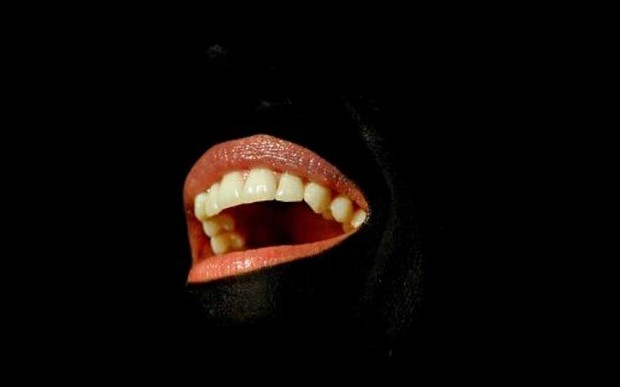
Not I

Whatever the reason, London is currently home to two major Beckett revivals; the Duchess Theatre, carving itself a niche in serious drama following their decision to host the hugely successful Chichester production of Arturo Ui, has transferred Not I from the Royal Court and paired it with two other late Beckett monologues, Footfalls and Rockaby.

Not to be outdone the Young Vic has staged one of Beckett’s greatest works, Happy Days. Written in 1961 it came during a ten year stretch that also saw the production of Waiting for Godot, Endgame, Krapp’s Last Tape, as well as the novels, Malone Dies and The Unnameable. Comparatively young, at 63, compared to recent winners, the award of the Nobel Prize for Literature in 1969 must by then have been mere formality.

Watching both productions in the space of three days it is impossible not to become immersed into Beckett’s singular vision and begin to understand themes that, viewed in isolation, can seem elusive. It is common to talk about how ‘nothing happens’ in his plays but viewing the four works in close succession it is possible to see what Beckett intends through this effect.

In the trilogy at the Duchess Theatre, we see the increasing minimalism of his later work, which seeks to pare theatre back to its most fundamental elements: action, voice, reaction, and that probably reaches its apogee in Not I – a work that is part-theatre, part-performance art and part-tone poem and in which ‘nothing happens’ at a furious rate.
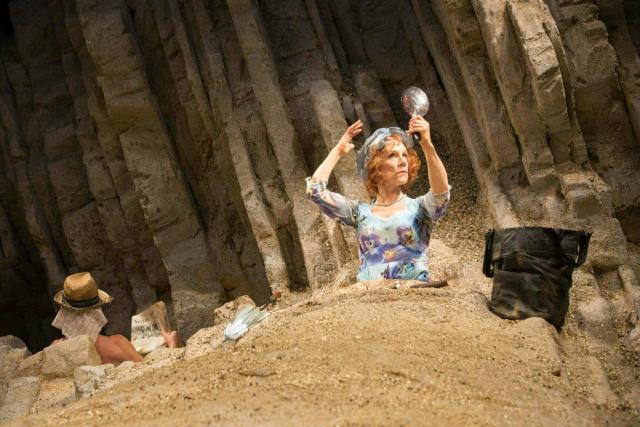
Happy Days, Young Vic, LondonIn Not I, the actor has become the literal mouthpiece for Beckett’s vision, in Footfalls every pace is prescribed before the actor steps onto stage and in Rockaby the actor can only react to what is offstage, they do not even control the rocking of the chair. Put together as one piece we, the audience, are left with an overwhelming sense of the lack of agency in the actor which seems to parallel the three characters inability to exert any sort of control over their environment.

It is telling that Beckett’s great collaborator, Billie Whitelaw, spoke of finding Rockaby ‘very frightening to do. And…desperately lonely to do’. In this work Beckett has recreated, without ever using the words, the universal and unyielding march of time, which must, inexorably, lead to death. The actor is alone and powerless and knowing all moments move towards the final moment when the chair will stop rocking and they won’t be called upon to join with the pre-recorded voice to plaintively cry ‘more’. With the meticulously written script prescribing each action of the actor there is very little for the actor to do and it is hard not to imagine, as the performance continues, an unseen struggle within the actor about mortality, a rising panic, and a desperation to share with the character the crying of ‘more’.

<<Continue to full review of Happy Days and Not I / Footfalls / Rockaby>>
King-Lear---National-Theatre_191213202638122

What makes these hard hearts? Finding warmth in King Lear

King Lear – Olivier @ National Theatre, until 28 May 2014

King Lear, in its monumental scale and overwhelming desolation, is a play that can defeat its audience. It continues to stand alone as the greatest of tragedies due to Shakespeare’s seamless transition from initial personal tragedy to something that contemplates human suffering at a universal level. It may be commonplace to reference the existential nature of the latter stages of King Lear but it is only within the last hundred years that the world has caught up with what Shakespeare was thinking when he wrote of Gloucester and Tom atop the cliff that never was or gave voice to the depths of Lear’s madness.

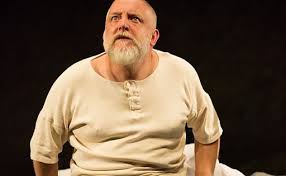
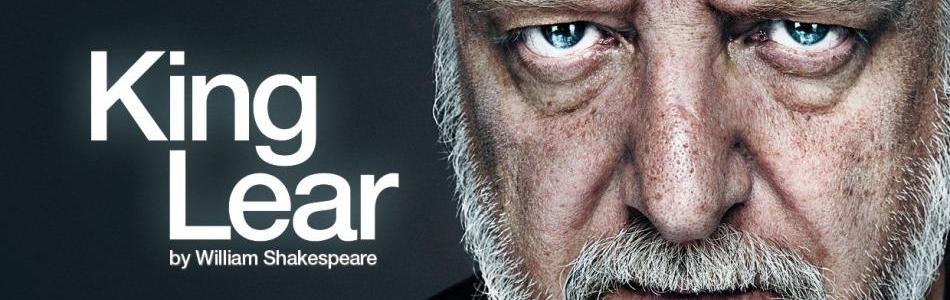
That Shakespeare was writing a play set in the years before England had become England, taking his sources from the Middle Ages and developing interior thoughts that would only be given a name four hundred years later gives an idea of Simon Russell Beale as King Learthe totality of the play and its all-encompassing nature. Indeed our understanding of the importance of the play appears to be only increasing over time; as Jonathan Bate notes, King Lear it has been performed more times in the previous fifty years than in the preceding three hundred and fifty.

Famously Samuel Johnson could not bring himself to re-read the play until forced into doing so by his role as an editor and even to audiences inured to a global world of senseless cruelty and terrible injustice, Shakespeare decision to move away from the original chronicles and deny his characters and his audience one final redemptive moment is both shocking and hard to bear.

It is as if Shakespeare determined to summon up all the miseries of the world and present them in the most elegantly poetical language so that those listening could not close their ears. To make matters worse this is not the tragedy of Euripides or Sophocles; events in Lear’s England do not hinge on the fickle nature of the gods, rather they are summoned into being by a mankind fully in control of their own destiny.

Shakespeare repeatedly shows that in a world without divine intervention suffering falls, without mercy, upon the just and the unjust alike. As we see Lear crumble and Gloucester blinded Shakespeare refuses to relent and even uses Edgar, in the persona of Mad Tom, for a piece of audacious foreshadowing of the horrors to come. By telling the audience that ‘…the worst is not / so long as we can say ‘this is the worst’’ [IV.i] we can hardly claimed to not have been warned.

Is it any wonder that for almost 150 years an alternative version in which the play ends with Cordelia marrying Edgar was the preferred version? What audience could countenance such grotesque horror without the possibility of redemption?

There is so much contained within the play that the role of the director is absolutely central to any production of King Lear. If the director has in mind an actor then it is likely he has already determined how his Lear should be. Sam Mendes and Simon Russell Beale have a long and fertile history, and a production of this scale must have been on the cards for some time.

One may argue that, at 53, Simon Russell Beale is too young to play Lear and one consequence is that makes the decision to pass his kingdom to the next generation seem even more short-sighted than usual. However the reverse of this is that there is always the tantalising prospect that he may one day return to the role with the wisdom of two further decades behind him.

Mendes introduces us to Lear’s England with a striking opening image; the Olivier space dominated by what appears to be a huge solar eclipse. Other reviews have mentioned its similarity to the eye of Sauron in the Lord of Rings films and it is unlikely that Mendes, no stranger to cinema, missed this clear reference point. Yet the recognition of such a link may be no bad thing as it acts as a subtle primer for the obsession with eyes and sight that exists in King Lear and affixes the notion into the audience; we are to enter a world where even the sun can become blind, so what hope for mere humans.

The image, reminiscent of a giant 0, can be seen to reflect Shakespeare’s repeated reference to ‘nothing’ within the text. In the opening scene Cordelia’s nothing, repeated by Lear as ‘nothing will come of nothing, speak again’ [I.i] begins this trend and we will later have Gloucester’s ‘This great world / Shall so wear out to naught’ [IV.vi].  Lear himself will find himself with nothing after having everything and Gloucester loss of sight is another form of encountering nothingness. King Lear is a play where people suffer the worst privations and are gradually reduced until almost nothing remains; Gloucester is stripped of his sight, Lear his mind, Edgar his status and the Fool and Cordelia, the two characters who perhaps exude the greatest moral worth, are stripped of their lives.

<<Continue to full review>>

Memories are made of this

The Dead – Barbican Pit, until 01 February (part of the London International Mime Festival)

Città di Ebla’s The Dead, inspired by the James Joyce’s short in the collection, Dubliners, is an intriguing performance piece that eventually struggles to overcome the sense it is a composite of a number of stunning images carefully interwoven with some technical wizardry rather than cohering together as a fully-functional whole.

Performed as part of the London International Mime Festival, Città di Ebla have used Joyce’s story as a jumping off point for a wider exploration of a person’s memory and its relation to past and present. Joyce’s original is rarely referenced directly, Città-di-Ebla_The-deadand it is hard to escape the shadow of Proust when unpicking what it is to remember, but The Dead does seem appropriate launch-pad as it delivers a universal experience to which the audience can relate.

The protagonist, performed by Valentina Bravetti, plays the nameless woman who appears to be returning to an apartment and in doing so her interactions with the surroundings trigger memories of a past love. These memories are captured live through Luca Di Fillipo’s photography and are instantly overlaid on a screen at the front of stage.

The live element of the photography changes the dynamic of what the audience are watching. On one level the difference between a slide-show of pre-recorded images and live photos is minimal; they achieve the same effect – of allowing a portal into the performer’s inner world. However understood on a second level it begins to challenge our intuitive assumptions about the nature of memory.

As these images are being created and displayed instantly it creates an implication that the past is a place where we cannot return and the act of remembering is something that happens in the present. All of our experiences are stored in the present. They cannot be stored in the past or future. So when Bravetti’s character is recalling her love is she creating a new moment in the present with her memory or is she genuinely accessing a memory of a past event?

citta-di-ebla-the-dead-85879Città di Ebla plays on this sense of dislocation by deliberately creating a vague sense of time. A voiceover implies the lover was 17 when they died, which would suggest several years must have passed, whilst Bravetti appears to be picking up papers that are suggestive of a much more recent event.

A reverse reading can also be seen in the production; an exploration of how the past shapes our present. Our past experiences clearly shape our present – not just in the outcome of the choices we make but also in the way it can suddenly come alive and infect our present. As Bravetti travels through the apartment she is forced into an act of remembering by a past that is dynamic and alive. It lives on in otherwise inanimate objects. Whether she chooses to or not, the artefacts, the remnants, of that relationship are shaping her present.

These questions are not resolved, and it is not Città di Ebla’s intention to resolve them; however as a result this lack of conclusion, allied to a lack of narrative thrust, means that the piece as a whole, whilst technically very impressive, struggles to exert a grip on the audience.

The screen separating the audience from performer acts creates a certain distance that leads to problems with empathy. For the majority of the show we see the performer through the  protective screen of her memories. This is used to create some startling effects and the choreography and interaction between the two leads to some scenes that are laid out with a painterly composition that Vermeer would be proud of.

Yet it is notable that some of the most engaging and human moments of the play are when we are left alone with Bravetti and are allowed to momentary step back from the window into her soul. One yearns for more of these moments, where we are left along with the external grieving process, and we recognise the human for what it is; something, that for all the technical mastery you want to employ, where the workings of the psyche is ultimately unknowable.

Clarity of thought amidst the blurred lines

Blurred Lines – The Shed, National Theatre until 22 February

Watching Blurred Lines, Nick Payne’s latest play created in close collaboration with director, Carrie Cracknell and the eight members of the all-female cast, is not a particularly comfortable experience for a male reviewer. This is not because it consists of seventy minutes of radicalised polemic damning all men to one of Dante’s more unpleasant circles of hell but rather because it does the reverse; performances are restrained, arguments are calm and reasonable, but clearly lying underneath the surface is an anger. An anger one suspects is born out both of individual experience and universal frustration.

It is primarily directed at rather oblique targets; the unthinking gender stereotyping that is ingrained into societies structures, the hardwired responses that define human relationships and the way that our understanding of women is being moulded Blurred Lines, The Shed by the relentlessly battery of consumer culture.

To describe the production as a play is not quite accurate, as it suggests a more cohesive piece that has a narrative thread running through it. What is presented is more a series of case studies – template models of the gender imbalances women face on a daily basis. This approach is perhaps not surprising, in part because it is based on Kat Banyard’s book, The Equality Illusion, and also because the purpose is to present the universal alongside the individual.

If this all sounds a little dry then the collaborative feel of the work, performed by an excellent cast, give the scenes the relaxed feel of a community workshop rather than the cold air of a lecture theatre. The bite-size chunks also suit the modern world’s preferred way of digesting information; in the internet age grand narratives are out and bullet-point lists are in. If you don’t engage with one scene – and not all of them work perfectly – then don’t worry as another will be along in a moment.

Blurred Lines is bookended with two stand-out scenes. Nick Payne, as he has demonstrated in previous work, has a poet’s ear for finding something musical in everyday language. This is showcased in the first scene, which reminds of the opening to London Road, itself a piece of verbatim theatre, and that demonstrates that real speech, taken out of context, can contain a tremendous power and vitality.

The scene sets the play’s direction with a wonderfully observed perspective of what being a woman means to other people. The cast come together as one voice with many mouths to present the audience with a series of tart one-liners of how women are portrayed. In the scene women are broken down to nameless, definable adjectives; when they are deemed worthy of being given more status it is directly through their relationship to a male. They become ‘wife of…’, ‘mother of…’ and through this their lives are given an implicit meaning.

The round starts with common descriptions that soon descend to absurdity and anger with the relentless repetition and the fall-back to common descriptors. Rose West’s ‘character face’ repeats again and again, and any initial amusement fades as the audience understands that it is another example of the malleability of the English language that has learnt to hide overt misogyny behind a second, socially acceptable double-speak.

<<Continue to full review>>

Taking the train to ‘El

The El Train – Hoxton Hall, until 30 December 2013

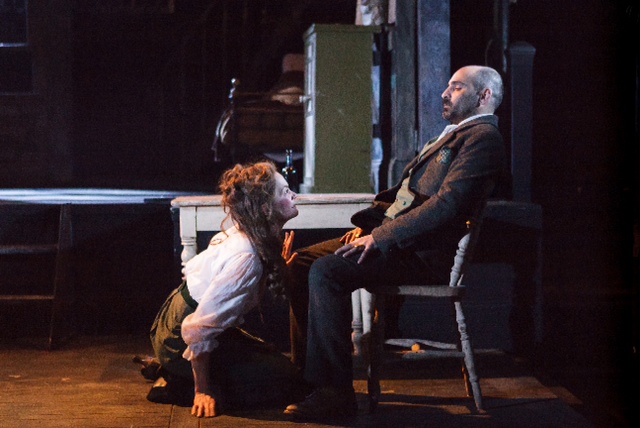
Sometimes the venue is everything when it comes to theatre. It is hard to imagine watching Eugene O’Neill’s three short plays – that make up The El Train – about life in the Bronx from the comfort of plush velvet seats Ruth Wilson  & Zubin Varla-steve-in-the-web-the-el-train-hoxton-hall-photo-marc-brenner-408on Shaftesbury Avenue.  Yet sat on rickety wooden seats in the cold, draughty Hoxton Hall, hemmed in by the elbows of your neighbours, and in the heart of what was once the heart of the East End slums, O’Neill’s histrionic melodramas about the perils affecting life among the forgotten beings to make a kind of sense.

The atmospheric surroundings of Hoxton Hall is critical in making the whole concept of The El Train work at all. Outside in Hoxton and around Old Street – Britain’s ‘Silicon Roundabout’ – it is difficult to appreciate just what life would have been like for those living in the same streets a century before, and so the location helps to ease the audience back to a time when earnest members of the Fabian society would deliver lectures on a range of esoteric subjects because they truly believed in the moral purpose of education for the bettering of the life of the working man; indeed it comes as little surprise to discover that for over twenty years the venue was run by the Quakers and linked to the temperance movement.

The El Train is a good way of seeing O’Neill writing in the style that would see him win two Pulitzer prizes and become Nobel laureate. A passionate writer that does for the American poor what had previously been highlighted in the U.K through works by George Bernard Shaw and Charles Dickens, O’Neill can be exhausting in the long form but in 20 minutes bursts his style can be rather invigorating.

O’Neill tends to be venerated by theatre critics but in his full-length plays he is often to be endured as much as enjoyed. He is as melodramatic as Tennessee Williams but without the entertaining southern gothic that makes Baby Doll and The Glass Menagerie such lurid delights. His plays, like Long Day’s Journey Into Night, mark some of the first developments of the narratives that are now seen as the great American themes and which dominate American drama and literature to the present day. However O’Neill’s work seems to lack the stringent naturalism that propels Arthur Miller’s All My Sons and Death of a Salesman into the ranks of great drama.

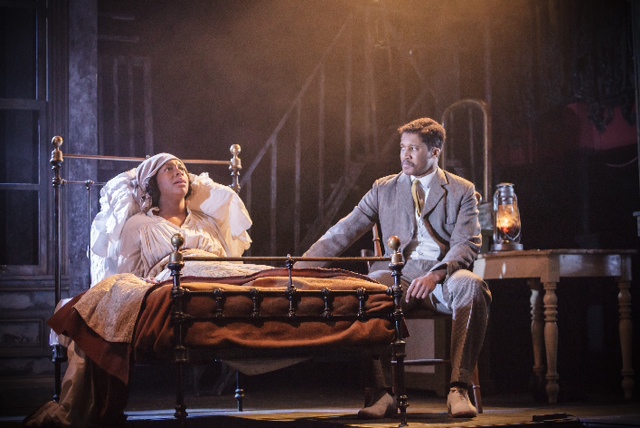
Nicola Hughes - Mammy Saunders and Simon Coombs-dreamy-in-the-dreamy-kid-the-el-train-hoxton-hall-photo-marc-brenner-837However in the short-form of The El Train one is reminded that there is nothing inherently wrong with melodrama as a dramatic style but it is in the application that it often falls apart. Placed in the hands of strong actors, who commit wholeheartedly to the concept rather than act against it, the moral force of the work begins to shine through. And Ruth Wilson, after her turns in Anna Christie and A Streetcar Named Desire at the Donmar Warehouse, has proved herself a very fine actor indeed.

Wilson is a magnificent presence in the first piece; a monologue about a frustrated housewife and her alcoholic artistic husband, and which is by some margin the strongest of the three. She captures the very essence of a human teetering on the edge, struggling to free herself from the binds placed on her by both her husband and her own sense of pride.

The real skill of Wilson’s performance is how she understands the limitations of O’Neil’s writing to a modern audience. She doesn’t try to force the language but instead inhabits the whole character; Wilson brings the part alive with a nervous tension that can be read through the way her hands struggle to knot the front of her apron or pick at the wood chipping off the kitchen table. The weight of the burden upon her can be felt through the way that the corner of her mouth begins to pull down as she lists her husband’s various failings, and in the rigidity of her body every time her husband makes noise offstage.

<<Continue to full review>>