Truth, lies and journalists

Gibraltar – Arcola Theatre, until 20 April 2013

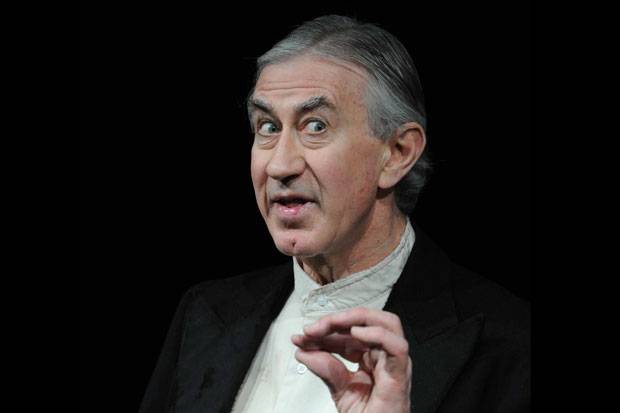
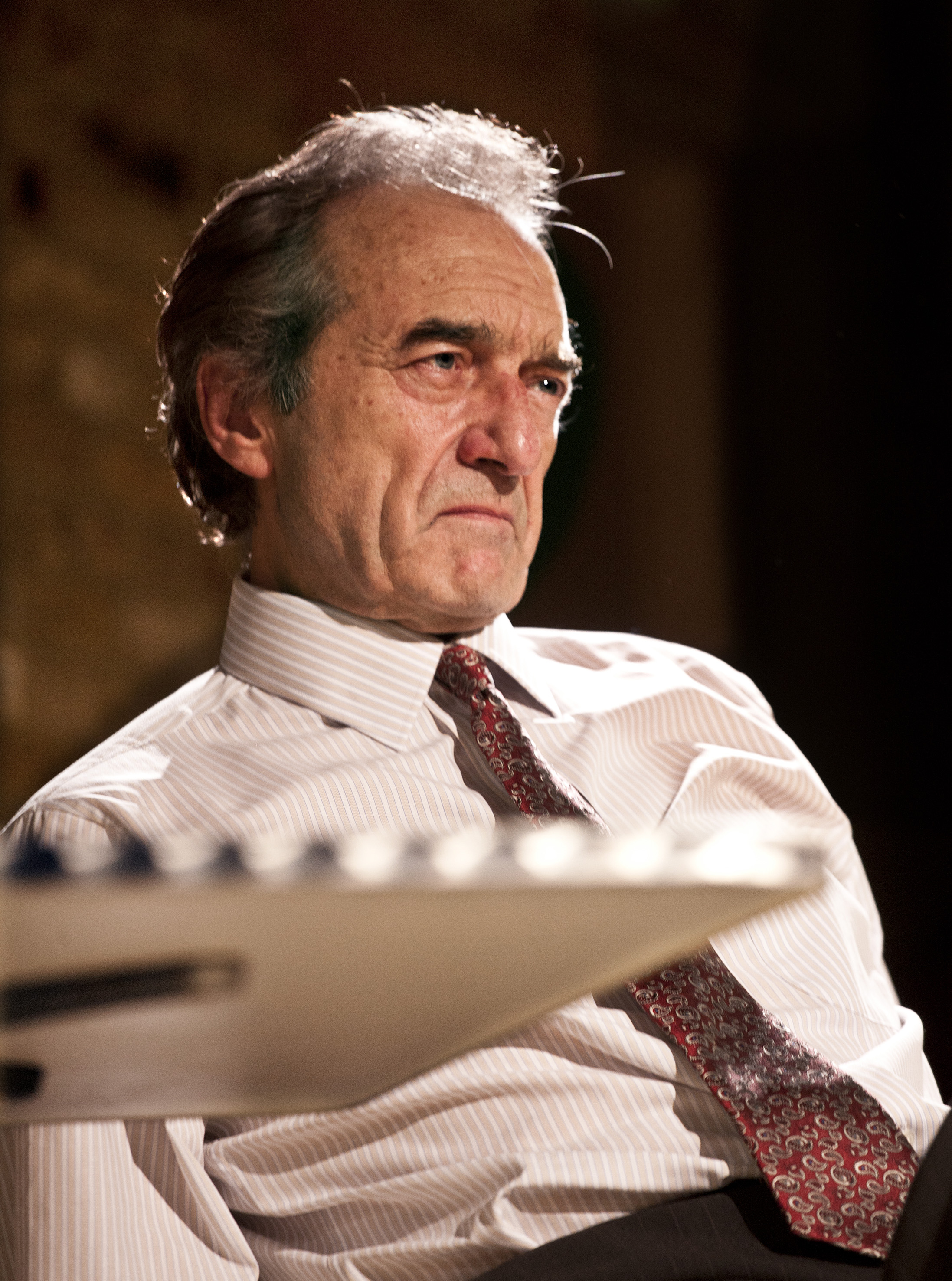
The IRA, and the whole period of the ‘Troubles’, has come to occupy a curious corner of the English consciousness. A decade-long focus on a militant threat that proved terrifying in its complete ‘otherness’ emerged just as the Nick (played by George Irving) - credit:courtesy of Simon Annand  peace terms of the Good Friday Agreement had put in place a clearly misplaced sense of security. As a result decades intermittently punctured by bombing campaigns, shootings and turmoil can sometime seem a quaint part of the nostalgic ‘little England’ experience; a part of our colonial history long since resolved.
That it is so easy to forget just twenty two years ago Downing Street was targeted with a mortar and during the decade before there those living in Great Britain waging a lethal campaign against the mainland makes the whole situation, in hindsight, appear surreal in the extreme. In actuality the actions of both the IRA and the Government were brutally, terribly real. If the atrocities that continued to mount through the 1980s, which include but don’t end with the events detailed in ‘Gibraltar’, eventually forced both sides to the negotiating table then it did so with significant blood on the hands of all involved.

Taken in this context it is hard to pick fault with the aims of Gibraltar – a new play written by Alastair Brett and Sian Evans, which examines the background to the infamous ‘Death on the Rock’ incident where the SAS shot three unarmed members of the IRA. It also portrays the inevitable press backlash to the testimony of those that dared question the account of ‘our brave boys’.

In such a loaded environment Alastair Brett is an intriguing figure to write the play. Previously Legal Manager to The Times and intimately involved with a libel action concerning Carmen Proetta (broadly the character of Rosa), the position of the play is pointedly opaque. There was a risk that the play would be distastefully myopic in its presentation of the facts but it soon becomes clear that there is little love between Brett and his previous colleagues – a number of caustic jibes are thrown in that certainly go a little further than an attempt at even-handedness.

<<Continue to full review>>

The Theatre of Politics

This House – National Theatrebooking until 16 May

This House has been the surprise package of what is proving to be a very successful season for the National – defying the surrounding economic gloom with a string of sell-out hits. It was inevitable that tickets for The Effect, Lucy Prebble’s follow-up to ENRON, and the latest Alan Bennett play would be scarcer than gold dust.

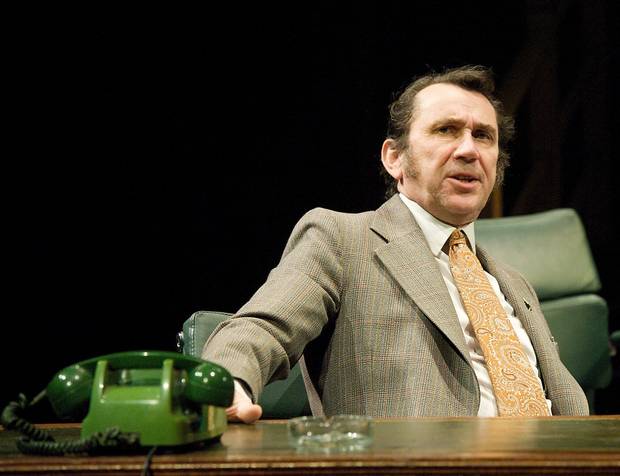
However This House did appear to be an altogether tougher sell; a play based almost entirely back rooms of Parliament, set between 1974 and 1979 and refusing the safety-net of caricature by eschewing references to MPs byPhil_Daniels_This_House name. Unless one held an acute knowledge of mid-70’s parliamentary constituencies it paid little concession to providing a Spitting Image-style satire on its subjects other than references to a certain ‘MP for Finchley’ and a fleeting appearance from a young Michael Heseltine.

As a self-confessed political and theatrical nerd none of this was particularly troubling as seeing the political process dissected on stage was the real joy. The likes of David Hare may stage politics with a big ‘P’, and there have always been any number of young tyros looking to reflect the impact of politics on society, but the institutions – the strange and archaic mechanisms that have supported one of the world’s longest running parliamentary democracies seem to have been rarely considered by playwrights.

Lord Scarman summed up the position eloquently in the late 80’s when he referred to the fact that the people are ‘only occasional partners in the constitutional minuet danced for most of the time by Parliament and the political party in power’. For all the radicalism of playwrights and protestors, politicians continue serenely onwards, safe in the institutions that have bent, flexed and twisted but never entirely shattered over the centuries. The British parliamentary system finds durability in its seeming lack of permanence. The lack of a codified constitution allows great flexibility in its approach; rules are in place because they are in place and always have been in place, not because they are written down in a book.

The very essence of maintaining the status quo, a great British tradition, is built into this approach. Without an awareness of the rules, and without any access to them, how can someone challenge the system? It is into these murky waters that James Graham’s This House looks to shine a light. It illuminates the hidden world of small ‘p’ politics; the grindingly mundane processes that allow the Government to govern and teases out exactly what happens when the metaphorical rulebook is thrown out of the metaphorical window.

So much of Parliament – the opening of Parliament by Black Rod, the Queen’s Speech, Prime Minister’s Question Time – is laced with symbolism about the importance of the function it serves, even if these aspects mean nothing to actual governing. James Graham and Jeremy Herrin have intrinsically grasped the parallels with theatre, which is that behind the spectacle there are those working themselves to the bone to keep the wheels turning and where power really resides. This is why the play focuses on the political Whips; the backroom boys who ensure that everything happens on time, that people know what they are supposed to be doing and that things actually happen.

<<Continue to full review>>

Peter and Alice and a whole lack of wonder

Peter and Alice – Noel Coward Theatre, until 01 June 2013

It all works so well on paper: Michael Grandage and Christopher Oram as director and set designer; John Logan behind the script; Ben Wishaw and Dame Judi Dench heading the cast. If any more of a hook was needed to guarantee an audience, the plot concerns Peter Pan and Alice in Wonderland (or at least their real-life inspirations).

What could possibly go wrong?Peter and Alice - Ben Wishaw and Judi Dench

In some ways very little.

The major problem is that very little goes right.

For the audience, Peter and Alice is an almost pitch-perfect study in the average, the mediocre, the reassuringly dull. No doubt the brigades that travel on mass from the Home Counties, that can afford to sit in the stalls, that buy a programme, a drink and an ice-cream, that keep the West End at near maximum-capacity and that are, without doubt, vital to the on-going vitality of the London theatre scene, are going to be satisfied.

However Charles Dodson and J.M Barrie would be appalled. Not necessarily by the character assassinations perpetrated on them by Logan, in scenes that have a loose connection to the truth, but certainly by the sheer lack of imagination displayed by everyone involved in the production. Peter Pan and Alice in Wonderland are two of the finest examples of the flexibility of the adult mind; the sheer imaginative range of Carroll’s wordplay and of Barrie’s adventuring is a joy that has not receded in over one hundred years.

Peter and Alice fails to capture one tenth of this joy, this anarchic free-spiritedness, in one hundred minutes.

Reading the description of Barrie’s original production of Peter and Wendy one learns that Tinkerbell was created by the expedient use of a mirror to reflect a light onto the stage so that it would seem to dart and fly. This illusion, using the simplest mechanism imaginable, holds more wonder than the entire po-faced philosophising of Logan’s script.

To begin on the positives; Christopher Oram’s set is a delight. Opening on a musty office, it unfolds to a reveal the reassuringly sight of a chequer-board set and instantly recognisable Tenniel-inspired drawings of familiar characters. Given Peter Pan’s origins on stage it was a nice touch to reflect this in the use of classic flats that drop from the sky and retain a resolute two-dimensionality that highlights the artifice that lies behind theatre, and that means it will only ever be a simulacrum of reality.

Ben Wishaw and Judi Dench are perfectly adequate, and one hopes that, given this was a preview, there is a certain vitality that is still to come as they feel their way into the roles. Dench has a commanding presence that cannot help but be transferred to her characters – it is hard to imagine her playing a particularly vulnerable part. Her Liddell has developed a cast-iron exterior to the pressures of the world, and this contrasts well with Wishaw’s more vulnerable Peter Davies, a man who has not come to terms with the world as it is and the man who he will always be.

<<Continue to full review>>

Watt? Beckett for the wary

Watt – Gate Theatre Dublin @ Barbican, until 16 March

The Gate Theatre Dublin’s production of Watt, currently residing in the Barbican’s Pit Theatre, is an intimate affair that will certainly draw interest from Beckett’s usual fan-base but one that also reaches out to those who may find the aura of austerity that surrounds Nobel-winning writer a little forbidding.

Watt+Barbican+Barry+McGovernCollated from selected extracts from Beckett’s original novel, Barry McGovern has skilfully reassembled a pathway through the deliberately tangled narration so that the monologue (free-flowing, inconsequential and seemingly aimless as it may be) lets us gaze upon the curious Watt.

In doing so McGovern has made accessible Beckett’s wonderful evocative use of language and shone a light on the absurdist comedy that so often counterpoints the undercurrent of melancholia. Nowhere is this better seen than in McGovern’s description of Watt’s amorous dealings with Mrs Gorman, one of a number of occasions where Beckett’s faculty with language allows a third-person narrated monologue to bring the scene into life as easily any Michael Frayn farce.

It is the preciseness of Beckett’s language that never fails to impress. Every word has its place and no other place, and no other order of words, would seem to suffice. His description of Watt kissing ‘Mrs Gorman on or about the mouth’ tells us more about the man Watt is than the most perfect casting could achieve.

McGovern works hard to bring a sense of the visual absurdity that is clearly there in the original text. His physical re-enactment of Watt’s peculiar walk brings to life a description whose vitality must have been bursting off the page. It is a comic’s dream and, by virtue of being the narrator, McGovern has license to fully exaggerate Watt’s absurdity. It is a splendid scene and a necessary injection of energy in a show that always run the risk of being swallowed whole by the dense richness of the lanBarry McGovern as Wattguage.

This problem is evaded throughout by making full use of changes of pace to keep the audience engaged. The description of the mixed choir is augmented by the sound of it. McGovern is such a skilful storyteller that the audience listen’s with him through two full choruses – the comic tension increasing each time chorus disappears further off-key.

McGovern’s lugubrious tones emerging from the unnamed narrator, a man appearing to be straining to retain the last vestiges of a more grand life cannot help but remind of Beckett’s most famous creations, Vladimir and Estragon, and the play retains much of the vaudevillian that is so closely associated with Waiting for Godot.

Beckett can be the most intense of authors and some of his monologues, no matter how skilful, are to be endured as much as enjoyed. ‘Not I’, a gruelling 17-minute work that was filmed with Julianne Moore as part of a Channel 4 season dedicated to Beckett, may be brilliant but it cannot be described as an easy experience. The language, powerful as it may be, is fired staccato with the audience picking up fragments, jumbled narratives, falling into one another until it finally emerges into a semblance of clarity.

The joy of this production of Watt is that the 50 minute show fairly races by and, in so doing, delivers a Beckett whose gift for language retains an accessibility that can be lost when exposed to the full range of modernist tricks that were employed to make him such an influential, if unforgiving , figure of 20th Century writing.

Emotions laid bare in stripped back production

Mydidae – Trafalgar Studios, booking until 30 March 2013

Arriving at the Trafalgar Studios you may unwittingly feel that you have walked into the wrong venue given the amount of signage for what appears to be a rather bombastic Macbeth with a certain Mr McAvoy seeming to dominate events.

Take closer order and you will discover that their intimate studio space is currently playing host to a drama that packs an equally shocking emotional punch. However it is one that sets aside the grandiose Shakespearian Keir Charles and Phoebe Waller-Bridge in Mydidae, Soho Theatre, 5 December 2012 (courtesy of Simon Annand) 16tragedy and instead hits you unaware from its home within a destabilising, and ultimately disturbing, modern naturalism.

Jack Thorne is a very promising writer, whose previous credits have included co-writing Greenland for the National and adapting The Physicists at the Donmar. In Mydidae, Thorne demonstrates the knack of not just writing well-crafted naturalistic dialogue but also developing concepts where a surface simplicity artfully hides unexpectedly complex depths.

Setting a play in a bathroom is such an obviously winning idea that it begs the question why it hasn’t been explored to this level of precision before. Playwrights are constantly searching for new ways to shine a light onto the way people relate to each other and the bathroom as a location is one that throws up intriguing questions about the public/private nature of the space and the contested and malleable boundaries that are placed upon it.

Throughout the play this question of boundaries keeps reoccurring. We see the boundaries of David’s job constantly shift into the private. The boundaries of their relationship are seen to constantly dissolve and reform. The balance of power is a contested space between them and even the audience is challenged on the assumptions it makes.

It is telling that one of the opening images of the play is the invasion of Marion’s private world by David’s very public phone conversation. In the technologically connected modern world the public persona blurs the boundaries of what was traditionally accepted to be the private.

A person can no longer easily control their own private space outside of what exists internally. However Thorne shows how this world of connectedness does not necessarily lead to more openness. Whilst Marion and David believe they have shared everything, they have in fact used sharing as a mechanism for locking away what most needs communicating.

<<Continue to full review>>

The show that ate itself

In The Beginning Was The End – dreamthinkspeak @ National Theatre, until 30 March 2013

In the beginning we are full of a nervous expectation. In the end we are full of a crushing disappointment. In the middle we find a soufflé – an indulgent and elaborate work that looks more and more underwhelming as time goes by.

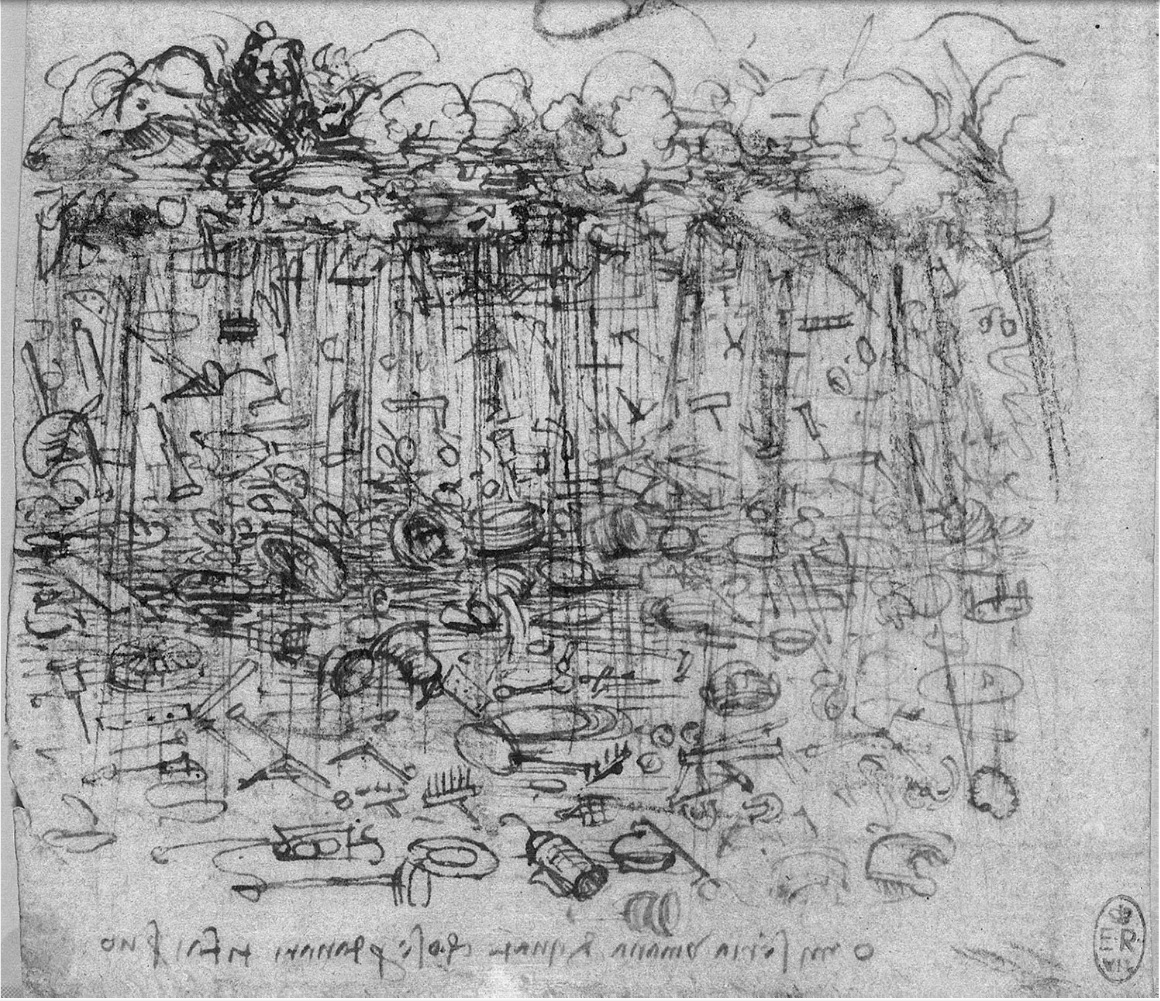
It is difficult to describe how many things are wrong with dreamthinkspeak’s attempt to weave inspiration from Leonardo Da Vinci’s ‘A Cloudburst of Material Possessions’ into a multi-stranded meditation on a world at a supposed crux of developmDa Vinci's Cloudburst - a work by a true geniusent and chaos.

It is difficult to describe because that would have entailed dreamthinkspeak feeling it was necessary to share any of their ideas with the audience rather than thinking that a hotchpotch collection of site-specific installations mixed with cod-philosophy and an imagined future that seemed startlingly reminiscent of a mid-1980’s episode of Tomorrows World was an acceptable substitute.

At the end of the audience’s ‘journey’ (even the word makes me cringe) you are handed a leaflet outlining the thinking behind what you have just seen. It is quite a useful addition if for no other reason than for the fact that it demonstrates that the cringingly pretentious claptrap that you have spent the last 70 minutes watching seem just as cringingly pretentious when written down.

‘John the Baptist…seems to be ever present. Is he pointing the way to The Second Coming, to our death, to the end-of-world, or is he a false prophet who leads us on then abandons us to an uncertain fate? Does the slightly strange man obsessed with lemons have the answers? He seems to be dreaming of a new kind of Eden. But is it a real or a comprised paradise? The final installation mixes the organic with rudimentary technology but is it really the way forward?”

Well, when given lemons…

<<Continue to full review>>