Bitesize Coward proves to be a tasty lunchtime treat

Still Life – Bridewell Theatre (13:00), until 06 July 2012

The Lunchbox Theatre programme of the Bridewell Theatre is one that taps into the roots of the St Bride Foundation. Established in the 1890’s, the Foundation Institute was created at the crossroads where the Church’s traditional notion of charity met the more enlightened of the Victorian patriarchs. Across London’s East End we see similar projects being set up, and a core function was not just the improvement of physical and material wealth but the improvement of the soul. Lectures on subjects that often took ideas such as the role of the pastoral in Shakespeare or the glories of classical Greece were given frequently to the working poor of London.
You would be hard pressed to argue that the Bridewell Theatre, based at the junction of Fleet Street and Farringdon Street, still caters to the working poor. From the road you can look east and see office blocks that tower over St Paul’s and obscures all of Cheapside. It might, however, still be argued that the workers of London’s financial heartland might benefit from the Victorian ideals of mental nourishment.

If so one hopes that they make use of Lunchbox Theatre to catch Noel Coward’s Still Life. At 45 minutes it acts as an exemplar of the one act structure and hopefully might rehabilitate some attitudes towards Coward. His prodigious output and general position as whipping boy for the angry young men of the 1960’s has perhaps obscured the incredible talent that enabled him to become a colossus of pre-1945 British theatre.

He writes, and is reflective of, a very specific period in Britain’s history – which bisects the Victorian and modern worlds – where the class upheaval put in motion after the disasters of World War 1 had challenged the rights of the upper classes to lead and the church to provide moral guidance. During this period of flux the culture of high society refused to seriously engage with the questions raised of the pre-existing order; Coward is no exception to this and a number of his works probably cannot be revived due to the nature of the elitism and class-caricatures contained in the text.

However Still Life suggests that he was aware of the changing pressures and the way that the upper-classes were trapped within the systems created by their own class (and one cannot but think that own sexuality was no doubt an underlying issue). The abiding impression for the audience is that whilst the play focuses on the relationship between Laura and Alec, it is the relationship of Myrtle and Albert that is allowed to be alive. It is arguable that in this Coward moves perilously close to suggesting the idea of the noble savage free to express their baser instincts, but in many ways the relationship could be closer to Shakespeare’s Phebe and Silvius from As You Like It – providing a comic background and emotional relief from the play’s driving relationship.

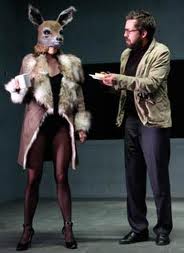
Still Life was famously adapted to the screen as Brief Encounter, and Celia Johnson and Trevor Howard were forever immortalised as the epitome of that very British type of love affair: all lingering looks and stiff upper lips. To walk in these shadows requires actors capable of working through what might otherwise appear on the verge of self-parody. Alice Knapton (Laura) and James Powell (Alec) are not always given a lot to work with in the text and there is a risk that performances will come across as one-note and slightly glassy. However they manage to sidestep this trap and bring a multi-layered texture to the roles that hints at all that lies beneath.
<<Continue to full review>>

Science under the microscope in Durrenmatt’s The Physicists

The Physicists – Donmar Warehouse, until the 21 July 2012 

Thomas Midgley Jr is not a name near to many people’s lips when asked about the most important scientific innovators of the twentieth century. Seemingly destined to be remembered solely as a speciality question in a pub quiz would appear a strange fate for a man whose contributions to science shaped the world and led him to being described as having a ‘greater environmental impact on the planet than any single organism in history’.

It is then unfortunate for Thomas Midgley Jr that the impact described was both an accidental consequence of his inventiveness and wholly negative in almost every conceivable aspect; for Thomas Midgely Jr is the man who came with the idea of adding lead to petrol. Not content with this world health hazard, his second invention was close to catastrophic, as he found a way to improve the process of refrigeration through a compound called Freon. In so doing he successfully managed to invent CFCs.

One can only imagine that after those two disastrous attempts at improving the world, poor Thomas Midgely Jr would have a great deal of sympathy for Johann Wilhelm Möbius, the scientist at the centre of Dürrenmatt’s farcical satire that poses questions on the burden of responsibility on scientists and the ability of state to understand and manage scientific developments. Indeed Möbius is so concerned with the potential capacity for destruction in his inventions that he decides it is better to feign insanity so that he is able to work on pure physics well away from the overbearing hand of the state.

Dürrenmatt wrote The Physicists in 1961, prefiguring the Cuban Missile Crisis but at a time when tensions between the Soviet Union and the West were reaching a new peak. The horrors of Hiroshima and Nagasaki remained fresh in the mind 15 years on, as societies across the world lived in the shadow of two countries committed to the real-politics of mutually assured destruction.

Charles Spencer, writing in The Telegraph, challenges the play’s value forty years on. It is a reasonable point at a time where the conflict between superstates has faded and the prospect of nuclear war has receded to be replaced by a more existential threat of individual extremists, dirty bombs and cyber-warfare. Josie Rourke’s production is never quite able to square this circle and throughout there remains the nagging sensation that one is watching a period piece; a very well-crafted and carefully staged absurdist drama that is fascinating but ultimately as clinical and sterile as its setting.

That is not to say that it cannot be enjoyed on its own merits. The quality is to the level that has come to be expected from a Donmar production. John Heffernman is superb in capturing the duality of Möbius’ character; drawing out the dignified trauma of being self-aware enough to understand that his brilliance can never realise its potential in a world where it will be handled by those with power but no understanding, but Heffernman also reveals the arrogance that afflicts many geniuses and causes them to underestimate the skill of the opponents, in this case hastening the final tragic denouement.

<<Continue to full review>>

Shakespeare’s Cymbeline finally turned into a true work of art

Cymbeline – Barbican Theatre

The Ninagawa Company, under the stewardship of Yukio Ninagawa, has built up a fearsome reputation in world theatre. They stand as the equal of any post-war company from Joan Littlewood’s Theatre Workshop through to Chicago’s Steppenwolf, whilst stylistically they are as uniquely identifiable as anything from Peter Brook or Simon McBurney.

Famed for his Shakespeare, Yukio Ninagawa has turned his attention to one of the most problematic plays in the Bard’s canon; Cymbeline. It is a difficult play to love and one that comes packaged with all kinds of traps for a modern audience. The plot winds and winds and seems unsure of what it wants to be, containing elements of romance, farce and tragedy. It has simplistic plot devices, like cross-dressing and misidentification, reminiscent of earlier plays but also contains the heavily allegorical language and non-human elements, in this case Jupiter descending on an eagle, that place it alongside The Winter’s Tale and The Tempest as one of the later plays.

Frank Kermode described the play as a tragi-comic romance and suggests that it may have been an in-joke for audiences who would have had a much better understanding of the text and references to earlier plays. None of which makes it any easier for a modern audience to unpick the complexities of the plot.

Luckily going to see a Ninagawa production is to have your visual senses wrapped in cotton wool and taken on a journey where the simplicity of images masks the masterful craftsmanship working behind the scenes. The technical understanding of balance is superbly illustrated again and again throughout the evening; light and shade, simplicity and complexity, the tonality is in harmony so that everything works towards the whole and the audience is never aware of the mechanics. Like other Japanese traditions that have bewitched Europeans over the years, from woodcuts to sushi, the skill rests on the ability to hide an incredible complexity behind a deceptively simple front.

It is difficult to fairly assess the skill of the actors without speaking Japanese and since the production leans so heavily on the visual, the rest of this review will take a radical detour and will look to provide a sense of the evening through the images it has left behind.

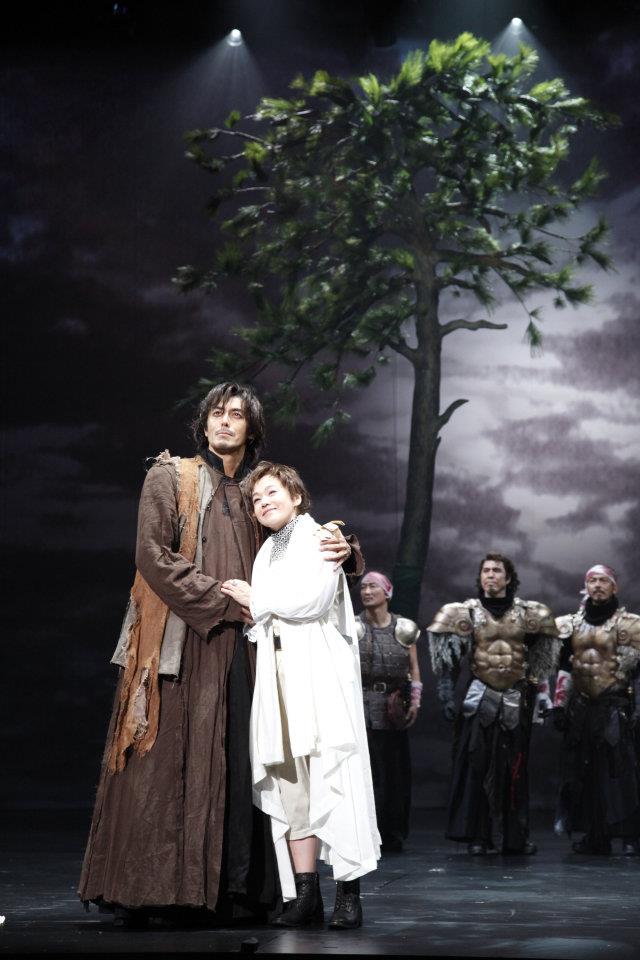
You can choose any one of a number of plot strands to call the centre of Cymbeline. Above we see the romance at the heart of the play, that of Posthumus and Imogen, as they are parted and again as they are reunited. As is traditional in Shakespeare the lovers must face many barriers before finally winning through in the end. However the play is made problematic, particularly to a modern audience, by the fact that Posthumus acts in such an unreasonable manner for much of the play, doubting his wife’s fidelity almost as soon as he leaves England before hiring his servant to murder her. That kind of level of trust does not always lead to happy relationships.

As the beating heart of the play, Hiroshi Abe, as the exiled Posthumus, and Shinobu Otake’s Imogen, bring the romance to life despite spending most of the play separated. They draw out the character traits despite the language barrier, with Hiroshi embodying the stoic and duty-bound Posthumus,  accepting of the State’s decision to banish him before later preparing to sacrifice himself in realisation at the fate he believes he inflicted on Imogen.

<<Continue to the full review>>

Antigone: A very modern ancient Greek tragedy

Antigone – National Theatre, until 21 July 2012

Polly Findlay’s production of Antigone, which runs at a brisk 100 minutes without an interval, is a fine example of balancing the demands of classical Greek tragedy against modern audience sensibilities. In this regard it is helped by Don Taylor’s solid translation that irons out much of the overly heightened poetics in favour of a more earthy realism. This has the dual effect of making the plot a lot less tangled to an audience not raised on the complexities of Grecian mythology and also downplaying the role of the gods in the drama – possibly the single biggest problem in finding contemporary resonance in the surviving works by Greek playwrights.

The text has been filleted to make it performable without a break and this broadly works in the narrative’s favour. Antigone is rooted in conflict  from the opening moments and it doesn’t take long to become apparent that the audience are watching the playing out of a tragedy made inevitable by the choices taken by humans. By removing the interval Findlay is able to keep the tension ratcheted up and allows momentum to build like a wave from first scene to last.

The action is set, effectively if not a little predictably, in the war rooms of Creon’s (Christopher Eccleston) administration. Soutra Gilmour’s set design has done an impressive job of filling the Olivier stage without giving the impression of it being cluttered. This is achieved by partitioning offices towards the back of the stage that has the effect of shortening the vast space by a good 10 metres and forcing most of the action towards the audience. As a result the production feels much more intimate than many staged at the Olivier.

Findlay doesn’t waste the space and there is the constant background buzz of an administration on the brink. The Chorus form the civil servants that run things behind the scenes. There are two very cute moments in the opening moments that help to create a world that is instantly recognisable; the first is what must surely be a deliberate echo of the famous image of Obama and team watching the raid on Osama’s hideout. The second is the chorus’ announcement of the death of Polyneices & Eteocles restaged as the drafting of the press release, with the text being revised to tone down the language of war.

What marks Antigone as one of the most important plays in the Western canon is the fact that, despite it being dated to a period almost 2500 years ago, it is still dealing with issues that are recognisably modern. Other surviving plays are of interest, or contain some certain relevance, to a modern audience but Sophocles captures issues that are still being played out on the world stage in the 21st century.

The idea of the rights of the individual against the rule of the state is one that will never be resolved and Sophocles shows it through an issue that has a stark modern relevance; the death of Osama Bin Laden led to mass protests following his burying at sea, which was seen as breaking Sharia law. This contemporary example amply demonstrates that the right to be buried in accordance with tradition has not diminished over two millennia.

<<Continue to the full review>>

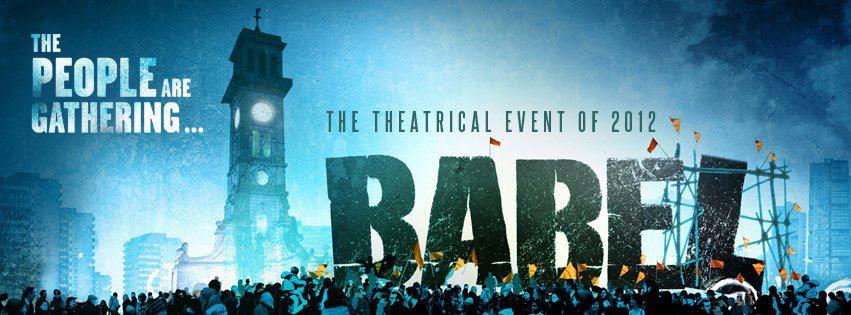
Tower of Babel crumbles to reveal evidence of shonky workmanship

Babel – Performed at Caledonian Park,  until May 20th 2012

When it was announced that a collaborative project involving Wildworks, integral to The Passion of Port Talbot; the Theatre Royal Stratford East, previously home to Joan Littlewood;  the Battersea Arts Centre, long-term supporters of Kneehigh and Punchdrunk; and the Young Vic, would focus on the story of Babel as part of the World Stages Festival there was a feeling that it could become the theatre event of 2012.

Involving a cast of over 300 and creating an immersive experience in the middle of London, Caledonian Park to be exact, Babel had the potential to create a truly gripping experience that would draw an audience together in a piece that would explore questions that have remained fundamental to human nature since the  birth of our earliest civilisations.

The story of Babel is a story of primeval humanity and the development of language. Primarily thought of as biblical, it has antecedents common to a number of ancient civilisations. This is not uncommon in origin stories, and Babel in particular touches on questions of a universal root language that is as central to modern linguistics today as it would have been to ancient thinkers. It is hard not to imagine an oral tradition passing the story of Babel down through the generations as an an answer to the question of how it came to pass that humanity, rooted in theistic societies, spoke with such a multiplicity of tongues?

It is a story that has many resonances with the modern day, particularly in a world where Twitter bridges culture and internet search engines can  translate web pages instantaneously. Perhaps after thousands of years humans are beginning to hurtle back towards a supposed original state where humans can converse across a universal language. The fact that Babel so singularly fails to address any of these questions is only the starting point of a troublingly flawed production.

In business circles, it is often felt that any negativity in performance appraisals should take the form of the infamous ‘shit sandwich’ – for those unaware of such a delicacy, it generally involves a criticism layered carefully between two positive statements. Unfortunately in the case of Babel, there is far too little of the positive to create a sandwich, at best you might be able to fashion some form of Danish Smørrebrød but even that appears optimistic.

<< Click here to continue to full review>>

Three Kingdoms: Three theatre companies, three languages, three countries and three genres

Three Kingdoms – Hammersmith Lyric, playing until 19 May 2012 [With Munich Kammerspiele and Estonia’s Teater NO99]

Three Kingdoms is an ambitious collaborative work that pulls together the best of Britain, Germany and Estonia in the shape of playwright Simon Stephens, director Sebastian Nübling and designer Ene-Liis Semper. If Simon Stephens is a well-known name on the British stage thanks to critically-acclaimed plays like Wastewater and Punk Rock, the general lack of recognition for the other two is more a result of our insular Anglo-American approach to theatre rather than any lack of talent on their part: Sebastian Nübling works with Munich Kammerspiele, whilst Ene-Liis Semper co-founded Teater NO99 in 2004, and I am reliably informed by Estonian cultural emissaries that they are generally regarded as being towards the top of a vibrant (?) theatre scene in Estonia.

This trio of talents have rather curiously taken it upon themselves to work with a narrative that would not seem out of place airing on ITV in three parts on successive Tuesday nights. Three Kingdoms begins by giving every impression of being a staged version of a TV crime drama; bleak scenes of cold, stained police rooms, dysfunctional domestic relationships and stereotypical Russian gangsters.

As the narrative begins to open out the ambition of the play starts to be revealed. Increasingly the action takes on a woozy, slightly sickening feel as the audience watches events as the alienated Detective Inspector Ignatius Stone (Nicholas Tennant) sees them, rather than his bi-lingual partner, Detective Sergeant Charlie Lee (Ferdy Roberts).

<< Read full review here >>

Watch the trailer below: