The Ruling Farce

The Ruling Class – Trafalgar Studios, until 11 April 2015 (Tickets

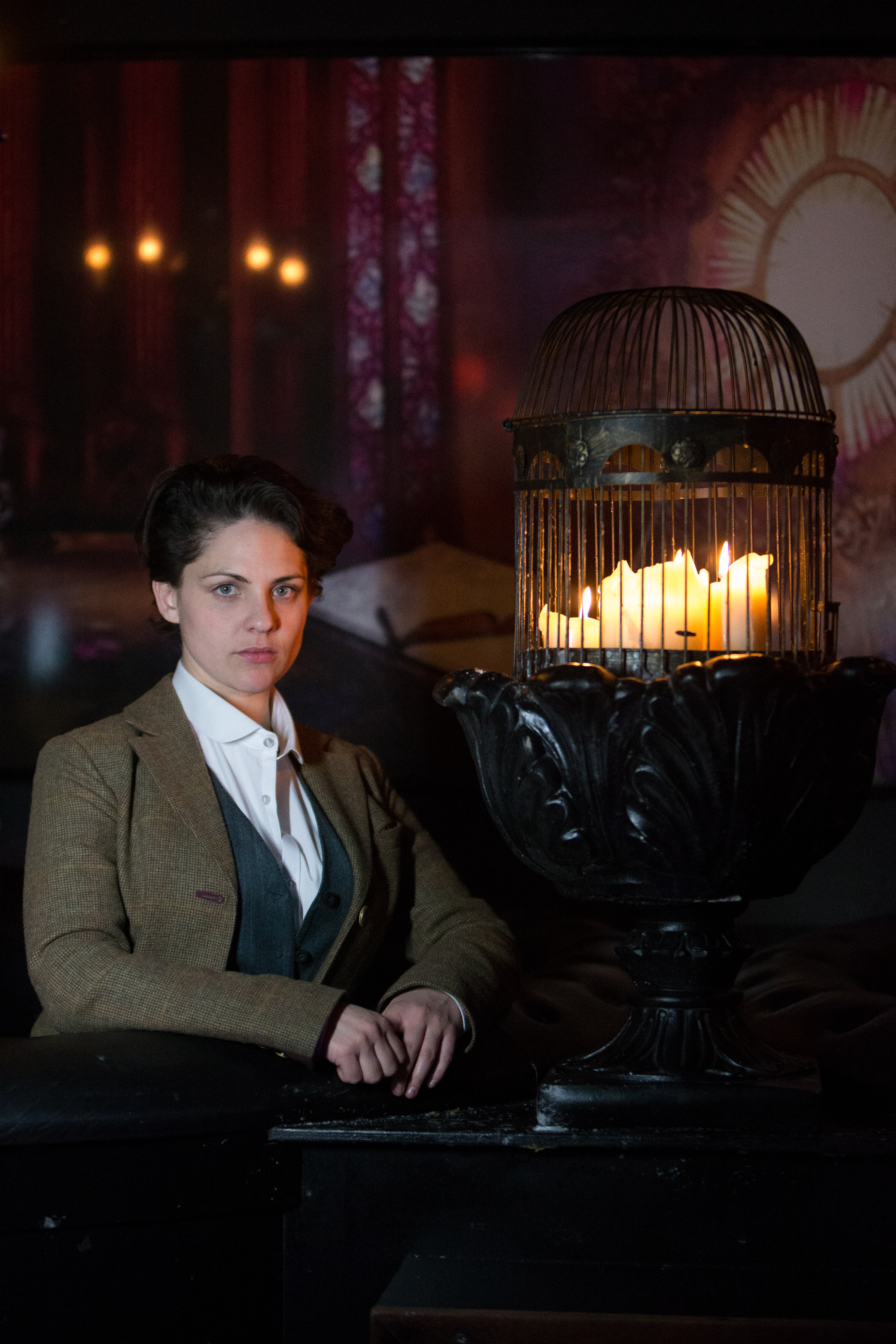
James McAvoy and Kathryn Drysdale in The Ruling Class at the Trafalgar Studios. Credit: Jonas Persson

It is entirely possible that finance for this revival of Peter Barnes’ satire of the British class system was raised purely on the back of a one-sentence pitch: ‘enter James McAvoy riding a unicycle whilst wearing white underpants’.

It may well have been a tough sell otherwise, as The Ruling Class acts as an exemplar of the potential perils of reviving a near-forgotten play. Staged in 1968 it would have appeared as a topical satire that referenced the ideals of the summer of love and the pressures being place on the established elites by the social revolutions that rippled through the decade. Barnes’ sets an aristocratic establishment against the more hippyish virtues of McAvoy’s ‘JC’ – who has a particular fascination in bonding the pleasures of the spiritual and physical realms.

Credit: Jonas PerssonHowever by 2014 – with society bended to fit the tyranny of the financial markets and the ideals of the free-spirited long broken by an advertising industry that learnt it could get fat by selling homogenised difference – this world is almost unrecognisable from the one we ended living in.

While a play does not need to be relevant to be enjoyed, one must question why it has never seen a major revival since the Leeds Playhouse in 1983.  Given the canny programming of Jamie Lloyd’s critically and commercially successful Trafalgar Transformed seasons up to this point, it does seem like a curious choice.

However it turns out the play isn’t without interest. Whilst it is creaky and overlong – two and a half hours plus an interval for a satirical comedy? – there are several quite unexpected tonal shifts that means you are never quite sure what is going to come next.

I certainly was unprepared for a play from 1968 to open with a quite gruesome death by way of auto-erotic asphyxiation misadventure. Equally the fact that it suddenly breaks into vaudevillian song and dance routines for no discernible reason is baffling and pleasing in equal measure.

<<Continue to full review>>

Life: Lost and found

Missing – Gecko @ Battersea Arts Centre, until 21 March 2015 (tickets)

There are few elements of the theatrical world that Civilian Theatre feels less qualified to talk about than cutting edge contemporary dance. Any reviewer who fits shows into their free time will Bar and admirers. Credit Robert Goldeneventually reach a point when you accept there is only so much they can actually watch and, as a result, an element of self-selection may creep into what press shows are attended.

So it is entirely possible that –  had I read the programme notes for Gecko’s Missing more  closely rather than be seduced by the intriguing image that accompanies it –the words ‘critically acclaimed physical dance company’ may have registered and I wouldn’t have crossed London to make it to the Battersea Arts Centre to watch their show.

And what a fool I would have been.

Missing is an intelligent, beautiful show that speaks volumes even to the choreographically illiterate. It may not have transformed my overall impressions about contemporary dance but it has shown that the form can be used to tell a story just as clearly as through the use of words.

The difference between Gecko and other shows I have seen is that the performance lacks the abstraction that can leave the inexperienced scratching their heads. Previously I have been unable to translate a plot synopsis to what I have been watching but here the narrative progression was entirely clear and the company seemed focussed on not losing its audience. Scenes took place within established settings and the movements between performers seemed structured to reflect traditional conversations but with the added advantage that dance allows of allowing the text and subtext of character motivations to interweave in their actions.

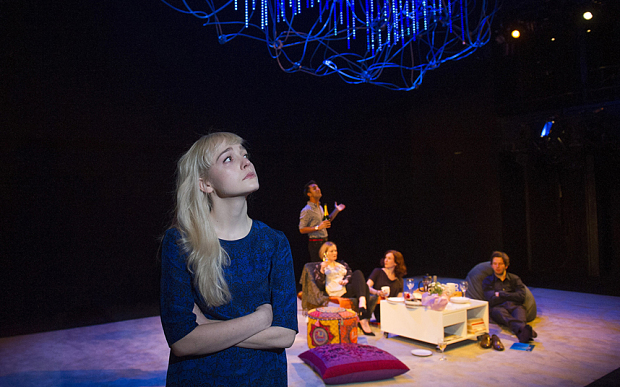
There was also little of the po-faced seriousness that has been a marked feature of my previous encounters with contemporary dance. Whilst the topic itself was treated seriously, they also found the humour that can be mined out of the awkwardness of relationships. The fracture lines that marked Lily’s marriage were played to great comic effect in a simple scene showing how they were unable to sit comfortably together watching a film, whilst the meeting of her parents became a slapstick encounter made more poignant with the knowledge of how it would eventually disintegrate.

<<Continue to full review>>

Bedtime Stories

Fiction – Battersea Arts Centre, until 21 March 2015 (Tickets)

The Battersea Arts Centre welcomes David Rosenberg and Glen Neath back to the Council Chamber following the hugely successful production of Ring – an audio-hallucinatory adventure that married a highly technical sound design with an engagingly simple premise to create an extremely enjoyable, if difficult to classify hybrid of funfair chills, performance and radio play.

Clearly an advocate of the ‘if it’s not broken’ school, their latest production revisits much of the same ground. Again the audience are plunged into total darkness and listen through headsets. Again it is a brilliant opening that works better than you can imagine, even though you know precisely what is about to happen.

Very little beats the instant breath-catching horror of being unexpectedly plunged into complete darkness. It is the sort of oppressive darkness that is rarely experienced in urban areas – absolute, total black, where you begin to forget whether your eyes are open or closed.

And then, just as you are adjusting, the voices begin. And even awareness of what is to come can’t stop it from being a spine-chilling moment, your brain fooling you into thinking that you can feel warm breath on your neck as they whisper in your ear.

However to say much more about the plot would be to spoil the experience. It is enough to say that the programme notes refer to Rosenberg and Neath’s interest in dreams, the production attempts to create a collective experience of the shared dream space and the story itself twists and turns on dream logic.

Technically the show is more complex than Ring. The sound feels more layered and the effects more complex. Multiple voices work together more effectively and it is much easier to get a sense of distance as sounds move further away.

However as the science becomes increasingly apparent it is hard not to feel that they have lost something of Ring’s charm. It is a strange thing to say about an evening spent in pitch darkness listening to headphones but it felt that Fiction was a more solitary experience. The premise of Ring, the circular aspect and the actor moving around the room created a sense of inclusivity. Here, seated auditorium style, facing a giant screen – even if in darkness – felt very isolating and oddly impersonal.

<<Continue to full review>>

We came hoping for a new arcadia and instead ended up with Welwyn Garden City.

The Hard Problem – Dorfman Space @ National Theatre, until 27 May 2015 (Tickets)

This production will be broadcast to cinemas on 16 Aprilthe_hard_problem398.jpg

The ‘hard problem’of the title refers to ‘consciousness’; a concept under assault from a battalion of neuroscientists laying claim to greater and greater certainty in their understanding of brain functionality as something that can be deconstructed to the micro-level of synapses, neurons and neurotransmitters. As neuroscience is in the ascendancy we are left with awkward questions over whether humans are left increasingly shackled by the tyranny of genetic determinism? Where does our freedom of thought – our freedom to act in ways contrary to the principles of evolutionary science – fit into the equation? In essence does the philosophical ‘mind’, as opposed to the functional ‘brain’, exist?

These are fascinating questions and truly weighty topics. It is the sort of subject we have come to expect from Tom Stoppard, who has demonstrated his formidable intelligence on countless occasions over the last forty years and in so doing has contributed some of Britain’s finest plays of the post-war era. This includes two genuine classics in Rosencrantz and Guildenstern are Dead and Arcadia and many others that found audacious approaches to create unabashedly literate drama enthused with a wit that refused to bow to the lowest common denominator.

Stoppard is 77 years old and it is his first new play for nine years. So perhaps the hard problem for the audience is reconciling itself to the idea that the play – quite possibly his last – is a bit of a dud. Critical reactions have been mixed and supported by an undercurrent of good will but, on reflection, can anyone seriously challenge the view that this is but a pale imitation of what has come before?

The play suffers primarily from a lack of drama. Things happen, time passes, the plot resorts to rather clichéd contrivances and one comes away finding it very difficult to care about any of it.

<<Continue to full review>>

An uncategorisable wonder

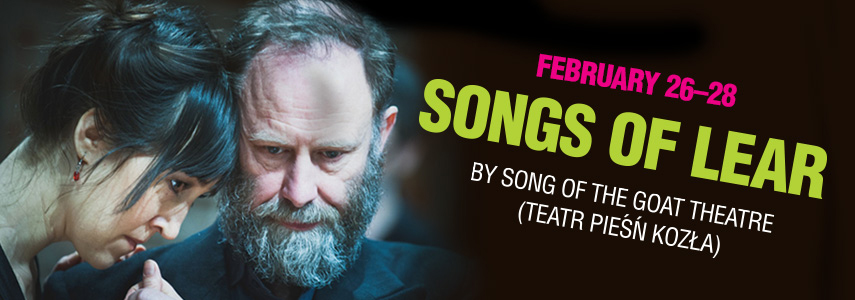
Songs of Lear – Song of the Goat @ Battersea Arts Centre, until 22 February 2015

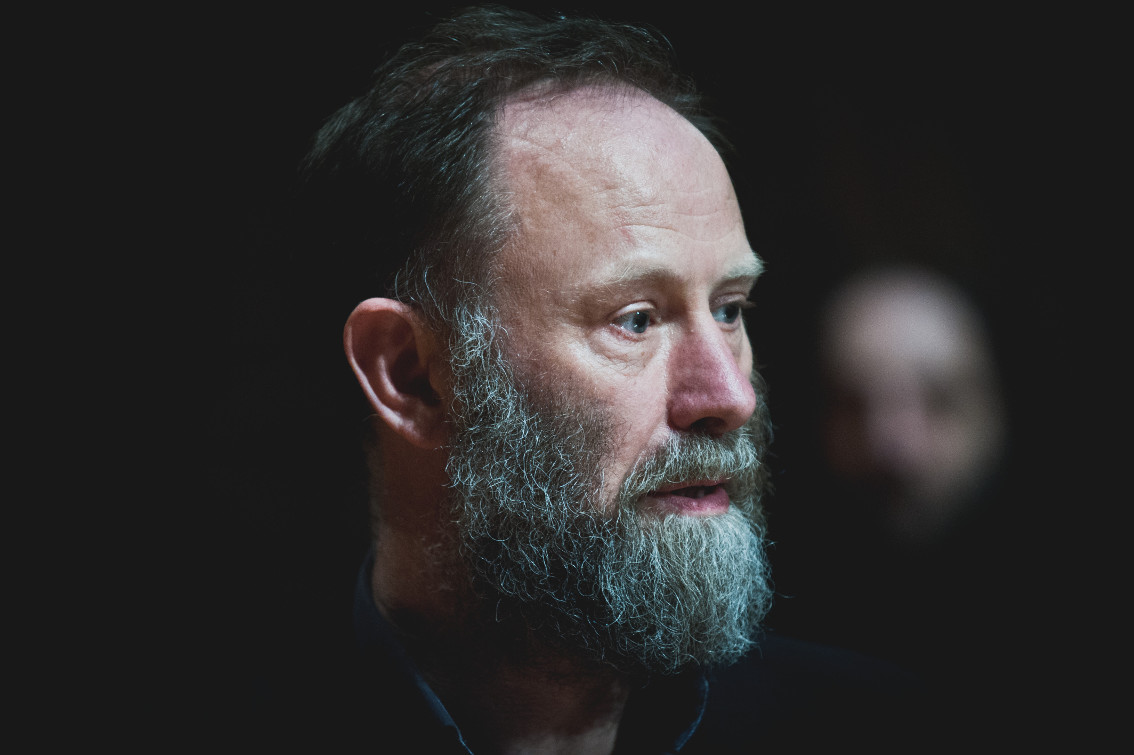
For some people theatre is purely a title used to describe a single homogenous mass of culture. They make no distinction between plays and musicals, and certainly don’t delineate between the many genre classifications that exist within drama. However for regular theatre goers there exist a number of tell-tale phrases that act as a useful guide as to whether a theatre event is something likely to be enjoyed.  Z Warzynski2 fot

Take Songs of Lear by Song of the Goat; they rather bravely describe their new play as ‘deeply rooted in the best traditions of Polish avant-garde theatre’. Despite putting it top of my list of plays to see in 2015, I must admit to being extremely intrigued in how tickets were selling at the box office.

So it was extremely heartening to report that the Grand Hall at the Battersea Arts Centre was a near sell-out; somewhere in the region of 400 people had clearly felt there wasn’t nearly enough non-linear, dramatic retellings of King Lear using polyphonic singing, gestures and mime in the London theatre scene to satisfy their cravings.

To describe Songs of Lear is close to impossible. It exists as a bold and brilliant reinvention of King Lear that takes its cue from the play but whose source material would be near impossible to identify without director, Grzegorz Bral, providing a summary explanation at the start of each episode.

It contains virtually no dialogue from the play but the dialogue it does contain seems to tell you all that is needed. Instead the cast – or possibly choir – perform the most haunting choral singing, with influences that seem to stretch from across Europe and North Africa.

1web_DSC0970Some moments sound liturgical and there are elements of what could be Gregorian chanting. A musician playing the Balkan bagpipes enters at key moments, directing his playing towards the actors; his interpolations are open to debate but for me they were a signifier of the existence of the wider world that is being slowly torn apart by the actions of Lear and his daughters. Or it could just be a man playing the bagpipes.

It ends with what appears to be an Arabic-inflected piece – the dead king paid homage to in the guttural cries of mourners, but are they mourning him or are they mourning the divided, fractured kingdom left behind?

<<Continue to full review>>

Though this be madness there should be method in it

Hamlet – English Repertory Theatre @ Cockpit Theatre, until 15 March 2015 (tickets)

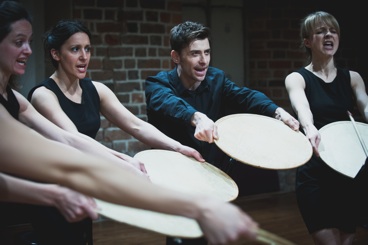
I would like to open this review by mentioning that Civilian Theatre does not see itself as one of those critics that takes a perverse pleasure in lacerating poor productions with a damning review; chuckling to oneself with each stab of the keyboard. In the four years of reviewing plays, Civilian Theatre has only really laid into two productions (Babel and Peter & Alice) and both were big B02J4494-210enough to make it unlikely that my chiding remarks would have any real impact on the sensitivities of those involved.

With smaller-scale, or up and coming, companies it usually preferable to take a more modulated tone; criticism can serve two purposes, on one hand a review is written so that a potential ticket buyer can draw something meaningful about a play whilst a theatre company may also use it to draw insight from what a person distanced from the production process took away from the evening.

So in a roundabout way, and with the previous two paragraphs forming a mea culpa for what is to follow, we reach Hamlet, usually by William Shakespeare but here pared-down to 90 minutes and subject to reworking by the English Repertory Theatre.

Now I have been a stalwart defender of the right to adapt Shakespeare in order to draw in new audiences or to cast fresh perspectives on the action. I loved both of Phyllidia Lloyd’s productions at the Donmar (Julius Caesar and Henry IV), and felt that cutting close to four hours from Henry IV Part I & Part II was entirely validated due to the way it thrillingly reinterpreting the relationship dynamics between the lead roles.

However it is a high risk approach and one has to be sure that every snip from the text is dramatically justified and lends to the clarity and purpose of the production. So in this version it is understandable that you would excise much of the political intrigue that swirls around Elsinore, cutting Fortinbras and Hamlet’s trip to England completely and narrowing the action to Hamlet’s coterie in order to fit it to the school setting.

What is less understandable is why you would then reallocate dialogue so that Horatio delivers Fortinbras’ final lines in a cod-Norwegian accent. It is a terribly misjudged comic coda for what is ostensibly a tragedy, and also acts as a strangely out-of-place addendum at odds with the key themes that have been drawn out in the cut-down text.

This is just one example of the confusion that mars a production that reeks of being cannily targeted at the school syllabus; the stripped down running time and the schoolyard setting feel  little more than a lure to entice the financially powerful student trip market. The use of a school as a framing device is never justified, and leads to far more questions than answers, so that in the end it becomes a performance that lacks narrative coherence.

<<Read the full review here>>