Everyman – Olivier Theatre @ National Theatre, until August 30 2015 (tickets)
As a statement of intent of what Norris intends to bring to the National Theatre during his tenure as Artistic Director, Everyman – his first directing role since taking over- could hardly have been more purposeful.
The bravura opening sequence that stretches from the studied simplicity of Kate Duchêne’s God to Chiwetel Ejiofor’s spectacular initial entrance marries energetic vitality to a clear eye for using the 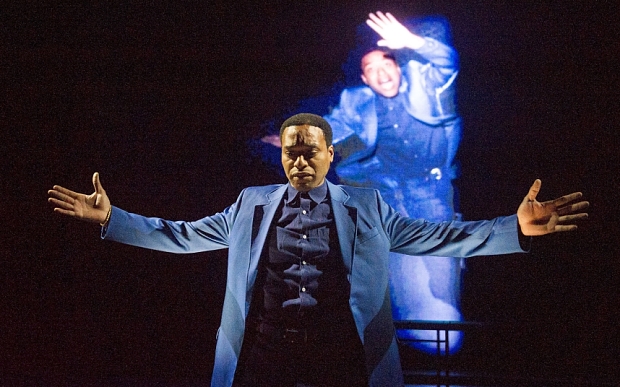 Olivier’s vast space to compose striking images. It is a breathless and hugely ambitious piece of staging that successfully draws the audience into the action from the off.
It feels like a mark of how the National Theatre stagnated towards the end of Nicolas Hytner’s tenure that one has to go back to Danny Boyle’s Frankenstein in 2011 (or, tellingly, Norris’ own direction of London Road in 2012) to find another play that so successfully combined powerful story-telling with making full use of the Olivier’s unique performance area to create a truly theatrical experience.
London Road – now a film – may well have done more than anything else to secure Norris the most coveted role in British theatre. The critically acclaimed production created a beautiful harmonisation between a visually spectacular design and a highly original approach to verbatim story-telling. The play took universal themes and pulled them inside out, seeking to give voice to those ignored by traditional genre plotting but who still have to live their lives at the epicentre of tragedy. Between Alecky Blythe’s dramatisation and Norris’ direction, the voices of regular people from a small corner of Britain were given as much weight as importance as Peter Morgan gave to the Queen in The Audience. London Road was not just a play but a thoughtful articulation on what a national theatre’s mandate could be.



 Voter turn-out has been declining since the 1950 election when almost 84% of people cast their ballot and by 2010 had sunk to 65% of the electorate (amazingly this is still higher than the nadir in 2001 which saw less than six out of ten eligible voters bothering to have an opinion on who they wanted to control their lives). In the intervening years mass political movements have come and gone but the institutions of Westminster have remained as hierarchal as they have ever been, and – based on a simplistic metric of ‘private education and Oxbridge’ – may have gone backwards to Victorian levels of patrician governance, with few MPs from across the political spectrum able to claim a background that even Tony Blair’s favoured ‘Mondeo Man’ could identify with.

 Civilian Theatre