A valuable lesson about forbidden love

‘Tis Pity She’s A Whore – Cheek by Jowl at the Barbican, until 10 March

‘Tis Pity She’s A Whore does not make itself the easiest of plays to love; even given the general sense of impending and unbending doom and attendant cast of flawed humanity that appears as a hallmark of Jacobean tragedies, John Ford’s ‘Tis Pity… is unsentimental, hard as flint and packed full of characters that do not exactly strain to gain the audiences sympathy.

It is difficult to imagine what was made of it in the 17th Century but its tale of intrigue, incest, and murder is one that retains a genuinely shocking impact two centuries later, whereas other plays, such as The Revenger’s Tragedy, The Duchess of Malfi or The Changeling struggle to escape the period detail of their plots.

The effectiveness of the impact may have much to do with the key subject matter of ‘Tis Pity. Whereas the actions of characters may appear a little antiquated to a modern audience – suicide and a bloodbath in the course of avenging another seems a little outré these days – incest remains one of the last remaining taboo areas. One needs only watch the end of Polanski’s neo-noir masterpiece Chinatown to see that it retains a visceral power. It maintains a mysterious otherness by sitting so far outside an audience’s range of experience.

Few plays tackle the subject openly; the inexorable slide through its beginnings into initiation and onwards onto final devastation is laid out in front of the audience in an astonishingly frank manner with surprisingly little of the expected moral criticism. Ford’s play wrong-foots the spectator at almost every turn leaving the audience fully engaged in the spectacle despite an awareness that the conventions of drama practically dictate the inevitable conclusion.
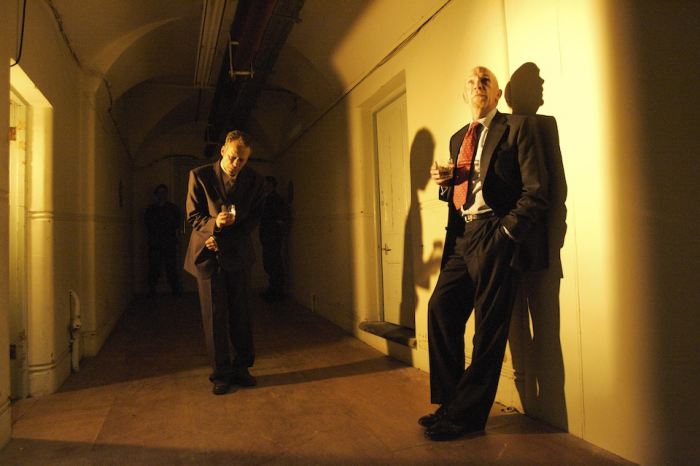
<Click here for the full review>

New World Order is a terrifying Brave New World

New World OrderHydrocracker, Shoreditch Town Hall, Running until 11 December 2011

Winding from the ornate meeting rooms and private recesses of power, where bureaucrats discuss policy and the media is entertained, down to the bowels of the building, through long forgotten corridors where concrete crumbles away from the walls and barren rooms echo to the sounds of clanking boilers and the scurrying of mice; Hydrocracker have created a staggeringly potent panorama of institutionalised state power, a lucid dream that unfolds to reveal nightmarish dimensions.

New World Order is an amalgam of five of Harold Pinter’s shorter work, deriving from his later period where his output began to more directly engage in questions of politics and control. Despite being a playwright who took fastidious care over every element of the script, it is hard to believe that Pinter, the political animal, would not have given his support to Ellie Jones’ superb reimagining that knits together five separate pieces so effortlessly that the joins between the work are made practically invisible (the only distinguishing mark being subtle changes in the linguistic character of different scenes).

Most impressive is the use of location to create a unity of action. Site-specific and immersive productions may have boomed in popularity in recent years, and as a result become short hand for companies wishing to demonstrate their innovation, but none has managed the unification of text and place that Hydrocracker have achieved through locating their work within Shoreditch Town Hall.

It is an inspired choice and the building is absolutely integral to the success of the piece. As the audience is led through the site, it becomes a living, breathing character of its own. Everything about the building exists in a contextual history of real politics, so when the audience halt on a staircase to let two policy wonks, deep in conversation pass, it is shocking to realise that rather than discussing the minutiae of planning regulations, they are in fact debating how many opposition supporters can be dealt with before they lose support of the general public.

Hydrocracker has clearly understood that location is everything. Led past a plaque detailing all the former mayors and into a conference room set-up for a press conference, the audience are reassured by familiar sights of the political establishment and are empowered to embrace the realism of the situation. It is only when people begin to speak that everything reveals itself to be off-kilter, and from that point on the audience are drawn ever further into the world of state-mandated terror.

Click here to continue to full review

Sheridan meets Brecht: when legends collide

School for Scandal – Barbican Theatre, 14 June 2011

There isn’t much left to write about the Deborah Warner directed School for Scandal currently playing at the Barbican. An award-winning director who was most recently seen at the National with a stellar production of Mother Courage and Her Children, Warner’s original take on Sheridan’s 18th century classic became the rather surprising subject of unusually intense critical debate, before descending into a rather indecorous war of words between Warner and the theatre critics, Michael Billington and Charles Spencer.

The production demonstrates fairly conclusively that Sheridan’s restoration comedy continues to withstand the test of time. A sparklingly witty acidic comedy, the dense wordplay maybe be occasionally hard to follow for modern audiences but taking the time to really listen is more than worthwhile, with a script packed with lines biting enough to make you think of an 18th century Thick of It. The cast do fine work with the material. Alan Howard as Sir Peter Teazle is first rate, finding the perfect blend of genuine compassion mixed with the kind of grumpiness evident in older men who find themselves in a fractious relationship with a younger wife. It is interesting to watch Howard and remember back to a time in the 1970’s when he was one of the coming men of the stage, running through the repertoire of romantic leads for the RSC. Matilda Ziegler’s Lady Sneerwell and Vicki Pepperdine as the irrepressible Mrs Candour are both excellent and wring the maximum amount of humour out of two of the funniest roles in the play.

Leo Bill, playing Charles Surface as a trustifarian with a, very deeply hidden, moral centre, is entirely convincing. A bundle of nervous energy, constantly on the move, Bill injects some much needed pace into a play that, while constantly zipping along and never feeling flabby, is still a three hour haul.

However fans of Sheridan maybe scratching their heads at the description of Charles Surface as a trustifarian and this is where problems in the production begin to arise. The criticisms of Warner’s production have focused on the modern flourishes that have been brought to the play and a certain irritation that parallels with society today were being, in some cases literally, clearly signposted for the audience. Continue reading here

The month ahead in reviews

A truth well recognised by those who must do the things they enjoy on an unpaid basis is that one must spend much time squeezed between the work you are paid to do and the work that you would like to do. Having spent the last few weeks dedicating some serious time and energy to the former, it feels that the latter requires a little more attention.

So now that the natural equilibrium of all things can look forward to being restored, here are the reviews that you can look forward to over the next month or so:

  • School for Scandal
  • The Infernal Comedy
  • The Cherry Orchard
  • Rosencrantz & Guildernstern Are Dead
  • Emperor & Galilean