Taking the train to ‘El

The El Train – Hoxton Hall, until 30 December 2013

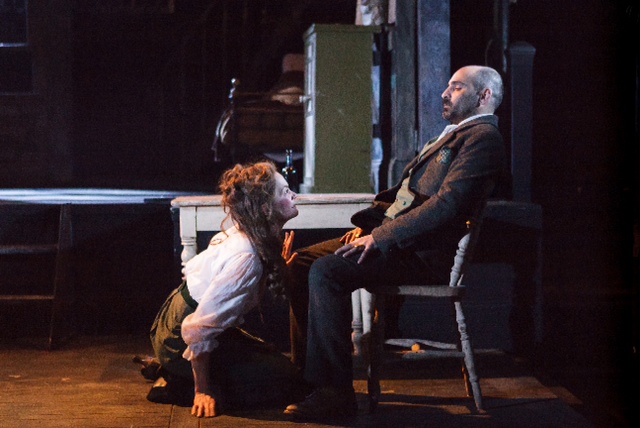
Sometimes the venue is everything when it comes to theatre. It is hard to imagine watching Eugene O’Neill’s three short plays – that make up The El Train – about life in the Bronx from the comfort of plush velvet seats Ruth Wilson  & Zubin Varla-steve-in-the-web-the-el-train-hoxton-hall-photo-marc-brenner-408on Shaftesbury Avenue.  Yet sat on rickety wooden seats in the cold, draughty Hoxton Hall, hemmed in by the elbows of your neighbours, and in the heart of what was once the heart of the East End slums, O’Neill’s histrionic melodramas about the perils affecting life among the forgotten beings to make a kind of sense.
The atmospheric surroundings of Hoxton Hall is critical in making the whole concept of The El Train work at all. Outside in Hoxton and around Old Street – Britain’s ‘Silicon Roundabout’ – it is difficult to appreciate just what life would have been like for those living in the same streets a century before, and so the location helps to ease the audience back to a time when earnest members of the Fabian society would deliver lectures on a range of esoteric subjects because they truly believed in the moral purpose of education for the bettering of the life of the working man; indeed it comes as little surprise to discover that for over twenty years the venue was run by the Quakers and linked to the temperance movement.

The El Train is a good way of seeing O’Neill writing in the style that would see him win two Pulitzer prizes and become Nobel laureate. A passionate writer that does for the American poor what had previously been highlighted in the U.K through works by George Bernard Shaw and Charles Dickens, O’Neill can be exhausting in the long form but in 20 minutes bursts his style can be rather invigorating.

O’Neill tends to be venerated by theatre critics but in his full-length plays he is often to be endured as much as enjoyed. He is as melodramatic as Tennessee Williams but without the entertaining southern gothic that makes Baby Doll and The Glass Menagerie such lurid delights. His plays, like Long Day’s Journey Into Night, mark some of the first developments of the narratives that are now seen as the great American themes and which dominate American drama and literature to the present day. However O’Neill’s work seems to lack the stringent naturalism that propels Arthur Miller’s All My Sons and Death of a Salesman into the ranks of great drama.
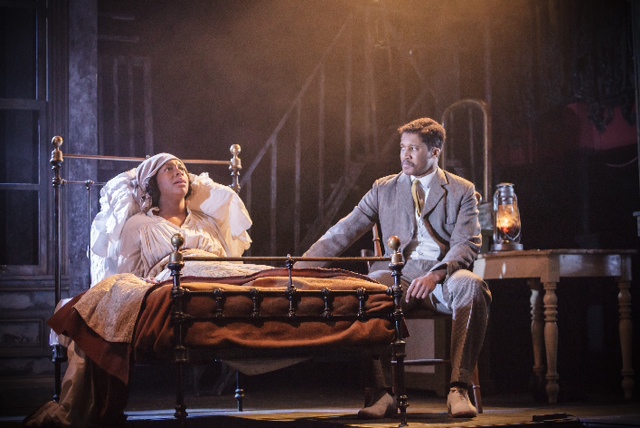
Nicola Hughes - Mammy Saunders and Simon Coombs-dreamy-in-the-dreamy-kid-the-el-train-hoxton-hall-photo-marc-brenner-837However in the short-form of The El Train one is reminded that there is nothing inherently wrong with melodrama as a dramatic style but it is in the application that it often falls apart. Placed in the hands of strong actors, who commit wholeheartedly to the concept rather than act against it, the moral force of the work begins to shine through. And Ruth Wilson, after her turns in Anna Christie and A Streetcar Named Desire at the Donmar Warehouse, has proved herself a very fine actor indeed.

Wilson is a magnificent presence in the first piece; a monologue about a frustrated housewife and her alcoholic artistic husband, and which is by some margin the strongest of the three. She captures the very essence of a human teetering on the edge, struggling to free herself from the binds placed on her by both her husband and her own sense of pride.

The real skill of Wilson’s performance is how she understands the limitations of O’Neil’s writing to a modern audience. She doesn’t try to force the language but instead inhabits the whole character; Wilson brings the part alive with a nervous tension that can be read through the way her hands struggle to knot the front of her apron or pick at the wood chipping off the kitchen table. The weight of the burden upon her can be felt through the way that the corner of her mouth begins to pull down as she lists her husband’s various failings, and in the rigidity of her body every time her husband makes noise offstage.

<<Continue to full review>>

Fleabag: A very modern heroine

Fleabag – DryWrite @ Soho Theatre, until 22 September 2013

In Fleabag, Phoebe Waller-Bridge has created a terrifying portrait of a person who embodies two of the major movements in modern society; the continuing reverberations of the feminist movement running headlong into society’s obsession with individualism and self-actualisation. It is of a person whose self-involved narcissism and belief in the right to be free to control one’s life-choices blinds them to any impact their actions may have on others. Fleabag continually rejects culpability for the paths she takes and even refines poor decisions into positive self-affirming actions. Fleabag is a 21st century manifestation of the id, rampant and uncontrolled.

It is also the funniest play that has hit London this year.

Rare is the playwright that truly captures the language of real life and turns it into something dramatically interesting. I have regularly extolled the virtues of Nick Payne for his skill in crafting modern, believable dialogue for his Fleabag - our eponymous anti-heroinecharacters; Waller-Bridge shares this talent whilst going further to infuse it with a poetic, heightened language that is rooted in the everyday.

It is startling to be confronted by a modern text that so positively drips with a love for sonorous language but yet doesn’t strive to root itself in the past. Every line feels written by someone with a deep respect for classical theatre but who understands that respect is best shown by not looking backwards and instead immersing yourself in the culture that surrounds you.

Monologues are as pure a form of theatre as it gets for writers and performers; there is no hiding place, the production rests and falls on the skill of the actor and the quality of language. Waller-Bridge spent a fair proportion of her last production, Mydidae, naked on stage so is better placed than most to quibble about the nature of exposure but Fleabag contains a ruthless emotional honesty that is shockingly, brutally, exposing.

Mydidae explored how removing our physical covering makes it easier to create a passage to the emotional core, whereas Fleabag removes all pretence and from its first moments delves into the deepest crevices of the mind of an independent, assured modern woman and probes it for cracks in the surface; the vulnerabilities that face all woman in an age of supposed liberation – political, economic, social and above all else, sexual.

For this is a monologue that is steeped in the current dialogues surrounding feminism and what it means to the generation that did not have to fight for it. It is here that Fleabag demonstrates the elements that have seen it be championed as one of the picks of the Edinburgh Fringe. It studiously avoids the polemics and instead displays its arguments through subtle highlighting of how hard-won equality under the law is still being undermined by socio-cultural norms.

©Richard Davenport 2013. 2nd August 2013. Edinburgh Fringe Festival. Phoebe Waller-Bridge in Fleabag at the Big Belly, Underbelly. Photo Credit: Richard DavenportWaller-Bridge’s Fleabag is a monster – a ravenous sexual entity that seemingly cannot discriminate between friend and conquest, desire and lust, attraction and obsession – but constantly the audience is reminded of how this may be viewed if the person delivering the monologue was a man.

The player/slut debate that Fleabag circles has been around for years and may seem like a hoary old trope but that doesn’t make it any less valid a reference point. A generation of woman have been brought up to believe that the battle has been won but changing the law does not lead to changing lives. The Twitter trolls and the campaigns over the increased use of sexualised imagery on the front covers of lads mags has shown that skirmishes continue.

Waller-Bridge’s Fleabag uses her body as a tool for her own personal gratification and talks in the frankest terms of an obsessive relationship with pornography. Does this debase her or does it set her free? Has she been enslaved by a masculine-fantasy of feminist equality – the idea that freedom to choose means becoming a hedonist to pleasure – or is she is a liberated self-actualised feminist who has rejected the traditional gender values of chastity and purity placed on woman by a patriarchal society?

<<Continue to full review>>

Buy the text from Nick Hern books here

Watt? Beckett for the wary

Watt – Gate Theatre Dublin @ Barbican, until 16 March

The Gate Theatre Dublin’s production of Watt, currently residing in the Barbican’s Pit Theatre, is an intimate affair that will certainly draw interest from Beckett’s usual fan-base but one that also reaches out to those who may find the aura of austerity that surrounds Nobel-winning writer a little forbidding.

Watt+Barbican+Barry+McGovernCollated from selected extracts from Beckett’s original novel, Barry McGovern has skilfully reassembled a pathway through the deliberately tangled narration so that the monologue (free-flowing, inconsequential and seemingly aimless as it may be) lets us gaze upon the curious Watt.

In doing so McGovern has made accessible Beckett’s wonderful evocative use of language and shone a light on the absurdist comedy that so often counterpoints the undercurrent of melancholia. Nowhere is this better seen than in McGovern’s description of Watt’s amorous dealings with Mrs Gorman, one of a number of occasions where Beckett’s faculty with language allows a third-person narrated monologue to bring the scene into life as easily any Michael Frayn farce.

It is the preciseness of Beckett’s language that never fails to impress. Every word has its place and no other place, and no other order of words, would seem to suffice. His description of Watt kissing ‘Mrs Gorman on or about the mouth’ tells us more about the man Watt is than the most perfect casting could achieve.

McGovern works hard to bring a sense of the visual absurdity that is clearly there in the original text. His physical re-enactment of Watt’s peculiar walk brings to life a description whose vitality must have been bursting off the page. It is a comic’s dream and, by virtue of being the narrator, McGovern has license to fully exaggerate Watt’s absurdity. It is a splendid scene and a necessary injection of energy in a show that always run the risk of being swallowed whole by the dense richness of the lanBarry McGovern as Wattguage.

This problem is evaded throughout by making full use of changes of pace to keep the audience engaged. The description of the mixed choir is augmented by the sound of it. McGovern is such a skilful storyteller that the audience listen’s with him through two full choruses – the comic tension increasing each time chorus disappears further off-key.

McGovern’s lugubrious tones emerging from the unnamed narrator, a man appearing to be straining to retain the last vestiges of a more grand life cannot help but remind of Beckett’s most famous creations, Vladimir and Estragon, and the play retains much of the vaudevillian that is so closely associated with Waiting for Godot.

Beckett can be the most intense of authors and some of his monologues, no matter how skilful, are to be endured as much as enjoyed. ‘Not I’, a gruelling 17-minute work that was filmed with Julianne Moore as part of a Channel 4 season dedicated to Beckett, may be brilliant but it cannot be described as an easy experience. The language, powerful as it may be, is fired staccato with the audience picking up fragments, jumbled narratives, falling into one another until it finally emerges into a semblance of clarity.

The joy of this production of Watt is that the 50 minute show fairly races by and, in so doing, delivers a Beckett whose gift for language retains an accessibility that can be lost when exposed to the full range of modernist tricks that were employed to make him such an influential, if unforgiving , figure of 20th Century writing.