Its ‘bloody’ good

Grand Guignol – Southwark Playhouse, until 22 November 2014 (tickets)

With the arrival of Grand Guignol at the Southwark Playhouse there is finally something in south London more terrifying than the underpasses that crisscross Elephant and Castle. Well more terrifying, and more kitsch. ForGRAND GUIGNOL within Carl Grose’s knowing script is contained both a loving homage to the famous Theatre du Grand-Guignol and also a gory melodrama in which the old Parisian theatre specialised.
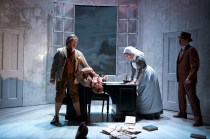
Grand Guignol has disappeared from the theatrical repertoire; it became a casualty of cinema’s ability to create a more naturalistic form of horror. Audiences had grown tired of the old tricks and the arrival of F.W. Murnau’s expressionist classic Nosferatu or Jacques Tourneaur’s remarkable Cat People were signs that cinema could deliver a more refined product that provided genuine psychological chills instead of cartoonish gore.
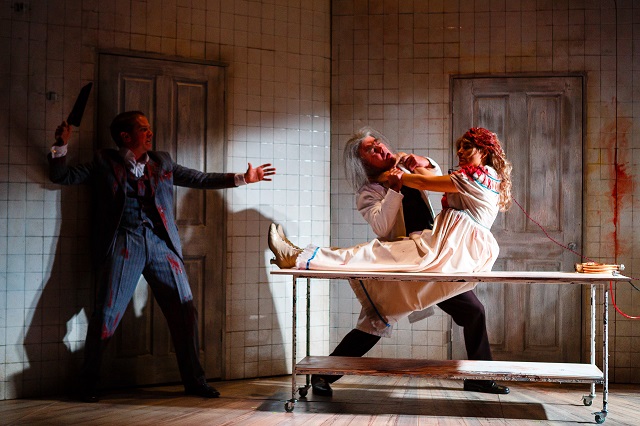
Paul-Chequer-Andy-Williams-Emily-Raymond-in-Grand-Guignol.-Credit-Steve-Tanner-13Grose’s evident love of the genre – seen through its close alignment with real characters and a smart eye for the detail – is combined with a blend of high-camp, knowing winks and straight out jokes played entirely straight. This approach is clear from the opening scene which throws the audience into the midst of the action; hearts are in mouths, not due to blood-curdling terror but rather down to the terrible dialogue, stilted delivery and risible premise. It is only when the set is rolled back and we realise that we are backstage in the theatre that we acknowledge that the scene was itself a spoof and one of many meta jokes for the theatre literate audience.

<<Continue to full review>>

I must thank the good people at Official Theatre for the tickets. Even without this shameless plug, please do check out their website to find out what is going on across the West End; it has links to tickets, venue contact details and bits ‘n bobs about all the theatres – the sort of thing I would do if I wasn’t so damn lazy.  (www.officialtheatre.com/fringe)
Humanity put on display

The Wild Duck – Barbican Theatre, until 01 November (tickets)

The last time I watched an Australian theatre company was when Sydney Theatre Company, boasting the talents of Cate Blanchett, Benedict Andrews and Martin Crimp, pitched up at the Barbican with a rather underwhelming production of Boho Strauss’ Big and Small.

Two years later Benedict Andrews’ star has reached the stratosphere with a highly-lauded Three Sisters being followed by the smash-hit of the summer; the Young Vic’s A Streetcar Named Desire. Meanwhile it is time for another Australian-import, as the Belvoir Sydney take part in the International Ibsen season at the Barbican, to go alongside invited productions of Peer Gynt and An Enemy of the People. Over the course of a tumultuous ninety minutes they prove they can certainly hold their own against strong competition.

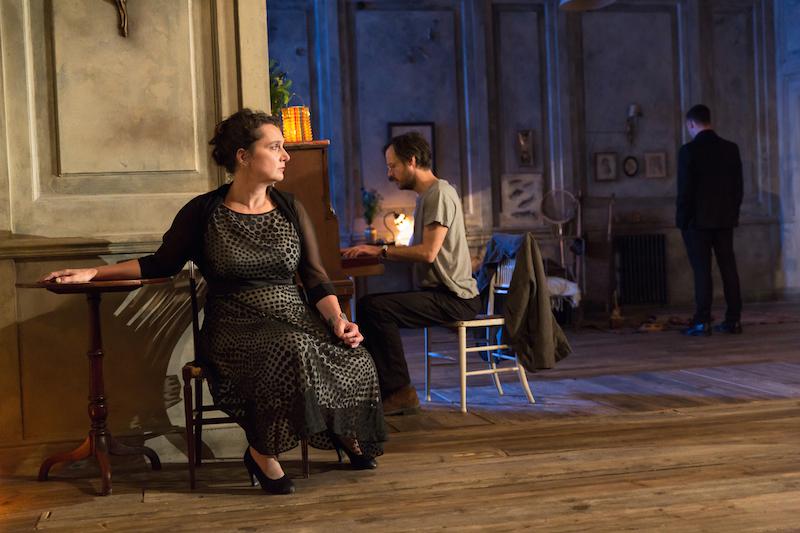
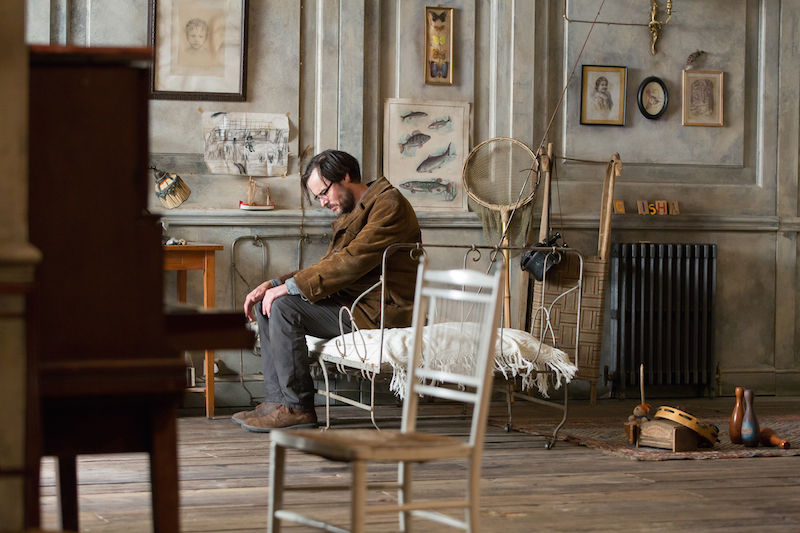
01. Belvoir Sydney, The Wild Duck, Anita Hegh credit Heidrun LöhrSimon Stone has taken scissors to Ibsen’s The Wild Duck and, in stripping out exposition and characters, has created an entirely modern, rigorously taut and emotional devastating portrait of a family in collapse. In short, tightly drawn scenes he presents with discomforting acuity the fragility that surrounds us.

Portrait is a carefully chosen word, and Stone appears to continually have in mind Hjalmar’s job as photographer. Scenes are punctuated by a sharp cut to blackout in a move that apes the flash of a photographer’s bulb, and which serves to sear images into the mind. Direction is highly stylised and all of Ibsen’s naturalism is stripped away. The play is presented within a glass box that suggests a photographic studio and also works as a specific commentary on theatre’s ability to put human beings on display for the audience’s consumption. Trapped within the glass box, the characters come to resemble animals in a zoo – living entirely in their own world but permanently open to an unseen audience.

It is only at the very end of the play that characters venture out of their glass prison, and it is this final scene that will break even the hardest of hearts. After the rapidity of scenes building up to a crescendo that it is inevitable as the gun on Hedda Gabbler’s wall, we suddenly have the quiet calm. The storm has blown itself out and the survivors slowly, quietly regroup to survey the damage and tally-up the losses. Brendan Cowell’s Hjalmar and Anita Hegh’s Gina present the raw reality of humans bereft and broken by circumstance. Here Hakon’s macular degeneration acts as both crucial plot point and metaphor for the way that Hjalmar and Gina must now grope their way blindly towards the future.

<<Continue to full review>>

Not alive exactly but definitely resurrected

Jacques Brel is alive and well and living in Paris – Charing Cross Theatre, until 22 November 2014 (tickets)

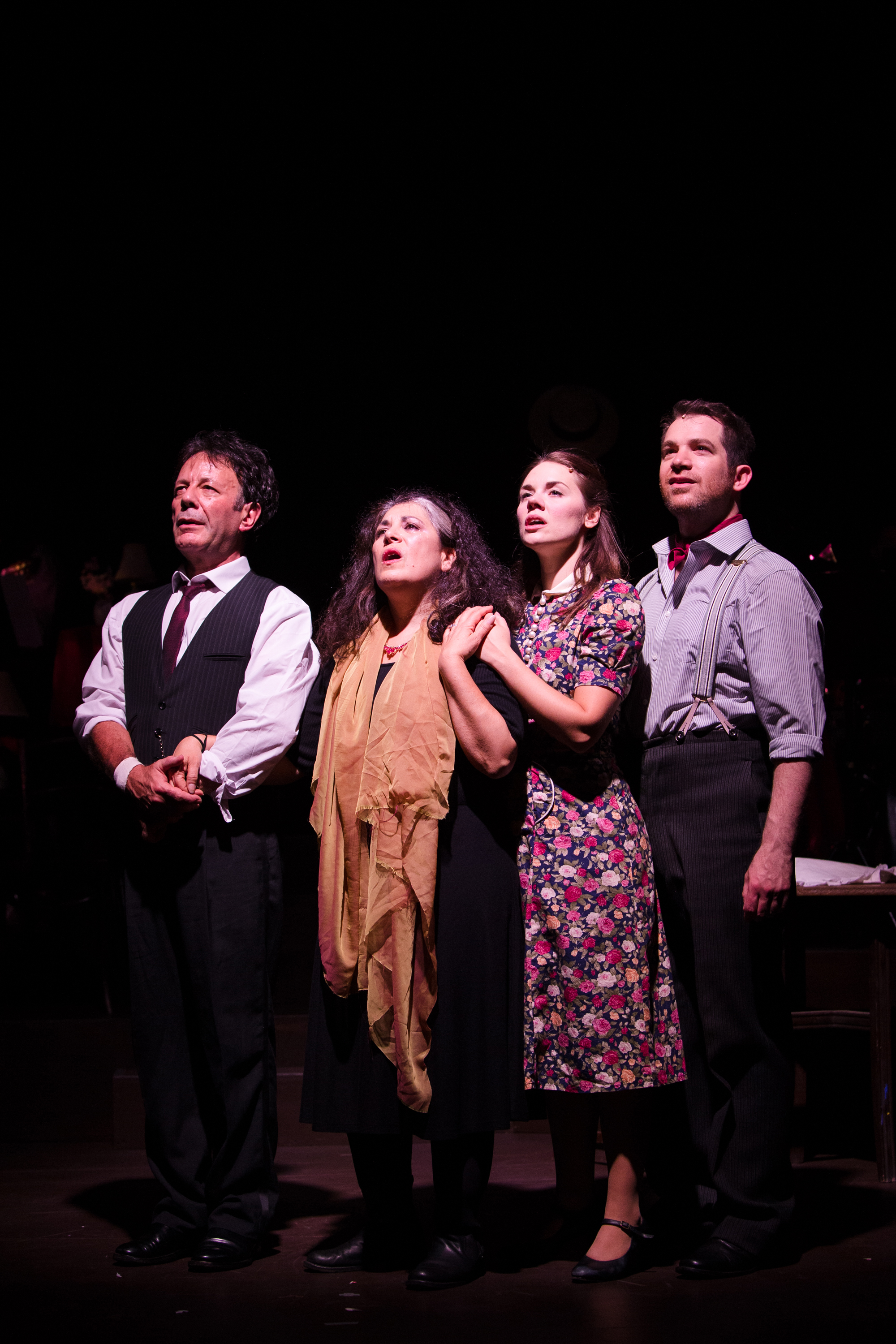
Jacques Brel embodied his era; his musical style, evocative of a philosophical rat-packer, fitted perfectly with the picture of France seen through the envious eyes of those in the grey, dreary England of energy rationing and emergency IMF loans. For those with intellectual pretensions, how could the Paris of the 1968 student revolt, Godard and the new-wave and, of course, the Satre-quoting, Gauloises-smoking, coffee-shop David Burt, Eve Polycarpou, Gina Beck, Daniel Boys (1) in Jacques Brel is Alive and Living in Paris Photo Scott Rylander (1)inhabitants of the left bank, possibly be resisted?

The extent of the obsession with France shouldn’t be underestimated and Brel came to personify the music (and, yes, he was actually Belgian but no matter). This obsession may explain the staggering fact that, after being scheduled for a two-week run in Cleveland in 1973, this show ran for more than two years and over 500 performances.

However all things must pass and interests move on to the next big thing. Brel has become something of a forgotten man, and nowadays I am not sure how many people under 40 have heard of him. One might suggest that the producers have taken rather a risk on reviving this rather curious show; would people who have never heard of Brel be interested in coming to see it, and would those who like Brel want to see his songs be reinterpreted through a musical revue?

These are tough questions but one of the answers lies in the talent of the performers. This is an opportunity to see a West End cast in an atmospheric and intimate venue. Gina Beck has previous as Glinda in Wicked, Daniel Boys came to prominence in the TV talent show, Any Dream Will Do, whilst David Burt and Eve Polycarpou are veterans of stage and screen. Watching up close you are reminded of the range and subtlety that West End stars possess – items that can get lost by the demands of performing in a 1000 seat venue with full-on technical wizardry.

<<Continue to full review>>


Simon Stephens’ takes axe to Chekov’s orchard

The Cherry Orchard – Young Vic Theatre, Until 29 November (Tickets)

Every regular theatre goer has their blind spots, the playwrights that don’t just pass them by but they go out of their way to avoid. Civilian Theatre will happily spend an evening debating the merits of the musical or delivering a polemic against those who worship at the pedestal of Sarah Kane. However in the dark, locked away from public view, is a secret shame; a failure to comprehend, or even by interested in, the merits of turn of Kate Duchêne (Lyubov Ranevskaya) and Paul Hilton (Peter Trofimov) in The Cherry Orchard at the Young Vic Photo by Stephen Cummiskeythe century Russian naturalism.

Being aware that Chekov is, arguably, thought of as second-only to Shakespeare as a playwright and that the finest writers, dramatists and critics hold the likes of Tolstoy, Gorky and Dostoevsky in the highest regard only increases the sense of a personal failure. Add a disinterest in Dickens and Ibsen and the feeling there is a black hole in my cultural awareness grows.

This is not to deny the obvious talent on display; it is impossible, even if you don’t like them, not to respect Dickens’ sentences or Chekov’s details but appreciating the building blocks is a very different thing to admiring the final structure – take the ArelorMitttal Tower, it is certainly impressively constructed but that doesn’t stop it being a hideous eyesore that is nothing more than a well-captured Freudian representation of Boris Johnson’s ego.

YOUNG VIC THEATRE: THE CHERRY ORCHARD, 2014Sticking with Freud, I suspect the problems spring from childhood – an A-Level interrogation of A Doll’s House through the lens of Stanislavski is enough to break the spirit of anyone. Task, Objective, Super Objective; it may be true, it may be necessary, it certainly sucks the spirit of the unknown out of theatre. It went in hand-in-hand with experiencing a lifeless, long and boring production of Gorky’s Summerfolk at the National (although seeing the cast included Roger Allam, Patricia Hodge and Simon Russell-Beale, I am willing to concede the problem may have been with this particular reviewer).

Whether the production was good or not, it came at one of those moments you only later realise was ‘formative’. In the same year I saw Complicite’s Mnemonic and  a revival of Steven Berkoff’s East – how could a staid, hundred year old drama possibly compete with the vitality of Berkoff or a company showing an impressionable young mind all that theatre could be.

<<Continue to full review>>


‘Presume not that I am the thing I was’ in Lloyd’s radical new Henry IV

Henry IV – Donmar Warehouse, until 29 November 2014 (tickets)

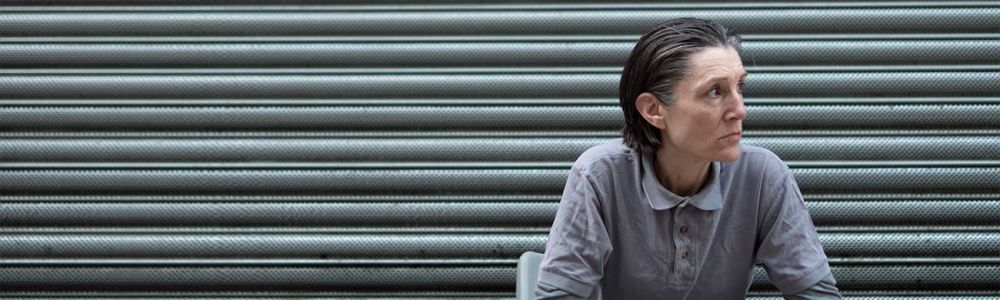
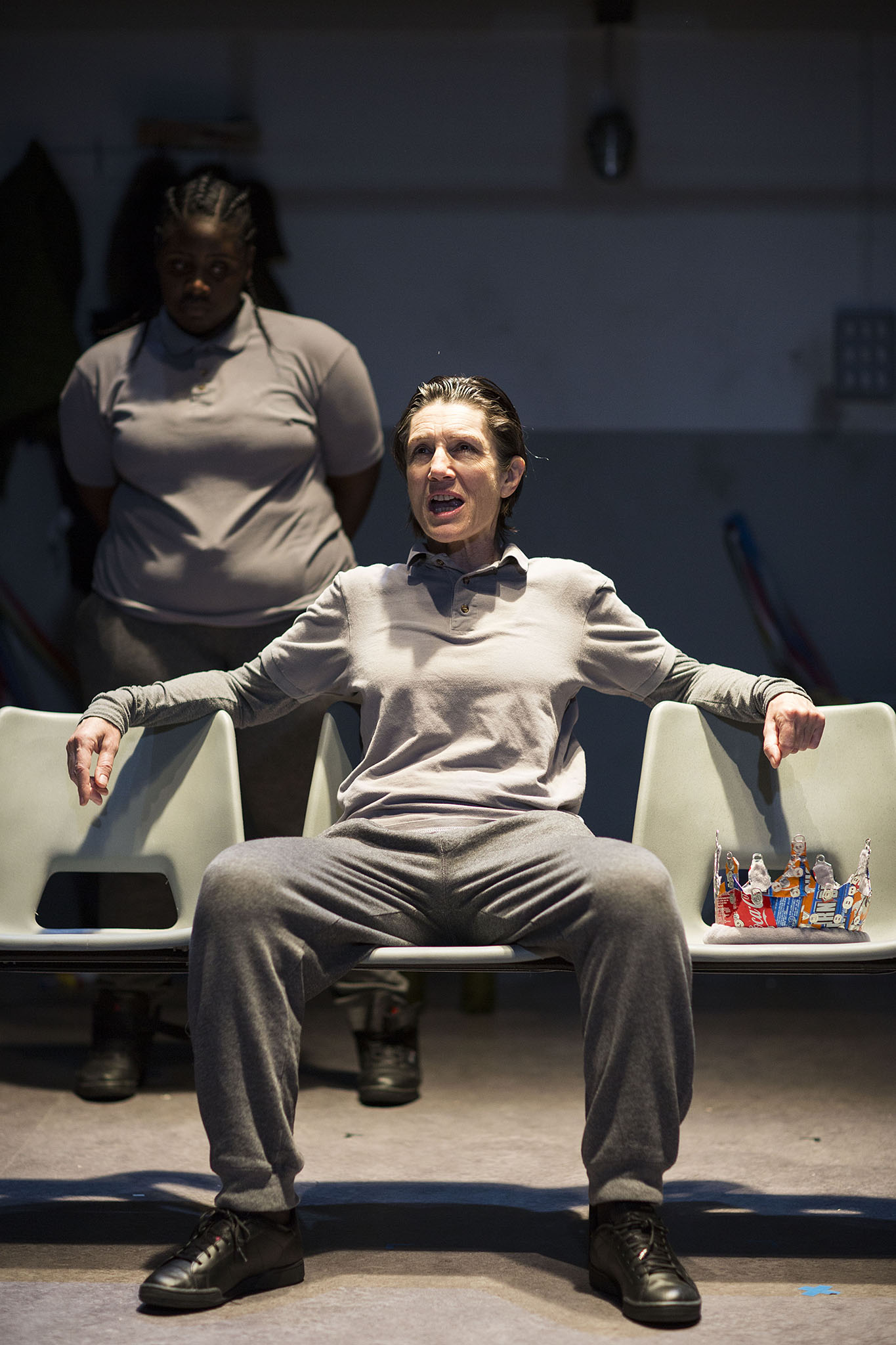
So here we are back at the Donmar Warehouse, back in a Phyllidia Lloyd production, back in prison, back with an all-female cast and, sadly, back to howls of protest emanating from the comment boards. Despite the compelling evidence of last year’s Julius Caesar for the benefits of seeing women perform ‘male’ roles, including Harriet Walter putting in the performance of the year as Brutus, little seems to have changed and so the old Harriet Walter (King Henry) 2 Photo credit Helen Maybanks.jpgarguments have been dusted off and trotted back out.

To incite further ire Phyllidia Lloyd has radically altered Shakespeare’s original text. This is not a snip here, a cut there. This is Henry IV Parts I and II, totalling almost six hours of performance, smashed together and pared down to 120 minutes. That really is an audacious move.

It is also a smart one. May directors have discovered how difficult it is to change Shakespeare by working around the fringes; if you are looking to show something new within something old then far better to prune the excess foliage until what is obscured below is revealed. Shakespeare’s talent did on occasion lead to an explosion of brilliance, his imagination working so fast that one play can contain more plot strands than most writers can work into several; this is his genius but the audience, unpicking the complexity of plot and language, can lose focus on anything that isn’t centre-stage.

Henry IVIn Henry IV productions almost all exclusively focus on the Hal/Falstaff dynamic; it is the interesting complexity of the prince we know will become the near-mythic Henry V, and his relationship with the greatest tragicomic creation of his age. However in Lloyd’s reduction we see this become a play that focuses on the dynamics of a father with two sons, and a son with two fathers.

With Harriet Walter as the dying king it makes sense to ensure that the most is made of an actor of her calibre. By barely cutting Henry IV’s lines, it makes the role far more central to the play. Much of Falstaff’s activities outside of Hal’s orbit are cut and this results in a balancing of Falstaff and Henry IV and creates two much clearer allegiances for Hal.

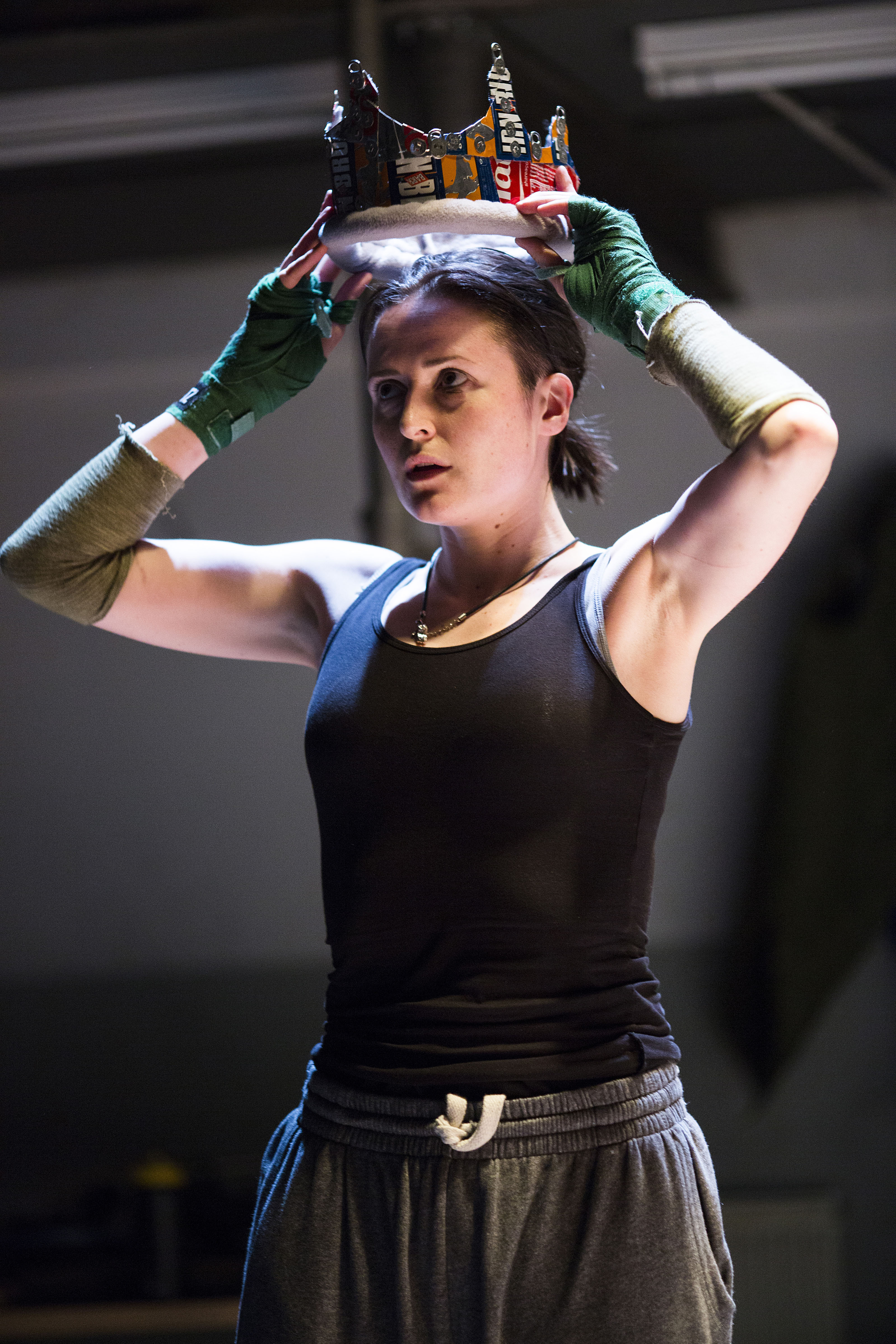
The resulting time is given over to the rebels, and in particular Jade Anouka’s sparky Hotspur – a brilliant performance that brings to vivid life Frank Kermode’s description of Hotspur’s lines being ‘anti-poetry, a contempt for poetry as flummery and affectation’. By stripping the text it aligns Hotspur and Hal as the son the king wished he had and the son that he wished he hadn’t. It also allows room for Hotspur’s wife, Lady Percy (Sharon Rooney), to shine. The scenes with her husband and mourning his death are often lost amid the action but here they are in focus and Rooney gives a heartbreakingly tender performance of someone who loses a husband and then desperately seeks to avoid losing a father.

<<Continue to full review>>

The making of a king

Richard III – Trafalgar Studios (01 July – 27 September 2014)

Richard III, as proved by his miraculous reappearance in a car park in Leicester, is someone who will not stay dead. In the last three years we had already seen three major productions, including turns from the cream of both stage and screen; Mark Rylance and Kevin Spacey. It is a brave performer who follows in those footsteps and even braver one who takes it despite minimal recent stage experience and a screen persona that has been fine-tuned to be the polar opposite of the larger-than-life, charismatic king.

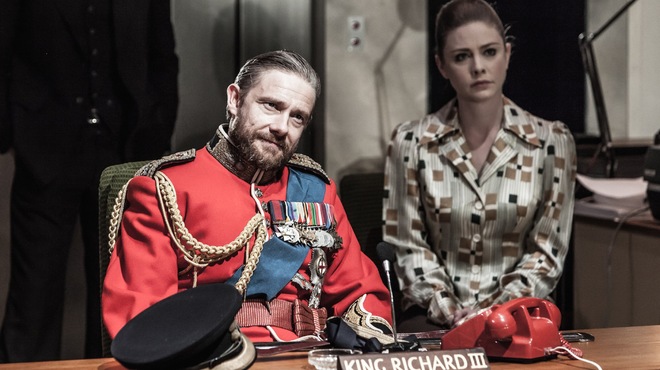
However Jamie Lloyd has been using the opportunity presented by Trafalgar Transformed to revitalise the space with high octane productions cast with performers that have been carefully chosen to appeal to a younger Martin Freeman as Richard IIIdemographic without destroying the vitality of Shakespeare’s language.

Richard III, and last year’s superb Macbeth with James McAvoy, blurs the lines between cinematic and theatrical expectations. It is reasonable to quibble with the handling of the language but it is wrong to deny they contain a thrilling visceral energy that may counter the preconceived notions of those whose only experience of theatre is via how drama is taught in schools.

There has been criticism in how Martin Freeman approached the text and it is true the verse of the famous opening monologue is all but destroyed through his delivery. However this is less marked in the rest of the play and often the iambic meter is fluid and complete. He may not have the rounded tones of a natural stage actor but this may be a combination of lack of experience and also the directorial decisions underpinning the play.

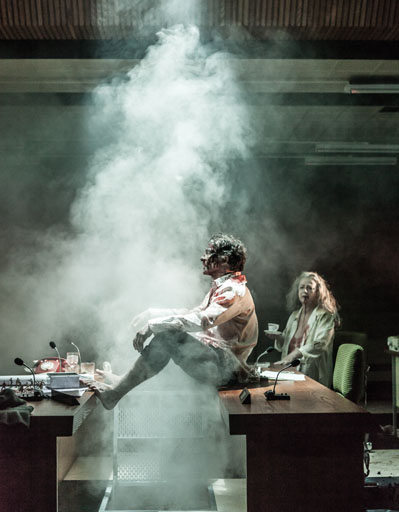
Richard III JLC PROD-1522The decision to tackle ‘Now is the winter of our discontent…’ in that way would not have been taken lightly and, on balance, the production gets away with it because it is being delivered as an address to the nation. If we accept the opening premise that changes it from a traditional monologue to a public speech then it is logically justifiable to deliver it in the clipped rhetorical tones of a politician rather than in the fluid verse of someone expressing their inner-thoughts.

Whilst changing the tone of one of Shakespeare’s greatest speeches is controversial, it does allow a wonderful moment that would not otherwise be delivered. To use the language of cinema there is a brilliant smash-cut at ‘But I, that am not shaped for sportive tricks’; Freeman’s Richard switches instantly from the exterior to the interior, from the public to the private. We see clearly the calculating nature of his public persona and the private contempt of others.

For an audience less literate in the convoluted back story of the play it also makes it easier to recognise the inappropriateness of the good humour he shows to Clarence as he is being sent to the tower. We have already been shown the duplicity of Richard and his ability to – use the jargon of modern politics in which it is set – ‘work the room’. Here with Clarence we witness this as a fine art; understanding, consoling and, naturally, mastering the double-speak that contains no lies – ‘well, your imprisonment shall not be long’.

If this Richard has one overriding trait it is that of the small-man syndrome writ on a national scale. This is most clearly witnessed in the wooing of Lady Anne; a scene that demonstrates both the driving force of this Richard, along with a sense of what makes the production ultimately problematic.

<<Continue to full review>>