Shelagh-Delaney-007

Spotlight on: Shelagh Delaney

Shelagh Delaney (1939 – 2011)

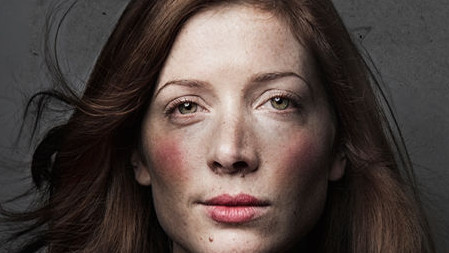
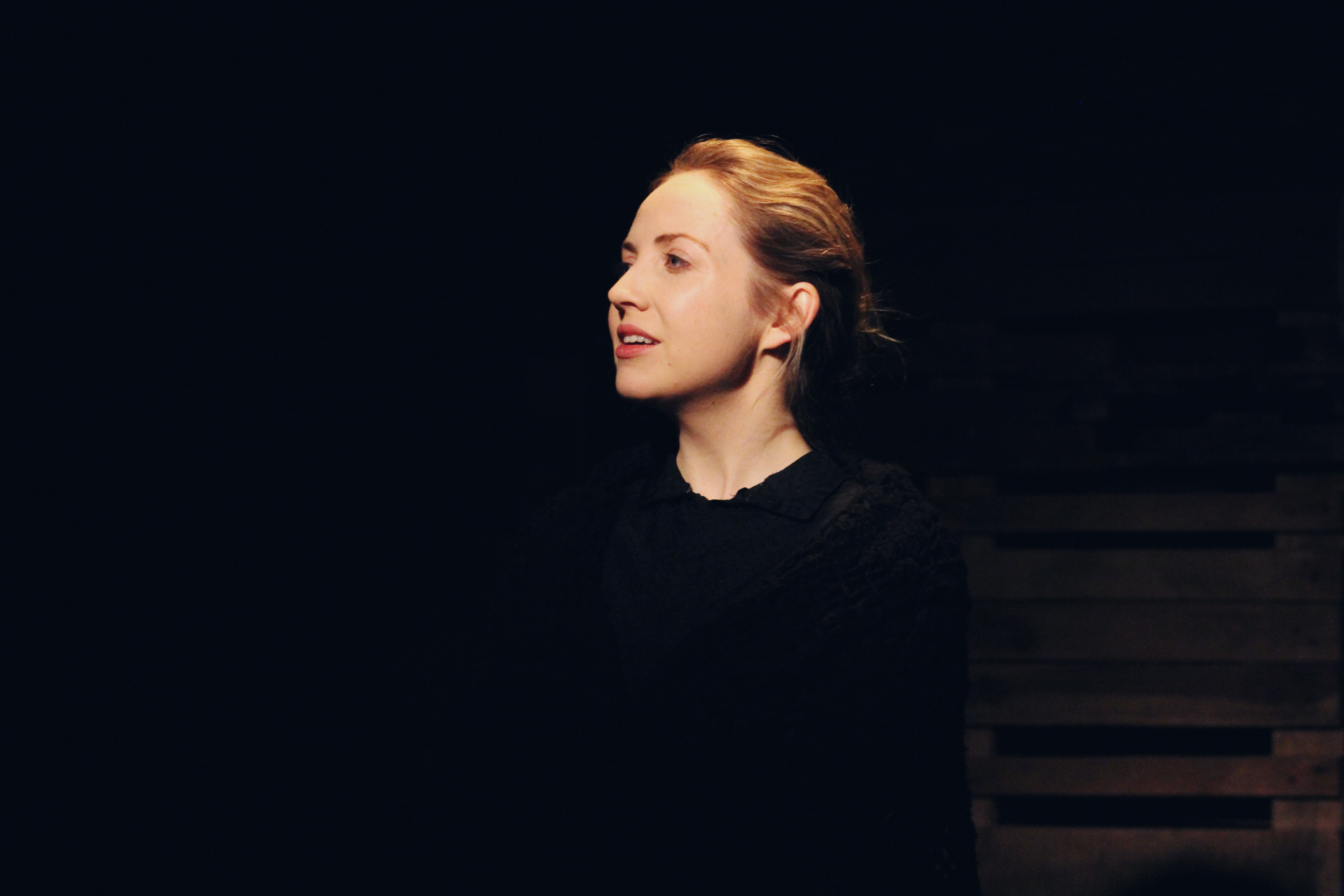
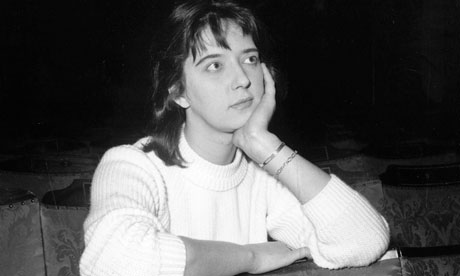
With A Taste of Honey enjoying a revival on the National’s Lyttlelton stage it seems a timely point to revisit one of my earlier posts on this blog, which was written in response to the sad death of Shelagh Delaney at the age of 73. One of the first things to note on coming back to this review is the realisation that even pinning down her date of birth is not clear. The Guardian went with 1939 in their obituary, which fits with the generally held Shelagh-Delaney-007idea that Shelagh was 19 when A Taste of Honey exploded into view but according to the New York Times, and apparently confirmed by her daughter as such, it was actually 1940. Either way a few months here or there does little to change the most remarkable fact about her; that seemingly out of nowhere she produced a play that was gloriously alive, that, in the words of Keith Tynan ‘smelt of living’.

Originally intended as a novel, it was watching late-era Rattigan – enjoying a current renaissance but at the time about to be engulfed by the new generation and held up as an example, somewhat simplistically and most unfairly, alongside Noel Coward as all that was wrong with British Theatre – that sparked Delagny into turning it into a play and sending it down to Joan Littlewood at the hugely influential Theatre Royal in Stratford.

Rough around the edges and raw in the middle, A Taste of Honey, was notable for offering not just a working-class but also a defiantly female perspective. At a time when the ‘Angry Young Men’ of British Theatre were setting their mark at the Royal Court; here was a play that shared their world but offered a vibrantly different viewpoint on post-war Britain.

Written in 1958 and considering the social mores of the time, it is almost inconceivable to think that A Taste of Honey contained sexual promiscuity, teenage pregnancy, interracial relationships and homosexuality. A critical hit and a counterpoint to the masculinity of Osborne, Arden and Pinter, A Taste of Honey secured Delaney’s reputation as a crucial figure in the development of female playwrights.

<<Click for full article>>

Big Brother: Doubleplusgood?

1984 – Headlong @ Almeida Theatre, until 29 March 2014 (Tickets)

In the accompanying text to Headlong’s adaptation of 1984, they state that ‘Robert Icke and Duncan Macmillan […] explore how Orwell’s novel is as applicable to the here and now as it ever was’ whilst the online trailer (below) draws on quotes from Bradley Manning and The Telegraph to make a clear link between the book and the current debate over surveillance culture.

In light of this the most surprising, and indeed pleasing, thing about Headlong’s production is how little it explicitly aligns itself with a modern world environment. Whilst Icke and MacMillan have played with form and function to add to a richer audience experience than would be allowed from a book that channels itself through the perspective of just one character, it is set within a world that far more closely resembles that imagined by Orwell than our current technology driven present.

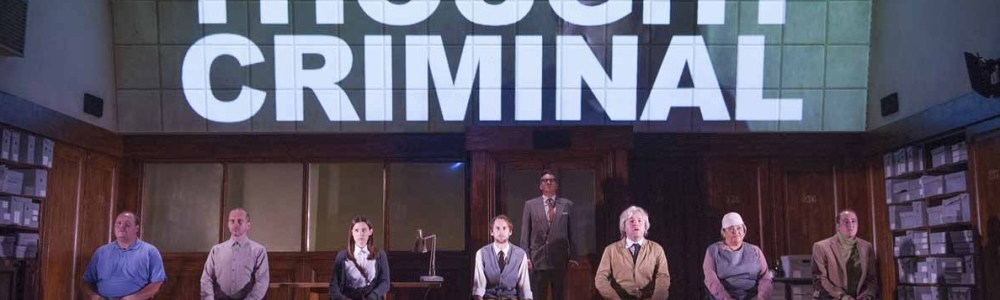
This comes as a relief, as the idea of merging Orwell with modern society seems wholly too obvious and more than a little trite for a company who have carved out a reputation for purposefully innovative takes on 1984_Image_Headlong at the Almeida heavyweight texts. Orwell’s book may have something to say about the dangers of allowing any one party to exert control over society but to try and parallel this with the use of modern surveillance techniques in democracies is facile and only serves to undermine the potency of his argument.

Indeed if the examples that Runciman highlights in his review of The Snowdon Files is an accurate picture then it may be possible for governments to gather information on pretty much anyone but the idea that they have any sort of competence to use it to manage history and through it control society comes across as laughable. The reality is that our general contempt for politicians is so great that the only way that they could get us to believe that 2 + 2 = 5 is to insist upon us that 2 + 2 = 4.

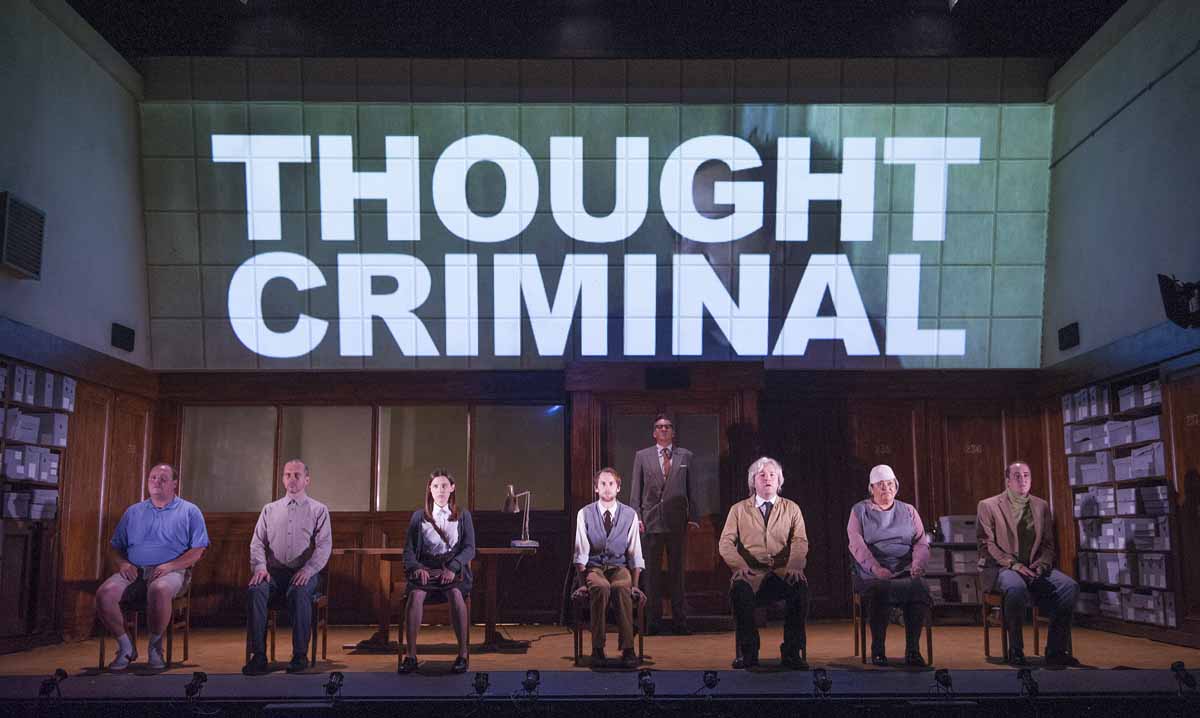
Headlong 1984The entire existence of the internet – and with it websites like Wikileaks – serves to undermine the notion that Orwell’s book could become reality in a society as it currently exists. The world is too globally networked to allow a political organisation to control the flow of information in the way that Orwell envisioned; even in countries that use firewalls it is still relatively easy to get around censored sites. Big Brother may well be watching us but that does not mean that Big Brother is controlling us.

So it comes as a relief to discover that the computer on which Winston toils away to reshape history is an item that seems strangely out-of-kilter within Chloe Lamford’s set design, which evokes that late-Communist feel of a country industrially advanced but only holding its infrastructure together with threads. The communal canteen at the Ministry could be from any 1970’s public sector building whilst the grainy feel of the video through which we watch Winston and Julia’s secret trysts, and the voyeuristic overtones it brings with it,  inevitably recalls The Conversation and the paranoia that runs through Alan J.Pakula’s The Parallax View and Klute.

That we may be reminded of the likes of Warren Beatty and Jane Fonda brings home a deliberate and brutal reality about the lives of Winston and Julia; that ordinary people, the archetypal Party drones, are rather bland and uninteresting, that desires and thoughts are mostly mundane and not the unique, world-changing inspiration that we like to believe. They may yearn for change but they will make do with chocolate and real coffee.

As we rail isolated against the system and plot great change from within who would want to admit to being more like Winston, with his ill-fitting vest tops and sweaty lank hair nervily considering whether or not to write a diary, rather than Beatty’s journalist, immaculately coiffured and square-jawed, uncovering conspiracies that go all the way to the top.

All of this is brilliantly exposed by O’Brien (Tim Dutton) who shows Winston the sad truth about his grand love affair; its furtive and grubby nature feeding a narrative that saw their radicalism only leading as far as their own desires. O’Brien levels the charge of solipsism at Winston, and the real terror of Headlong’s production is the struggle to disagree with the accusation. Their love, so important and all-consuming moments before, now seems so small; the world may have moved for them but they did not move the world even an inch.

<<Continue to full review>>

Watch the trailer

A wintery tale

In Skagway – Arcola Theatre, until March 01 2014

In Skagway, currently playing in Studio 2 at the Arcola Theatre, is a play baring all the hallmarks of the exuberant writer finding their feet – and carries along with it the positives and negatives that such a statement may suggest.

Karen Ardiff’s play has won the Stewart Parker/BBC Radio Drama award. This is a telling achievement as there are moments watching In Skagway that one feels that radio, where it is within a person’s imagination that the last embers of the Alaskian gold rush ahead of the encroaching Alaskan winters are recreated, is the perfect medium for this story.

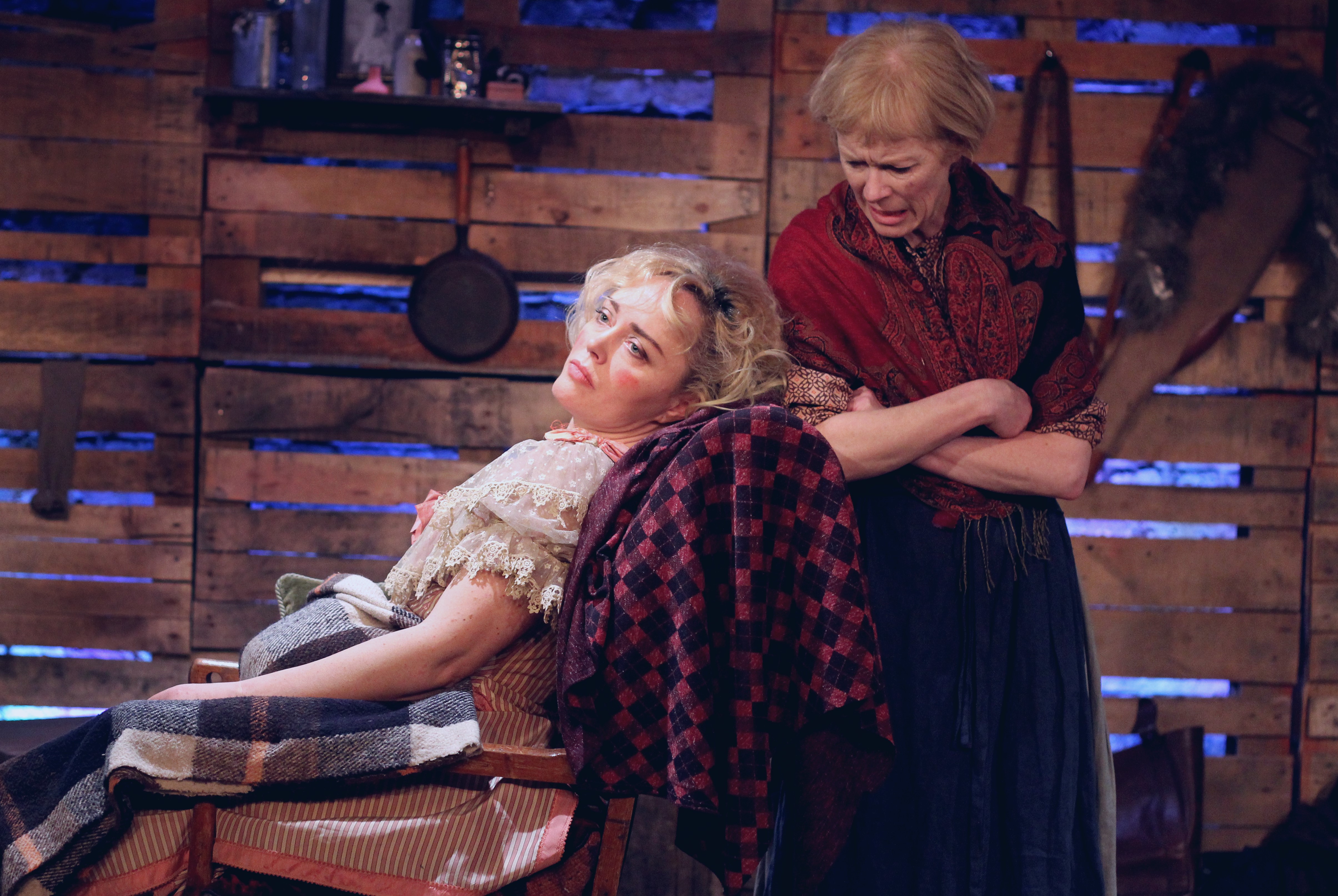
Through the heart of this play runs a fabulously well thought out parallel; Frankie Harmon (Angeline Ball) plays anIn Skagway, Arcola Theatre, Feb 2014, courtesy Leith Lothian 8 actress whose heyday has passed and is now immobile after what appears to be a stroke, whilst the role she was most famous for was that of Hermione in The Winter’s Tale – most well known for being a statue that is eventually restored to life.

This idea – of an actress no longer capable of action being feted for a role that is known for its transition from statue to life – is a brilliant conceit and a wonderful place to begin a story. For the play to then be set in the face of the approaching harsh winter, as the gold that sustains the town begins to run out, suggests that Ardiff has a keen eye for creating a narrative that is able to fold back in on itself.

However at times the narrative attempts to much and some of the themes risk falling into incoherence; a large proportion of the play was dedicated to Frankie’s backstory and it was not always entirely clear how this meshed with the central story. Throughout the play there were hints that she was difficult and manipulative but a revelatory twist revealed by May’s towards the end still appeared to come out of leftfield with very little foreshadowing.

A secondary problem with placing so much emphasis on Frankie’s history was that it relied on a number of transitions to a rather ill-defined past. This is a shift that can work well on radio but in the theatre it did lead to a struggle to maintain fluidity and coherence. The final scenes, which operated with a voiceover, were more successful and mimic the radio experience more explicitly but those that were straight re-enactments were less successful and did jolt the audience out of the reality of the Alaskan cabin.

In Skagway, Arcola Theatre, Feb 2014, courtesy Leith Lothian 9 (1)Geraldine Alexander (May) and Kathy Rose O’Brien (T-Belle) did a fine job with their characters and the scenes towards the end, as they took their final look back towards the Alaskan town that was soon to become another footnote in the history of American gold rush, evoked a lyrical tenderness that hinted at a more poetic and reflective play lying under the surface.

Ardiff has the qualities needed for good writing; she has a well-defined sense of place – Skagway itself is a fascinating and underdeveloped slice of history – and an astute eye for an interesting dramatic structure – layering the plot with intricate themes that faintly echo each other. That being said it does not come as a surprise to find that Ardiff was previously an actor; In Skagway currently feels as if was written to be performed rather than written to be watched.

To directly lift from a great writer, Kurt Vonnegut captured it best when he said ‘we have to be continually jumping off cliffs and developing our wings on the way down’ for how else do we learn?

Not feeling my opinion? Here are two more reviews plucked from the web

A true life American has this to say (Webcowgirl)

A proper magazine has this to say (Fourth Wall)

King-Lear---National-Theatre_191213202638122

What makes these hard hearts? Finding warmth in King Lear

King Lear – Olivier @ National Theatre, until 28 May 2014

King Lear, in its monumental scale and overwhelming desolation, is a play that can defeat its audience. It continues to stand alone as the greatest of tragedies due to Shakespeare’s seamless transition from initial personal tragedy to something that contemplates human suffering at a universal level. It may be commonplace to reference the existential nature of the latter stages of King Lear but it is only within the last hundred years that the world has caught up with what Shakespeare was thinking when he wrote of Gloucester and Tom atop the cliff that never was or gave voice to the depths of Lear’s madness.

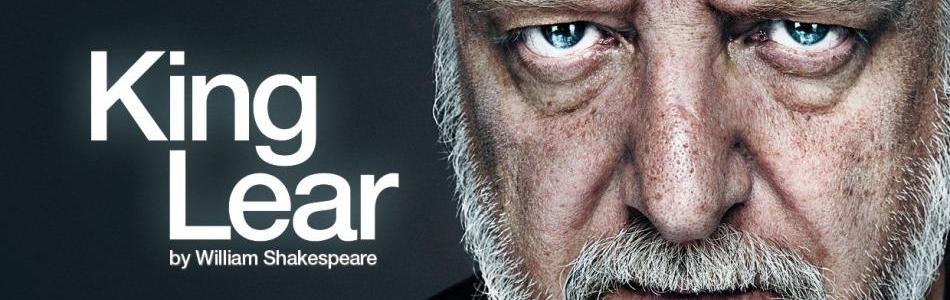
That Shakespeare was writing a play set in the years before England had become England, taking his sources from the Middle Ages and developing interior thoughts that would only be given a name four hundred years later gives an idea of Simon Russell Beale as King Learthe totality of the play and its all-encompassing nature. Indeed our understanding of the importance of the play appears to be only increasing over time; as Jonathan Bate notes, King Lear it has been performed more times in the previous fifty years than in the preceding three hundred and fifty.
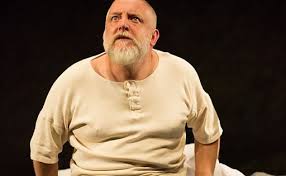
Famously Samuel Johnson could not bring himself to re-read the play until forced into doing so by his role as an editor and even to audiences inured to a global world of senseless cruelty and terrible injustice, Shakespeare decision to move away from the original chronicles and deny his characters and his audience one final redemptive moment is both shocking and hard to bear.

It is as if Shakespeare determined to summon up all the miseries of the world and present them in the most elegantly poetical language so that those listening could not close their ears. To make matters worse this is not the tragedy of Euripides or Sophocles; events in Lear’s England do not hinge on the fickle nature of the gods, rather they are summoned into being by a mankind fully in control of their own destiny.

Shakespeare repeatedly shows that in a world without divine intervention suffering falls, without mercy, upon the just and the unjust alike. As we see Lear crumble and Gloucester blinded Shakespeare refuses to relent and even uses Edgar, in the persona of Mad Tom, for a piece of audacious foreshadowing of the horrors to come. By telling the audience that ‘…the worst is not / so long as we can say ‘this is the worst’’ [IV.i] we can hardly claimed to not have been warned.

Is it any wonder that for almost 150 years an alternative version in which the play ends with Cordelia marrying Edgar was the preferred version? What audience could countenance such grotesque horror without the possibility of redemption?

There is so much contained within the play that the role of the director is absolutely central to any production of King Lear. If the director has in mind an actor then it is likely he has already determined how his Lear should be. Sam Mendes and Simon Russell Beale have a long and fertile history, and a production of this scale must have been on the cards for some time.

One may argue that, at 53, Simon Russell Beale is too young to play Lear and one consequence is that makes the decision to pass his kingdom to the next generation seem even more short-sighted than usual. However the reverse of this is that there is always the tantalising prospect that he may one day return to the role with the wisdom of two further decades behind him.

Mendes introduces us to Lear’s England with a striking opening image; the Olivier space dominated by what appears to be a huge solar eclipse. Other reviews have mentioned its similarity to the eye of Sauron in the Lord of Rings films and it is unlikely that Mendes, no stranger to cinema, missed this clear reference point. Yet the recognition of such a link may be no bad thing as it acts as a subtle primer for the obsession with eyes and sight that exists in King Lear and affixes the notion into the audience; we are to enter a world where even the sun can become blind, so what hope for mere humans.

The image, reminiscent of a giant 0, can be seen to reflect Shakespeare’s repeated reference to ‘nothing’ within the text. In the opening scene Cordelia’s nothing, repeated by Lear as ‘nothing will come of nothing, speak again’ [I.i] begins this trend and we will later have Gloucester’s ‘This great world / Shall so wear out to naught’ [IV.vi].  Lear himself will find himself with nothing after having everything and Gloucester loss of sight is another form of encountering nothingness. King Lear is a play where people suffer the worst privations and are gradually reduced until almost nothing remains; Gloucester is stripped of his sight, Lear his mind, Edgar his status and the Fool and Cordelia, the two characters who perhaps exude the greatest moral worth, are stripped of their lives.

<<Continue to full review>>
Clarity of thought amidst the blurred lines

Blurred Lines – The Shed, National Theatre until 22 February

Watching Blurred Lines, Nick Payne’s latest play created in close collaboration with director, Carrie Cracknell and the eight members of the all-female cast, is not a particularly comfortable experience for a male reviewer. This is not because it consists of seventy minutes of radicalised polemic damning all men to one of Dante’s more unpleasant circles of hell but rather because it does the reverse; performances are restrained, arguments are calm and reasonable, but clearly lying underneath the surface is an anger. An anger one suspects is born out both of individual experience and universal frustration.

It is primarily directed at rather oblique targets; the unthinking gender stereotyping that is ingrained into societies structures, the hardwired responses that define human relationships and the way that our understanding of women is being moulded Blurred Lines, The Shed by the relentlessly battery of consumer culture.

To describe the production as a play is not quite accurate, as it suggests a more cohesive piece that has a narrative thread running through it. What is presented is more a series of case studies – template models of the gender imbalances women face on a daily basis. This approach is perhaps not surprising, in part because it is based on Kat Banyard’s book, The Equality Illusion, and also because the purpose is to present the universal alongside the individual.

If this all sounds a little dry then the collaborative feel of the work, performed by an excellent cast, give the scenes the relaxed feel of a community workshop rather than the cold air of a lecture theatre. The bite-size chunks also suit the modern world’s preferred way of digesting information; in the internet age grand narratives are out and bullet-point lists are in. If you don’t engage with one scene – and not all of them work perfectly – then don’t worry as another will be along in a moment.

Blurred Lines is bookended with two stand-out scenes. Nick Payne, as he has demonstrated in previous work, has a poet’s ear for finding something musical in everyday language. This is showcased in the first scene, which reminds of the opening to London Road, itself a piece of verbatim theatre, and that demonstrates that real speech, taken out of context, can contain a tremendous power and vitality.

The scene sets the play’s direction with a wonderfully observed perspective of what being a woman means to other people. The cast come together as one voice with many mouths to present the audience with a series of tart one-liners of how women are portrayed. In the scene women are broken down to nameless, definable adjectives; when they are deemed worthy of being given more status it is directly through their relationship to a male. They become ‘wife of…’, ‘mother of…’ and through this their lives are given an implicit meaning.

The round starts with common descriptions that soon descend to absurdity and anger with the relentless repetition and the fall-back to common descriptors. Rose West’s ‘character face’ repeats again and again, and any initial amusement fades as the audience understands that it is another example of the malleability of the English language that has learnt to hide overt misogyny behind a second, socially acceptable double-speak.

<<Continue to full review>>