Review
And so we reach the final five…
Over the last few days Civilian Theatre has been counting down their Top 10 plays of 2013. The decision making process to find a top 10 was difficult enough to begin with, and there were at least five or six plays that were edged out in the end. It was a surprise to discover that Coriolanus – thoroughly enjoyable – did not get close and even David Tennant in Richard II was edged out; a particularly hard call given it sees one of my favourite verse-speakers meet one of my favourite plays by Shakespeare. A mention should also go to Harriet Walter – superb in a brave all-female production of Julius Caesar and the best Brutus that I have seen on stage, but with enough overall flaws to edge it out of contention.
But a reminder of what we have seen already
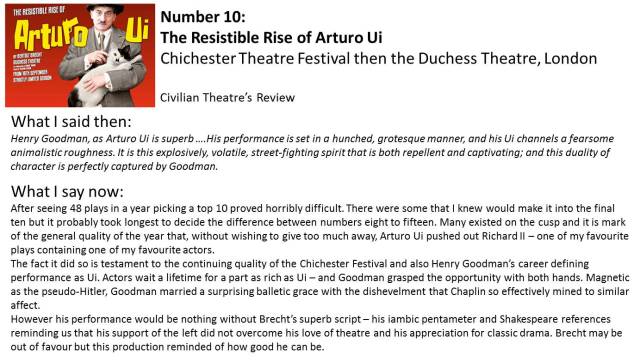
10) The Resistible Rise of Arturo Ui – Chichester Festival and Duchess Theatre
09) Ubu Roi – Cheek By Jowl at the Barbican’s Silk Street Theatre
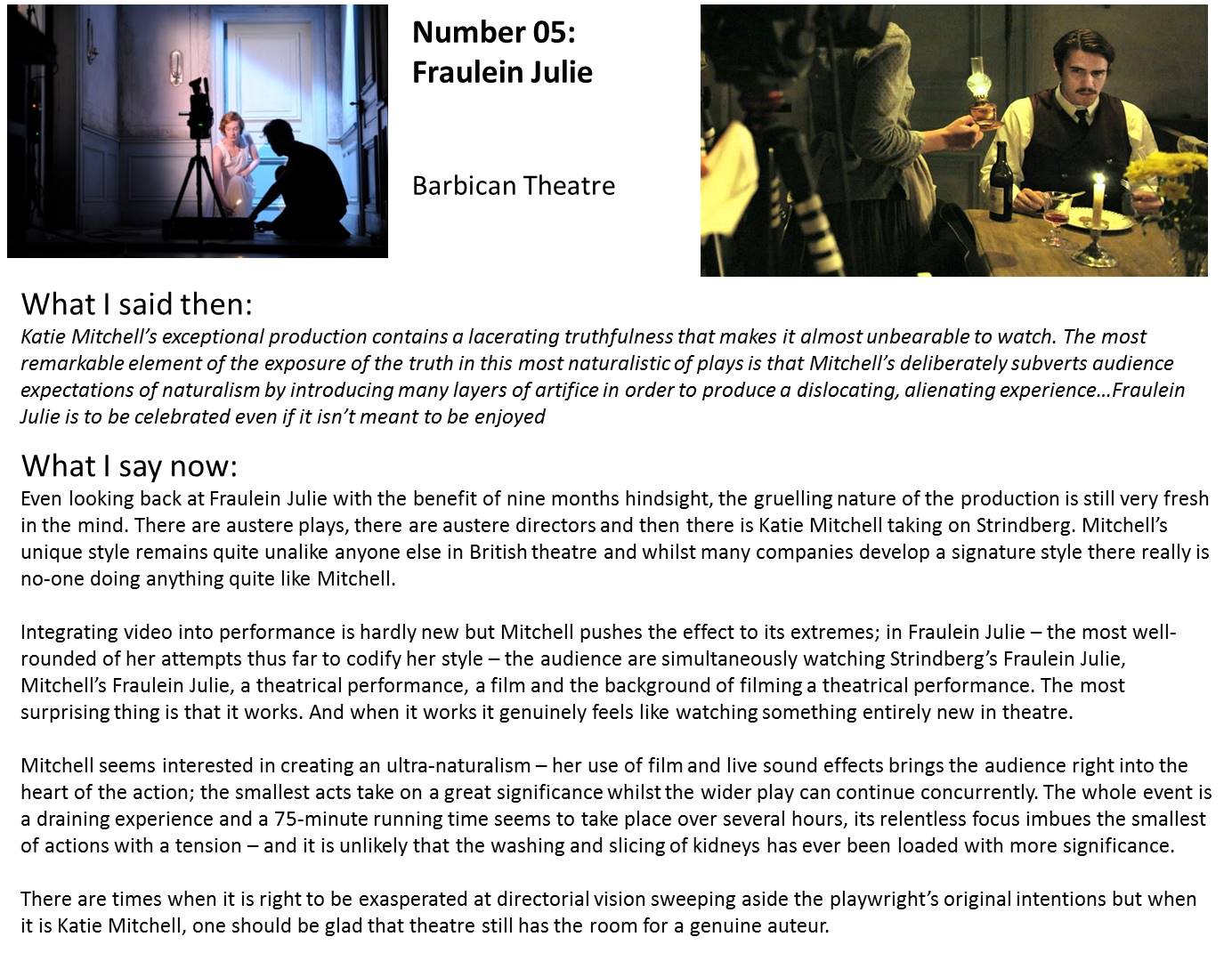
08) Macbeth – Trafalgar Transformed at the Trafalgar Studios
07) Mydidae – Trafalgar Studios
06) Othello – Olivier Stage at the National Theatre
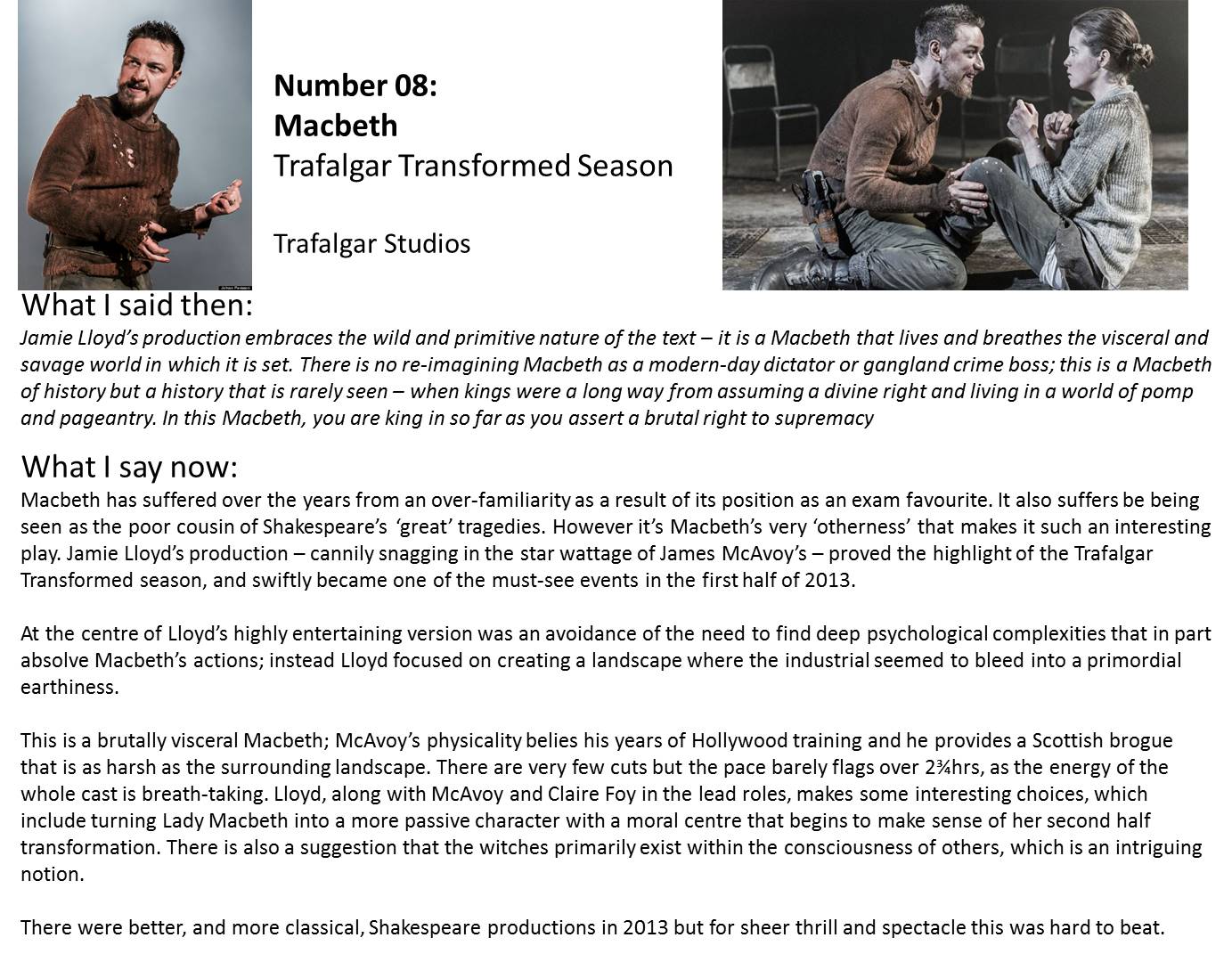
And so at Number 05….Fraulein Julie
And the link to the original review
Introducing the ‘Civil Awards’
Over the next few days, and in keeping with all the other blogs and newspapers that got there already – and in the right year – Civilian Theatre will be unveiling its inaugural annual awards and revealing our Top 10 plays for 2013.
Given the sheer amount of theatre available it is not difficult to find plays that were fantastic, moving and challenging but reflecting on what Civilian Theatre has been to see across the year (and the expectations that had built up in advance), it does not feel that 2013 was a vintage year for theatre.
It would be easy to equate the drop-off in quality with the cuts to Arts Council funding; the first cracks beginning to appear as the money begins to run out. However this only tells one half of the story – and if anything 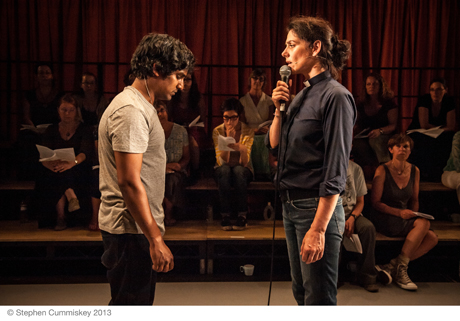 much of the best of the year’s theatre occurred in unexpected locations and in new voices that are beginning to emerge. Good theatre does not big budgets or big stars, it needs ideas and the willingness to take risks; in very different ways The Events and Fleabag proved this point.
Indeed the drop in quality, if anywhere, appeared at the top-end. The gap between bloggers and newspaper critics never appeared wider than in the debate around the Michael Grandage season. Routinely given 4/5* reviews in the press, the majority of the programme provoked the ire of seasoned bloggers who felt it promised much and then failed to deliver.
Civilian Theatre lauds elements of the programme: a West End season that was committed to drama and even included a new play; the sheer number of £10 seats, which if booked early enough didn’t have to be back of the balcony where the most pressing concern is not seeing the stage but rather calculating the risks of deep-vein thrombosis. However the dull production and conservative directions produced lifeless and leaden work that challenged the audience’s endurance rather than their intellect.
One rarely looks to the West End for intellectual challenge and radical drama but the publically-subsidised sectors also appeared more unfocused than usual. It is a transitory time in British Theatre and whilst this may bear fruit in the coming years, it felt that many people were still finding their feet. An honourable exception goes to the Almeida who – in snagging Rupert Goold – may have pulled off the biggest coup of all, and also managed a season that gave audiences, successively, Chimerica, Ghosts and American Psycho at non-West End prices.
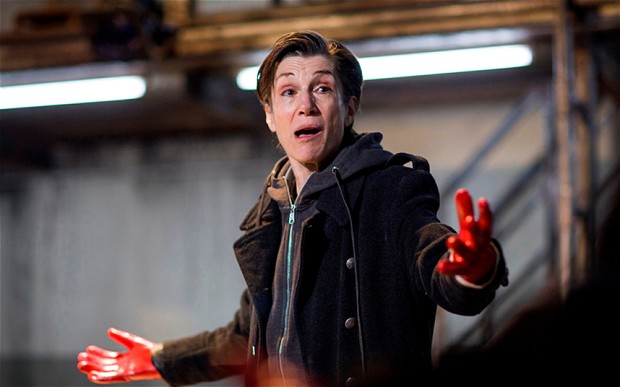 Josie Rourke’s tenure at the Donmar Warehouse has so far produced interesting plays in isolation but there has been little sense of coherence in the overall scheduling, and some productions that were just hard work full stop;Trelawny of the Wells proving that just because a play is forgotten doesn’t necessarily make it a classic in waiting.
That the National Theatre had an uneven year was unsurprising given all the speculation around the top job. Rufus Norris is a bold choice and one that is likely to bring a very different feel to the National and perhaps reshape to more accurately reflect a modern British theatre. He, like audiences, should benefit from the development of The Shed, particularly if its early inventive and innovative programming continues into 2014.
Outside of London, (or into the hinterland for this blog), the argument about funding distribution continues unabated. There was more change at the top as the National Theatre of Scotland lost Vicky Featherstone to the Royal Court (a canny move to breathe fresh, non-London-centric life into an organisation that is always at the risk of being subsumed by the voice of the metropolitan middle-class).
The other powerhouse, the RSC, have crafted a seamless transfer into handing the reigns to Gregory Doran. The RSC seem reinvigorated and scored a big hit with David Tennant in Richard II, and Doran seems to be keen to move through the history cycle as Henry IV Parts I and II are planned for 2014, which mark both the return of Antony Sher to the RSC and the continuance of a partnership with the Barbican that will seem them return as part of a 3-year deal.

The Civil Categories
- Best Production
- Best Actor – Male
- Best Actor – Female
- Best Supporting Actor
- Best Director
- Theatre / Theatre Company of the Year
- Surprise of the Year
- Best thing to happen in theatre in 2013
- Biggest disappointment of the year
- Worse thing to happen in theatre in 2013
ccc
<<You can find out everything that happened in 2013 here>>
ccc
Taking the train to ‘El
The El Train – Hoxton Hall, until 30 December 2013
Sometimes the venue is everything when it comes to theatre. It is hard to imagine watching Eugene O’Neill’s three short plays – that make up The El Train – about life in the Bronx from the comfort of plush velvet seats 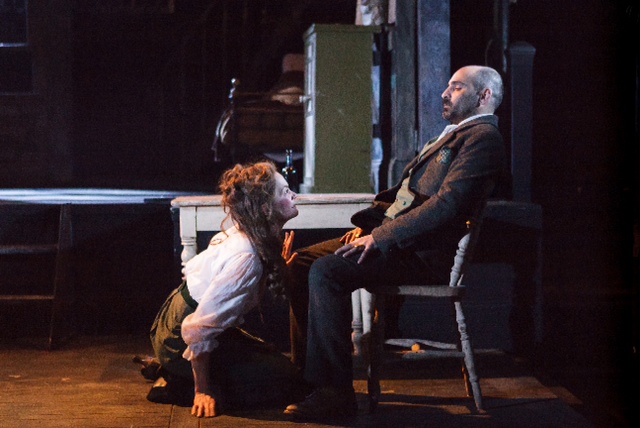 on Shaftesbury Avenue. Yet sat on rickety wooden seats in the cold, draughty Hoxton Hall, hemmed in by the elbows of your neighbours, and in the heart of what was once the heart of the East End slums, O’Neill’s histrionic melodramas about the perils affecting life among the forgotten beings to make a kind of sense.
The atmospheric surroundings of Hoxton Hall is critical in making the whole concept of The El Train work at all. Outside in Hoxton and around Old Street – Britain’s ‘Silicon Roundabout’ – it is difficult to appreciate just what life would have been like for those living in the same streets a century before, and so the location helps to ease the audience back to a time when earnest members of the Fabian society would deliver lectures on a range of esoteric subjects because they truly believed in the moral purpose of education for the bettering of the life of the working man; indeed it comes as little surprise to discover that for over twenty years the venue was run by the Quakers and linked to the temperance movement.
The El Train is a good way of seeing O’Neill writing in the style that would see him win two Pulitzer prizes and become Nobel laureate. A passionate writer that does for the American poor what had previously been highlighted in the U.K through works by George Bernard Shaw and Charles Dickens, O’Neill can be exhausting in the long form but in 20 minutes bursts his style can be rather invigorating.
O’Neill tends to be venerated by theatre critics but in his full-length plays he is often to be endured as much as enjoyed. He is as melodramatic as Tennessee Williams but without the entertaining southern gothic that makes Baby Doll and The Glass Menagerie such lurid delights. His plays, like Long Day’s Journey Into Night, mark some of the first developments of the narratives that are now seen as the great American themes and which dominate American drama and literature to the present day. However O’Neill’s work seems to lack the stringent naturalism that propels Arthur Miller’s All My Sons and Death of a Salesman into the ranks of great drama.
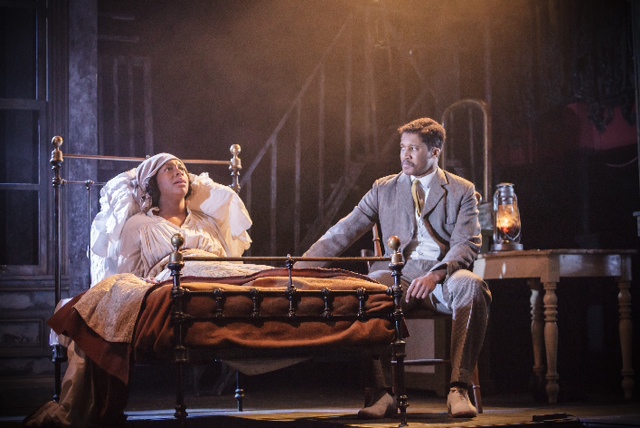 However in the short-form of The El Train one is reminded that there is nothing inherently wrong with melodrama as a dramatic style but it is in the application that it often falls apart. Placed in the hands of strong actors, who commit wholeheartedly to the concept rather than act against it, the moral force of the work begins to shine through. And Ruth Wilson, after her turns in Anna Christie and A Streetcar Named Desire at the Donmar Warehouse, has proved herself a very fine actor indeed.
Wilson is a magnificent presence in the first piece; a monologue about a frustrated housewife and her alcoholic artistic husband, and which is by some margin the strongest of the three. She captures the very essence of a human teetering on the edge, struggling to free herself from the binds placed on her by both her husband and her own sense of pride.
The real skill of Wilson’s performance is how she understands the limitations of O’Neil’s writing to a modern audience. She doesn’t try to force the language but instead inhabits the whole character; Wilson brings the part alive with a nervous tension that can be read through the way her hands struggle to knot the front of her apron or pick at the wood chipping off the kitchen table. The weight of the burden upon her can be felt through the way that the corner of her mouth begins to pull down as she lists her husband’s various failings, and in the rigidity of her body every time her husband makes noise offstage.
 Civilian Theatre