A new star shines brightly in Constellations

Constellations – Duke of York’s Theatreuntil January 05 2013

The transfer to the West End of Constellations, the latest play by Nick Payne, caps what has been, by any measure, a remarkably successful year for someone oft-referred to as one of Britain’s brightest young playwrights. With a Stars that I did see at Nick Payne's Constellations (Sally Hawkins and Rafe Spall)bone-fide A-list actor cast in New York and clutching an Evening Standard Best Play Award for Constellations – a play wearing its learning on its sleeve and displaying an innate understanding of the mechanics of plotting far beyond Mr Payne’s 28 years – it can be difficult to tell whether ‘brightness’ is a reference to the current luminosity of his career or the marked intelligence that he brings to the theatre.

To write a play about string theory that looks to ‘show’ as well as ‘tell’ is a sizable task. Given the complexity of the topic and perceived tensions between the two schools of thought, it is perhaps unsurprising that there are relatively few plays about science and so, given the lack of comparators and the formidable confidence required to attempt such a mesh, it is perhaps inevitable that parallels will be made with Tom Stoppard.

It would perhaps be unfair to challenge Mr Payne to step into the shoes of one of Britain’s most eminent post-war playwrights but parallels can be discerned– at the age of 30 Mr Stoppard wrote an audaciously confident of his own in ‘Rosencrantz and Guildenstern are Dead’. It remains one of the few Shakespeare-inspired works of art that can be held up to its inspiration and look it straight in the eye. The ease with which real scientific and philosophical rigour is interweaved with one of drama’s most potent works is frightening.

Stars that I didn't see at Nick Payne's Constellations

To say that Constellations does not quite match that gold standard is no disgrace because Constellations is very good on its own terms. It maintains intellectual ambition whilst driving a more humanist approach to comedy that is far more modern than either the farce of Michael Frayn or the rather mannered intellectualisms of Stoppard. The resultant characters are able to display much more in the way of warmth and manage to avoid the rather calculating artifice that affects much farce.
<<Click here to read full review>>

The Cat that got the Mother but not the cream

The Cat’s Mother – The Courtyard Theatre, until 08 December 2012

Through poor fortune or poor choice over the last six months there has been a lot of mediocre theatre served up by some of the establishment’s big names performing in London’s highest profile spaces. Having had the misfortune to sit through a disproportionate amount, there has been ample opportunity to muse upon the reasoning that leads to one wrong decision after another contriving to reduce potentially sublime theatre experiences into hollow shells of directorial pretension and actor artifice.

The pendulum of audience response suspended over every production seems to swing heavily towards the director when it is not well received and towards the actor when all is going well. It is perhaps unsurprising that this should be the case. Given that much of London’s theatre is about reviving classics then the director is in a tight spot. There is an expectation that a play should be looked at afresh but too fresh – as Deborah Warner found with the School for Scandal and Charles Spencer’s enraged response to Ian Rickson’s Hamlet at The Young Vic demonstrate – and the critics can be up in arms.

Actors’ are usually not blamed for such decisions and a safe, or even dull, production can generally reap much praise for the traditional performances of the cast –the phenomenally overrated Long Day’s Journey into the Night was stymied by overly naturalistic performances in an interminably conservative productions. The result: no risk and the cast showered in praise.

The key in theatre, as with so much in life, is balance. A director must work harmoniously with the actor to recreate the text in a manner that resonates for the audience and elicits truth in whatever form that should take. This point may work in an academic textbook or possibly in particularly un-radical manifesto for the theatre but halfway through watching The Cat’s Mother the central flaw of this approach became apparent. It may be fine for plays where the author is dead or removed from the production but how about when they are very much involved?

We are currently in the midst of a startling rebirth of new dramatic writing – a process that seems to come in waves every decade or so. It appears that British playwrights have finally thrown off the shackles of Sarah Kane and Mark Ravenhill and are finding their own voice. Lucy Prebble has followed up ENRON with the acclaimed ‘The Effect’,  Simon Stephen’s output has reached prodigious levels and Nick Payne has ‘Constellations’ shortlisted for Evening New Standard Best Play and has enticed Jake Gyllenhall to star in ‘If There Is I Haven’t Found It Yet’ across the pond.

Clearly there is a case that the author cannot be ignored if they are alive, kicking and taking an interest in the end product, and this is what I fear may have happened with The Cat’s Mother. Having seen some of the cast earlier in the year in Girlband, I am fully aware of their talents and a transition to more serious subjects was of interest. Pericles Snowdon is an award-winning writer and so this meeting of minds was an enticing prospect.

<<Continue to full review>>

Hiddleston’s impresses as Hal but Eyre’s Henry can’t quite match Goold’s Richard

Henry IV part I: The Hollow Crown – BBC 2  / BBC HD

Following the rapturous reception received by Goold’s treatment of Richard II was always going to be a challenge; the highly experienced Richard Eyre was assigned the task of continuing The Hollow Crown through Henry IV parts I and II, and on last night’s offering is set to deliver a textually inventive if slightly visually austere riposte.

Overall The Hollow Crown concept has been left a little exposed – clever and audience-enticing as it may be – as the stylistic dissimilarities mean that, other than the continuation of history, there is little in Henry IV part I that audiences would recognise from the filmic vistas of Goold’s Richard II.

Fortunately Shakespeare is not constrained by the straightjacket of slick BBC publishing. Henry IV part I is a play that needs no extra gloss; it contains his most-loved character in Falstaff and gives the audience, as Simon Schama pointed to in his recent documentary, a view of England from the bottom-up. This is in direct contrast to a Richard II that inhabited the world of kings and noble elites.

It’s also a play in which Shakespeare sketches out, in Prince Hal, the images that he would shade in later in one of his greatest creations, Hamlet – complete with two fathers (Falstaff and Henry IV pre-empting Claudius and the Ghost) and a play within a play (the great Act II Scene IV where Hal, in the guise of his Father, banishes Falstaff).

There is a seismic shift in language between Richard II and Henry IV. The world of Richard’s verse has been replaced by the more naturalistic prose of Henry Bolingbroke, now Henry IV. It serves to emphasise the working people that inhabit the play; the phrasing and speech reflects the way people actually talk to one another. It reflects a changing England; the shattering of Richard’s divine right and replaced by a, now frail and ill, Henry IV paranoid to the threat of conspirators. There is no place in this landscape for the playful verse that marked Richard II. This point is rammed home by Shakespeare through Harry Percy who ridicules and undercuts the fanciful imagery put forward by Glendower about his birth.

The core of Henry IV is not, of course, the King but his son, Prince Hal. Falstaff may steal the show but he is not the heart; the heart is the relationship of Hal to his two fathers, the King and the Fool, and the inevitable renunciation of the latter in order to safeguard the former.

In this production Eyre appears to have taken a very deliberate step to recast Hal and Falstaff’s relationship away from the loving underpinnings with which it is normally shown. It is usual to show a warmth and affection in Hal when he undercuts Falstaff’s numerous embellishments but here there is coldness in Tom Hiddleston’s Hal. This is introduced from the very opening scenes of the play and Hal’s speech where he talks of renouncing his way of life; it is delivered in voiceover and there is an added potency to lines like ‘So when this loose behaviour I throw off’ [I.ii] given out in contemptuous manner at the same time as Hiddleston’s Hal strides through the Boar’s Head. Outwardly he is smiling, winking, interacting, whilst his interior monologue makes clear he understands that he is just playing a part that will be discarded.

<<Continue to full review>>

Masterful Richard II proves the BBC does ‘do’ Shakespeare

Richard II – BBC2 and BBC HD, until late July 2012

Settling into watching Richard II in glorious HD on the BBC last night it was difficult to ignore the Beeb’s previous ill-fated attempts to engage with ‘the Bard’. Whilst Civilian Theatre has a better opinion than most of the BBC’s attempt to film all the Shakespeare plays; where else could we see an Othello with Anthony Hopkins and Bob Hoskins as the leads, or a young Helen Mirren playing Rosalind in As You Like It and Imogen in Cymbeline – it is still hard to avoid the criticisms of wobbly sets and at times really duff stage-to-screen acting.

However the BBC’s reputation has been pulled significantly out of the mire after their last two adaptations of acclaimed stage productions – Tennant’s Hamlet and Stewart’s Macbeth- received sensitive transitions. Goold’s Macbeth in particular had a visual style that was magnificently assured given his background as a stage director. So hearing that he had been tasked with opening proceedings with Richard II did a lot to calm the nerves.

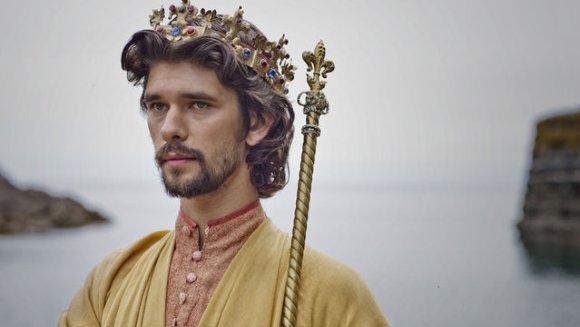
This calm was only reinforced by the sweeping shot across Richard II’s court; Ben Wishaw as Richard; Patrick Stewart as John of Gaunt; Rory Kinnear as his son, Bolingbroke; the two David’s – Suchet and Morrisey – as father and son of York; and James Purefroy, steaming under armour as Mowbray. It goes without saying that once such accomplished actors are placed in position then there is little left to do but let them unfurl Shakespeare’s glorious language.

Richard II, compared to the rest of the history plays, is difficult. It has less of the cartoonish villain that makes Richard III such a crowd-pleaser; it lacks a comic core of Falstaff or the jingoism of Henry V. It is a wordy play about a poor king and bitter nobles. To make it worse Shakespeare, as a stylistic tic, vastly increases the amount of rhyming verse. For those untrained in plays of the era the language is often perceived to be a barrier – and Richard II does risk encapsulating everything that people think they dislike about Shakespeare – it is difficult, unnatural and can be hard to follow.

Goold and the cast respond to this challenge magnificently. For perhaps the first time we see that TV could have the edge of stage productions in some aspects. The history plays, far more than the tragedies and comedies, are complex, difficult and rely on a certain level of prior-knowledge that Shakespeare contemporaries would have had but that current audiences, for the most part, lack.

The ability to zoom-in, jump-cut and provide proper location filming – sweeping landscapes and equisite interiors that provide a true sense of time and place – thus provides an essential element in driving the plot. No longer must we scan the faces of a court scene to decide who Richard is castigating, the camera does this for us. Some may cry foul but this is both good TV – no-one needs completely static shots – and also good for accessibility. It is a period location but that does not mean that modern stylistic devices shouldn’t be used.

Goold deserves a huge amount of credit. This, and his Macbeth, were excellent adaptations that demonstrated he has a natural eye for balance and an assured touch. He may well work alongside a mighty fine cinematographer but having seen a number of his plays staged, it is clear that he has an innate understanding of composition and brings to the theatre filmic elements and here he proves he can work his artistry in reverse.

<<READ ON FOR THE FULL REVIEW>>

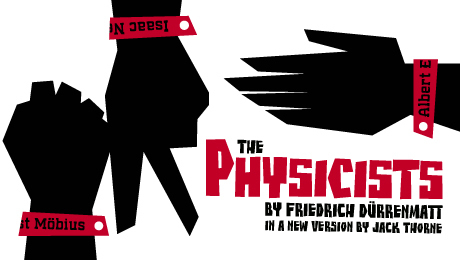
Science under the microscope in Durrenmatt’s The Physicists

The Physicists – Donmar Warehouse, until the 21 July 2012 

Thomas Midgley Jr is not a name near to many people’s lips when asked about the most important scientific innovators of the twentieth century. Seemingly destined to be remembered solely as a speciality question in a pub quiz would appear a strange fate for a man whose contributions to science shaped the world and led him to being described as having a ‘greater environmental impact on the planet than any single organism in history’.

It is then unfortunate for Thomas Midgley Jr that the impact described was both an accidental consequence of his inventiveness and wholly negative in almost every conceivable aspect; for Thomas Midgely Jr is the man who came with the idea of adding lead to petrol. Not content with this world health hazard, his second invention was close to catastrophic, as he found a way to improve the process of refrigeration through a compound called Freon. In so doing he successfully managed to invent CFCs.

One can only imagine that after those two disastrous attempts at improving the world, poor Thomas Midgely Jr would have a great deal of sympathy for Johann Wilhelm Möbius, the scientist at the centre of Dürrenmatt’s farcical satire that poses questions on the burden of responsibility on scientists and the ability of state to understand and manage scientific developments. Indeed Möbius is so concerned with the potential capacity for destruction in his inventions that he decides it is better to feign insanity so that he is able to work on pure physics well away from the overbearing hand of the state.

Dürrenmatt wrote The Physicists in 1961, prefiguring the Cuban Missile Crisis but at a time when tensions between the Soviet Union and the West were reaching a new peak. The horrors of Hiroshima and Nagasaki remained fresh in the mind 15 years on, as societies across the world lived in the shadow of two countries committed to the real-politics of mutually assured destruction.

Charles Spencer, writing in The Telegraph, challenges the play’s value forty years on. It is a reasonable point at a time where the conflict between superstates has faded and the prospect of nuclear war has receded to be replaced by a more existential threat of individual extremists, dirty bombs and cyber-warfare. Josie Rourke’s production is never quite able to square this circle and throughout there remains the nagging sensation that one is watching a period piece; a very well-crafted and carefully staged absurdist drama that is fascinating but ultimately as clinical and sterile as its setting.

That is not to say that it cannot be enjoyed on its own merits. The quality is to the level that has come to be expected from a Donmar production. John Heffernman is superb in capturing the duality of Möbius’ character; drawing out the dignified trauma of being self-aware enough to understand that his brilliance can never realise its potential in a world where it will be handled by those with power but no understanding, but Heffernman also reveals the arrogance that afflicts many geniuses and causes them to underestimate the skill of the opponents, in this case hastening the final tragic denouement.

<<Continue to full review>>

Shakespeare’s Cymbeline finally turned into a true work of art

Cymbeline – Barbican Theatre

The Ninagawa Company, under the stewardship of Yukio Ninagawa, has built up a fearsome reputation in world theatre. They stand as the equal of any post-war company from Joan Littlewood’s Theatre Workshop through to Chicago’s Steppenwolf, whilst stylistically they are as uniquely identifiable as anything from Peter Brook or Simon McBurney.

Famed for his Shakespeare, Yukio Ninagawa has turned his attention to one of the most problematic plays in the Bard’s canon; Cymbeline. It is a difficult play to love and one that comes packaged with all kinds of traps for a modern audience. The plot winds and winds and seems unsure of what it wants to be, containing elements of romance, farce and tragedy. It has simplistic plot devices, like cross-dressing and misidentification, reminiscent of earlier plays but also contains the heavily allegorical language and non-human elements, in this case Jupiter descending on an eagle, that place it alongside The Winter’s Tale and The Tempest as one of the later plays.

Frank Kermode described the play as a tragi-comic romance and suggests that it may have been an in-joke for audiences who would have had a much better understanding of the text and references to earlier plays. None of which makes it any easier for a modern audience to unpick the complexities of the plot.

Luckily going to see a Ninagawa production is to have your visual senses wrapped in cotton wool and taken on a journey where the simplicity of images masks the masterful craftsmanship working behind the scenes. The technical understanding of balance is superbly illustrated again and again throughout the evening; light and shade, simplicity and complexity, the tonality is in harmony so that everything works towards the whole and the audience is never aware of the mechanics. Like other Japanese traditions that have bewitched Europeans over the years, from woodcuts to sushi, the skill rests on the ability to hide an incredible complexity behind a deceptively simple front.

It is difficult to fairly assess the skill of the actors without speaking Japanese and since the production leans so heavily on the visual, the rest of this review will take a radical detour and will look to provide a sense of the evening through the images it has left behind.

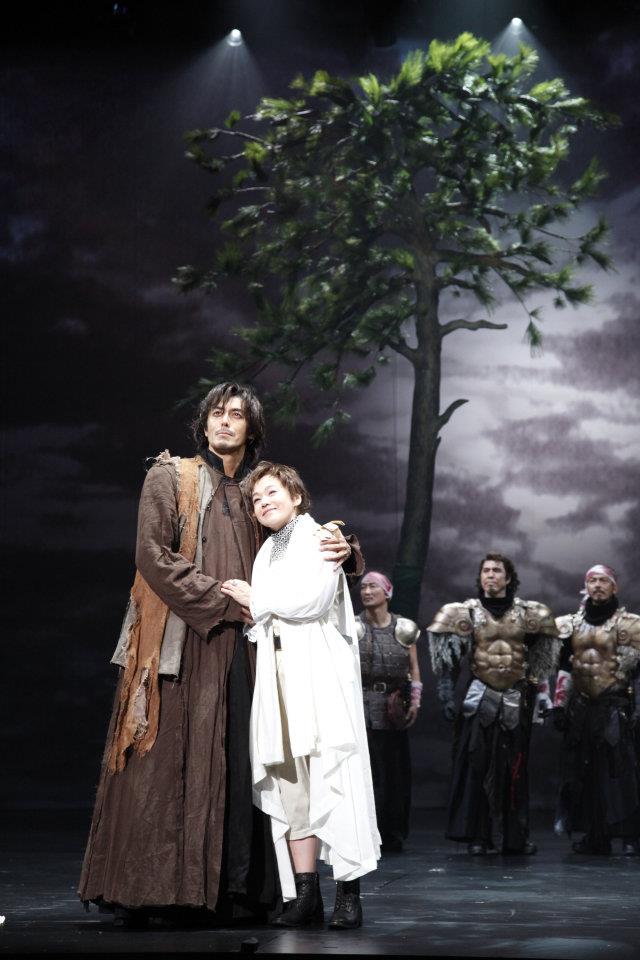
You can choose any one of a number of plot strands to call the centre of Cymbeline. Above we see the romance at the heart of the play, that of Posthumus and Imogen, as they are parted and again as they are reunited. As is traditional in Shakespeare the lovers must face many barriers before finally winning through in the end. However the play is made problematic, particularly to a modern audience, by the fact that Posthumus acts in such an unreasonable manner for much of the play, doubting his wife’s fidelity almost as soon as he leaves England before hiring his servant to murder her. That kind of level of trust does not always lead to happy relationships.

As the beating heart of the play, Hiroshi Abe, as the exiled Posthumus, and Shinobu Otake’s Imogen, bring the romance to life despite spending most of the play separated. They draw out the character traits despite the language barrier, with Hiroshi embodying the stoic and duty-bound Posthumus,  accepting of the State’s decision to banish him before later preparing to sacrifice himself in realisation at the fate he believes he inflicted on Imogen.

<<Continue to the full review>>