Antigone: A very modern ancient Greek tragedy

Antigone – National Theatre, until 21 July 2012

Polly Findlay’s production of Antigone, which runs at a brisk 100 minutes without an interval, is a fine example of balancing the demands of classical Greek tragedy against modern audience sensibilities. In this regard it is helped by Don Taylor’s solid translation that irons out much of the overly heightened poetics in favour of a more earthy realism. This has the dual effect of making the plot a lot less tangled to an audience not raised on the complexities of Grecian mythology and also downplaying the role of the gods in the drama – possibly the single biggest problem in finding contemporary resonance in the surviving works by Greek playwrights.

The text has been filleted to make it performable without a break and this broadly works in the narrative’s favour. Antigone is rooted in conflict  from the opening moments and it doesn’t take long to become apparent that the audience are watching the playing out of a tragedy made inevitable by the choices taken by humans. By removing the interval Findlay is able to keep the tension ratcheted up and allows momentum to build like a wave from first scene to last.

The action is set, effectively if not a little predictably, in the war rooms of Creon’s (Christopher Eccleston) administration. Soutra Gilmour’s set design has done an impressive job of filling the Olivier stage without giving the impression of it being cluttered. This is achieved by partitioning offices towards the back of the stage that has the effect of shortening the vast space by a good 10 metres and forcing most of the action towards the audience. As a result the production feels much more intimate than many staged at the Olivier.

Findlay doesn’t waste the space and there is the constant background buzz of an administration on the brink. The Chorus form the civil servants that run things behind the scenes. There are two very cute moments in the opening moments that help to create a world that is instantly recognisable; the first is what must surely be a deliberate echo of the famous image of Obama and team watching the raid on Osama’s hideout. The second is the chorus’ announcement of the death of Polyneices & Eteocles restaged as the drafting of the press release, with the text being revised to tone down the language of war.

What marks Antigone as one of the most important plays in the Western canon is the fact that, despite it being dated to a period almost 2500 years ago, it is still dealing with issues that are recognisably modern. Other surviving plays are of interest, or contain some certain relevance, to a modern audience but Sophocles captures issues that are still being played out on the world stage in the 21st century.

The idea of the rights of the individual against the rule of the state is one that will never be resolved and Sophocles shows it through an issue that has a stark modern relevance; the death of Osama Bin Laden led to mass protests following his burying at sea, which was seen as breaking Sharia law. This contemporary example amply demonstrates that the right to be buried in accordance with tradition has not diminished over two millennia.
<<Continue to the full review>>

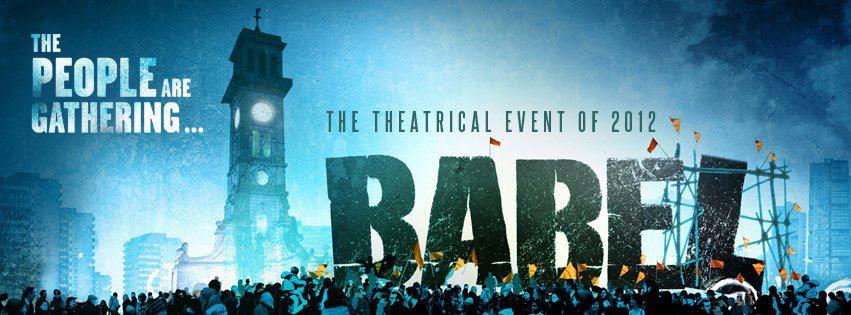
Tower of Babel crumbles to reveal evidence of shonky workmanship

Babel – Performed at Caledonian Park,  until May 20th 2012

When it was announced that a collaborative project involving Wildworks, integral to The Passion of Port Talbot; the Theatre Royal Stratford East, previously home to Joan Littlewood;  the Battersea Arts Centre, long-term supporters of Kneehigh and Punchdrunk; and the Young Vic, would focus on the story of Babel as part of the World Stages Festival there was a feeling that it could become the theatre event of 2012.

Involving a cast of over 300 and creating an immersive experience in the middle of London, Caledonian Park to be exact, Babel had the potential to create a truly gripping experience that would draw an audience together in a piece that would explore questions that have remained fundamental to human nature since the  birth of our earliest civilisations.

The story of Babel is a story of primeval humanity and the development of language. Primarily thought of as biblical, it has antecedents common to a number of ancient civilisations. This is not uncommon in origin stories, and Babel in particular touches on questions of a universal root language that is as central to modern linguistics today as it would have been to ancient thinkers. It is hard not to imagine an oral tradition passing the story of Babel down through the generations as an an answer to the question of how it came to pass that humanity, rooted in theistic societies, spoke with such a multiplicity of tongues?

It is a story that has many resonances with the modern day, particularly in a world where Twitter bridges culture and internet search engines can  translate web pages instantaneously. Perhaps after thousands of years humans are beginning to hurtle back towards a supposed original state where humans can converse across a universal language. The fact that Babel so singularly fails to address any of these questions is only the starting point of a troublingly flawed production.

In business circles, it is often felt that any negativity in performance appraisals should take the form of the infamous ‘shit sandwich’ – for those unaware of such a delicacy, it generally involves a criticism layered carefully between two positive statements. Unfortunately in the case of Babel, there is far too little of the positive to create a sandwich, at best you might be able to fashion some form of Danish Smørrebrød but even that appears optimistic.

<< Click here to continue to full review>>

Three Kingdoms: Three theatre companies, three languages, three countries and three genres

Three Kingdoms – Hammersmith Lyric, playing until 19 May 2012 [With Munich Kammerspiele and Estonia’s Teater NO99]

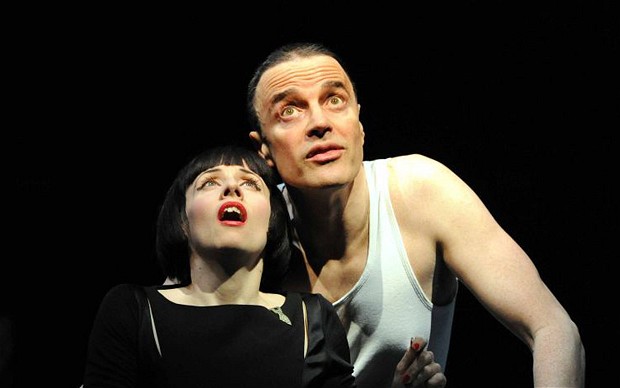
Three Kingdoms is an ambitious collaborative work that pulls together the best of Britain, Germany and Estonia in the shape of playwright Simon Stephens, director Sebastian Nübling and designer Ene-Liis Semper. If Simon Stephens is a well-known name on the British stage thanks to critically-acclaimed plays like Wastewater and Punk Rock, the general lack of recognition for the other two is more a result of our insular Anglo-American approach to theatre rather than any lack of talent on their part: Sebastian Nübling works with Munich Kammerspiele, whilst Ene-Liis Semper co-founded Teater NO99 in 2004, and I am reliably informed by Estonian cultural emissaries that they are generally regarded as being towards the top of a vibrant (?) theatre scene in Estonia.

This trio of talents have rather curiously taken it upon themselves to work with a narrative that would not seem out of place airing on ITV in three parts on successive Tuesday nights. Three Kingdoms begins by giving every impression of being a staged version of a TV crime drama; bleak scenes of cold, stained police rooms, dysfunctional domestic relationships and stereotypical Russian gangsters.

As the narrative begins to open out the ambition of the play starts to be revealed. Increasingly the action takes on a woozy, slightly sickening feel as the audience watches events as the alienated Detective Inspector Ignatius Stone (Nicholas Tennant) sees them, rather than his bi-lingual partner, Detective Sergeant Charlie Lee (Ferdy Roberts).

<< Read full review here >>

Watch the trailer below:

The Curious Incident of the Detective on the Radio

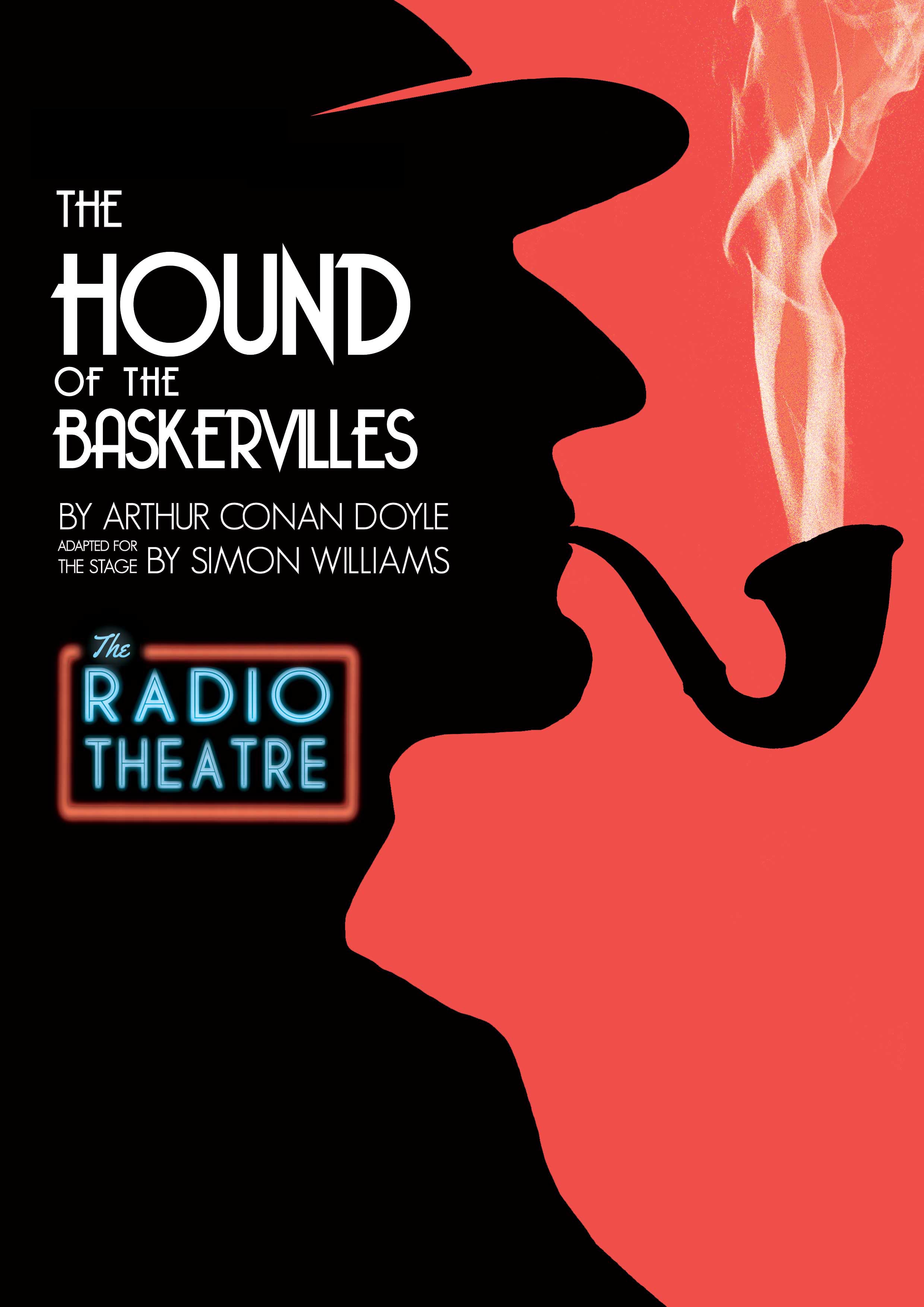
The Hound of the Baskerville –  The Radio Theatre – Veni Vedi Theatre, Theatro Technis, until 12 May 2012

Veni Vedi Theatre’s ‘The Hound of the Baskervilles – The Radio Theatre’ is being sold as an immersive event theatre and whilst it ultimately struggles to live up to this billing , it proves itself as a very entertaining romp that successfully recreates the behind-the-scenes excitement of a live radio broadcast unfolding.

The strength of Veni Vedi’s production initially appears to lie in the attention to detail placed on the period setting and the use of live sound effects to recreate the atmosphere of the Conon Doyle story. However this is a smokescreen that obscures the real talent that lies in successfully managing an ensemble cast through what is essentially one 2hr static scene.

Director Natalie-Anne Downs has pulled off a minor-key miracle in overcoming the challenge of the format. One of the draws of the play is the use of on-stage sound effects but Downs’ manages to avoid it become the focal point of the production – which rightly remains as the Sherlock Holmes’ story. In every sense it enhances the evening and adds both a technical and emotional depth, as it is first admirable for its virtuosity before falling into the background and serving to drive the tension in the story.

The play opens intelligently, running straight into the opening scene – perhaps a nod towards immersion – as the audience filters in. The adaptation of Simon William’s script provides inconsequential conversations as the radio actors arrive. This creates a free-flowing nature that adds a relaxed naturalism to the dialogue and allows the audience to feel as if they are genuinely overhearing conversations that hint of characters with lives that continue off-stage. So often in the theatre there is the sense that the audience is only being allowed to see what the playwright wishes us to see but with no scene breaks there is nowhere for William’s script to hide.

<<Continue to full review here>>

The Master and Margarita – a devilish concoction of imagery

The Master and Margarita – Complicite at the Barbican, until 07 April (Sold Out)

Few companies generate the same level of excitement before a new production as Complicite. There is a noticeable frisson of energy circulating the foyer before the audience takes it seat that is the result of a reputation for innovation and startling coup de theatre. It is a position that is very much deserved, as for three decades Complicite have pushed at the boundaries of the possible in both staging and story-telling; they have championed physical theatre and challenged the standardly linear model of naturalistic performances as a mechanism for exploring deeper metaphysical questions in their work.

This approach has been extraordinarily effective in tackling themes and stories that would otherwise be far too complex to bring to stage. Who else would have attempted A Disappearing Number, a play that shone a light on the 20th century mathematical genius, Ramanujan, and engaged the audience with the complexities of sting theory? Or attempted Mnemonic, a play that was part anthropological lecture told through the story of a corpse entombed in ice, part-character study of those involved in his later discovery and throughout an examination of memory and its mutability, fragmentation and unreliability.

Mikhail Bulgakov’s 1930’s Soviet satire, The Master and Margarita, often held up alongside the greatest novels of the 20th century, has defeated visionaries from Polanski to Fellini. It’s digressive storylines and recursive plotting variously tells the story of the titular characters, The Master and Margarita, and the lengths they would go to for love, whilst also featuring the devil in the shape of Woland and a retinue of associates who wreak havoc on the Soviet literature establishment, whilst a dialogue between Pontius Pilate and Christ interweaves and informs the narrative throughout.

<Click her for the full review>

You don’t have to be mad to extemporise here but it helps

Hamlet – Young Vic, Running until 21 January 2012

Ian Rickson’s production of Hamlet at the Young Vic begins with an elaborate entrance through the backstage area, which has been transformed into a passage through a mental hospital. As you wind through narrow corridors, you catch glimpses of action through windows and the pervading sense from the TV screens and telephones on display that we are entering the 1970s.

To be honest all this effort feels a little laboured although it does help to immediately ground the play in its overarching theme: is Hamlet mad?  It is a question that has been raked over many times, be it in productions, literary criticism or psychological analysis. However through Ian Rickson’s radical interpretative staging, it is a question that delivers a revelatory redefinition of how the play can be understood.

The play begins with a striking image; Michael Sheen’s Hamlet appears out of nowhere in long shot, trapped in a solitary light shining upstage. Rickson’s exquisite framing is a feature that runs throughout the play but this first image, with a clear allusion to Carol Reed’s The Third Man is particularly notable. It is a potent reference point, immediately conjuring up thoughts of Vienna; the spiritual home of Freud and the psychology movement. The Third Man itself is indebted to German expressionists of early cinema, such as  Fritz Lang and FW Murnau, who were fascinated by madness and its effect on the human condition.

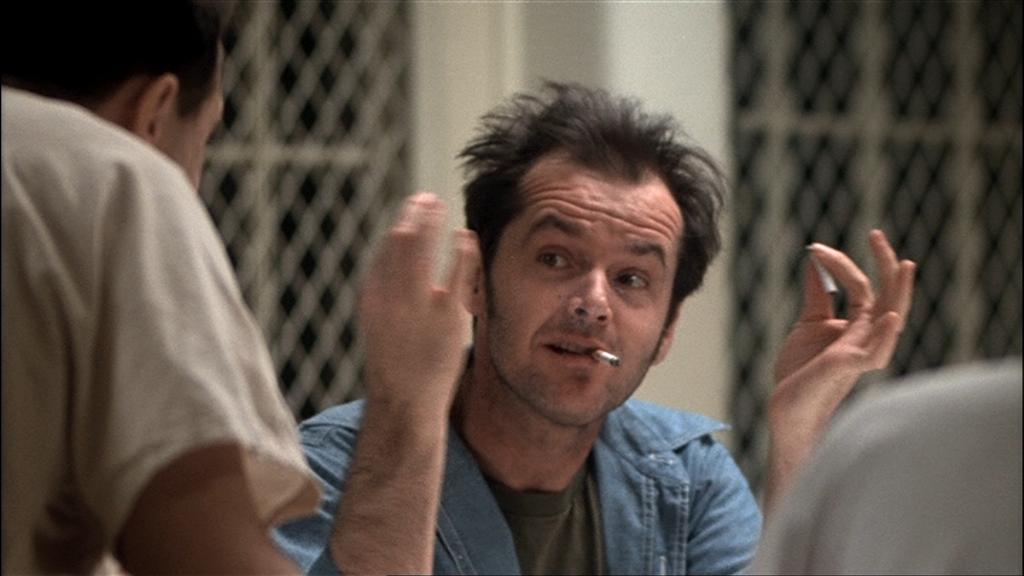
References abound in this play; the 1970’s institutional setting brings to mind One Flew Over the Cuckoo’s Nest and, compared to the recent Hamlets of David Tennant and John Simm, Sheen has an alpha-male muscularity that is redolent of Jack Nicholson without, thankfully, adopting any more of Nicholson’s mannerisms.

The other crucial reference point is the work of RD Laing. In a play that has at its heart the discussion and understanding of madness, Laing’s work has a relevance that underpins the perspective that Rickson takes to the play. At the centre of Laing’s theories is the idea that psychosis is not a biological or psychic response but something that can develop out of socio-cultural situations. This has a direct relevance to the understanding of Hamlet. Hamlet is not ‘mad’ per se but he may have become mad due to the conditions that he has found himself within and the drama of the play may be an attempt to break him of that psychosis.

This reading is reinforced through Laing’s idea that ‘going crazy’ can be the sane response to an insane situation. In this, as in so many other cases, we can infer that Shakespeare touched on the principle a few hundred years before the development of psychology as a science. This may be a stretch but it does appear to reflect Hamlet’s understanding of himself; he wishes to assert his own identity, ‘to thine own self be true’, through his understanding and response to his father’s death. However Hamlet’s ideas conflicts with the response demanded by his ‘uncle-father’ Claudius; Laing would argue that Hamlet is stuck between the persona he has created, the avenger of his father, and the one demanded by parental authority and it is in this bind that the context for Hamlet’s ‘madness’ should be understood.

Click here to read full review