The Civil Awards
So the judges have ill-met by moonlight, the runes read, the die cast and the Oracle consulted. Bribes have been counted, tallied and sent to the accountants to be stored in one of Civilian Theatre’s numerous tax havens in the British Virgin Islands. And so, without further ado, here are the winners in the inaugural Civilian Theatre Awards: The Civil Awards
Best Actor – Male
- James McAvoy – Macbeth (Macbeth)
- David Tennant – Richard II (Richard II)
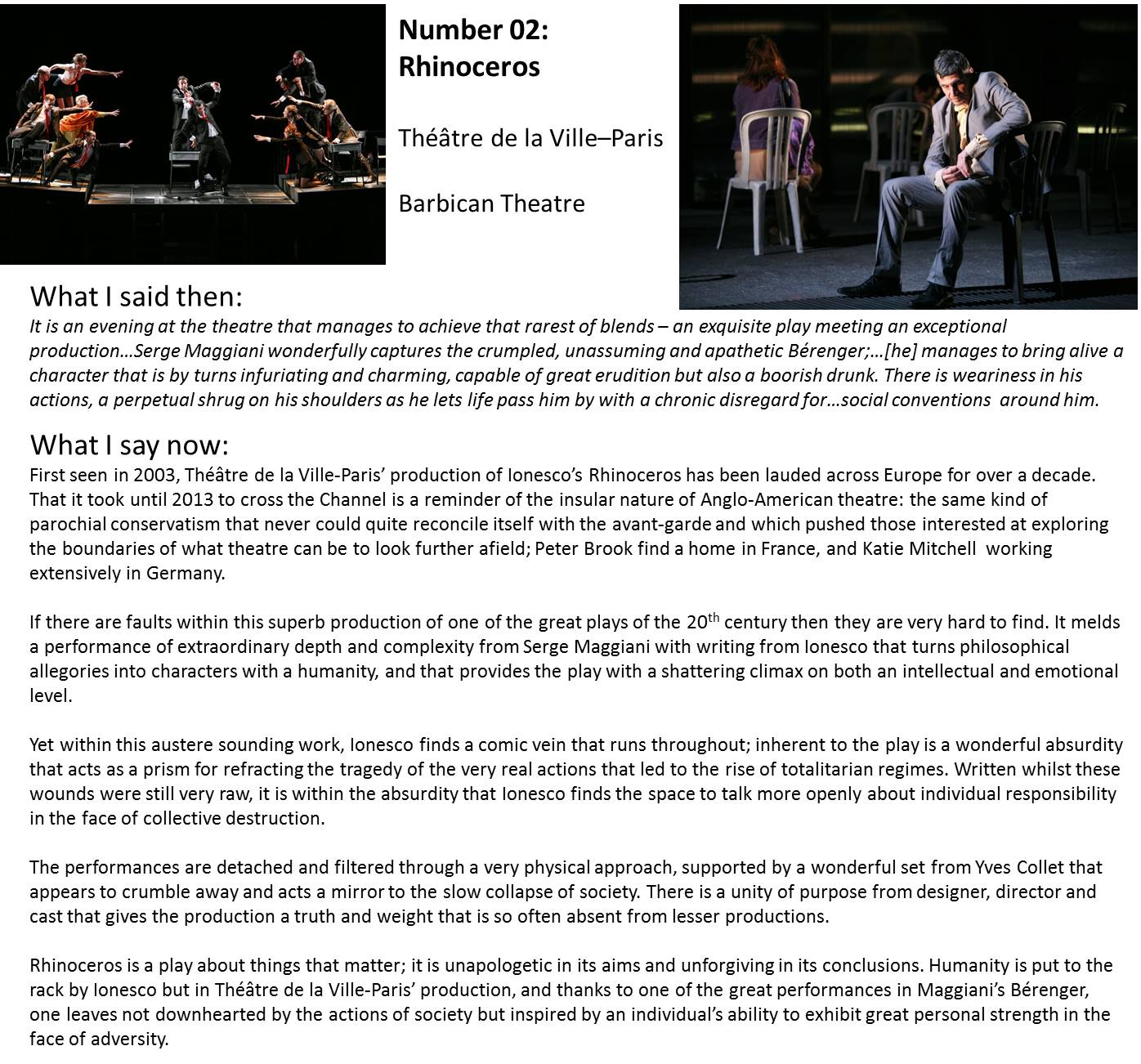
- Serge Maggiani – Berenger (Rhinoceros)
- Henry Goodman – Arturo Ui (The Resistible Rise of Arturo Ui)
- Rory Kinnear – Iago (Othello)
In the most hotly-contested category of the year we see the usual array of brilliant Shakespeare performances. The difficulty in choosing between them is that they take such different routes into interpreting the Bard for a modern audience. James McAvoy may not be the greatest Shakespearian but he put body as well as soul into a hugely physical performance in the intimate Trafalgar Studios. His was a magnetic Macbeth that may have offended the purists but did make this GSCE-favourite come alive.
There is a notable contrast in David Tennant’s Richard II; Tennant’s quick-silver tongue has made him the most fluid verse speaker of his generation and he reveled in Richard’s fascination with words and language, showing flashes of interpretative genius to draw out the subtleties from the text’s formidable complexity. The final Shakespere on the list was Rory Kinnear’s Iago. Civilian Theatre felt that he edged out Adrian Lester in the Othello double-hander; his Iago was brought into the present as a credible presence in the modern world, immediately recognisable to those watching.
Henry Goodman’s wonderful Arturo Ui was a marvel, blending an ability to move seamlessly between slapstick and seriousness, and proving once again of the fertile life of plays outside London. But the winner comes from even further afield and demonstrating that language is no barrier to great performance. Playing the everyman is often seen as one of the hardest roles to recreate on stage, and Bérenger is presented as the archetypal everyman. Maggiani beautifully captures Bérenger in all his contrarian frailty and gives to the audience a momentary insight into what it is to be truly human on stage. It is a performance that achieves a rare transcendent universalism and makes Maggiani a worthy winner.
And the Winner is… Serge Maggiani as Bérenger in Rhinoceros (Barbican)
Best Actor – Female
- Phoebe Waller-Bridge – Marion / Fleabag (Mydidae / Fleabag)
- Harriet Walter – Brutus (Julius Caesar)
- Hannah Waddingham – Kate (Kiss Me, Kate)
- Neve McIntosh – Claire (The Events)
- Ruth Wilson – Monologue (The El Train)
The year started off with fireworks as critics, for no obvious reason, got flustered by the idea of all-female Julius Caesar; however Harriet Walter proved why gender should not be a barrier by giving us an utterly spell-binding Brutus. It showed that given the chance a great actor (male or female) can find a depth and subtlety to Shakespeare’s leading roles, which are full of rich texture and fascinating new interpretations.
Phoebe Waller-Bridge finds herself nominated twice over, with both Mydidae and Fleabag superbly showcasing her skills. Both challenging parts that required both emotionally and physical intimacy, Waller-Bridge proved herself as an actor unafraid of taking risks and a star to watch rise over 2014. It is rare for a musical to generate a nomination but Hannah Waddingham (Kiss Me, Kate) combined a wonderfully vocal performance with solid acting and superb comic timing that lifted the whole production, whilst effortlessly stealing the show from those around her.
Neve McIntosh’s Claire in The Events was the threat that held this powerful work together. It was the sort of performance that was laced with a quiet grief, an understated emotional core that supported rather than threatening to overwhelm the whole. It was the kind of performances that are rarely noticed because by playing small you allow the play itself to take centre stage, and that is a rare enough skill in an actor.
Ruth Wilson’s performances in The El Train came just in time for nomination and proved once again that few British actors do American better. She has developed the rare skill of stillness that cannot help but draw the audience to her. Wilson’s performance in The El Train was an acting masterclass in the art of the monologue and in building a full realised character out of the smallest of scraps.
And the Winner is… Harriet Walter as Brutus in Julius Caesar (Donmar Warehouse)
Best Supporting Actor
- Kyle Soller – Gaveston (Edward II)
- Vanessa Kirby – Isabella (Edward II)
- Jonathan Slinger – Parolles (All’s Well That Ends Well)
- Ben Whishaw – Baby (Mojo)
- William Gaunt – Dogsborough (The Resistible Rise of Arturo Ui)
After the tremendous disappointment of Peter and Alice it was a relief to see, in Mojo, what an electrifying actor Ben Whishaw can be. His presence onstage ramped up the wattage by some degrees and he once again undercut his somewhat fey persona with a dangerous malevolence. Jonathan Slinger’s Parolles in the RSC’s All’s Well That Ends Well continues his fine run of form for the Company. Growing in presence and with a Hamlet under his belt, Slinger is continuing his rapid rise through ranks.
Two supporting nominations for the uneven but often entertaining Edward II at the National; Kyle Soller is a clear rising star and has become a go-to for beefing up a supporting presence over the last couple of years but it was Vanessa Kirby’s Isabella who takes even more praise. Gaveston is a clear supporting role but Kirby carved out a weighty role for a part that could have sat far more in the background. Her role as one of Lear’s daughter in the upcoming Sam Mendes’ production should be one to watch.
However the award must go to the old guard and William Gaunt’s fabulous Dogsborough in Arturo Ui. It’s not easy play Brecht – Gaunt must represent the entire failure of the German establishment seen through Hindenburg as refracted the role of a southern gentleman. Gaunt gives the role a tragic grandeur – of a man who betrays his principles and realises far too late how far he has been outflanked.
And the Winner is… William Gaunt as Dogsborough in The Resistible Rise of Arturo Ui (Duchess Theatre)
Best Director
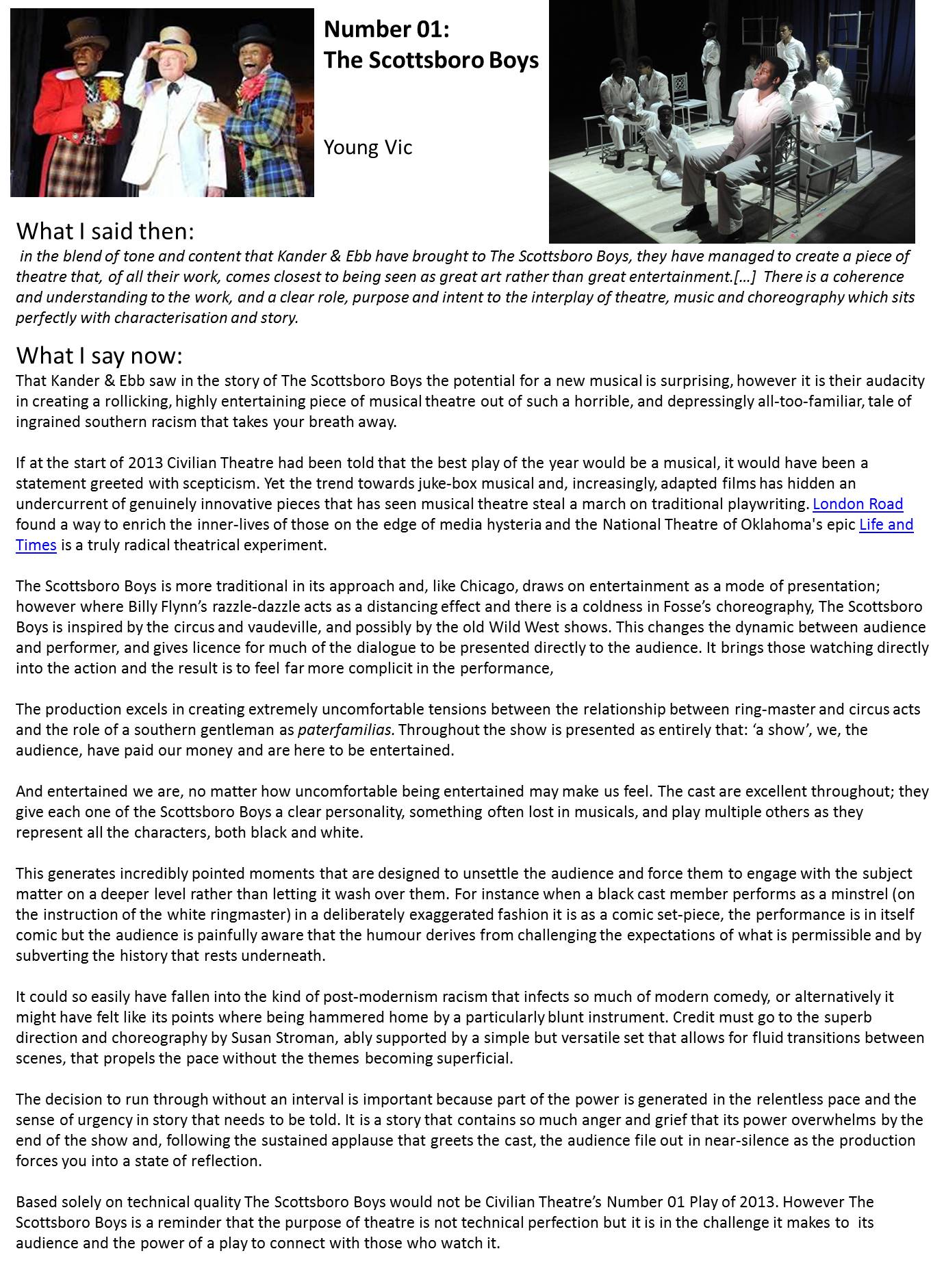
- Susan Stroman – The Scottsboro Boys
- Katie Mitchell – Fraulein Julie
- Jamie Lloyd – Macbeth
- Declan Donnellan – Ubu Roi
- Gregory Doran – Richard II
All the directors on the list deserve acclaim for rich and involving productions. It is no surprise that only one failed to make it to Civilian Theatre’s Top 10 shows of 2013 (and even then Doran’s Richard II only missed out by the most slender of margins).
Each brings something different to the table but in the end the prize must go to the formal inventiveness of Katie Mitchell’s Fraulein Julie. There are many British companies pushing boundaries but Mitchell does more than this. She seems less concerned with the question of what theatre is and instead is wholly focused on how to deliver greatest truth to the audience. Her blurring of traditional mediums reached its greatest coherence to date in Fraulein Julie; a grueling but stunning reinvention of the Strindberg classic.
And the Winner is… Katie Mitchell for Fraulein Julie (Barbican Theatre)
Theatre / Theatre Company of the Year
- Young Vic
- Barbican Centre
- Trafalgar Transformed
- Harold Pinter Theatre
The Harold Pinter Theatre is a surprise entrant on the list but it has shown impressive diversity for a West End theatre; Old Times, Mojo and Merrily We Roll Along all proving to be canny acquisitions and audience hits. The Barbican and the Young Vic continued their traditionally strong programming with a mixture of plays to suit every taste at prices that remain, just about, on the affordable end of the spectrum. However the prize goes to the Trafalgar Studios for their audacious Trafalgar Transformed season and for giving Jamie Lloyd free-run of their main space. It was a move that could have potentially backfired spectacularly but The Hothouse, Macbeth and The Pride proved that there is life for serious drama in a more commercial setting.
And the Winner is… Trafalgar Transformed
Surprise of the Year
- The Scottsboro Boys
- The Events
- Hamlet de los Andes
Three very different plays united in their complete unexpectedness. Between them they made three of the top four places in Civilian Theatre’s Top 10. It proved once again that you just need to scratch the surface to find innovative, powerful and challenging theatre. In the end Hamlet de los Andes edges it purely because nothing about it seemed promising. The Events had the weight of David Greig and The Scottsboro Boys had Kander & Ebb; Hamlet de los Andes was an unknown– in the UK – Bolivian company that had the audacity to rip apart Hamlet for their own ends. The result was brilliant.
And the Winner is… Hamlet de los Andes
Best thing to happen in theatre in 2013
- The amount of £10 seats for the Michael Grandage season
- Rupert Goold appointed as the next artistic director of the Almeida
- The opening of The Shed
Even despite the disappointing season that was offered, Michael Grandage must be applauded for the amount of affordable tickets – and not all in rubbish seats – that were on sale for his plays. If the Stalls seats are going to be extravagantly priced then at least it was used to subsidise others. The Shed looks exciting but the prize goes to Rupert Goold taking the reins at the Almeida. Our most innovative director in charge of his own theatre, and one that blends public and commercial sensibilities at that; it should be an interesting few years and this move positions Goold perfectly for something even high-profile the next time the roundabout turns.
And the Winner is… Rupert Goold at the Almeida
Biggest disappointment of the year
- Not going to see Chimerica
- The general flat direction and conservative productions in the Michael Grandage season
- The fact that The Book of Mormon won Tony awards and The Scottsboro Boys didn’t
Well on a personal level it was being too lazy to see Chimerica. Clearly one of the plays of the year and it was through indolence alone that it was missed by Civilian Theatre. However the out and out winner is the Michael Grandage season. Having bought into the hype, and into the tickets, it produced disappointment after disappointment. Peter and Alice was dross on every level, The Cripple of Inishmaan did scrape over average and then an immediate downturn into a boring baby boomer A Midsummer Night’s Drum before a dull as ditchwater Henry V rounded things off.
Worse thing to happen in theatre in 2013
- The growing trend to not allow people to book seats so that there is only one left on its own
- The continuing upward creep of top-end theatre ticket prices
- The cull of theatre critics across the mainstream press
Any of the three above are more than worthy of winning the prize. However a late entrant steals the show for being both terrible, and for being so unexpectedly terrible. Mark Rylance. James Earl Jones. Vanessa Redgrave. Shakespeare. The Old Vic. Nothing in those words suggests anything other than a production of the highest calibre and undoubted interest from audience and critics alike. However the unmitigated disaster that was Much Ado About Nothing led all that saw it to attempt to blank the experience from their mind. It was a catastrophe of the like that is rarely seen on the London stage and although it gives no pleasure to do so, it must be awarded the prize of: worse thing to happen in theatre in 2013.
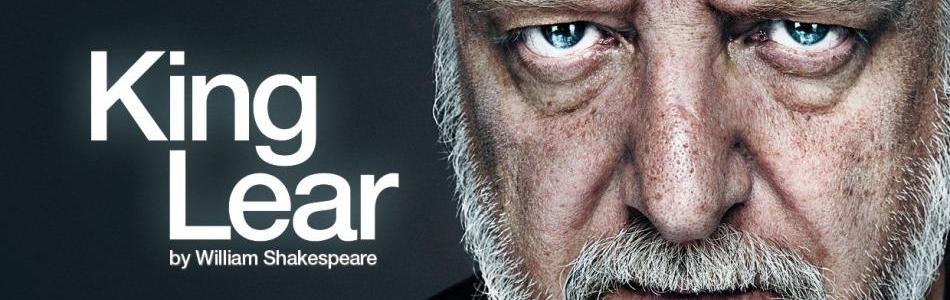
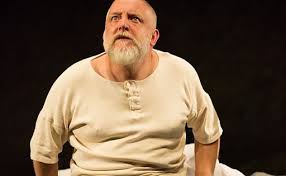 the totality of the play and its all-encompassing nature. Indeed our understanding of the importance of the play appears to be only increasing over time; as Jonathan Bate notes, King Lear it has been performed more times in the previous fifty years than in the preceding three hundred and fifty.


 Civilian Theatre