Fleabag: A very modern heroine

Fleabag – DryWrite @ Soho Theatre, until 22 September 2013

In Fleabag, Phoebe Waller-Bridge has created a terrifying portrait of a person who embodies two of the major movements in modern society; the continuing reverberations of the feminist movement running headlong into society’s obsession with individualism and self-actualisation. It is of a person whose self-involved narcissism and belief in the right to be free to control one’s life-choices blinds them to any impact their actions may have on others. Fleabag continually rejects culpability for the paths she takes and even refines poor decisions into positive self-affirming actions. Fleabag is a 21st century manifestation of the id, rampant and uncontrolled.

It is also the funniest play that has hit London this year.

Rare is the playwright that truly captures the language of real life and turns it into something dramatically interesting. I have regularly extolled the virtues of Nick Payne for his skill in crafting modern, believable dialogue for his Fleabag - our eponymous anti-heroinecharacters; Waller-Bridge shares this talent whilst going further to infuse it with a poetic, heightened language that is rooted in the everyday.

It is startling to be confronted by a modern text that so positively drips with a love for sonorous language but yet doesn’t strive to root itself in the past. Every line feels written by someone with a deep respect for classical theatre but who understands that respect is best shown by not looking backwards and instead immersing yourself in the culture that surrounds you.

Monologues are as pure a form of theatre as it gets for writers and performers; there is no hiding place, the production rests and falls on the skill of the actor and the quality of language. Waller-Bridge spent a fair proportion of her last production, Mydidae, naked on stage so is better placed than most to quibble about the nature of exposure but Fleabag contains a ruthless emotional honesty that is shockingly, brutally, exposing.

Mydidae explored how removing our physical covering makes it easier to create a passage to the emotional core, whereas Fleabag removes all pretence and from its first moments delves into the deepest crevices of the mind of an independent, assured modern woman and probes it for cracks in the surface; the vulnerabilities that face all woman in an age of supposed liberation – political, economic, social and above all else, sexual.

For this is a monologue that is steeped in the current dialogues surrounding feminism and what it means to the generation that did not have to fight for it. It is here that Fleabag demonstrates the elements that have seen it be championed as one of the picks of the Edinburgh Fringe. It studiously avoids the polemics and instead displays its arguments through subtle highlighting of how hard-won equality under the law is still being undermined by socio-cultural norms.

©Richard Davenport 2013. 2nd August 2013. Edinburgh Fringe Festival. Phoebe Waller-Bridge in Fleabag at the Big Belly, Underbelly. Photo Credit: Richard DavenportWaller-Bridge’s Fleabag is a monster – a ravenous sexual entity that seemingly cannot discriminate between friend and conquest, desire and lust, attraction and obsession – but constantly the audience is reminded of how this may be viewed if the person delivering the monologue was a man.

The player/slut debate that Fleabag circles has been around for years and may seem like a hoary old trope but that doesn’t make it any less valid a reference point. A generation of woman have been brought up to believe that the battle has been won but changing the law does not lead to changing lives. The Twitter trolls and the campaigns over the increased use of sexualised imagery on the front covers of lads mags has shown that skirmishes continue.

Waller-Bridge’s Fleabag uses her body as a tool for her own personal gratification and talks in the frankest terms of an obsessive relationship with pornography. Does this debase her or does it set her free? Has she been enslaved by a masculine-fantasy of feminist equality – the idea that freedom to choose means becoming a hedonist to pleasure – or is she is a liberated self-actualised feminist who has rejected the traditional gender values of chastity and purity placed on woman by a patriarchal society?

<<Continue to full review>>

Buy the text from Nick Hern books here

Cabaret-infused Conrad is confusing cocktail

The Secret Agent – Theatre O @ the Young Vic, until 21 September

Note: This review was a preview performance

London in September; leaves begin to turn autumnal brown and regular theatre-goers, who have shunned the opportunity to join the annual pilgrimage north of the border to experience rents higher even that those for a 1-bed The Secret Agentshoebox in Clapham and a population densisty that rivals Waterloo Bridge at 11:59 on New Year’s Eve, settle in for one of the more interesting months in the London theatrical calendar.

September is the month for quietly baking in one studio space after another as London’s theatres take their chances of the pick of the fringe, and companies from across the country set out their stall and make their pitch for the hearts of audiences and the wallets of producers.

Working out of the Maria Room at the Young Vic, Theatre O have certainly snagged a prized piece of theatrical real-estate. Despite it being the first night of previews a bustling atmosphere is in evidence, which is testament to the anticipation of Theatre O’s return after five years away and to the strides made in both the Young Vic’s innovative programming and muscular promotion over the last few years.

03-Young-Vic--The-Secret-Agent.-Photo-by-Stephen-Cummiskey..previewThe mixture of highly inventive company and classic novel with modern resonance is a potentially intoxicating blend. Theatre O take a high-concept, extremely physical approach to staging the play – not exactly a rarity amongst the Fringe where naturalism tends to push budgets to the limit, but all too infrequently seen in London since the likes of Berkoff and Bond have been pushed into the shadows. Edinburgh is increasingly a refreshing anecdote to the depressing move towards a process-heavy, formulaic approach to the development of new writing that is affecting London’s major fringe venues.

Theatre O’s production highlights the best and worst of physical theatre. There are moments when actors and actions synchronise and time appears to slow down to a point of transcendent stillness. Theatre O’s use of an expressionist style enables them to capture the physical manifestation of a character’s emotion and then focus on it with such a relentless intensity that the world appears to have shrunk around it and all that remains is a tableau of emotion frozen forever in time.

<<Continue to full review>>

…And happily ever after?

All’s Well That Ends Well – Royal Shakespeare Company, until 26 September 2013

One of the more curious of Shakespeare plays, All’s Well That Ends Well never seems to have sat comfortably with its audience. Even its title can be seen as one of Shakespeare’s playful jokes; riffing, as it does, on the fairy-tale narrative of ‘happily ever after’ despite those watching being left with serious question marks over the likelihood of the future joy to be shared between Helena and Bertram.

At its core All’s Well That Ends Well combines a number of fairy-tale tropes and applies them to the real-world. The healing of the king by someone of lower birth who is granted what their heart desires forms the play-logic that allows Helena, a ward of the Countess of Rossillion, to be granted the hand of Bertram, the Countess’ son.

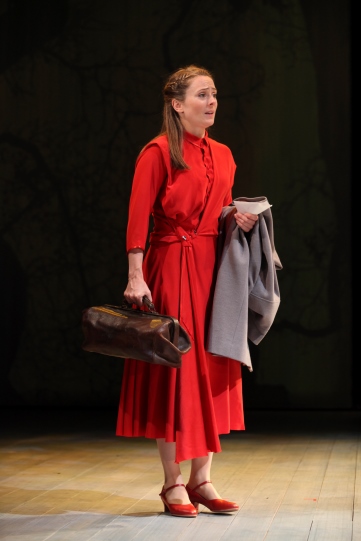
In the world of fairy-tale this would be the ideal marriage and Bertram, the prince, would realise that he loved the woman of lower-birth all along. However by placing the plot in a world where people are not shaped by archetypes, weJoanna Horton as Helena in All's Well That Ends Well. Photo by Ellie Kurttz see Bertram as little more than an indulged trustifarian who runs at the first sight of emotional commitment, who is used to bending the world to his whims and who believes honour is for the battlefield not the bedroom.

This may explain modern concerns with the play; that the resourceful, intelligent and determined Helena would seemingly humiliate herself and traipse across Europe for a man who clearly does not lover her.

It is on this point that Nancy Meckler’s production of the Royal Shakespeare Company comes into its own and in doing so helps to rehabilitate a play that, for its problems, contains, in Parolles, a comic creation of rare intelligence alongside two strong female roles that are pillars of wisdom and virtue.

Meckler’s production updates the plot to the early twentieth century and through this framing device we see the character dynamics in a whole new light. The fairy-tale plotting remains but within a world that is realistic to us.

The background is Europe at war and in Helena we feel any one of the millions of women who stepped into the roles left by men. Helena’s curing of the King of France is a reminder of the importance of women to the war effort and how they carried out job that before the War they would never have been allowed to do.

Bertram’s treatment of Helena and his dismissive rejection of the King’s statement that ‘Tis only title thou disdain’st in her, the which / I can build up’ [II.iii] reflects the wider disintegrating status of hereditary gentry. Bertram has truly never considered Helena within the context of a potential wife despite living in close proximity at court.

There is also a significant amount of comedic irony to a modern audience in his plea that ‘In such a business give me leave to use / The help of mine own eyes’ [II.iii]; it is clear that once the shoe is on the other foot, the male ego struggles with the concept of entering what is effectively a shotgun wedding.

<<Continue to full review>>


Luton: Immortalised

The Same Deep Water As Me – Donmar Warehouse, until 28 September 2013

Set in Luton, featuring personal injury lawyers and conventionally played, Nick Payne’s The Same Deep Water As Me at first glance appears to have an underwhelming premise to follow his sparkly original and hugely successful Constellations. However Nick Payne, despite young in years, has already begun to establish a formidable reputation as a playwright with an ear for the patter of the everyday voices and so it proves with a solid follow-up to one of the more original plays of recent years.

Mark Wooten

Payne’s talent goes farther than the mimicking of the everyday, it is also possible to see him channelling the distinctive voices of the late 20th century. There was a Stoppardian verve to the writing that grounded Constellations and it  is impossible to watch The Same Deep Water As Me and not recognise the muscularity of Mamet lying below the surface.

It is rare, in British playwriting, to find someone who can so convincingly evoke the language of those that may be labelled the working middle-classes. His characters seem to spring from a previously untapped well of working professionals; strong working-class roots but perhaps the first to make use of widening university provision.

By and large Payne writes characters who are near-invisible on the stage, and who are often routinely talked-down and patronised by those who see themselves as the guardians of culture. They do not have a socialist chip on their shoulders but they also are not part of the institutional elites; in short they are not political but are fiercely individual and rarely do playwrights try to illuminate the inner-lives and desires.

At times Payne’s writing is reminiscent of a well-crafted stand-up routine; turning ordinary lives into something faintly surreal and highlighting the hidden absurdity’s in established routines. Rather than grotesque caricatures, Payne finds humanity in the everyday.  A repeat call-back to Greggs – a very modern class touchstone – under Payne’s gentle probing reveals glimpses of a hidden world where relationships develop and life experience is shared. We find the quality of a steak slice is quantified and rated with the same precision that foodies reserve for bread and olives.

The shadow of Mamet is impossible to ignore and these is reinforced through both plot and structure. The ambulance-chasing, insurance scams of In The Same Deep Water As Me operates in a similar moral universal to Glengarry Glen Ross.  They both operate within a macho-office-based culture; they are full of people who are not operating at the margins but are still having to scrap and scramble to survive.

<<Continue to full review>>

Transforming a classic of Victorian gothic horror

Jekyll and Hyde – Flipping the Bird & Red Shift @ Maltings Art Centre, 25 July 2013 (and at the Assembly Roxy Downstairs from 31 July to 25 August 2013)

The Edinburgh preview trail winds its way onto St Albans and possibly the first time visiting a town that so defiantly tries to hide its arts centre away from anyone with the slightest interest in culture (and for anyone going you can find it in the Mall, located on the 2nd floor between the library and the car park). Still this is not the time for London snobbery even if the venue is rather unbecoming of one of the grandest of Victorian gothic horrors.

On the menu was Robert Louis Stevenson’s The Strange Case of Dr Jekyll & Mr Hyde; an endlessly adaptable work and if the creation doesn’t quite sit in popular consciousness as easily as his natural bed-fellows, Dracula and Frankenstein, then the suggestion is that it is because in Jekyll/Hyde Stevenson created a horror that lives as much in our own mind as in our external experiences.

Jekyll & Hyde might be prefigured by James Hogg’s too oft-forgotten, The Private Memoirs and Confessions of a Justified Sinner, but Stevenson’s work remains the more relevant because it strips out much of the religion and leaves behind something that could have come straight out of a Freudian handbook. The concept continues to have a huge influence in one of the most lasting forms of pulp fiction; the comic book. Hulk and Two-Face are two characters centred around the Jekyll/Hyde idea but the idea of a character leading a duel-existence is a fundamental to the mythos of the comic book universe.

jekyll-and-hyde

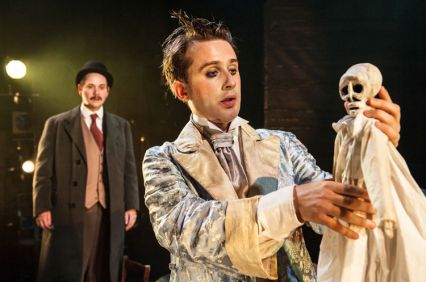
The question for any company is how you add something fresh to the equation; Flipping the Bird and Red Shift have approached the task by drafting in Jonathan Holloway to adapt it for the stage and have placed gender identity centre stage. It is a neat way to breathe life into a well-known story, meaning that fun can be had with Victorian gender politics and more importantly allowing a relationship to develop between Utterson and Jekyll that transforms the traditional end of the story.

The production is bolstered by the addition of an onstage music accompaniment from the narrator and the potential buyer of the story. If the style is overly reminiscent of The Tiger Lillies accompaniment to the hugely influential ‘junk opera’ Shockheaded Peter, the originality of the music and the coherence it has with the narrative means that it refuses to disappoint and is an effective way to work through scene transitions.

<<Continue to full review>>

Exploring new worlds in Battersea

Where The White Stops – ANTLER @ Battersea Arts Centre, 23 July 2013

Sitting inside a stiflingly hot and airless bar-cum-theatre at the Battersea Arts Centre watching the emerging ANTLER theatre company dressed head-to-toe in arctic-ready furs it was hard to resist summoning up that most over-used of precious theatrical clichés; performers that suffer for their art. Despite unbuttoning my shirt to a level that would certainly raise eyebrows at the Royal Opera House I couldn’t help but think that on this occasion the audience had got it relatively easy.

Visiting an Edinburgh preview show is always a refreshing experience. So often going to the theatre carries the expectation of seeing a product in its finished form, and it is pleasant to be occasionally reminded of the process that goesWhere the White Stops into getting to that stage. This is particularly true of a show like Where the White Stops, which has the feel of a piece that has been born out of collaborative improvisation. ANTLER, founded last year, is a young company and they retain a freshness of ideas that is an invigorating contrast to the staid conservatism of much of the West End.

Their production of Where the White Stops balances a sense of surrealist whimsy with a faintly disorientating emotional depth that gives rise to the slightly strange feeling of being trapped inside Bjork’s superb video for Wanderlust. They employ a mixture of physical theatre and polyphonic singing to create a vividly original vision of a fantastical frozen world.

If at times the whimsy can veer uncomfortably close the more navel gazing elements of The Mighty Boosh then it is not long before ANTLER bring it back on course through a tightly written narrative arc that suggests that below the improvisational, physical surface is a keen sense of the importance of the traditional story.

The story is of the modern fairytale; a heroine going on a journey to discover the world, and within it, herself. The key to the freshness of these stories – understood by everyone from Suzanne Collin’s Hunger Games trilogy to Hayao Miyazaki’s work at Studio Ghibli, and in particular Spirited Away – is in the development of a carefully designed world where flights of fancy can be accommodated within the dreamlike logic of the set-up.

<<Continue to full review>>