Matilda: Capturing the imagination of children and the wallets of adults alike

Very good news emanating from our cousins across the pond, as Matilda opens to rave reviews from pretty much every critic on Broadway. Whilst it doesn’t make the show any less brilliant if it fails to convert to our American Matilda friends, a Broadway smash is still seen as the gold standard for any musical – and there are many West End hits that failed to become the next ‘Phantom’ (over £5.5 billion sales worldwide and counting).
As the Guardian points out, there is money to be made in this market – the RSC anticipating £11 million advance by the end of the first day. £2.5 million was made in previews alone. It recouped its £7 million costs in London in ten weeks and plays at 98% capacity ever  since its October 2011 opening. However without the Broadway gold star then it makes the global tour of ‘Les Mis’ that much more likely, it means opening up to tours of Australia and Asia, across Europe and indeed anywhere else where it could be marketed.

There may be some in the art world that still sneers at playing to the gallery, at the rather déclassé notion of thinking about returns on investment, but this ignores the 15% real terms cut to the RSC’s Arts Council funding. It ignores just how much productions like Les Mis and Warhouse lined the coffers of publically subsidised theatre companies in the times of plenty so that now, when times are difficult and will continue to be so for some time, we see the National managing to erect a completely new temporary space in ‘The Shed’ rather than cutting costs and going dark whilst the Cottesloe is renovated. It allows the RSC’s annual tour to Newcastle to be reinstated.

In the week of Thatcher’s death it seems appropriate that the biggest product in British Theatre is a musical subsidised by the public sector. It was entirely in keeping with her vision that success in theatre equated directly to success at the box office, and to this Matilda appears to of hit the brief. However could Matilda have been made purely with private investment; could the private sector have brought the true subversive nature of Dahl to the stage? Could they have taken the risk on such a child-centric production? Would they have wanted to spend money on a production that decries the traditional family, that cocks a sneer at perceived lower-brow passions and that hires a lyricist as dynamically witty as Tim Minchin?

<<Read rest of article here>>

Olivier Awards: Runners and Riders and Early Fallers

Last week the nominations for the Olivier Awards were revealed and if its place at the end of the long awards season means it is an unlikely place to find many surprises, the shortlist does provide potential of scope for eyebrow raising omissions. Most people in theatre – who don’t work for the RSC – will be mightily relived that the Matilda juggernaut is no longer crush all of the competition. Looking across the nominations, it seems impossible that anything will come close to the level of dominance that Matilda achieved. The leading contender, ‘The Curious Incident of the Dog in the Night Time, has eight nominations  and could conceivably end up with five awards given the excellent technical work underpinning the show.

As usual the subsidised sector leads the nominations but the private sector is not totally unrepresented. However the lasting impression of the shortlist is the absence of controversy and also the absence of anything that really stands out. For the first time in a number of year there doesn’t seem to be a new play that blew everyone away or a revival that places an actor at the very top of their game.

Thinking back through the last few Best Actor winners, the Mark Rylance of Twelve Night does not appear comparable to the Mark Rylance of Jerusalem. James McAvoy is good but not near the level of Chiwetel Ejiofor in the 2008 Othello.  Rupert Everett appears to be getting rave reviews in The Judas Tree and good easily be the dark horse in the pack for a play that continues to build an unstoppable momentum.

This year’s round-up takes its cue from the Oscars and includes a number of special awards dedicated to certain fields. So without further ado we have:

3243292_ratio1x1_width42The Day-Lewis Award:

This special award is made of cast-iron and essentially means that whether or not the judges have actually seen the play in question, they are duty bound to give the award to this actor. It’s cast-iron qualities means that its long-lasting and on receipt of one, you are more likely to come home with another in the future. Not to be mistaken for the Tomei Award, which is made of stone and causes your career to sink equally fast.

1d1ea3a837e3cfcc607da792eb69bc38_normalThe Deakins Award:

The Deakins is given to those who suffer from unrecognised brilliance. The ability to from award show to award show and be cast over due to the fact you are so darn good that people already think that you have won one. Unfortunately as a result you have never won an award. This award is for you.

ben-affleck-2013-64x64The Ben Affleck WTF Award:

So just because you star and direct something that goes on to win Best Film means you will at least get nominated right? I mean, you even went to the effort of growing a dashing, auteur beard for the occasion. Wrong, sucker. I mean they loved absolutely everything about the show, well, apart from the way it was directed and the main star was pretty irritating as well.

*Note: Apologies for the terribly boring formatting below. WordPress is still completely inept at handling tables. Or more possible is the fact that I am equally inept at handling tables in WordPress. Why you can’t just past from Word it keep the formatting is beyond me. God knows where the lines are. I can see the lines and then they disappear. *Sigh* Technology Fail.


Best Actor
James McAvoy

Macbeth

Mark Rylance

Twelfth Night

Rafe Spall

Constellations

Luke Treadaway

The Curious Incident Of The Dog In The Night-Time

Rupert Everett

The Judas Kiss

As noted this doesn’t feel as much as gold star category as it has done in previous years. It is hard to look beyond a Rylance / Everett shoot-out for the win. Rafe Spall is good with a very difficult text but not stretched, McAvoy is the weaker of the two Shakespeare and Treadaway may just be a little young to take it from such established titans.
The Day-Lewis Award: No lock-in here, but I fancy the almost unrecognisable Rupert Everett against the gender-bending but still strangely recognisable Mark Rylance.

The Deakins Award: Again nothing stands out, probably Rupert Everett.

The Ben Affleck WTF Award: It is telling that I cannot think of a single person more deserving than these five. Maybe Christopher Ecclestone in Antigone but even that was slightly underwhelming

Best Actress
Helen Mirren

The Audience

Hattie Morahan

A Doll’s House

Billie Piper

The Effect

Kristin Scott Thomas

Old Times

If the men have not lived up to expectations then Michael Billington was able to find an almost entire shortlist of women who might have expected to be represented.It is hard to see (particularly after last years Cumberbatch / Lee-Miller double) how they could split Lia Williams and Kristin Scott-Thomas. However Hattie Morahan is so much of a lock for the Day-Lewis they might as well rename it the Morahan for next year.
The Day-Lewis Award: Hattie Morahan. That is all.

The Deakins Award: Since Kristin Scott-Thomas and Helen Mirren are already in the upper firmament of stars, they can hardly claim the Deakins. So again it must go to Morahan.

The Ben Affleck WTF Award: Lia Williams for sure. But also how there is no space for Harriet Walter in the Donmar’s Julius Caesar is absolutely outrageous – for me the stand-out female performance of the year without question. Also, given Rafe’s nomination, Sally Hawkins may feel a little hard done-by not to get a look in.

Best Actor in a Supporting Role
Paul ChahidiTwelfth Night

Richard McCabe

The Audience

Adrian Scarborough

Hedda Gabler

Kyle Soller

Long Day’s Journey Into Night

For this I campaign on an anyone but ‘Kyle’ ticket. Having given total support for his emergence after The Young Vic’s The Glass Menagerie a volte-face is in operation after watching this car crash of a show. Strangely beloved by critics, no-one I went with could comprehend why such a stiflingly long and boring production could have had everyone in such raptures.
The Day-Lewis Award: Richard McCabe – because we love a Peter Morgan play and Helen Mirren won’t win.

The Deakins Award: Paul Chahidi – if only that someone wins who isn’t Kyle Soller.

The Ben Affleck WTF Award: Reversing it for this award – Kyle Soller, really? (Fine actor, just not in this).

Best Actress in a Supporting Role
Janie DeeNSFW

Anastasia Hille

The Effect

Cush Jumbo

Julius Caesar

Helen McCrory

The Last Of The Haussmans

Nicola Walker

The Curious Incident Of The Dog In The Night-Time

Having not seen any of these performances bar Cush Jumbo it is difficult to provide a fair judgement.  All were well received and again are, if anything, stronger than their male counterparts.
The Day-Lewis Award: In a strongly contested field Helen McCrory may edge it due to the intergenerational vote-grabbing of The Last Of The Haussmans .

The Deakins Award: Pass.

The Ben Affleck WTF Award: Linda Bassett in People. I thought as far as Supporting Parts are concerned this was the kind of scene-stealing performance in a populist play that is guaranteed a nomination. Surprised to see People miss out across the board.

MasterCard Best New Play 
ConstellationsThe AudienceThe Curious Incident Of The Dog In The Night-TimeThis House Well a win for Constellations would be a final feather in the cap for what has been an obscenely successful year for the 29-yr old playwright, Nick Payne.However this may prove a bridge to far and whilst I hope that an adaptation won’t win, I think the sheer complexity and vision of This House will see it through.
The Day-Lewis Award: This House. Not without flaws but you have to admire the vision.

The Deakins Award: Constellations. A play that shows a deeply complex topic can sell-out the West End.

The Ben Affleck WTF Award: The Effect. Lucy Prebble’s follow-up to ENRON was one of the most anticipated of the year and sold-out almost instantly. Despite picking up two acting nominations, it has been snubbed for new play and best director. Ouch.

Best Director
Stephen DaldryThe Audience

Marianne Elliott

The Curious Incident Of The Dog In The Night-Time

Jeremy Herrin

This House

Simon McBurney

The Master And Margarita

Stephen Daldry’s return to the stage can be met with a significant yawn; The Audience proving to be a rather bland affair given the previous vehicles that Peter Morgan has found for Dame Mirren.The other three are technically complex in varying ways. McBurney deserves great credit for bring Bulgakov’s masterpiece to the stage with some degree of coherence.Herrin’s This House is remarkable for the way it gels such difficult material and Marianne Elliott combines visuals with superb performances from the leads.
The Day-Lewis Award: Marianne Elliott. The only director to get both visual and acting nominations for the play.

The Deakins Award: Marianne Elliott. For the above reason.

The Ben Affleck WTF Award: Rupert Goold, like Lucy Prebble, must be feeling somewhat aggrieved by the nominations. Still he does get to be Artistic Director at the Almeida, so there’s always that.

Best Actor in a Musical
Michael Ball – Sweeney Todd
Alex Bourne – Kiss Me, Kate
Tom Chambers – Top Hat
Will Young – Cabaret
 Michael Ball has this locked in. He has won pretty much everything going and a better Mr Todd in a better production it is hard to imagine.
Best Actress in a Musical
Heather Headley – The Bodyguard
Imelda Staunton – Sweeney Todd
Summer Strallen – Top Hat
Hannah Waddingham – Kiss Me, Kate
Until seeing Kiss Me, Kate then I would have put the house on Imelda Staunton helping Sondheim sweep the board. However Hannah Waddingham’s performance is sunshine in an otherwise cloudy production and is most deserving of the win.
Best Performance in a Supporting Role in a Musical
Adam Garcia – Kiss Me, Kate
Debbie Kurup – The Bodyguard
Siân Phillips – Cabaret
Leigh Zimmerman – A Chorus Line
 Having only seen Adam Garcia, all I know about this is that Adam Garcia surely can’t win. There must have been something better. My money goes on A Chorus Line.
Best New Musical
Loserville
Soul Sister
The Bodyguard
Top Hat
Christ, best new musical includes a remake of a woeful 1990’s film with one massive song, and (how is this anything but technically not a revival) of the 1935 classic with Fred ‘n Ginger.For that reason hopefully the flop Loserville will win it.
Best Revival
Long Day’s Journey Into Night
Macbeth
Old Times
Twelfth Night
I suspect that Long Day’s Journey Into Night will win. It sends a cold shiver down my spine but I think it will. Any of the others are more deserving but lets face it Macbeth and Twelfth Night are revived every other bloody year.
Best Musical Revival
A Chorus Line
Cabaret
Kiss Me, Kate
Sweeney Todd
  Sweeney Todd. The Day-Lewis Award for certainty.
Outstanding Achievement in Affiliate Theatre
Caroline Horton for You’re Not Like The Other Girls Chrissy at the Bush theatre
The production of Red Velvet at the Tricycle theatre
The season of new writing at the Jerwood Theatre Upstairs at the Royal Court theatre
Kate Bond and Morgan Lloyd for You Me Bum Bum Train, presented by Theatre Royal Stratford East
The usual suspects are deservedly well-represented here. The Royal Court with its normal stellar seasons, the Bush gets a nod and its nice to see Jerwood recognised.Hopefully the Tricylce will win but I have a fear that You Me Bum Bum Train may get the prize and even worse fear that it may encourage others to follow in its footsteps.

Truth, lies and journalists

Gibraltar – Arcola Theatre, until 20 April 2013

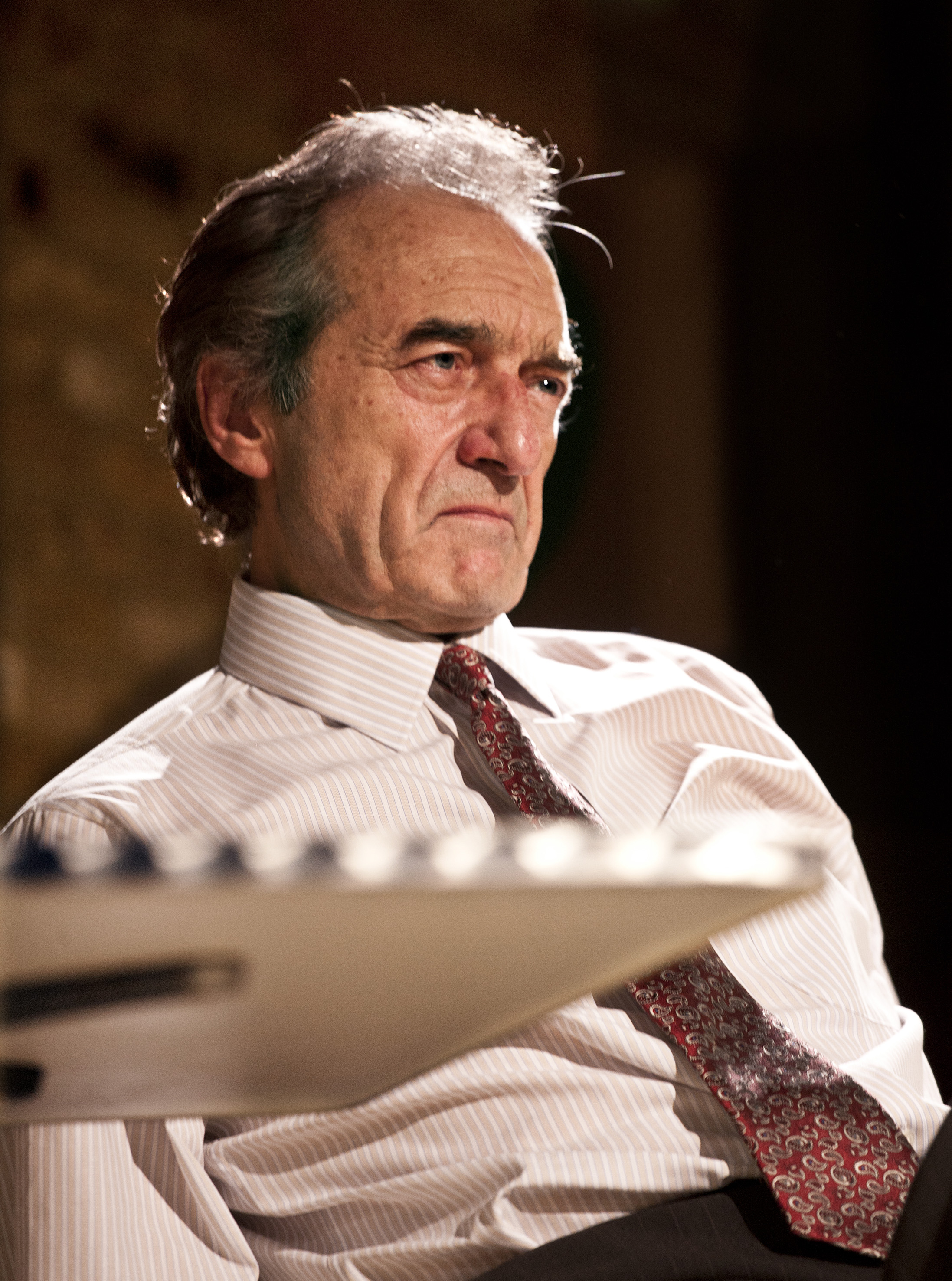
The IRA, and the whole period of the ‘Troubles’, has come to occupy a curious corner of the English consciousness. A decade-long focus on a militant threat that proved terrifying in its complete ‘otherness’ emerged just as the Nick (played by George Irving) - credit:courtesy of Simon Annand  peace terms of the Good Friday Agreement had put in place a clearly misplaced sense of security. As a result decades intermittently punctured by bombing campaigns, shootings and turmoil can sometime seem a quaint part of the nostalgic ‘little England’ experience; a part of our colonial history long since resolved.

That it is so easy to forget just twenty two years ago Downing Street was targeted with a mortar and during the decade before there those living in Great Britain waging a lethal campaign against the mainland makes the whole situation, in hindsight, appear surreal in the extreme. In actuality the actions of both the IRA and the Government were brutally, terribly real. If the atrocities that continued to mount through the 1980s, which include but don’t end with the events detailed in ‘Gibraltar’, eventually forced both sides to the negotiating table then it did so with significant blood on the hands of all involved.

Taken in this context it is hard to pick fault with the aims of Gibraltar – a new play written by Alastair Brett and Sian Evans, which examines the background to the infamous ‘Death on the Rock’ incident where the SAS shot three unarmed members of the IRA. It also portrays the inevitable press backlash to the testimony of those that dared question the account of ‘our brave boys’.

In such a loaded environment Alastair Brett is an intriguing figure to write the play. Previously Legal Manager to The Times and intimately involved with a libel action concerning Carmen Proetta (broadly the character of Rosa), the position of the play is pointedly opaque. There was a risk that the play would be distastefully myopic in its presentation of the facts but it soon becomes clear that there is little love between Brett and his previous colleagues – a number of caustic jibes are thrown in that certainly go a little further than an attempt at even-handedness.

<<Continue to full review>>

The Theatre of Politics

This House – National Theatrebooking until 16 May

This House has been the surprise package of what is proving to be a very successful season for the National – defying the surrounding economic gloom with a string of sell-out hits. It was inevitable that tickets for The Effect, Lucy Prebble’s follow-up to ENRON, and the latest Alan Bennett play would be scarcer than gold dust.

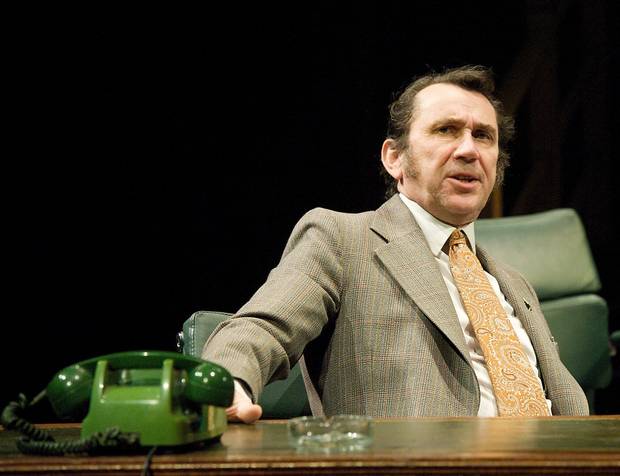
However This House did appear to be an altogether tougher sell; a play based almost entirely back rooms of Parliament, set between 1974 and 1979 and refusing the safety-net of caricature by eschewing references to MPs byPhil_Daniels_This_House name. Unless one held an acute knowledge of mid-70’s parliamentary constituencies it paid little concession to providing a Spitting Image-style satire on its subjects other than references to a certain ‘MP for Finchley’ and a fleeting appearance from a young Michael Heseltine.

As a self-confessed political and theatrical nerd none of this was particularly troubling as seeing the political process dissected on stage was the real joy. The likes of David Hare may stage politics with a big ‘P’, and there have always been any number of young tyros looking to reflect the impact of politics on society, but the institutions – the strange and archaic mechanisms that have supported one of the world’s longest running parliamentary democracies seem to have been rarely considered by playwrights.

Lord Scarman summed up the position eloquently in the late 80’s when he referred to the fact that the people are ‘only occasional partners in the constitutional minuet danced for most of the time by Parliament and the political party in power’. For all the radicalism of playwrights and protestors, politicians continue serenely onwards, safe in the institutions that have bent, flexed and twisted but never entirely shattered over the centuries. The British parliamentary system finds durability in its seeming lack of permanence. The lack of a codified constitution allows great flexibility in its approach; rules are in place because they are in place and always have been in place, not because they are written down in a book.

The very essence of maintaining the status quo, a great British tradition, is built into this approach. Without an awareness of the rules, and without any access to them, how can someone challenge the system? It is into these murky waters that James Graham’s This House looks to shine a light. It illuminates the hidden world of small ‘p’ politics; the grindingly mundane processes that allow the Government to govern and teases out exactly what happens when the metaphorical rulebook is thrown out of the metaphorical window.

So much of Parliament – the opening of Parliament by Black Rod, the Queen’s Speech, Prime Minister’s Question Time – is laced with symbolism about the importance of the function it serves, even if these aspects mean nothing to actual governing. James Graham and Jeremy Herrin have intrinsically grasped the parallels with theatre, which is that behind the spectacle there are those working themselves to the bone to keep the wheels turning and where power really resides. This is why the play focuses on the political Whips; the backroom boys who ensure that everything happens on time, that people know what they are supposed to be doing and that things actually happen.

<<Continue to full review>>

Peter and Alice and a whole lack of wonder

Peter and Alice – Noel Coward Theatre, until 01 June 2013

It all works so well on paper: Michael Grandage and Christopher Oram as director and set designer; John Logan behind the script; Ben Wishaw and Dame Judi Dench heading the cast. If any more of a hook was needed to guarantee an audience, the plot concerns Peter Pan and Alice in Wonderland (or at least their real-life inspirations).

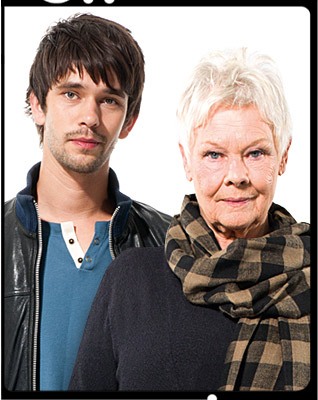
What could possibly go wrong?Peter and Alice - Ben Wishaw and Judi Dench

In some ways very little.

The major problem is that very little goes right.

For the audience, Peter and Alice is an almost pitch-perfect study in the average, the mediocre, the reassuringly dull. No doubt the brigades that travel on mass from the Home Counties, that can afford to sit in the stalls, that buy a programme, a drink and an ice-cream, that keep the West End at near maximum-capacity and that are, without doubt, vital to the on-going vitality of the London theatre scene, are going to be satisfied.

However Charles Dodson and J.M Barrie would be appalled. Not necessarily by the character assassinations perpetrated on them by Logan, in scenes that have a loose connection to the truth, but certainly by the sheer lack of imagination displayed by everyone involved in the production. Peter Pan and Alice in Wonderland are two of the finest examples of the flexibility of the adult mind; the sheer imaginative range of Carroll’s wordplay and of Barrie’s adventuring is a joy that has not receded in over one hundred years.

Peter and Alice fails to capture one tenth of this joy, this anarchic free-spiritedness, in one hundred minutes.

Reading the description of Barrie’s original production of Peter and Wendy one learns that Tinkerbell was created by the expedient use of a mirror to reflect a light onto the stage so that it would seem to dart and fly. This illusion, using the simplest mechanism imaginable, holds more wonder than the entire po-faced philosophising of Logan’s script.

To begin on the positives; Christopher Oram’s set is a delight. Opening on a musty office, it unfolds to a reveal the reassuringly sight of a chequer-board set and instantly recognisable Tenniel-inspired drawings of familiar characters. Given Peter Pan’s origins on stage it was a nice touch to reflect this in the use of classic flats that drop from the sky and retain a resolute two-dimensionality that highlights the artifice that lies behind theatre, and that means it will only ever be a simulacrum of reality.

Ben Wishaw and Judi Dench are perfectly adequate, and one hopes that, given this was a preview, there is a certain vitality that is still to come as they feel their way into the roles. Dench has a commanding presence that cannot help but be transferred to her characters – it is hard to imagine her playing a particularly vulnerable part. Her Liddell has developed a cast-iron exterior to the pressures of the world, and this contrasts well with Wishaw’s more vulnerable Peter Davies, a man who has not come to terms with the world as it is and the man who he will always be.

<<Continue to full review>>

Watt? Beckett for the wary

Watt – Gate Theatre Dublin @ Barbican, until 16 March

The Gate Theatre Dublin’s production of Watt, currently residing in the Barbican’s Pit Theatre, is an intimate affair that will certainly draw interest from Beckett’s usual fan-base but one that also reaches out to those who may find the aura of austerity that surrounds Nobel-winning writer a little forbidding.

Watt+Barbican+Barry+McGovernCollated from selected extracts from Beckett’s original novel, Barry McGovern has skilfully reassembled a pathway through the deliberately tangled narration so that the monologue (free-flowing, inconsequential and seemingly aimless as it may be) lets us gaze upon the curious Watt.

In doing so McGovern has made accessible Beckett’s wonderful evocative use of language and shone a light on the absurdist comedy that so often counterpoints the undercurrent of melancholia. Nowhere is this better seen than in McGovern’s description of Watt’s amorous dealings with Mrs Gorman, one of a number of occasions where Beckett’s faculty with language allows a third-person narrated monologue to bring the scene into life as easily any Michael Frayn farce.

It is the preciseness of Beckett’s language that never fails to impress. Every word has its place and no other place, and no other order of words, would seem to suffice. His description of Watt kissing ‘Mrs Gorman on or about the mouth’ tells us more about the man Watt is than the most perfect casting could achieve.

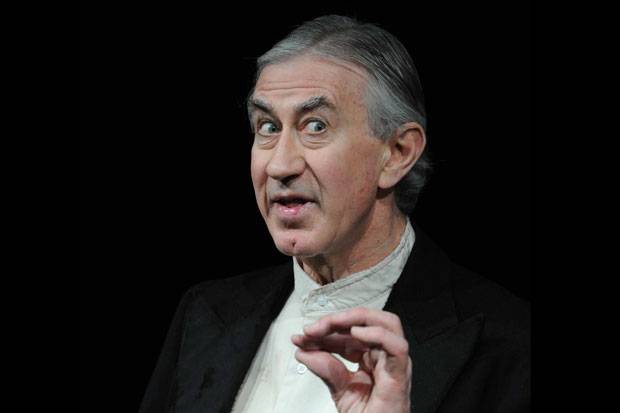
McGovern works hard to bring a sense of the visual absurdity that is clearly there in the original text. His physical re-enactment of Watt’s peculiar walk brings to life a description whose vitality must have been bursting off the page. It is a comic’s dream and, by virtue of being the narrator, McGovern has license to fully exaggerate Watt’s absurdity. It is a splendid scene and a necessary injection of energy in a show that always run the risk of being swallowed whole by the dense richness of the lanBarry McGovern as Wattguage.

This problem is evaded throughout by making full use of changes of pace to keep the audience engaged. The description of the mixed choir is augmented by the sound of it. McGovern is such a skilful storyteller that the audience listen’s with him through two full choruses – the comic tension increasing each time chorus disappears further off-key.

McGovern’s lugubrious tones emerging from the unnamed narrator, a man appearing to be straining to retain the last vestiges of a more grand life cannot help but remind of Beckett’s most famous creations, Vladimir and Estragon, and the play retains much of the vaudevillian that is so closely associated with Waiting for Godot.

Beckett can be the most intense of authors and some of his monologues, no matter how skilful, are to be endured as much as enjoyed. ‘Not I’, a gruelling 17-minute work that was filmed with Julianne Moore as part of a Channel 4 season dedicated to Beckett, may be brilliant but it cannot be described as an easy experience. The language, powerful as it may be, is fired staccato with the audience picking up fragments, jumbled narratives, falling into one another until it finally emerges into a semblance of clarity.

The joy of this production of Watt is that the 50 minute show fairly races by and, in so doing, delivers a Beckett whose gift for language retains an accessibility that can be lost when exposed to the full range of modernist tricks that were employed to make him such an influential, if unforgiving , figure of 20th Century writing.