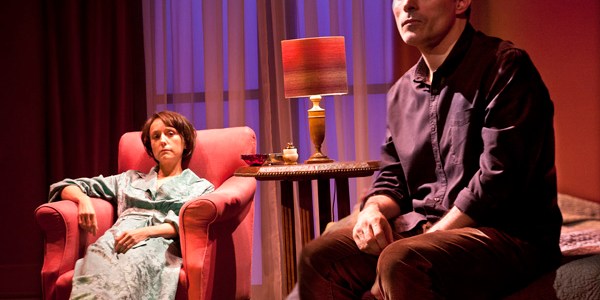
Old Times – Harold Pinter Theatre, until Saturday 06 April [Tickets]
There is nothing wrong with leaving a theatre perplexed. Shakespeare, Ibsen or Chekov may have been storytellers of the highest order, their plays a painstaking work of characters and plots woven together until the strands hang like a medieval tapestry; solid but exquisite. However the 20th century saw the emergence of new writers and new forms; those who use who would use character and language to explore mood and atmosphere. The results of these investigations are equally exquisite but the strands are of gossamer silk and as such one wrong move can destroy their beautiful fragility.
Old Times, written by Pinter in 1971, sits in the middle of his plays that explore ambiguous themes of memory and remembering and that sees characters interrogate their past lives from a present that often appears to exist in a meta-physical hinterland. For his next play, No Mans Land, Pinter would go back to the same ideas again and turn them into the great play of this period of his career.
There is nothing particularly wrong about Old Times but if it is a masterpiece, it is one that is in a minor-key. You get the sense of a playwright stretching out, prodding at ideas that require deeper exploration and as a result you get semi-formed fragments that burst fitfully into life as Pinter’s ability to generate unease through the rhythm of language comes to the surface. However there also exist oddities that seem to jar and where his trademark shifts in tone and interruption appear enforced.
The meaning of the play may be ambiguous but it seems, in Ian Rickson’s decision to alternate the roles of Anna/Kate’s between Kristin Scott Thomas and Lia Williams, that he is following in the interpretation that suggests Anna may be a figment of Kate’s imagination – or even a psychological reference point to an older part of the life that she felt it necessary to ‘kill’ off when marrying Deeley.
One of the great problems that theatre, and theatre criticism, has always faced is it suffers from an intrinsic impermanence, an ethereal nature that is born out of the nature of live performances. Of course it is exactly these elements that make theatre such a thrilling experience, which gives it a sense of immediacy and danger that cannot be matched by film or TV – despite their ability to provide a much more realistic sense of place that doesn’t require the active suspension of disbelief.
Every night the audience – be it two, twenty, two hundred or two thousand – share an experience that can never be replicated. Performance to performance will continue to be different, even with the same cast, and once a play ends its run, or changes it cast, something is fundamentally lost that cannot be reclaimed. A great play may be revived but a great production must disappear and only be retold through the memories of those who witnessed it.
Books have been written about the ground-breaking nature of Peter Brook’s production of ‘A Midsummer Night’s Dream’ but there is no way to recreate the sensation of what it must have been like for those who were there and who, perhaps unwittingly and at the time unknowingly, were experiencing a revolution in what it means to stage Shakespeare.
It is a sign of how the internet has so transformed how people approach the consummation of information that this feels like it could be a problem. Prior to filesharing, legal or illegal, people were able to rent videos but there was a cost attached to it. Music was even more difficult to get hold of – it could be rented from the library but obscure music had to be tracked down or saved up to buy. In the era of Youtube and Spotify the cost of consumption has fallen to a virtual pittance and, either as a result of or alongside this, a generation has developed in a world where it is entirely possible to take a magpie approach to culture. Why should we look forward when all the greats of the past are so easily accessible?
The tribal sense of fealty to ‘your’ music – the mods, the goths, the new romantics, the punks – appears to have been lost to a wave of people who can happily listen to The Who, The Cure and Ultravox whilst intermittently switching to the best bits of Blood on the Tracks and A Kind of Blue.
It seems it is not enough to live within your own culture when you can absorb it from all times. The question that it seems to pose is whether this is making us fundamentally conservative – looking back to the past for validation of our choices rather than pushing into new territory – or does it allow for a much more rounded sense of the now by looking back to understand how we have got to where ‘here’ is?
Theatre is slowly joining other cultural streams in sharing its back catalogue – whether willingly as through the quite wonderful Digital Theatre – or by the army of users playing little caution to copyright and posting videos to Youtube. The argument that it builds in an intrinsic conservatism is worrying and not without merit, I think there is a greater value in exposing theatre to a wider, global audience. Theatre has been so limited, far more than TV, film or music, by the constraints of time and place that the ability to breakdown these boundaries through the internet are only to be applauded.
Youtube captures an audience that might not experience the theatre in any other context– and to spend a life without even an awareness of playwrights of the power of Pinter, Arthur Miller, Martin Crimp or John Osborne or all the rest?
What drove these musings was the unexpected treat of receiving The Caretakerfor Christmas. Having seen it twice on stage, it was a delight to suddenly have in my hands the chance of watching two-thirds of the original cast and also, if Donald Pleasance as Davies and Alan Bates as Mick weren’t quite enough, throwing in Robert Shaw as Aston.
It is opportunities such as this that underpin why looking back is so important. Superb actors in a seminal play by one of our greatest playwrights – these are the things that should be recorded and stored for all time. It certainly isn’t perfect – it has been opened out so that scenes take place outside (even if it was adapted by Pinter it still feels like a mistake and a sop to the financiers) and there is a certain boxiness to the interior scenes which bear the hallmarks of 60’s TV.
However when you have the opportunity to see an actor of the calibre of Robert Shaw giving an absolutely chilling rendition of Aston’s monologue about being admitted to the mental hospital the problems of the staging disappear into the background and you are lost, transfixed, in Pinter’s overpoweringly direct dialogue that always contains such an eerie and unquantifiable sense of menace.
This sense of menace is framed even more clearly in the exchanges between Mick and Davies. Mick’s baiting of Davies in ‘You remind of a man…’ is both comic and terrifying in equal measure and highlights Pinter’s exceptional ability to create a disquieting unease in everyday conversations. The clip below is not the best but it does show-off the talents of Donald Pleasance and Alan Bates in giving full range to the verbal dexterity of Pinter’s dialogue. Mick expertly controls the conversational flow – switching between attack and defence so that Davies is continually thrown off-balance and creating a palpable air of tension for the audience despite revealing very little.
The amount of column inches generated in discussion of Phylida Lloyd’s all-female production of Julius Caesar would be admirable if the content of the articles had done much more than highlight just how deeply conservative the British theatre scene really is and how it still runs far behind Europe when it comes to pushing new boundaries.
It is this reviewer’s opinion that such arguments are so lacking in depth that they brook little need for response. Indeed the best rejoinder is to point across London to the Apollo Theatre where Mark Rylance and Stephen Fry are currently commanding plenty of column inches of their own but mainly on account of their acting abilities rather than any discussion of gender.
The usual argument is that an all-male casts generates its legitimacy through ‘tradition’ but this is somewhat undermined by the plaudits given to the RSC’s superb all-Black production of Julius Caesar, or by idly speculating whether Rylance and Fry are performing under torchlight and with an unruly audience urinating in the stalls.
An all-female production is necessary due to the rather obvious point that Shakespeare, like the majority of pre-20th century playwrights, did not write many great parts for women and considering we have a much greater attachment to the classics than our European neighbours – should we really exclude so much fine actors from some of the greatest roles in the English language?
Indeed let us return to Shakespeare himself to labour the point yet further: ‘the play’s the thing, Wherein I’ll catch the conscience of the King’ Stretching this laborious point to breaking possibly, it reminds us that the purpose of the play is to elicit reaction, to be a delivery mechanism for showing to the audience something that it wasn’t expecting. On this score it is hard to deny that Phylida Lloyd has more than succeeded.
So the reasonable question to ask is whether the decision to use an all-female cast works. Broadly the answer is yes but not with unnecessary problems that seem to have resulted from an attempt to pre-empt questions over the casting decisions.
One of the more interesting aspects of going to watch a lot of theatre is the sight of an idea dusted off to be given a new lease of life and then mainstreamed across London until audiences get tired of it again. The current default
position doing the rounds is that staple motif of directors looking for a fresh angle to breathe life into classic texts; playing the play as a play within a play.
Last year Ian Rickson’s Hamletwas set in the world of 1970’s psychiatry and the action unfolded with references abound to RD Laing, Phyllida Lloyd’s Julius Caesar – currently at the Donmar – is set within the confines of a women’s prison and, not having yet seen it, one would imagine that power structures of the play reflect upon the institutional setting. Joe Hill-Gibbin’s take on The Changeling – Thomas Middleton’s and William Rowley’s Jacobean tragedy – appears to be set within a mental institute with the audience taking on the role of paying guests.
The advantage of doing this is that it liberates the text from the confines of the period in which it was written and it allows space for allusions and references that would not otherwise be possible. The criticism is equally obvious – directorial authority runs roughshod over the intentions of the playwright and their director’s decision-making becomes the critical factor in the production.
This is less of a problem for The Changeling – a play where the plot is so bizarre and bloody that it is hard to understand how it could ever be played with serious intent, seemingly more suited to the plays of Le Theatre du Grand-Guignol. Yet there is an enduring popularity to Jacobean tragedy that seems to be shared by mass audiences and critics alike. The revival of The Changeling has been broadly welcomed, whilst Cheek by Jowl’s equally modern take on ‘Tis Pity She’s A Whore was a critical success and tickets for Punchdrunk’s unique, if fantastically over-hyped, production of The Duchess of Malfi in an abandoned Docklands office block were like gold-dust.
Perhaps it was figures published by the Office of National Statistics that suggested the top 10% of households are now 850 times wealthier than the bottom 10%, or possibly it was the leaks to the media that categorically ruled out a Mansion Tax whilst uplifting the majority of welfare benefits by just 1% but, whatever the cause, it was difficult to warm to Alan Bennett’s latest play, People, that contains some questionably judgements on the balance to be made between those who inherited their wealth and can’t afford it, and those can afford it but can’t enjoy it.
Alan Bennett has always existed as a very British radical. Not one to follow in the footsteps of the Angry Young Men of the 1950’s and a world away from Edward Bond’s ferocious anger, one suspects that Bennett has always looked to subvert opinion in unexpected ways – right from the earliest days of Beyond the Fringe.
However watching People, it was hard to not question whether the targets of his ire are particularly deserving of it. There is nothing wrong with it as a play, even if it is a little slighter than some of his earlier work. It is an intelligent comedy that contains Bennett’s traditional meshing of farce with wry humour. There are plenty of excellent one-liners and fully-rounded characters that manage to make what are fairly broad comedy tropes (the Bishop and the porn film could have been a terribly tired cliché) seem reasonably fresh.
No-one goes to a Bennett play expecting the uncomfortable laughs of Martin McDonagh or the breathless extreme farce of Joe Orton, but there is a certain softness that at times makes everything a little too comfortable. The play continues to set up quite uncomfortable philosophical positions about class, inherited wealth and the self-importance of organisations that take it upon themselves to reflect the nation, and then edges away to operate the middle ground.
There are targets scattered throughout the script and whilst Bennett is perfectly capable of doing with a stiletto what others would do with a 12-bore shotgun, there are times when the mercy he shows his subjects makes it difficult to gauge where the audience’s sympathies are supposed to lie.
The transfer to the West End of Constellations, the latest play by Nick Payne, caps what has been, by any measure, a remarkably successful year for someone oft-referred to as one of Britain’s brightest young playwrights. With a bone-fide A-list actor cast in New York and clutching an Evening Standard Best Play Award for Constellations – a play wearing its learning on its sleeve and displaying an innate understanding of the mechanics of plotting far beyond Mr Payne’s 28 years – it can be difficult to tell whether ‘brightness’ is a reference to the current luminosity of his career or the marked intelligence that he brings to the theatre.
To write a play about string theory that looks to ‘show’ as well as ‘tell’ is a sizable task. Given the complexity of the topic and perceived tensions between the two schools of thought, it is perhaps unsurprising that there are relatively few plays about science and so, given the lack of comparators and the formidable confidence required to attempt such a mesh, it is perhaps inevitable that parallels will be made with Tom Stoppard.
It would perhaps be unfair to challenge Mr Payne to step into the shoes of one of Britain’s most eminent post-war playwrights but parallels can be discerned– at the age of 30 Mr Stoppard wrote an audaciously confident of his own in ‘Rosencrantz and Guildenstern are Dead’. It remains one of the few Shakespeare-inspired works of art that can be held up to its inspiration and look it straight in the eye. The ease with which real scientific and philosophical rigour is interweaved with one of drama’s most potent works is frightening.
To say that Constellations does not quite match that gold standard is no disgrace because Constellations is very good on its own terms. It maintains intellectual ambition whilst driving a more humanist approach to comedy that is far more modern than either the farce of Michael Frayn or the rather mannered intellectualisms of Stoppard. The resultant characters are able to display much more in the way of warmth and manage to avoid the rather calculating artifice that affects much farce.






 Civilian Theatre