Bitesize Coward proves to be a tasty lunchtime treat

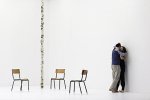
Still Life – Bridewell Theatre (13:00), until 06 July 2012

The Lunchbox Theatre programme of the Bridewell Theatre is one that taps into the roots of the St Bride Foundation. Established in the 1890’s, the Foundation Institute was created at the crossroads where the Church’s traditional notion of charity met the more enlightened of the Victorian patriarchs. Across London’s East End we see similar projects being set up, and a core function was not just the improvement of physical and material wealth but the improvement of the soul. Lectures on subjects that often took ideas such as the role of the pastoral in Shakespeare or the glories of classical Greece were given frequently to the working poor of London.
You would be hard pressed to argue that the Bridewell Theatre, based at the junction of Fleet Street and Farringdon Street, still caters to the working poor. From the road you can look east and see office blocks that tower over St Paul’s and obscures all of Cheapside. It might, however, still be argued that the workers of London’s financial heartland might benefit from the Victorian ideals of mental nourishment.

If so one hopes that they make use of Lunchbox Theatre to catch Noel Coward’s Still Life. At 45 minutes it acts as an exemplar of the one act structure and hopefully might rehabilitate some attitudes towards Coward. His prodigious output and general position as whipping boy for the angry young men of the 1960’s has perhaps obscured the incredible talent that enabled him to become a colossus of pre-1945 British theatre.

He writes, and is reflective of, a very specific period in Britain’s history – which bisects the Victorian and modern worlds – where the class upheaval put in motion after the disasters of World War 1 had challenged the rights of the upper classes to lead and the church to provide moral guidance. During this period of flux the culture of high society refused to seriously engage with the questions raised of the pre-existing order; Coward is no exception to this and a number of his works probably cannot be revived due to the nature of the elitism and class-caricatures contained in the text.

However Still Life suggests that he was aware of the changing pressures and the way that the upper-classes were trapped within the systems created by their own class (and one cannot but think that own sexuality was no doubt an underlying issue). The abiding impression for the audience is that whilst the play focuses on the relationship between Laura and Alec, it is the relationship of Myrtle and Albert that is allowed to be alive. It is arguable that in this Coward moves perilously close to suggesting the idea of the noble savage free to express their baser instincts, but in many ways the relationship could be closer to Shakespeare’s Phebe and Silvius from As You Like It – providing a comic background and emotional relief from the play’s driving relationship.

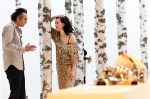
Still Life was famously adapted to the screen as Brief Encounter, and Celia Johnson and Trevor Howard were forever immortalised as the epitome of that very British type of love affair: all lingering looks and stiff upper lips. To walk in these shadows requires actors capable of working through what might otherwise appear on the verge of self-parody. Alice Knapton (Laura) and James Powell (Alec) are not always given a lot to work with in the text and there is a risk that performances will come across as one-note and slightly glassy. However they manage to sidestep this trap and bring a multi-layered texture to the roles that hints at all that lies beneath.

<<Continue to full review>>

Advance Notice – Highlights of the Autumn Season 2012

In recent days we have had announcements from both the Royal Court and Michael Grandage of their upcoming seasons. Representing the very different ends of the theatrical experience for audiences; the small intimately thrilling Royal Court where so many of our great playwrights were given a space to write and the cavernous and wallet-sapping Noel Coward Theatre, the name alone indicative of its West End heritage. It is heartening to think of Grandage’s past as Artistic Director of The Crucible and a ten-year stint at the Donmar and realise that it is still possible to trace a line from the heart of regional theatre all the way to the money-making centre of the British stage.

One might grumble about the prices of Grandage’s plays but it cannot be denied that a West End line-up containing two Shakespeare’s, a McDonagh and a new play by John Loga, whilst, maybe not groundbreaking, provides rather more interest than the usual fare of rehashed musicals, Coward revivals and vehicles for ageing American celebrities. Ticket prices may be steep at the top end but, as I have commented elsewhere, the £10 tickets actually undercut the National’s Travellex offer and, if star power is what you are after, provide fantastic value for money. Whilst advertised as ‘moderately restricted view’ I have found the seats to be absolutely adequate and you would miss virtually none of the action. Given they are available in both the Royal and Upper Circles they arguably offer better value for money than the Gallery tickets that are the next cheapest but are  already edging towards an uncomfortable £27.50 for seats right up in the gods.

With information about the National Theatre and the Barbican already available we can see that the upcoming months look very rosy indeed. And as a public service, Civilian Theatre is very happy to provide you with a month-by-month guide to the most interesting plays over the coming months (a growing requirement as it is becoming more and more evident that theatre is going the same way as gigs and stand-up comedy and selling its major events anything up to 18 months in advance – Jude Law in Hamlet in November 2013 anyone? Not busy I hope?)

___________________________________________________________________ 

September 2012

London Road (National)

This may be a last chance to catch one of the most interesting and innovative musicals in recent years. It sadly had the misfortune to go up against the Matilda juggernaut in all the major award ceremonies and as a result came home empty-handed but this tale, based on documentary footage taken from Ipswich in the aftermath of the discovery of five bodies in 2006 and put to music by Adam Cork, is one of the most complex and affecting new musicals in a long time. A real slow-burn hit, its success can be seen in the major summer revival it was given by the National just a year after it was first introduced. September is possibly the last time you will be seeing it in quite a while so go while you can.

Mademoiselle Julie (Barbican)

Hopefully not setting myself up for a fall after the general disappointment of Cate Blanchett in Big and Small – where the size of the play failed to meet the stature of the actor – we see Juliette Binoche meet Strindberg as another entry in the Barbican’s generally excellent international programming. Binoche is one of the deserved greats of French acting; an actress capable of turning down Spielberg’s Jurassic Park for a role in Kieslowski’s Three Colours: Blue (now that is range). The set photos are fascinating and suggest a radical take on a work famed for its naturalistic excellence:

love and information (Royal Court)

Whilst not to everyone’s tastes, a new play by Caryl Churchill is certainly not something to be ignored. One of Britain’s leading playwrights over the last 40 years and an icon for the current generation of female writers who grew up on Top Girls and Cloud 9, Churchill returns to the Royal Court with a new play, love and information. Details are scarce other but it looks likely that it will be a continuation of Churchill’s abiding fascination with non-linear story-telling and the use of the less naturalistic elements of theatre, as she creates a panoramic landscape of over 100 characters.

Hamlet (Queen Elizabeth Hall)

In what was very high up Civilian Theatre’s ‘Must Watch’ list was this import from Denmark – The Tiger Lillies performing Hamlet. Unfortunately recent news tells us that it has been cancelled for ‘scheduling issues’ but if they can find a slot for it in 2013 then I urge all to go and see it. The Tiger Lillies describe their own music as Brechtian street opera and are instantly memorable for all of those who had the fortune to see their version of Shockheaded Peter many moons ago. For those who have missed their vaudevillian morality tales then here is a performance of a song from Shockheaded Peter:

___________________________________________________________________

For more on the Autumn Season, including highlights from October and November then please click through for more.

Science under the microscope in Durrenmatt’s The Physicists

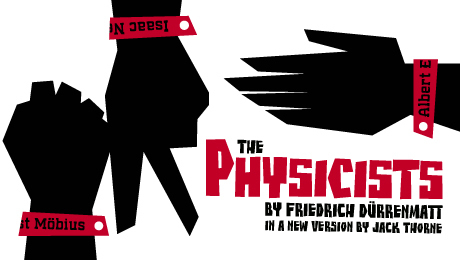
The Physicists – Donmar Warehouse, until the 21 July 2012 

Thomas Midgley Jr is not a name near to many people’s lips when asked about the most important scientific innovators of the twentieth century. Seemingly destined to be remembered solely as a speciality question in a pub quiz would appear a strange fate for a man whose contributions to science shaped the world and led him to being described as having a ‘greater environmental impact on the planet than any single organism in history’.

It is then unfortunate for Thomas Midgley Jr that the impact described was both an accidental consequence of his inventiveness and wholly negative in almost every conceivable aspect; for Thomas Midgely Jr is the man who came with the idea of adding lead to petrol. Not content with this world health hazard, his second invention was close to catastrophic, as he found a way to improve the process of refrigeration through a compound called Freon. In so doing he successfully managed to invent CFCs.

One can only imagine that after those two disastrous attempts at improving the world, poor Thomas Midgely Jr would have a great deal of sympathy for Johann Wilhelm Möbius, the scientist at the centre of Dürrenmatt’s farcical satire that poses questions on the burden of responsibility on scientists and the ability of state to understand and manage scientific developments. Indeed Möbius is so concerned with the potential capacity for destruction in his inventions that he decides it is better to feign insanity so that he is able to work on pure physics well away from the overbearing hand of the state.

Dürrenmatt wrote The Physicists in 1961, prefiguring the Cuban Missile Crisis but at a time when tensions between the Soviet Union and the West were reaching a new peak. The horrors of Hiroshima and Nagasaki remained fresh in the mind 15 years on, as societies across the world lived in the shadow of two countries committed to the real-politics of mutually assured destruction.

Charles Spencer, writing in The Telegraph, challenges the play’s value forty years on. It is a reasonable point at a time where the conflict between superstates has faded and the prospect of nuclear war has receded to be replaced by a more existential threat of individual extremists, dirty bombs and cyber-warfare. Josie Rourke’s production is never quite able to square this circle and throughout there remains the nagging sensation that one is watching a period piece; a very well-crafted and carefully staged absurdist drama that is fascinating but ultimately as clinical and sterile as its setting.

That is not to say that it cannot be enjoyed on its own merits. The quality is to the level that has come to be expected from a Donmar production. John Heffernman is superb in capturing the duality of Möbius’ character; drawing out the dignified trauma of being self-aware enough to understand that his brilliance can never realise its potential in a world where it will be handled by those with power but no understanding, but Heffernman also reveals the arrogance that afflicts many geniuses and causes them to underestimate the skill of the opponents, in this case hastening the final tragic denouement.

<<Continue to full review>>

Watch out George R. R. Martin, Shakespeare’s coming

The BBC certainly seem to have taken a leaf out of HBO’s book with their new preview trailer for their Shakespeare Unlocked series. Right down to the title ‘The Hollow Crown’ – a fabulously fantasy touch – they have gone out of their way to draw on the huge water-cooler success of Game of Thrones.

With season 2 drawing to a close on Sky Atlantic, it seems like the perfect opportunity to launch The Hollow Crown – four successive history plays from Richard II through to Henry V. The cast looks suitably stellar as every high-profile actor going has put themselves forward for some high profile thesping. The limited casting released on the BBC Website hints at the quality – Rory Kinnear, Tom Hiddlestone, Ben Wishaw and the mighty Patrick Stewart (getting the rights to one of Shakespeare’s most well known speeches in ‘this royal throne of kings, this scepter’d isle…’). 

And the trailer? Well isn’t this just mouthwatering.

Shakespeare’s Cymbeline finally turned into a true work of art

Cymbeline – Barbican Theatre

The Ninagawa Company, under the stewardship of Yukio Ninagawa, has built up a fearsome reputation in world theatre. They stand as the equal of any post-war company from Joan Littlewood’s Theatre Workshop through to Chicago’s Steppenwolf, whilst stylistically they are as uniquely identifiable as anything from Peter Brook or Simon McBurney.

Famed for his Shakespeare, Yukio Ninagawa has turned his attention to one of the most problematic plays in the Bard’s canon; Cymbeline. It is a difficult play to love and one that comes packaged with all kinds of traps for a modern audience. The plot winds and winds and seems unsure of what it wants to be, containing elements of romance, farce and tragedy. It has simplistic plot devices, like cross-dressing and misidentification, reminiscent of earlier plays but also contains the heavily allegorical language and non-human elements, in this case Jupiter descending on an eagle, that place it alongside The Winter’s Tale and The Tempest as one of the later plays.

Frank Kermode described the play as a tragi-comic romance and suggests that it may have been an in-joke for audiences who would have had a much better understanding of the text and references to earlier plays. None of which makes it any easier for a modern audience to unpick the complexities of the plot.

Luckily going to see a Ninagawa production is to have your visual senses wrapped in cotton wool and taken on a journey where the simplicity of images masks the masterful craftsmanship working behind the scenes. The technical understanding of balance is superbly illustrated again and again throughout the evening; light and shade, simplicity and complexity, the tonality is in harmony so that everything works towards the whole and the audience is never aware of the mechanics. Like other Japanese traditions that have bewitched Europeans over the years, from woodcuts to sushi, the skill rests on the ability to hide an incredible complexity behind a deceptively simple front.

It is difficult to fairly assess the skill of the actors without speaking Japanese and since the production leans so heavily on the visual, the rest of this review will take a radical detour and will look to provide a sense of the evening through the images it has left behind.

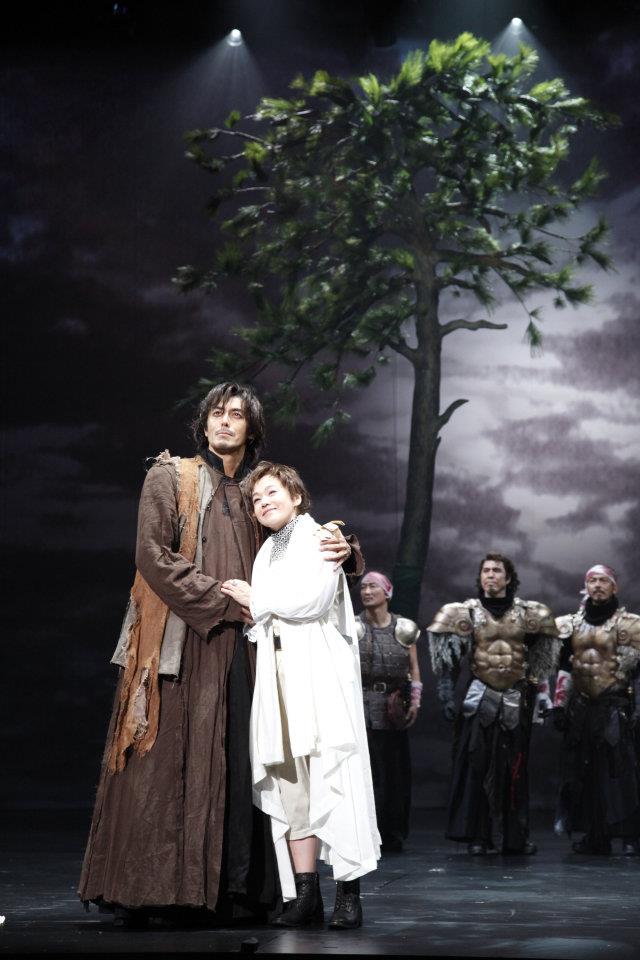
You can choose any one of a number of plot strands to call the centre of Cymbeline. Above we see the romance at the heart of the play, that of Posthumus and Imogen, as they are parted and again as they are reunited. As is traditional in Shakespeare the lovers must face many barriers before finally winning through in the end. However the play is made problematic, particularly to a modern audience, by the fact that Posthumus acts in such an unreasonable manner for much of the play, doubting his wife’s fidelity almost as soon as he leaves England before hiring his servant to murder her. That kind of level of trust does not always lead to happy relationships.

As the beating heart of the play, Hiroshi Abe, as the exiled Posthumus, and Shinobu Otake’s Imogen, bring the romance to life despite spending most of the play separated. They draw out the character traits despite the language barrier, with Hiroshi embodying the stoic and duty-bound Posthumus,  accepting of the State’s decision to banish him before later preparing to sacrifice himself in realisation at the fate he believes he inflicted on Imogen.

<<Continue to the full review>>

Antigone: A very modern ancient Greek tragedy

Antigone – National Theatre, until 21 July 2012

Polly Findlay’s production of Antigone, which runs at a brisk 100 minutes without an interval, is a fine example of balancing the demands of classical Greek tragedy against modern audience sensibilities. In this regard it is helped by Don Taylor’s solid translation that irons out much of the overly heightened poetics in favour of a more earthy realism. This has the dual effect of making the plot a lot less tangled to an audience not raised on the complexities of Grecian mythology and also downplaying the role of the gods in the drama – possibly the single biggest problem in finding contemporary resonance in the surviving works by Greek playwrights.

The text has been filleted to make it performable without a break and this broadly works in the narrative’s favour. Antigone is rooted in conflict  from the opening moments and it doesn’t take long to become apparent that the audience are watching the playing out of a tragedy made inevitable by the choices taken by humans. By removing the interval Findlay is able to keep the tension ratcheted up and allows momentum to build like a wave from first scene to last.

The action is set, effectively if not a little predictably, in the war rooms of Creon’s (Christopher Eccleston) administration. Soutra Gilmour’s set design has done an impressive job of filling the Olivier stage without giving the impression of it being cluttered. This is achieved by partitioning offices towards the back of the stage that has the effect of shortening the vast space by a good 10 metres and forcing most of the action towards the audience. As a result the production feels much more intimate than many staged at the Olivier.

Findlay doesn’t waste the space and there is the constant background buzz of an administration on the brink. The Chorus form the civil servants that run things behind the scenes. There are two very cute moments in the opening moments that help to create a world that is instantly recognisable; the first is what must surely be a deliberate echo of the famous image of Obama and team watching the raid on Osama’s hideout. The second is the chorus’ announcement of the death of Polyneices & Eteocles restaged as the drafting of the press release, with the text being revised to tone down the language of war.

What marks Antigone as one of the most important plays in the Western canon is the fact that, despite it being dated to a period almost 2500 years ago, it is still dealing with issues that are recognisably modern. Other surviving plays are of interest, or contain some certain relevance, to a modern audience but Sophocles captures issues that are still being played out on the world stage in the 21st century.

The idea of the rights of the individual against the rule of the state is one that will never be resolved and Sophocles shows it through an issue that has a stark modern relevance; the death of Osama Bin Laden led to mass protests following his burying at sea, which was seen as breaking Sharia law. This contemporary example amply demonstrates that the right to be buried in accordance with tradition has not diminished over two millennia.

<<Continue to the full review>>