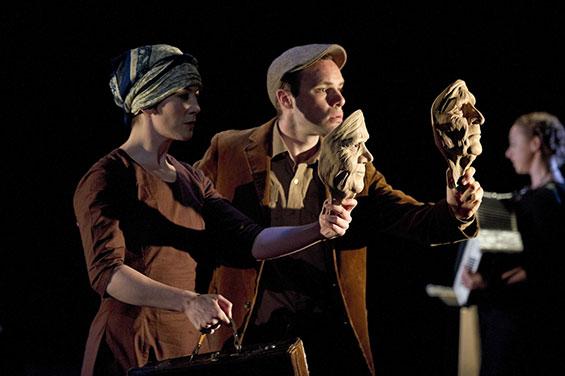
It takes a little less than ten minutes of Theatre Ad Infinitum’s remarkableTranslunar Paradise, a show that is about death and then process of moving forward, to be assured that its creator, George Mann, has developed an intimate understanding of the rhythms of grieving. The programme provides background but you do not need it to know that this devised work was forged in the pain of experience. It captures, and expresses with sublime beauty, a simple truth that is missed time and time again in lesser works: that the true tragedy of death lies not in the moment of loss but in the moment of realisation that life continues relentlessly onwards.
A bravura opening sequence sees two masked performers enact the final moments of a long-lasting relationship. We watch actions that have been repeated so often it is as if they have been instilled in the muscle memory of the characters; a pat on the elbow, an offer to carry the suitcase, a crossword clue. These little touches are what remains after a loss and offer a gateway to the past, where the man can relive the key moments in his life and create a way of holding on to what has been lost. In some ways similar to Pixar-film Up, Translunar Paradise begins in tragedy and then expands the scope to explore how this impacts on the surviving partner.
Crazy for You – Ivor Novello Theatre, Booking until July 2012
Fresh from its successful run at the Regents Park Open Air Theatre, Crazy for You has since transferred to the Ivor Novello Theatre. It seems a suitable home for a production that showcases the best of the 1930′s musical songbook. Whilst Novello contributed to a very British version of the musical comedy that had little in common with his American counterparts, Crazy for You’s chorus line routines, zinging one-liners and infectious melodies would appear to be closer to his taste than the overblown power chords, million pound sets and star billing of the modern day musical. It is both interesting and depressing to note Shrek: The Musical is in residency just two hundred metres up the road, and a stone’s throw from the Royal Opera House.
Having seen the show in its original run, it is interesting to make comparisons between the two. The Open Air Theatre is a daunting place to stage a show; the director needs to battle a large auditorium where small. intimate gestures are likely to be missed but without access to the same range of special effects and staging techniques available in a more traditional space.
There have been a few alterations during the transfer to the Novello, clearly with the aim of giving the show a little more spectacle, but these are only minor and there is a pleasing sense that there has been a deliberate decision to stay true to the spirit of the period. Whether it is due to being staged indoors, in more familiar surroundings, the dancing has become noticeably tighter. The routines have been slightly rechoreographed for the smaller stage and the chorus line display a uniformity and invention that is a necessity for reviving the true spirit of Broadway. Click here to read the full review
For a quick preview see the trailer below
(warning: this trailer contains moving images of Jeffrey Archer)
Our gremlins, who work tirelessly to ensure that the site maintains a bare minimum of functionality, are proud to inform all our lovely visitors that they can now follow A Civilian’s Guide to the Theatre on Facebook. If you find the ‘widget’, yep that is the technical term, on the right-side of the page and click on the ‘like’ button then it means that you can be the first to know when we have uploaded any new articles to the site.
It might be no more than yet another sign of the slow death rattle of Hollywood, the slow, wheezing sound of the balloon deflating as originality continues to be usurped in favour of that most valued of commodities – the ‘sure-fire’ hit, however it never stops being frustrating to go and see a film you loved on stage only to realise that those complex, live-wire characterisations by total unknowns have been replaced by a type-A, blank-eyed, lantern-jawed hero who only ever appear against a backdrop of an elegiac piano-based score while using a script so simplistic it might have been rejected by Dan Brown…
Welcome to Hollywood Does Theatre – an opportunity to see your favourite plays on the big screen: re-scripted, re-cast and re-duced substantially in quality. Well that may not be entirely fair, it can be argued that given the right play with the right cast and a sympathetic director the results can be substantially more enjoyable than the original play. This play went on to do be quite popular as I recall…
The beginning of last year saw the crowning of The Kings Speech, whilst towards the end of the year Terence Davies took on Terence Rattigan in a version of ‘The Deep Blue Sea’. The critical consensus seems to have awarded it the label of solid, if unspectacular. Davies is such a talent and,due to his relative inactivity, under-appreciated master of composition that it could hardly fail to overwhelm the visual but it is also clear that he is a huge admirer of Rattigan and if anything the material is handled to reverently. By the end the audience is left wondering, as splendid as all the constituent parts are, why they are watching a film of a play that felt outdated even at the time of its original release back in 1952. (I mean this was released in 1951 and within moments our obsession with emotional reticence looked about as old-fashioned as our obsession with the Empire:
So what is on the slate for 2012?
1) Warhorse (Released: 13 January)
Unless you had been living in a cave you could scarcely have failed to notice the Warhorse phenomenon that has developed over the last 5 years. Initially a hit as a book for Michael Morpurgo, it tells the story of the relationship between a young soldier and his horse. It is a unashamed tear-jerker and touches on just about every emotional heartstring going. So it is, perhaps, no surprise that it eventually found its way into Spielberg’s mitts. If there was ever a director who has mastered the blockbuster, wide-angle lens camera pan set to a not-too-obvious but vaguely familiar stringed background, then it is the man who directed E.T., Close Encounters and Band of Brothers.
Perhaps more surprisingly is the fact that in between the book and the film came a play that has been both critically lauded and a commercial smash wherever it has played. And each and every review poured praise on the inventiveness and skill of the puppetry of the horse in evoking an anthropomorphic reaction to the creature. At times zyou can barely hear the actors over the sound of sobbing in the aisles. So naturally Spielberg has removed the puppet.
Well it pulls about every Spielbergian trick out the book – it seems you can’t move in his trailers without risking an eye to an errant violinist’s bow. This is movie-making not film-making. It is a statement of intent but a statement that seems to have fallen on deaf ears among the critics that appreciate the quality but feel there is an absence of heart. So Puppets 1: 0 Spielberg.
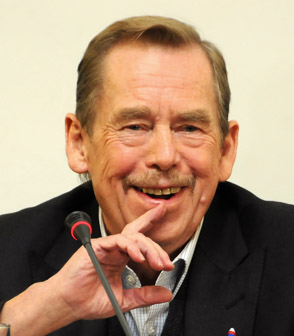
The tragic death of Vaclav Havel (1936 – 2011) earlier this month has sadly robbed the theatrical world of one of the more impressive résumé’s of modern playwrights. Harold Pinter may have been awarded the Nobel Prize for his contributions to literature – an award which contained an inherent recognition of the political aspect of his later writing – but Havel can claim to go one step further; he was a major presence in world politics and also a key figure in the transition from authoritarian communist rule to democracy in the ex-Soviet states. Indeed the gulf between the two can be seen in the fact that it was Pinter who played ‘Vanek’, Havel’s semi-autobiographical alter-ego, in a BBC radio play in 1977.
Following the Velvet Revolution in 1989 Havel was elected, by the Federal Assembly, as the ninth, and as it turned out final, President of Czechoslovakia. He was also responsible for introducing democracy to the country following 40 years of Communist rule, and, despite opposing it, oversaw the movement that led to the eventual split between the Czech Republic and Slovakia.
In a world where most politicians appear to be motivated primarily by money and power, Havel can be held up as a shining example of a true public intellectual. Whereas many playwrights can write about politics, Havel lived through his beliefs and will remain in the history books as a powerful reminder that the literary world can engage with the political on an equal footing.
The fact that there is a Havel legacy in the U.K, given the generally dire prominence of any modern playwrights who are not Anglo-American is almost entirely down to the marvellous Orange Tree Theatre in Richmond. It has become a bastion of Havel’s work, and has been responsible for staging 12 major productions, including the first English translations of many of his plays. In 1977, on the eve of premiering Havel’s work in England, Charter ’77 exploded and the Orange Tree, a tiny theatre above a pub in the heart of liberal London suburbia found itself at the centre of Czech politics. From this moment forward the Orange Tree, an increasingly influential fringe venue, forged a sustained and meaningful relationship with Havel that continued through to his death.
For more on the relationship between the Orange Tree and Vaclav Havel click here.
There is a long and often inglorious history of converting much-loved books into musical theatre. The temptation for doing so is obvious; flying in the face of overwhelming critical disdain, Les Miserables has provided a template for financial success. It has a mantelpiece of audience-choice awards, a global army of devoted fans and by January 2010 it was celebrating notching up 10,000 performances in the West End. In short the tills have not stopped ringing since the original Cameron Mackintosh-Trevor Nunn production in 1985.
A salient and oft-overlooked fact by those who sneer at Les Mis is that this success has seen the RSC (producers of Matilda) through the brutal conditions suffered in the 1980’s under a prime minister who held Andrew Lloyd Webber as a shining example of artistic achievement. No doubt Jean Valjean would not have countenanced betraying his principles in such a manner but clearly the financially imperatives of publically subsidised theatre led to Trevor Nunn’s rather more pragmatic vision.
With Les Miserables finally beginning to flag, transferring to the noticeably smaller Queens Theatre and with the famous Barricade seemingly less than impressive in its new surrounds, the RSC have sought to launch a new cash cow in the form of a major new musical adapted from a well-known book. Clearly it was though that the National’s approach of writing a verbatim musical, ‘London Road’, about the serial killing of five prostitutes in Ipswich was not the way to long-term commercial success.
However the road to the West End is paved with the carcasses of plots from their literary womb untimely ripped. Topping this sad and unfestive tree must be Gone With The Wind, critically reviled and starring a woefully miscast Darius (remember him?), but there is also Carrie The Musical, a concept so clearly problematic that the mind boggles at the commissioning process. For most of 2012 we have been entertained by the sorry stories emanating across the Atlantic surrounding the sheer ineptitude of Spiderman: The Musical; a show that could only have come from trouble-shooting consultants who identified a previously unidentified cross over between comic book fans and musical theatre goers.
The RSC must have approached Roald Dahl’s much-loved children’s book with some trepidation. He is an author who, like Enid Blyton, never seems to go out of fashion despite offering a nostalgic view of England that those reading the books will find hard to reconcile with a world of X-Boxes and Club Penguin. With a central premise built on libraries, it even smacks of radicalism that seems very at odds with Dahl’s natural conservatism.
 intimate understanding of the rhythms of grieving. The programme provides background but you do not need it to know that this devised work was forged in the pain of experience. It captures, and expresses with sublime beauty, a simple truth that is missed time and time again in lesser works: that the true tragedy of death lies not in the moment of loss but in the moment of realisation that life continues relentlessly onwards.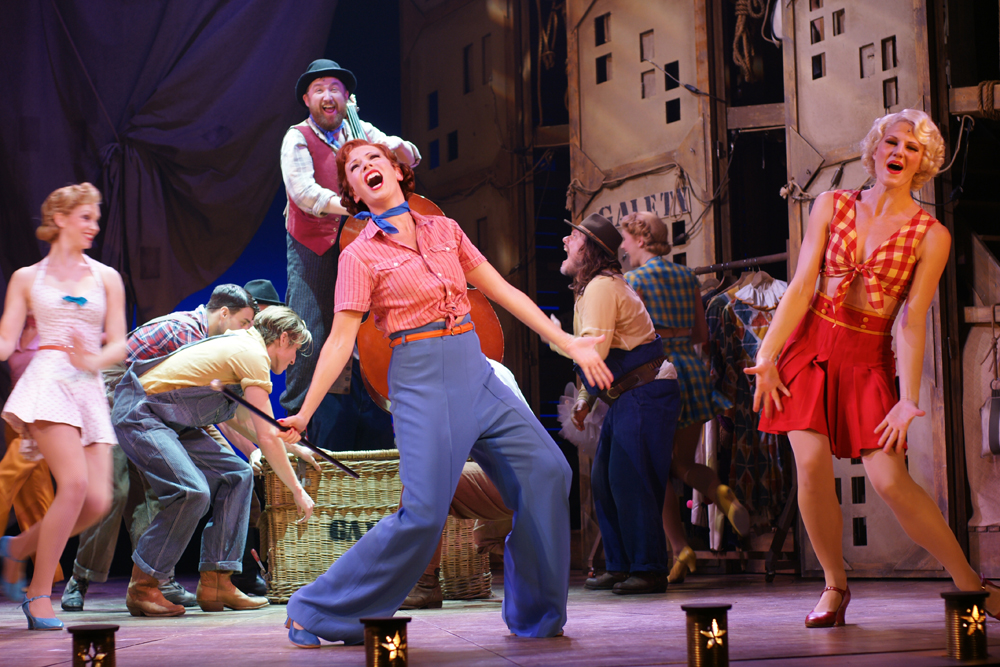

 Civilian Theatre