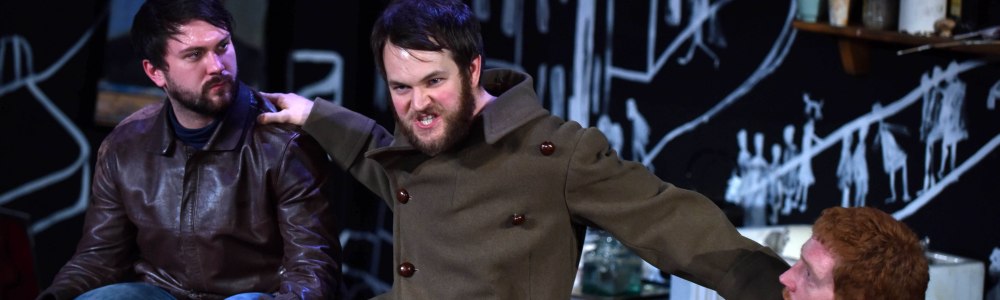
Finding magic in The Tempest

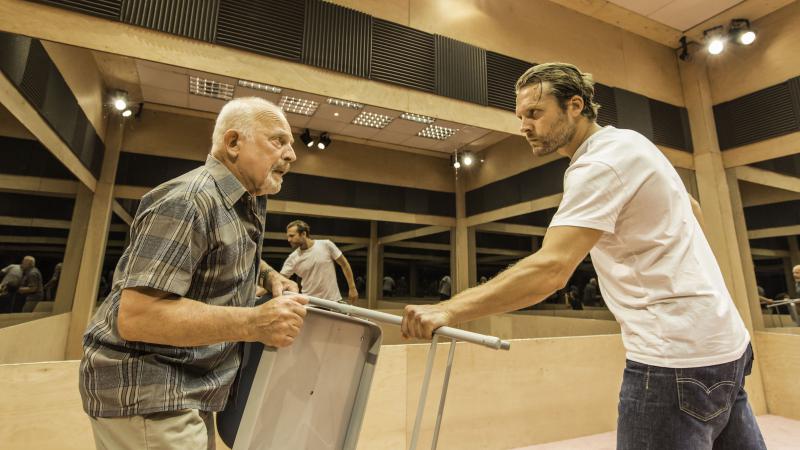
The Tempest – Thick as Thieves @ Hope Theatre, until 18 July 2015 (tickets)

There are those who feel that criticising Shakespeare is the theatrical equivalent of apostasy, and to accept just one flaw is to admit the existence of a crack that could fatally undermine his genius. Yet while zealots shout heresy, it cannot be denied that Shakespeare wrote a lot of plays and that not all are masterpieces. Each century has its favourites but time seems to have led to the The tempest hope theatre 2emergence of an A-list and B-list; in the modern age whither have gone Pericles, King John or Henry VI Parts I, II and III?
But there are problems even among his more popular outings; I would argue that Henry V is a second-rate play enlivened only by Shakespeare’s ability for heart-swelling, grandiose speeches (indeed it is hard to even write the sentence without wanting to refer to how he can ‘stiffen the sinews [and] summon up the blood’). Equally if I could go through life without experiencing the entire post-interval acts from Romeo & Juliet then I would be all the happier for it.

Yet The Tempest has always proved a more challenging option. It is held up as the scholarly choice for greatest Shakespeare play. The temptation
for academic insight is too much to bear. It is his last solo play, his farewell to the stage. Prospero can easily be seen as Shakespeare writing himself into the story. As he waves goodbye to the mysterious magical island, his powers fading, how can it not be seen in this light?

This dry academic interest inevitably strips much of the fun out of the play. The Tempest has magic and monsters, comedy and romance. It starts with a shipwreck and teeters towards tragedy. At the very least it should be entertaining. However too many productions get wrapped up in Prospero and it becomes little more than an opportunity for an actor to wrestle with Shakespeare’s last great part, and get under the skin of the man himself (and if that is the aim then I recommend any actor look no further than the challenge of Edward Bond’s Bingo if they want to take on Shakespeare directly).

Cheek By Jowl’s Russian company produced a superb version in 2011, and they did so through an inventiveness and an absurd but near malicious humour that sits easily with Prospero’s casual cruelty towards Caliban and recognition of Ariel being not far removed from the trickster sprite of Robin Goodfellow. If this production falls short in comparison it is because Cheek By Jowl have spent 20 years building a reputation worthy of generating international acclaim. However Thick of Thieves can be applauded for approaching a challenging play with spirited energy and an appealing ingenuity that makes best use of the limited resources offered by a small black-box space. They have set out to entertain rather than inform, and if I left having learnt little I didn’t already know then I must also admit to leaving having not enjoyed Shakespeare this much for quite some time.
<<Continue to full review>>


The sins of the father

A Number – The Maria @ Young Vic, until 15 August 2015 (tickets)

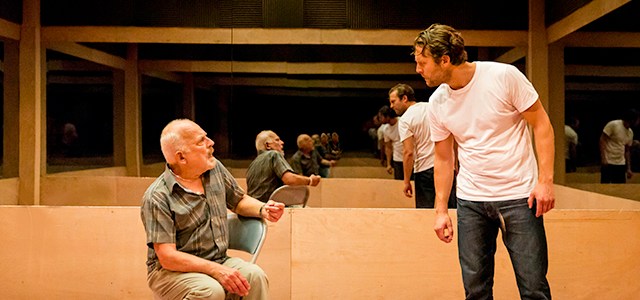
Carol Churchill is a playwright that I always feel I should know more about. She writes clever, spiky, experimental theatre and is one of the rare playwrights to critically engage with themes that toy with what some rather  snobbishly decry as science-fiction. Her consistency over four decades of writing plays for stage and radio make a strong candidate for the title of ‘Britain’s greatest living playwright’ following the death of Harold Pinter in 2008 and that alone is enough to make her worthy of considerable interest.

Whenever I read a description of her plays, such as the mixing of historical and fictional women in Top Girls, the rhyming verse of Serious Money, using the Putney Debates in Light Shining in Buckinghamshire or the Brechtian Vinegar Tom, I cannot help be fascinated by the striking originality and clarity of her vision. She rarely seems to experiment for its own sake; her plays appear to have a cohesive and clear sense of what they want to be and how they want to achieve it.

A Number is an appealing science-fiction two-hander on cloning that mines the idea of how knowledge of a replicated self can impact on a person’s sense of identity, but with Churchill’s characteristic sharp eye also delves into psychoanalytic ideas around the impact that the parental environment has on the adult self.

The play is performed excellently by father-son duo, John and Lex Shrapnel, and is never less than interesting. It takes the form of a series of intense, tightly-framed duologues between the father and versions of his son. The audience is kept off-kilter by jumps in time between scenes, and a lack of framing to the wider world. We must pick up our cues from the conversation as it unfolds in front of us.

It is doubtless Churchill’s intention to leave you slightly unbalanced and trapped within the Father’s personal unravelling. Initially sympathetic, the revelations across the conversations reveal an ever-more monstrous side to his character, and the havoc wreaked by his choices many years ago echo down the generations to the present day. This is brought out most clearly in the last conversation with a version of his son that was entirely separated from the father. He is the most at peace with the idea of being a clone and is the one who had least closeness to the original family.

<<<Continue to full review>>>

…Look on my works, ye Mighty, and despair!’ Nothing beside remains…

Little Malcolm and his struggle against the eunuchsSoggy Arts @ Southwark Playhouse, until 01 August 2015 (tickets)

It takes quite a lot to shake Civilian Theatre from a natural state of relative placidity. However arriving at Southwark Playhouse on a hot Friday evening, after a long day at work, to find out your 20.00 press show will run a shade under 3 hours is enough to test even this reviewer’s equanimity.
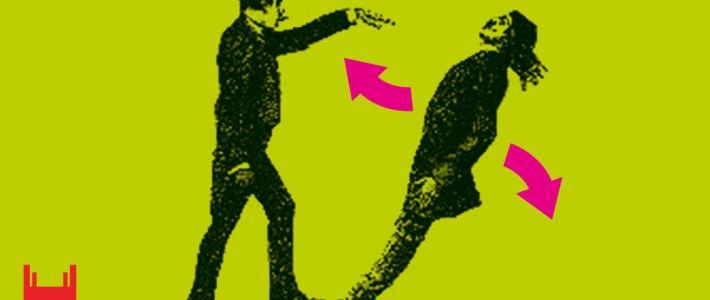
Little Malcolm… is being billed as a lost gem. Well, it was certainly lost. It was an early directing adventure for Mike Leigh that crashed and burned in London, before heading to America where it suffered a similar fate. And god only knows what Americans would made of this strange class and gender satire set around an art school in a northern working class town.

True-HumilityYet it has always had its champions, and was turned into a film starring John Hurt, and produced by George Harrison, which walked off with the Silver Bear at the 1974 Berlin International Film Festival. And then nothing. Malcolm found himself lost in the mists of time until Soggy Arts and Folie a Deux Productions retrieved him and his eunuchs for a 50th anniversary staging.

It gives no pleasure to say that on the basis of this production, Little Malcolm… is less precious gem, and more curate’s egg. David Halliwell has not written a bad play, and parts of it are in fact excellent. He has a rare ear for high prose and often finds a striking harmony when balancing it against the cadences of northern speech patterns. Unfortunately in Little Malcolm… he has taken it upon himself to write three different plays when one would have sufficed. It feels like Halliwell saw this as his only chance to make his mark upon the world, and made sure he included all his ideas at once.

<Continue to full review>

Continuing adventures in Podcast Land

How very exciting (well for me, I will leave further excitement up to reader discretion), after a week hiatus I ended back in the world of podcasts and a repeat visit to the As Yet Unnamed Theatre Podcast. This time play’s under discussion were Face The Music! and An Oak Tree (both previously reviewed on the site), and Violence and Son.

Joining our host, Tim Watson (http://www.londontheatregoer.com), was Nick (Partially Obstructed View), Gareth (http://garethjames.wordpress.com/) and Johnny Fox (www.johnnyfox.co.uk)

You can listen here: As Yet Unnamed Theatre Podcast 

Enjoy (and, as always, thoughts and feedback are welcome)

An assault on the ears: Reviews in handy podcast format

It was probably inevitable that after spending three years forcing diligent readers to consume my witterings through their eyeballs, I would look to find an even easier way to force my views upon people. Handily the perfect opportunity has arrived and all Civilian Theatre had to do was show up.

Earlier this month I went to see the excellent Oresteia at the Almeida Theatre. It is the first part of Rupert Goold’s ‘Almeida Greeks’ season, which will also include The Bakkhai (with Ben Whishaw) and Medea (with Kate Fleetwood). Aeschylus’ tragic trilogy of plays concerning the curse of the House of Atreus has been condensed into one super-play lasting 3hr40min. The time may put a lot of people off, but luckily the podcast is a mere 10min – a much easier proposition.

Civilian Theatre will be writing a more detailed article in due course on Oresteia, but until then you can fix your lugholes on this:

As Yet Unnamed Theatre Podcast (either listen to the whole thing, or the review of Oresteia is about 14min in).

Also taking part was Tim Watson (Host and http://www.londontheatregoer.com),  Phil from the West End Whingers (http://westendwhingers.wordpress.com), Gareth James, (http://garethjames.wordpress.com/), Julie Raby (http://julieraby.com/).

Enjoy (and, as always, thoughts and feedback are welcome)

Whose line was it anyway? A Tim Crouch theatrical experience

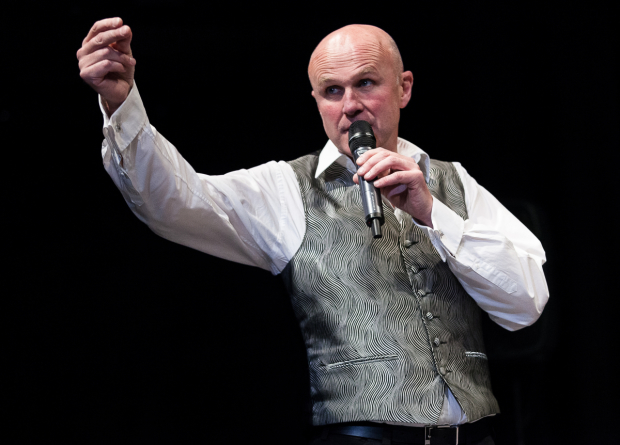
An Oak Tree – Temporary Space @ National Theatre, until 15 July 2015 (Tickets)tim-crouch-97210

Whether you would enjoy An Oak Tree might be best based on the response you’d give on learning that the play is named after a Michael Craig-Martin artwork in which an artist asks the viewer to suppose a glass of water has become a tree, and that Crouch is someone who described theatre as ‘a conceptual artform. It doesn’t need sets, costumes and props, but exists inside an audience’s head’.

There will be many who find the 70-min play – where Crouch performs opposite an actor who he meets an hour before and arrives on stage not having seen the script, or knowing anything about the play – exactly the kind of pretentious garbage that justifies the swingeing cuts currently being delivered to the Arts Council. However those who see in theatre a medium naturally open to the world of almost infinite possibility will surely be invigorated by this revival of an early work from one of the most formally inventive writers of the 21st century.

In recent years we have seen the flowering of a new generation of playwrights, with few ties to the in-yer-face dramatists of the 1990s. Nick Payne, Lucy Prebble and Lucy Kirkwood have burst onto the scene with superbly delicate plays that balance strong writing with inventive design and narrative trickery. Yet for all their skill none have come close to Crouch’s assault on the nature of theatre.

Coming in under the radar, Adler & Gibb – his most high profile play to date – was a shock to the system and a welcome reminder that there are still people willing to use theatre as a means to interrogate itself. It was infuriating, brilliant and radical. Exactly what theatre ought to be.

<Continue to full review>