Snobbish champagne socialites at the Old Vic

High Society – Old Vic Theatre, until 22 August 2015 (Tickets)wpid-wp-1434876973039.jpg

After a decade at the helm, High Society marks Kevin Spacey’s last show in charge of the Old Vic. If Clarence Darrow was a – not unwarranted – gift from Spacey to himself, a much deserved lap of honour that indulged his love of great character parts and allowed the audience to wallow in the sheer magnetism of the man, then High Society is a chance to give the crowds a little sparkle and razzmatazz as he heads out the door.

In a fortuitous piece of scheduling, I headed to the Old Vic just days after seeing a Berlin & Hart musical (Face the Music) staged splendidly in a tiny theatre pub in east London. To watch both in such close proximity only reinforced the gigantic financial disparities in the theatre world. It is clearly evident on the stage, where Maria Friedman (Merrily We Roll Along) deploys pretty much every available bell and whistle to make the musical in-the-round, and also in the murky world of ticket prices – £10 for High Society, £18 for Face The Music – where corporate sponsorship enables incredible cheap tickets in the face of a steep production budget.

As you are sitting in the baking hot auditorium waiting for the second half to start, it is likely you will be thinking that even £10 seemed a little steep. The first half of High Society is a real mish-mash. It suffers from problems everywhere you look; the story takes time to get going as it labours under a endless series of characters being introduced only to be whisked off in search of a plot device. There is a real absence of decent songs and routines before the interval, whilst some of the vocal talent on display is rather uneven. The only exception is Who Wants To Be A Millionaire, a lovely little number that sees Porter’s lyrical wit matched with fun choreography and energetic performances from Jamie Parker and Katherine Pearson.

Then the lights go down, the double bass begins to play and 12 minutes later Nathan M Wright’s superbly choreographed Let’s Misbehave has transformed the evening. It is a fantastic set-piece and one of those glorious numbers that seems as if it will go on and on for the rest of the night. Just as it hits a peak, it will relax before coming back even more impressively with a new routine. This is one of few numbers where the choreography is truly at a West End standard. It even had someone tap-dancing on the top of a piano.

<Continue to full review>

Jade Anouka in Chef @ Soho Theatre

A chef with a tongue as a sharp as a knife

Chef – Soho Theatre, until 04 July 2015 (Tickets)wpid-wp-1434742428681.jpg

There are few things more satisfying to a regular theatre goer than watching an actor emerge into the spotlight. Go and see enough plays and you soon realise that the same familiar faces keep on cropping up. The personal nature of the theatre – the intimacy of the shared space giving a sense of an assumed connection between audience and actor – can lead to a greater sense of investment and emotional connectivity with the actor than you find in film. Seeing actors like Phoebe Waller-Bridge (Mydidae and Fleabag) or Rudi Dharmalingham (The Events and Oresteia) develop has been the biggest privilege of writing this theatre blog over the last 4 years.

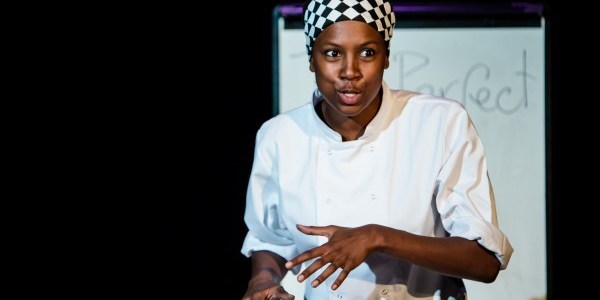
To that list it is safe to add the considerable talents of Jade Anouka (Henry IV and The Vote); currently at Soho Theatre with Sabrina Mahfouz’s Fringe First-award winning Chef. A one-woman show, Chef gives Anouka free range to showcase the considerable skills and highly kinetic performance style that was so captivating as a completely atypical Hotspur in Phyllidia Lloyd’s radical and brilliant Henry IV.

Jade Anouka in Chef @ Soho TheatreAs a reviewer there is a lot of trepidation in viewing a one-person show. It needs an exceptionally high level of writing and acting talent in order to keep an audience from start to finish. Without any actors to bounce lines off there is a risk that the show will soon become one-note and tonally flat. A poor script can sometimes be hidden by action between characters but it dies on the mouth of even a talented actor, whilst a poor actor trying to deliver a strong script is one of the more painful theatrical experiences.


Sabrina Mahfouz is a recipient of a Sky Arts Scholarship Award for Poetry, and this background may be what grounds the play in the rhythms and structures of performance poetry. Whilst clearly a play, it feels highly sensitive to the flow of language, and is at times more interested in the beauty of language than capturing the naturalism of delivery.

It is unlikely that anyone would say “I’d never been in love / but I decided that I’d know when I was / because the man would remind of the way/ seagulls glide out of stalactite clouds, / suddenly, / smoothly, / that’s how he’d find me” but within the show – delivered after describing how she had left her estate and joined her dad on a fishing boat – it is given the dreamy lyrical wonder of someone who has just begun to realise the limitations of her world.

<Continue to full review>

Small is beautiful in first-class fringe revival

Face The Music – All Star Productions @ Ye Olde Rose and Crown, until 03 July 2015 (tickets)

Sometimes, through no fault of their own, theatres are so indelibly linked with a traumatic experience that all plays there become tarred by association. Three years ago I sat in a sweltering black box theatre above the Rose and Crown and watched WAG: The Musical – a show so terrible it effectively caused me to avoidwpid-wp-1434282633307.jpg my local Walthamstow-based theatre ever since.

During that time All Star Productions have continued to develop their reputation as purveyors of solid fringe productions of near forgotten musicals. Having seen a production of Howard Goodall’s Girlfriends that showed the limitations of the venue alongside the strength of the performances, the team had rather fallen off my radar during to the horror of the singing footballers’ wives.

However whispers across the blogging sphere in the intervening years had led me to believe All Star Productions had been going from strength to strength, and earlier this year they scored a West End transfer when Superman: The Musical made it to the Leicester Square theatre. So when an unexpected, but wholly welcomed, invitation to accompany View From The Gods to the depths of E17 to watch an Irving Berlin & Moss Hart musical that I had not previously heard of, Civilian Theatre finally felt it was time to seek closure on the past.

All Star Productions should be lauded for their dedication for restaging the unknown and the forgotten. I would imagine it is a rather canny financial position as well – one would think the staging rights to an Irving Berlin musical not performed for 70 years are rather less than for Anything Goes. It also doesn’t come weighted with expectation and if it proves to be a success then you may find yourself – well if not Cameron Mackintosh rich – then at least as rich as Croesus.

Face The Music has the distinction of being the first collaboration between Berlin & Hart and is the first professional UK staging of the show.  These facts make the show worthy of interest but are certainly not enough to praise it. And the potential downside of All Star Productions dedication is obvious – there may well be good reasons why a musical has sat on the shelf for 70 years.

While it may lack the absolute belters that can be found in the best works of both Berlin & Hart, there are still some lovely tunes in here. If You Believe closes the first half and is a thumping, toe-tapping cod-evangelical feel that musical devotees will find has distinct echoes of Blow, Gabriel, Blow, that wonderful number which kicks-off the second half of Anything Goes. Equally songs like Let’s Have Another Cup of Coffee, My Beautiful Rhinestone Cowboy and Manhattan Madness are not ground-breaking numbers but they do tend to be quite delightful (or given who we are talking about, possibly it is in fact de-lovely).

<Continue to full review>

Scotch & Soda leaves you in high spirits

Scotch & Soda feat. The Crusty Suitcase Band – Spiegeltent @ London Wonderground, until 02 August 2015 (tickets)

Three years after launching with their immediately identifiable brand of well-financed, 12a-rated, corporately-sponsored debauchery aimed squarely at a target market of well-heeled financiers from Clapham and people who consider reading 50 Shades of Grey on the bus the height of risqué behaviour, London Wonderground has begun to feel as much a Thames-side institution as the statue people who so bafflingly thrill tourists with the amazing ability to stand still.

Yet until now Civilian Theatre has never made the trip across the river to experience the famous Spiegeltent and its carnival of delights and vigilant readers may have noticed the faint whiff of cynicism rising from the above paragraph. I should make clear this is in no way is aimed at the performers – Scotch & Soda, or any of those taking part this summer. Having seen some of the acts perform elsewhere, the talent is not to be doubted.

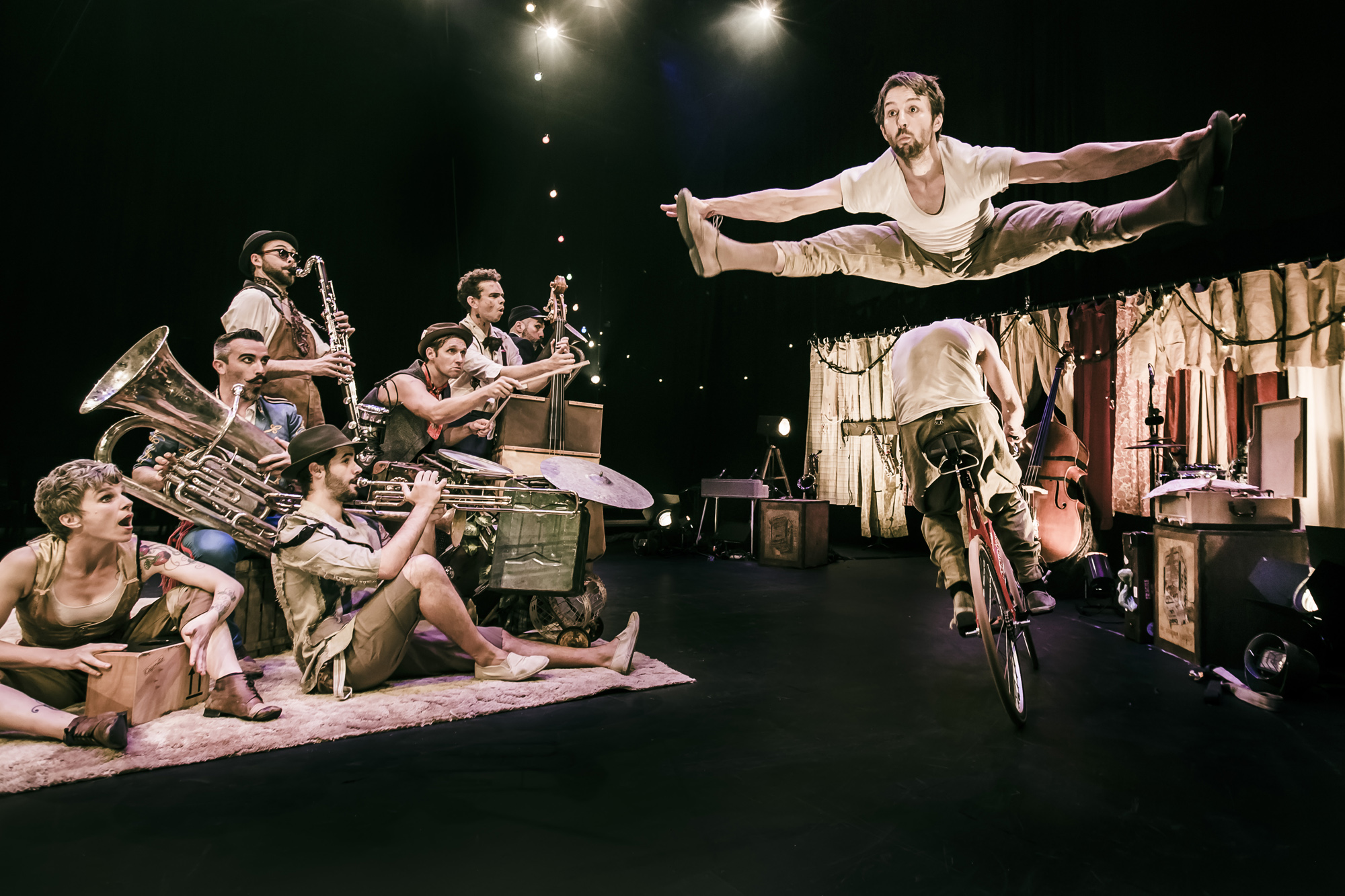
Scotch and Soda. Credit Sean Young Photography (4)No, my main issue with the London Wonderground experience is struggling to avoid the chuckling charlies braying their stock portfolios at one another as they think nothing of throwing down another £7 on a glass of Pimms, or forking out £10 for a souvenir programme (7 pages of high gloss photos). This is not a show for those looking to manage their budgets. A family of four would be hard pressed to be spending less than £120 for a show that lasts 70 minutes (and that assumes calls for ice creams, cokes or glasses of wine are resisted).

All that said, Scotch & Soda is a highly entertaining show. The Australian troupe is a mixture of skilled circus performers and fantastically enjoyable horn and drum infused jazz. Their style is perhaps inspired by the idea of early 20th century touring circuses – a hipster meets hillbilly confection where moustaches meet muscles, where a jug-band meets a classically trained double-bassist.

<Continue to full review>


Watch a little video courtesy of our friends at Official Theatre


Staring into the abyss…

This is how we die Battersea Arts Centre, until 14 November 2014 (Tickets)Christopher Brett Bailey_THIS IS HOW WE DIE_Credit Jemima Yong

The extent to which I was totally blown away by Christopher Brett Bailey’s performance of This is how we die last autumn can be seen in his appearance alongside Mark Strong and Tim Piggott-Smith in Civilian Theatre’s annual end-of-year awards bonanza. Indeed his blistering quick, laceratingly acerbic but impressively managed style was enough to edge out Simon Russell Beale’s King Lear for a place on the Best Actor shortlist. It also holds the distinction – along with Trevor Nunn’s glorious production of Anything Goes, Kneehigh’s Cymbeline and an amateur production of Dürrenmatt The Visit – of being one of only a very small number of productions I have seen twice.

The following review is taken from the Autumn 2014 performance at the Battersea Arts Centre. On reflection my opinion remains the same. It is a highly impressive work. The writing feels like it has been tightened slightly and the performance style has gained a little more subtlety (although I do feel it suffers from such an intense, fast, loud beginning that it does struggle at times to provide enough variation in tone). Bailey has the measure of the text and has peppered the text with language that provokes seeming incongruities. There is a delightful play on mouse and mouth that suckers the audience into thinking that Bailey has slipped on his material but in fact is an entirely knowing absurdist thread to a poem. Seeing it a second time does provide an opportunity to allow some of the imagery to wash over you rather than frantically trying to keep up with the rapid fire delivery. I would highly recommend that fans of the show think about a return trip.


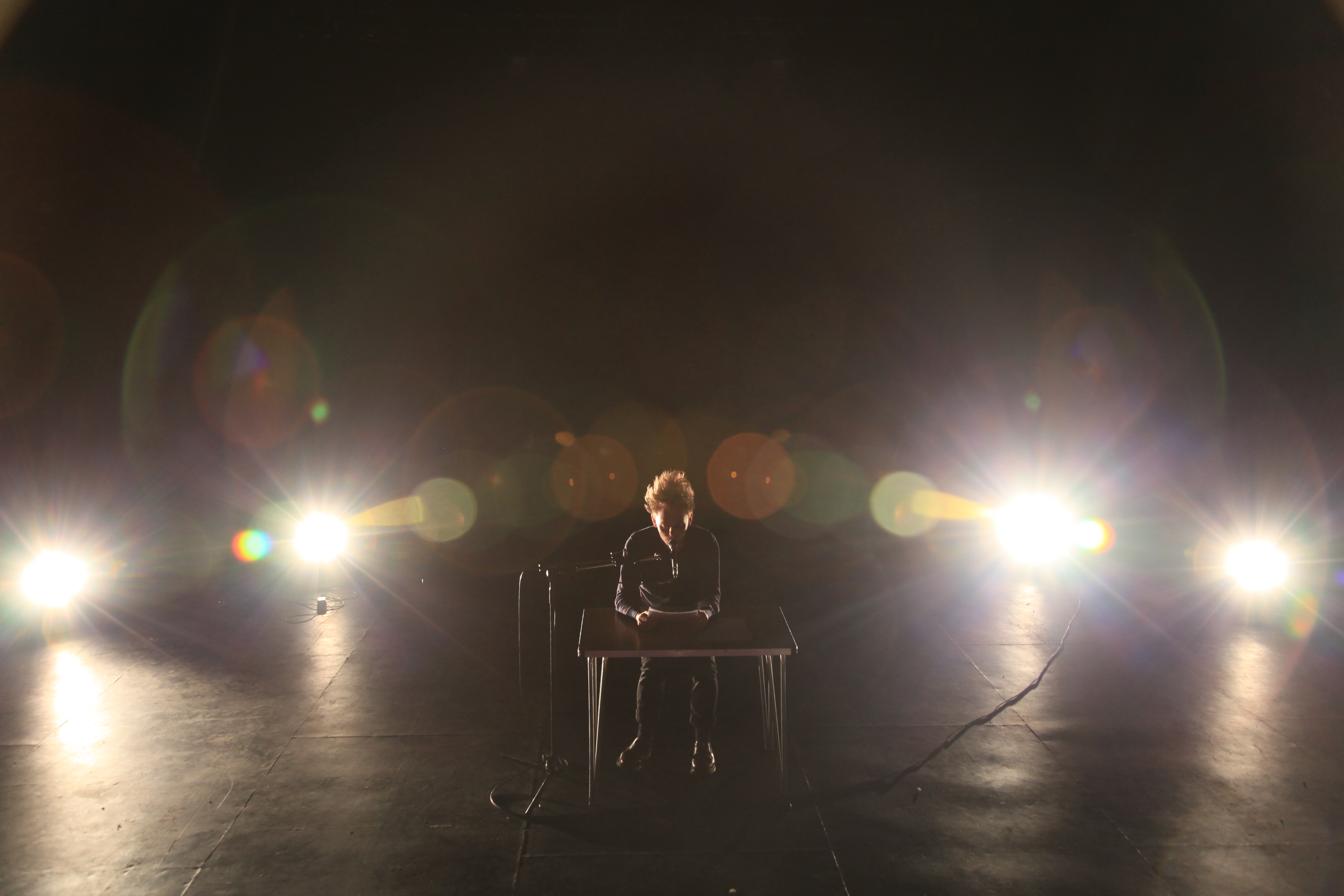
At the end of Christopher Brett Bailey’s performance of This is how we die the audience are subjected to – and it is a case of being subjected to rather than being passive observers of – a sonic assault that is best imagined as the sound of an imploding, decaying universe and the tentative hope that something new and beautiful can rise from the fading flickering light. The stage lights turn their impassive bulbs on the audience, bathing the observers in a harsh, unforgiving light whilst ear-shattering, fuzzy rhythms rise and fall, roll and repeat, looping and overlaying motifs amongst discordant sounds. It is the white-noise of paranoia and of an overwhelmingly claustrophobic hopelessness. And then suddenly, within this kaleidoscope of fear, emerges the purity of higher-pitched strings, cutting through the chaos and providing the possibility of escape.

Video Doc Still 2014-07-09 at 17.27.44This antagonistic ending, this attritional warfare waged between performer and observer is only eight minutes long but it could easily have been eighty. It is a wonderfully considered reflection and response to the sixty minutes that come before, and adds to the impression that Christopher Brett Bailey has talents and intelligence far beyond being a highly articulate performer blessed with startling verbal dexterity.

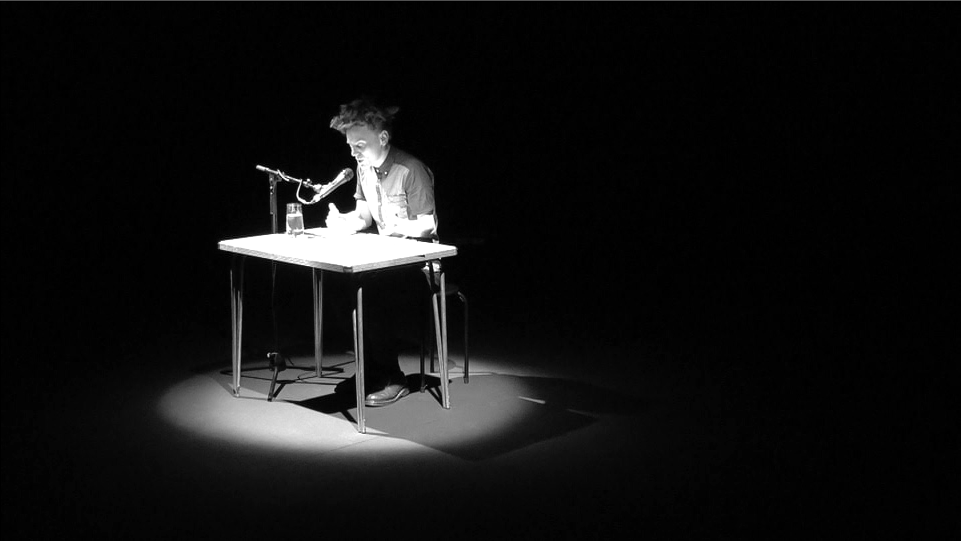
Having not previously heard of Bailey, and without looking at the show’s synopsis, I hadn’t really considered what to expect. Whatever I might have expected wouldn’t have come close to the reality. This is a performance that is felt rather than seen. The audience are almost immaterial; nothing has been created for our benefit. The stagecraft is defiantly un-staged. It is a man at a desk, talking, talking and continuing to talk, from notes, for sixty minutes, without stopping, almost without breathing, he continues to talk, to himself, to the walls, to the room, whether the audience is in the room or not, it feels as if he would continue to talk, possibly until all words had become exhausted.

It leaves you in a state of mental and physical exhaustion. Listening to the dialogue, focusing on the words is mentally draining, but there is also palpable tension, as a result of a deliberately abrasive delivery style, that creates an adrenalin rush so intense that by the end of performance you leave the auditorium woozy, unsteady and in need of air.

Bailey arrives as an unassuming, almost diffident presence – perhaps the only hint of what is to come is the resemblance to a young David Lynch – but as soon as he begins he exerts a magnetism that pulls in whatever direction the flight of fancy will take him. He is a remarkably assured performer and is blessed with a lyrical nimbleness that allows what, are assumed to be, tightly crafted pieces the air of stream-of-consciousness dialogue.

<Continue to full review>

Some mothers do ‘ave ’em

Like Mother, Like Daughter – Complicite Creative Learning and Why Not Theatre @ Battersea Arts Centre, until 06 June 2015 (Returns only)

Occasionally the hectic nature of theatre booking throws up some delightfully apposite pairings. A fallow period has meant that, by chance rather by design, Everyman at the National has been wpid-wp-1432982917946.jpgfollowed by Like Mother, Like Daughter at the Battersea Arts Centre. It would be difficult to find two plays that better juxtapose the potential of theatre. Everyman was theatre as spectacle. Vast and impressive; the video and sound design had a forceful muscularity that carried through the choreography and into Chiwetel Ejiofor’s powerful central performance. Like Mother, Like Daughter was theatre as communal activity. All theatre is staged and performed but here there is no interest in bombast or special effects. It has confidence in the minimalism of its approach, and in the power of the stories it has to tell.

For all of Everyman’s impressive showmanship, Like Mother, Like Daughter is the more radical. It asks question of the form that a theatrical experience should take, and of the functional purpose of the medium. It opens with an informal gallery containing a series of mood boards identifying the performers, their shared lives and the rehearsal process. The audience are encouraged to browse the profiles and to learn more about the background to the relationships between the mother/daughter pairings. It is theatre that puts the viewer in control. We choose how much information we want to hold about those taking part rather than having their stories hidden behind the paywall of a programme, or delivered directly to us during the performance process.

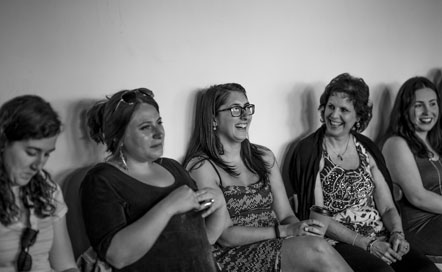
We then watch the non-actors, real-life mother/daughter pairings, answer randomly assigned questions. Is this theatre or just voyeurism? Is it therapy or is it drama? Watching it, the answer is both. The reactions to hearing the question, the revealing nature of the answers – for the audience this is pure theatre, for the performer it must surely be a form of therapy.

The setting is minimal. During the show, the participants sit round a dining table and the audience around them. It feels intrusive – like an ad executive watching a focus group – but it does not faze those taking part, who react with good humour and a complete openness to questions thrown at them. The age dynamics, and how they shape responses and how they interact with the audience are fascinating. It covers teenagers through to those old enough to remember wartime Britain – some are used to sharing their lives on social media whilst others come from more a more closed era

It ends with a communal meal. Audience members join with participants. It is an opportunity for reflection and to ask further questions of those taking part. The understated simplicity, the lack of pretence and the emotional honesty that comes from non-actors sharing their real lives helps lower the barriers between viewer and performer, creates a discussion and makes it a genuinely participatory experience.

<<Continue to full review and to watch a trailer>>