In the beginning we are full of a nervous expectation. In the end we are full of a crushing disappointment. In the middle we find a soufflé – an indulgent and elaborate work that looks more and more underwhelming as time goes by.
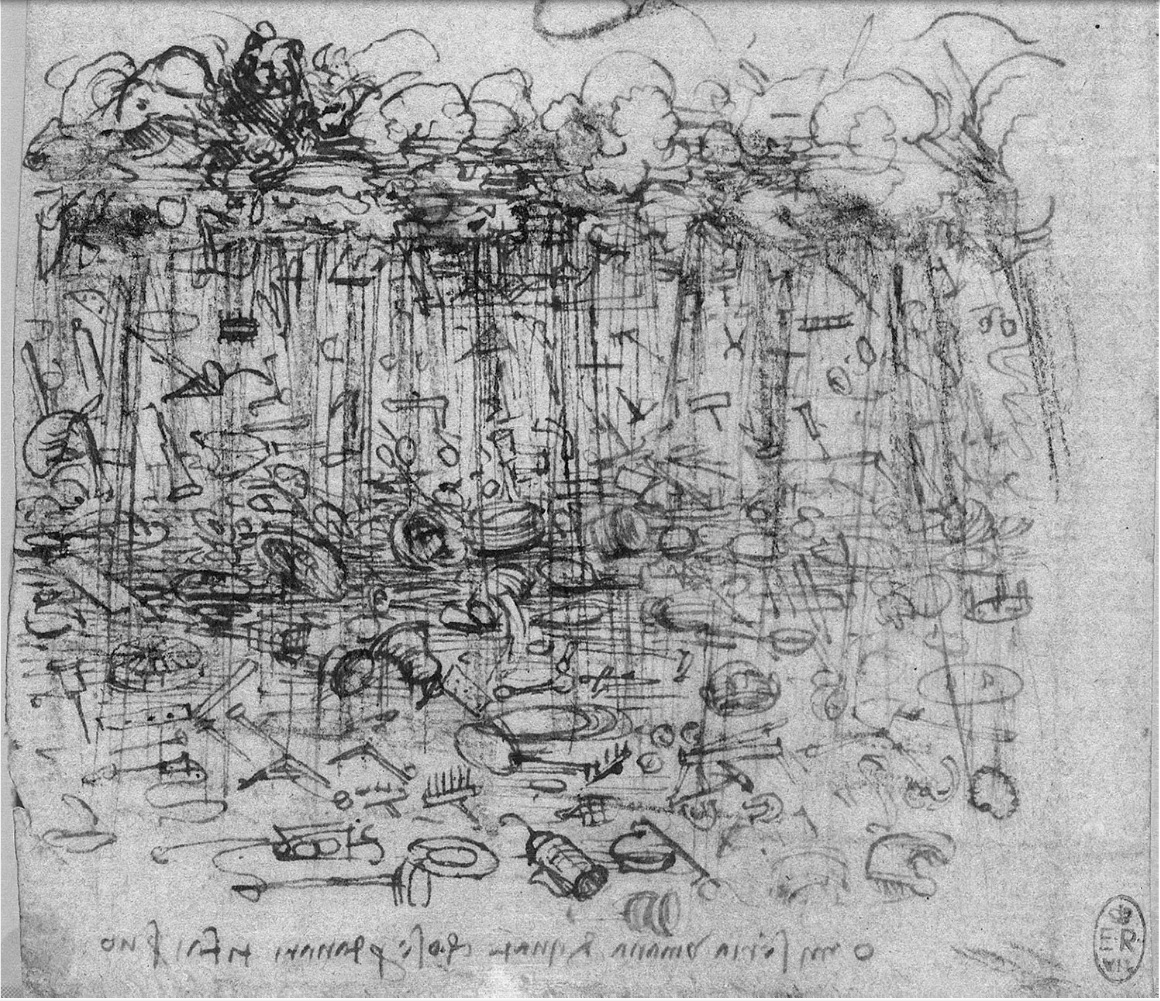
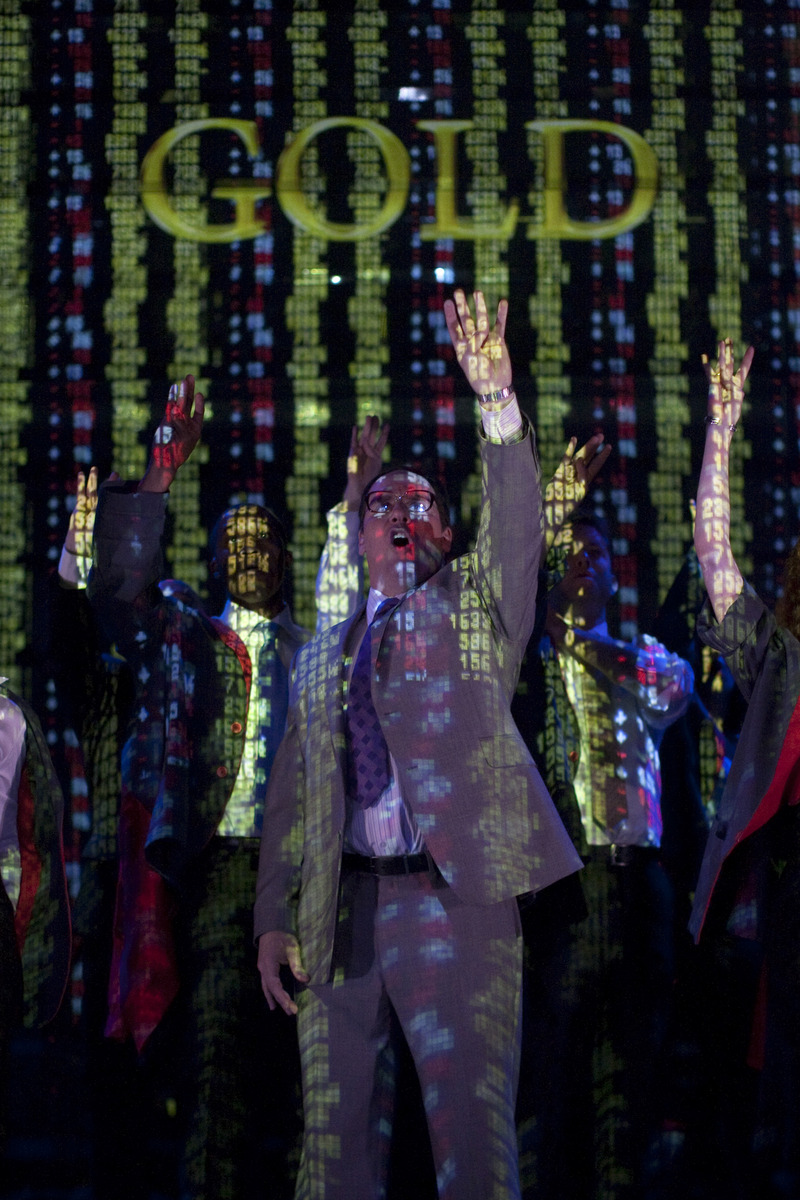
It is difficult to describe how many things are wrong with dreamthinkspeak’s attempt to weave inspiration from Leonardo Da Vinci’s ‘A Cloudburst of Material Possessions’ into a multi-stranded meditation on a world at a supposed crux of development and chaos.
It is difficult to describe because that would have entailed dreamthinkspeak feeling it was necessary to share any of their ideas with the audience rather than thinking that a hotchpotch collection of site-specific installations mixed with cod-philosophy and an imagined future that seemed startlingly reminiscent of a mid-1980’s episode of Tomorrows World was an acceptable substitute.
At the end of the audience’s ‘journey’ (even the word makes me cringe) you are handed a leaflet outlining the thinking behind what you have just seen. It is quite a useful addition if for no other reason than for the fact that it demonstrates that the cringingly pretentious claptrap that you have spent the last 70 minutes watching seem just as cringingly pretentious when written down.
‘John the Baptist…seems to be ever present. Is he pointing the way to The Second Coming, to our death, to the end-of-world, or is he a false prophet who leads us on then abandons us to an uncertain fate? Does the slightly strange man obsessed with lemons have the answers? He seems to be dreaming of a new kind of Eden. But is it a real or a comprised paradise? The final installation mixes the organic with rudimentary technology but is it really the way forward?”
Théâtre de la Ville–Paris’ production of Ionesco’s Rhinoceros is practically faultless and it is with considerable surprise to discover that it has taken nearly nine years for it to have crossed the Channel; it is very rare for a near-decade old show to appear to contain so much vitality. It is an evening at the theatre that manages to achieve that rarest of blends – an exquisite play meeting an exceptional production. Over the last five years I can think of just two other productions that could lay claim to being of a similar calibre; Jez Butterworth’s Jerusalem anchored by Mark Rylance’s ‘Rooster’ Byron and Rupert Goold’s production of Macbeth with Patrick Stewart and Kate Fleetwood.
We are clearly operating in exulted company and it is perhaps telling that despite barriers of style, language and time the three productions share common traits. They all rely on a strong central male character who across the course of the narrative embarks on what we might recognise as an existential crisis that leads them to stand against the forces of change and modernity. To a greater or lesser extent they are the architects of their own downfall, as they each retain a strong moral code that is a major driver for action and embeds a sense of duty that can seem inexplicable to others, and that will cause them to follow a path that can only lead to isolation and destruction.
Each of the productions also share a perfectly pitched casting for its lead character; there is not one moment where Rylance doesn’t fully convince as Rooster, a man whose self-important sense of being part of a grander element of England’s narrative blinds him – metaphorically and eventually all too literally – to the modern culture of the nation. Stewart, as I have written before, captures the transition of Macbeth from the brutally effective soldier to his existential crisis point and onwards to an acceptance of predetermined resolution.
In Théâtre de la Ville–Paris’ production we have a central character of equally moral and dramatic weight. Serge Maggiani wonderfully captures the crumpled, unassuming and apathetic Bérenger;a paradoxical figure who is both an everyman and of such inconsequence that his friend, Dudard,feels mindful to provide him with a tie and gives him stern lectures on his social habits. Ionesco has caught in Bérenger a figure that everyone will recognise; the amiable friend who like a drink, and likes an argument alongside it.
Maggiani manages to bring alive a character that is by turns infuriating and charming, capable of great erudition but also a boorish drunk. There is weariness in his actions, a perpetual shrug on his shoulders as he lets life pass him by with a seemingly chronic disregard for the social conventions of those around him. Often striking a rather pathetic figure in sober company, his transformation is a reflection of Kantian virtue as it goes against our sense of his natural manner; where those around him, be they of stronger moral purpose or following a rationalistic instinct, choose to join the Rhinoceroses, Bérenger doggedly becomes the contrarian and rejects the easy path of transformation in favour of humanity.
Excellent news this week as Rupert Goold was announced the new artistic director of the Almeida Theatre, following Michael Attenborough hugely successful tenure. Now firmly established as one of the most influential theatres that bridge the gap between the West End and the regions, it is difficult to remember that 11 years ago the Almeida was running a sizable deficit and that Attenborough not only turned this on its head but did so whilst also almost doubling the number of new productions.
Rupert Goold has a challenge on his hands but the freedom of the role, and his own prior knowledge of the space through working on Headlong co-productions, allows him to enter on a firm footing. His own uniquely stylistic flair, as recognisable in theatre as Tarintino is in film, make the possibility of creative control over an entire programme a most enticing one proposition for the audience.
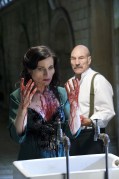
Goold’s Macbeth was praised to the heavens by critics on both sides of the Atlantic; brilliantly designed, blessed with the stand-out performance from Patrick Stewart’s illustrious career and one more than equalled by Kate Fleetwood’s splendid Lady Macbeth. Goold’s production manages to maintain the golden thread that so often eludes directors of style; every element contributes something to the whole enabling the sum to be so much greater than the parts. Most pleasingly, it is also available for anyone to see as it was expertly captured for theBBC; rather sickeningly Goold proves himself to be equally at home in this medium, and the transfer retains a spirit and vitality that was sadly lacking in the televised version of Hamlet with David Tennant.
The extent to which I think this is seminal viewing is the fact that I am prepared to suggest buying something from Amazon in order to do so – boycott be damned, it is just too good.
Rupert Goold is only the latest in a line of seat-swapping that has amounted to a seismic shift in the theatrical landscape. The last couple of years have come to feel like a pivotal moment for the next generation to pick up the baton from their predecessors. Coinciding with a new political landscape, we are seeing the emergence of a new wave of directors and producers who will be charged with guiding British theatre through the murky quagmire of reduced funding and a more oppositional approach to politics.
It is too early to say but it could mean a return to more overt political dramas. One of the problems of the Labour regime is that they remained difficult to criticise following the experience of almost twenty years of Conservative power – and even more so when they pumped more money into the cultural landscape than it had seen in years. Where Labour were criticised, most excoriatingly by David Hare, was on foreign policy, or more accurately their foreign policy in Iraq – less was said about interventions in Sierra Leone and Kosovo.
During the Labour years it is hard to think of many plays that really sought to tackle domestic policy until the financial meltdown made everyone realise how far the country had sleepwalked into inequality under the watchful eyes of a supposedly centre-left government. One can only hope that the shake-up can also dislodge the art of the politics and reveal a new generation of dramatists less concerned with the ‘I’ than the ‘We’.
The most high profile, and contested, position up-for-grabs was that to succeed Michael Boyd as Artistic Director at the Royal Shakespeare Company. Whilst the National Theatre has more power and money, it is hard to dispute the RSC still carries the most prestige – flying the flag for Shakespeare and under Boyd’s leadership emerging from the mire with a reinvigorated sense of self. It is questionable whether anyone other than Gregory Doran had a look in, and the press release is rather telling ‘‘Greg Doran is a perfect choice for the RSC and is well known to all our audiences. His long history with the Company[…]’. It contains every impression of wanting to promote from within and maintaining a sense of continuity in a company that has too often lost its focus. Gregory Doran is without doubt an exceptional director but could well be seen as a safe pair of hands. However is this a bad thing when dealing with Shakespeare? Every year there will be attempts to reinvent Shakespeare for the modern age, most will be terrible and a few will not. In many ways it is much harder to breathe life into more traditional staging that are more interested in the text than in assuming what Shakespeare may have meant the text to mean.
Continuing outside of London, but yet further North, the National Theatre of Scotland has announced that Laurie Sansom will take over from Vicky Featherstone – herself off to the Royal Court to keep the merry-go-round spinning. The National Theatres’ of Wales and Scotland are probably the most important, and successful, developments in British theatre over the last 15 years. Vicky Featherstone was a hugely influential part of that culture of success, and was instrumental in bringing the widely acclaimed Black Watch to the stage, and the hugely entertaining Alan Cumming one-man Macbeth.
It is a shame that her departure was partly overshadowed by claims of a parochial attitude among the Theatre’s management but one hopes that they Royal Court will be the chief beneficiary of the time that she has spent outside of London. As an added intrigue, the poaching of Lucy Davies from the National Theatre of Wales to be an executive director at the Royal Court means that both have suffered a significant loss of leadership and one hopes that a firm hand is kept on the rudder of both organisations.
And the final move, and probably the most written about, is that of Josie Rourke taking the reigns at the Donmar Warehouse. Already a year into the programme we have seen an interesting array of productions that, if not setting the world alight are at least suggestive of a non-confirmist mindset. Durrenmatt’s The Physicists is not a play that has aged gracefully but it is still good to see it revived, whilst an all-female Julius Caesar may have caught some predictable flak but it provides challenge and most importantly provides new insight into the group dynamic of political leadership that a traditional cast production cannot achieve. It does feel like we are still waiting for Rourke to stamp her authority on her tenure but it also feels like that production is not far away.
Old Times – Harold Pinter Theatre, until Saturday 06 April [Tickets]
There is nothing wrong with leaving a theatre perplexed. Shakespeare, Ibsen or Chekov may have been storytellers of the highest order, their plays a painstaking work of characters and plots woven together until the strands hang like a medieval tapestry; solid but exquisite. However the 20th century saw the emergence of new writers and new forms; those who use who would use character and language to explore mood and atmosphere. The results of these investigations are equally exquisite but the strands are of gossamer silk and as such one wrong move can destroy their beautiful fragility.
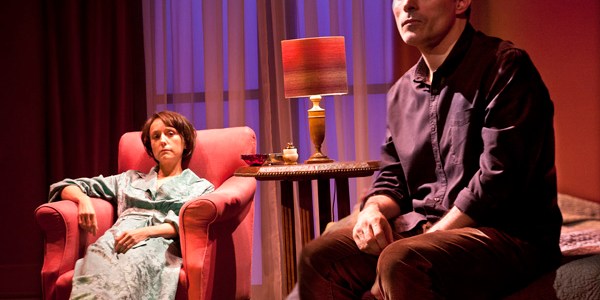
Old Times, written by Pinter in 1971, sits in the middle of his plays that explore ambiguous themes of memory and remembering and that sees characters interrogate their past lives from a present that often appears to exist in a meta-physical hinterland. For his next play, No Mans Land, Pinter would go back to the same ideas again and turn them into the great play of this period of his career.
There is nothing particularly wrong about Old Times but if it is a masterpiece, it is one that is in a minor-key. You get the sense of a playwright stretching out, prodding at ideas that require deeper exploration and as a result you get semi-formed fragments that burst fitfully into life as Pinter’s ability to generate unease through the rhythm of language comes to the surface. However there also exist oddities that seem to jar and where his trademark shifts in tone and interruption appear enforced.
The meaning of the play may be ambiguous but it seems, in Ian Rickson’s decision to alternate the roles of Anna/Kate’s between Kristin Scott Thomas and Lia Williams, that he is following in the interpretation that suggests Anna may be a figment of Kate’s imagination – or even a psychological reference point to an older part of the life that she felt it necessary to ‘kill’ off when marrying Deeley.
One of the great problems that theatre, and theatre criticism, has always faced is it suffers from an intrinsic impermanence, an ethereal nature that is born out of the nature of live performances. Of course it is exactly these elements that make theatre such a thrilling experience, which gives it a sense of immediacy and danger that cannot be matched by film or TV – despite their ability to provide a much more realistic sense of place that doesn’t require the active suspension of disbelief.
Every night the audience – be it two, twenty, two hundred or two thousand – share an experience that can never be replicated. Performance to performance will continue to be different, even with the same cast, and once a play ends its run, or changes it cast, something is fundamentally lost that cannot be reclaimed. A great play may be revived but a great production must disappear and only be retold through the memories of those who witnessed it.
Books have been written about the ground-breaking nature of Peter Brook’s production of ‘A Midsummer Night’s Dream’ but there is no way to recreate the sensation of what it must have been like for those who were there and who, perhaps unwittingly and at the time unknowingly, were experiencing a revolution in what it means to stage Shakespeare.
It is a sign of how the internet has so transformed how people approach the consummation of information that this feels like it could be a problem. Prior to filesharing, legal or illegal, people were able to rent videos but there was a cost attached to it. Music was even more difficult to get hold of – it could be rented from the library but obscure music had to be tracked down or saved up to buy. In the era of Youtube and Spotify the cost of consumption has fallen to a virtual pittance and, either as a result of or alongside this, a generation has developed in a world where it is entirely possible to take a magpie approach to culture. Why should we look forward when all the greats of the past are so easily accessible?
The tribal sense of fealty to ‘your’ music – the mods, the goths, the new romantics, the punks – appears to have been lost to a wave of people who can happily listen to The Who, The Cure and Ultravox whilst intermittently switching to the best bits of Blood on the Tracks and A Kind of Blue.
It seems it is not enough to live within your own culture when you can absorb it from all times. The question that it seems to pose is whether this is making us fundamentally conservative – looking back to the past for validation of our choices rather than pushing into new territory – or does it allow for a much more rounded sense of the now by looking back to understand how we have got to where ‘here’ is?
Theatre is slowly joining other cultural streams in sharing its back catalogue – whether willingly as through the quite wonderful Digital Theatre – or by the army of users playing little caution to copyright and posting videos to Youtube. The argument that it builds in an intrinsic conservatism is worrying and not without merit, I think there is a greater value in exposing theatre to a wider, global audience. Theatre has been so limited, far more than TV, film or music, by the constraints of time and place that the ability to breakdown these boundaries through the internet are only to be applauded.
Youtube captures an audience that might not experience the theatre in any other context– and to spend a life without even an awareness of playwrights of the power of Pinter, Arthur Miller, Martin Crimp or John Osborne or all the rest?
What drove these musings was the unexpected treat of receiving The Caretakerfor Christmas. Having seen it twice on stage, it was a delight to suddenly have in my hands the chance of watching two-thirds of the original cast and also, if Donald Pleasance as Davies and Alan Bates as Mick weren’t quite enough, throwing in Robert Shaw as Aston.
It is opportunities such as this that underpin why looking back is so important. Superb actors in a seminal play by one of our greatest playwrights – these are the things that should be recorded and stored for all time. It certainly isn’t perfect – it has been opened out so that scenes take place outside (even if it was adapted by Pinter it still feels like a mistake and a sop to the financiers) and there is a certain boxiness to the interior scenes which bear the hallmarks of 60’s TV.
However when you have the opportunity to see an actor of the calibre of Robert Shaw giving an absolutely chilling rendition of Aston’s monologue about being admitted to the mental hospital the problems of the staging disappear into the background and you are lost, transfixed, in Pinter’s overpoweringly direct dialogue that always contains such an eerie and unquantifiable sense of menace.
This sense of menace is framed even more clearly in the exchanges between Mick and Davies. Mick’s baiting of Davies in ‘You remind of a man…’ is both comic and terrifying in equal measure and highlights Pinter’s exceptional ability to create a disquieting unease in everyday conversations. The clip below is not the best but it does show-off the talents of Donald Pleasance and Alan Bates in giving full range to the verbal dexterity of Pinter’s dialogue. Mick expertly controls the conversational flow – switching between attack and defence so that Davies is continually thrown off-balance and creating a palpable air of tension for the audience despite revealing very little.
One of the more interesting aspects of going to watch a lot of theatre is the sight of an idea dusted off to be given a new lease of life and then mainstreamed across London until audiences get tired of it again. The current default
position doing the rounds is that staple motif of directors looking for a fresh angle to breathe life into classic texts; playing the play as a play within a play.
Last year Ian Rickson’s Hamletwas set in the world of 1970’s psychiatry and the action unfolded with references abound to RD Laing, Phyllida Lloyd’s Julius Caesar – currently at the Donmar – is set within the confines of a women’s prison and, not having yet seen it, one would imagine that power structures of the play reflect upon the institutional setting. Joe Hill-Gibbin’s take on The Changeling – Thomas Middleton’s and William Rowley’s Jacobean tragedy – appears to be set within a mental institute with the audience taking on the role of paying guests.
The advantage of doing this is that it liberates the text from the confines of the period in which it was written and it allows space for allusions and references that would not otherwise be possible. The criticism is equally obvious – directorial authority runs roughshod over the intentions of the playwright and their director’s decision-making becomes the critical factor in the production.
This is less of a problem for The Changeling – a play where the plot is so bizarre and bloody that it is hard to understand how it could ever be played with serious intent, seemingly more suited to the plays of Le Theatre du Grand-Guignol. Yet there is an enduring popularity to Jacobean tragedy that seems to be shared by mass audiences and critics alike. The revival of The Changeling has been broadly welcomed, whilst Cheek by Jowl’s equally modern take on ‘Tis Pity She’s A Whore was a critical success and tickets for Punchdrunk’s unique, if fantastically over-hyped, production of The Duchess of Malfi in an abandoned Docklands office block were like gold-dust.
 ent and chaos.



 Civilian Theatre