Olivier Awards: Runners and Riders and Early Fallers

Last week the nominations for the Olivier Awards were revealed and if its place at the end of the long awards season means it is an unlikely place to find many surprises, the shortlist does provide potential of scope for eyebrow raising omissions. Most people in theatre – who don’t work for the RSC – will be mightily relived that the Matilda juggernaut is no longer crush all of the competition. Looking across the nominations, it seems impossible that anything will come close to the level of dominance that Matilda achieved. The leading contender, ‘The Curious Incident of the Dog in the Night Time, has eight nominations  and could conceivably end up with five awards given the excellent technical work underpinning the show.

As usual the subsidised sector leads the nominations but the private sector is not totally unrepresented. However the lasting impression of the shortlist is the absence of controversy and also the absence of anything that really stands out. For the first time in a number of year there doesn’t seem to be a new play that blew everyone away or a revival that places an actor at the very top of their game.

Thinking back through the last few Best Actor winners, the Mark Rylance of Twelve Night does not appear comparable to the Mark Rylance of Jerusalem. James McAvoy is good but not near the level of Chiwetel Ejiofor in the 2008 Othello.  Rupert Everett appears to be getting rave reviews in The Judas Tree and good easily be the dark horse in the pack for a play that continues to build an unstoppable momentum.

This year’s round-up takes its cue from the Oscars and includes a number of special awards dedicated to certain fields. So without further ado we have:

3243292_ratio1x1_width42The Day-Lewis Award:

This special award is made of cast-iron and essentially means that whether or not the judges have actually seen the play in question, they are duty bound to give the award to this actor. It’s cast-iron qualities means that its long-lasting and on receipt of one, you are more likely to come home with another in the future. Not to be mistaken for the Tomei Award, which is made of stone and causes your career to sink equally fast.

1d1ea3a837e3cfcc607da792eb69bc38_normalThe Deakins Award:

The Deakins is given to those who suffer from unrecognised brilliance. The ability to from award show to award show and be cast over due to the fact you are so darn good that people already think that you have won one. Unfortunately as a result you have never won an award. This award is for you.

ben-affleck-2013-64x64The Ben Affleck WTF Award:

So just because you star and direct something that goes on to win Best Film means you will at least get nominated right? I mean, you even went to the effort of growing a dashing, auteur beard for the occasion. Wrong, sucker. I mean they loved absolutely everything about the show, well, apart from the way it was directed and the main star was pretty irritating as well.

*Note: Apologies for the terribly boring formatting below. WordPress is still completely inept at handling tables. Or more possible is the fact that I am equally inept at handling tables in WordPress. Why you can’t just past from Word it keep the formatting is beyond me. God knows where the lines are. I can see the lines and then they disappear. *Sigh* Technology Fail.


Best Actor
James McAvoy

Macbeth

Mark Rylance

Twelfth Night

Rafe Spall

Constellations

Luke Treadaway

The Curious Incident Of The Dog In The Night-Time

Rupert Everett

The Judas Kiss

As noted this doesn’t feel as much as gold star category as it has done in previous years. It is hard to look beyond a Rylance / Everett shoot-out for the win. Rafe Spall is good with a very difficult text but not stretched, McAvoy is the weaker of the two Shakespeare and Treadaway may just be a little young to take it from such established titans.
The Day-Lewis Award: No lock-in here, but I fancy the almost unrecognisable Rupert Everett against the gender-bending but still strangely recognisable Mark Rylance.

The Deakins Award: Again nothing stands out, probably Rupert Everett.

The Ben Affleck WTF Award: It is telling that I cannot think of a single person more deserving than these five. Maybe Christopher Ecclestone in Antigone but even that was slightly underwhelming

Best Actress
Helen Mirren

The Audience

Hattie Morahan

A Doll’s House

Billie Piper

The Effect

Kristin Scott Thomas

Old Times

If the men have not lived up to expectations then Michael Billington was able to find an almost entire shortlist of women who might have expected to be represented.It is hard to see (particularly after last years Cumberbatch / Lee-Miller double) how they could split Lia Williams and Kristin Scott-Thomas. However Hattie Morahan is so much of a lock for the Day-Lewis they might as well rename it the Morahan for next year.
The Day-Lewis Award: Hattie Morahan. That is all.

The Deakins Award: Since Kristin Scott-Thomas and Helen Mirren are already in the upper firmament of stars, they can hardly claim the Deakins. So again it must go to Morahan.

The Ben Affleck WTF Award: Lia Williams for sure. But also how there is no space for Harriet Walter in the Donmar’s Julius Caesar is absolutely outrageous – for me the stand-out female performance of the year without question. Also, given Rafe’s nomination, Sally Hawkins may feel a little hard done-by not to get a look in.

Best Actor in a Supporting Role
Paul ChahidiTwelfth Night

Richard McCabe

The Audience

Adrian Scarborough

Hedda Gabler

Kyle Soller

Long Day’s Journey Into Night

For this I campaign on an anyone but ‘Kyle’ ticket. Having given total support for his emergence after The Young Vic’s The Glass Menagerie a volte-face is in operation after watching this car crash of a show. Strangely beloved by critics, no-one I went with could comprehend why such a stiflingly long and boring production could have had everyone in such raptures.
The Day-Lewis Award: Richard McCabe – because we love a Peter Morgan play and Helen Mirren won’t win.

The Deakins Award: Paul Chahidi – if only that someone wins who isn’t Kyle Soller.

The Ben Affleck WTF Award: Reversing it for this award – Kyle Soller, really? (Fine actor, just not in this).

Best Actress in a Supporting Role
Janie DeeNSFW

Anastasia Hille

The Effect

Cush Jumbo

Julius Caesar

Helen McCrory

The Last Of The Haussmans

Nicola Walker

The Curious Incident Of The Dog In The Night-Time

Having not seen any of these performances bar Cush Jumbo it is difficult to provide a fair judgement.  All were well received and again are, if anything, stronger than their male counterparts.
The Day-Lewis Award: In a strongly contested field Helen McCrory may edge it due to the intergenerational vote-grabbing of The Last Of The Haussmans .

The Deakins Award: Pass.

The Ben Affleck WTF Award: Linda Bassett in People. I thought as far as Supporting Parts are concerned this was the kind of scene-stealing performance in a populist play that is guaranteed a nomination. Surprised to see People miss out across the board.

MasterCard Best New Play 
ConstellationsThe AudienceThe Curious Incident Of The Dog In The Night-TimeThis House Well a win for Constellations would be a final feather in the cap for what has been an obscenely successful year for the 29-yr old playwright, Nick Payne.However this may prove a bridge to far and whilst I hope that an adaptation won’t win, I think the sheer complexity and vision of This House will see it through.
The Day-Lewis Award: This House. Not without flaws but you have to admire the vision.

The Deakins Award: Constellations. A play that shows a deeply complex topic can sell-out the West End.

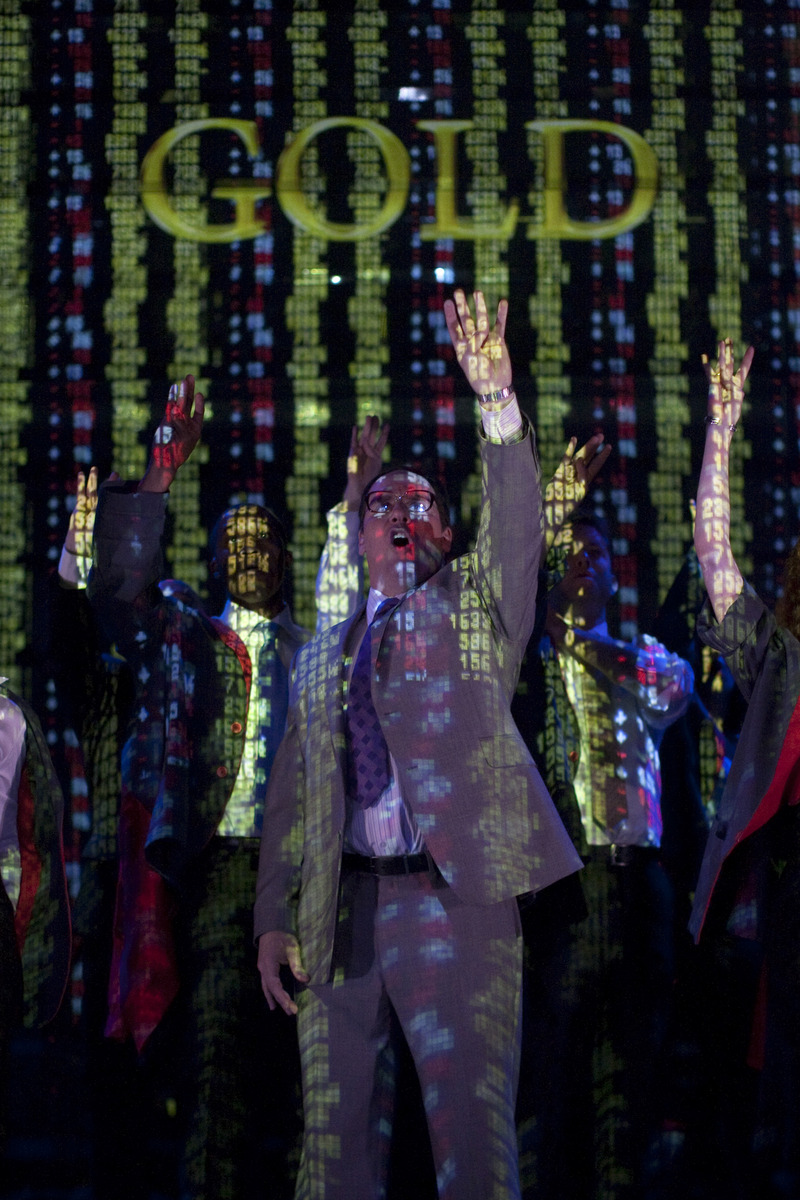
The Ben Affleck WTF Award: The Effect. Lucy Prebble’s follow-up to ENRON was one of the most anticipated of the year and sold-out almost instantly. Despite picking up two acting nominations, it has been snubbed for new play and best director. Ouch.

Best Director
Stephen DaldryThe Audience

Marianne Elliott

The Curious Incident Of The Dog In The Night-Time

Jeremy Herrin

This House

Simon McBurney

The Master And Margarita

Stephen Daldry’s return to the stage can be met with a significant yawn; The Audience proving to be a rather bland affair given the previous vehicles that Peter Morgan has found for Dame Mirren.The other three are technically complex in varying ways. McBurney deserves great credit for bring Bulgakov’s masterpiece to the stage with some degree of coherence.Herrin’s This House is remarkable for the way it gels such difficult material and Marianne Elliott combines visuals with superb performances from the leads.
The Day-Lewis Award: Marianne Elliott. The only director to get both visual and acting nominations for the play.

The Deakins Award: Marianne Elliott. For the above reason.

The Ben Affleck WTF Award: Rupert Goold, like Lucy Prebble, must be feeling somewhat aggrieved by the nominations. Still he does get to be Artistic Director at the Almeida, so there’s always that.

Best Actor in a Musical
Michael Ball – Sweeney Todd
Alex Bourne – Kiss Me, Kate
Tom Chambers – Top Hat
Will Young – Cabaret
 Michael Ball has this locked in. He has won pretty much everything going and a better Mr Todd in a better production it is hard to imagine.
Best Actress in a Musical
Heather Headley – The Bodyguard
Imelda Staunton – Sweeney Todd
Summer Strallen – Top Hat
Hannah Waddingham – Kiss Me, Kate
Until seeing Kiss Me, Kate then I would have put the house on Imelda Staunton helping Sondheim sweep the board. However Hannah Waddingham’s performance is sunshine in an otherwise cloudy production and is most deserving of the win.
Best Performance in a Supporting Role in a Musical
Adam Garcia – Kiss Me, Kate
Debbie Kurup – The Bodyguard
Siân Phillips – Cabaret
Leigh Zimmerman – A Chorus Line
 Having only seen Adam Garcia, all I know about this is that Adam Garcia surely can’t win. There must have been something better. My money goes on A Chorus Line.
Best New Musical
Loserville
Soul Sister
The Bodyguard
Top Hat
Christ, best new musical includes a remake of a woeful 1990’s film with one massive song, and (how is this anything but technically not a revival) of the 1935 classic with Fred ‘n Ginger.For that reason hopefully the flop Loserville will win it.
Best Revival
Long Day’s Journey Into Night
Macbeth
Old Times
Twelfth Night
I suspect that Long Day’s Journey Into Night will win. It sends a cold shiver down my spine but I think it will. Any of the others are more deserving but lets face it Macbeth and Twelfth Night are revived every other bloody year.
Best Musical Revival
A Chorus Line
Cabaret
Kiss Me, Kate
Sweeney Todd
  Sweeney Todd. The Day-Lewis Award for certainty.
Outstanding Achievement in Affiliate Theatre
Caroline Horton for You’re Not Like The Other Girls Chrissy at the Bush theatre
The production of Red Velvet at the Tricycle theatre
The season of new writing at the Jerwood Theatre Upstairs at the Royal Court theatre
Kate Bond and Morgan Lloyd for You Me Bum Bum Train, presented by Theatre Royal Stratford East
The usual suspects are deservedly well-represented here. The Royal Court with its normal stellar seasons, the Bush gets a nod and its nice to see Jerwood recognised.Hopefully the Tricylce will win but I have a fear that You Me Bum Bum Train may get the prize and even worse fear that it may encourage others to follow in its footsteps.

All change at the top

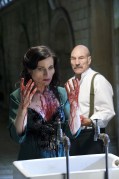
Macbeth - Kate Fleetwood and Patrick Stewart in Rupert Goold's Production

Excellent news this week as Rupert Goold was announced the new artistic director of the Almeida Theatre, following Michael Attenborough hugely successful tenure. Now firmly established as one of the most influential theatres that bridge the gap between the West End and the regions, it is difficult to remember that 11 years ago the Almeida was running a sizable deficit and that Attenborough not only turned this on its head but did so whilst also almost doubling the number of new productions.

Rupert Goold has a challenge on his hands but the freedom of the role, and his own prior knowledge of the space through working on Headlong co-productions, allows him to enter on a firm footing. His own uniquely stylistic flair, as recognisable in theatre as Tarintino is in film, make the possibility of creative control over an entire programme a most enticing one proposition for the audience.

Goold’s Macbeth was praised to the heavens by critics on both sides of the Atlantic; brilliantly designed, blessed with the stand-out performance from Patrick Stewart’s illustrious career and one more than equalled by Kate Fleetwood’s splendid Lady Macbeth. Goold’s production manages to maintain the golden thread that so often eludes directors of style; every element contributes something to the whole enabling the sum to be so much greater than the parts. Most pleasingly, it is also available for anyone to see as it was expertly captured for the BBC; rather sickeningly Goold proves himself to be equally at home in this medium, and the transfer retains a spirit and vitality that was sadly lacking in the televised version of Hamlet with David Tennant.

The extent to which I think this is seminal viewing is the fact that I am prepared to suggest buying something from Amazon in order to do so – boycott be damned, it is just too good.

Rupert Goold is only the latest in a line of seat-swapping that has amounted to a seismic shift in the theatrical landscape. The last couple of years have come to feel like a pivotal moment for the next generation to pick up the baton from their predecessors. Coinciding with a new political landscape, we are seeing the emergence of a new wave of directors and producers who will be charged with guiding British theatre through the murky quagmire of reduced funding and a more oppositional approach to politics.

It is too early to say but it could mean a return to more overt political dramas. One of the problems of the Labour regime is that they remained difficult to criticise following the experience of almost twenty years of EnronConservative power – and even more so when they pumped more money into the cultural landscape than it had seen in years. Where Labour were criticised, most excoriatingly by David Hare, was on foreign policy, or more accurately their foreign policy in Iraq – less was said about interventions in Sierra Leone and Kosovo.

During the Labour years it is hard to think of many plays that really sought to tackle domestic policy until the financial meltdown made everyone realise how far the country had sleepwalked into inequality under the watchful eyes of a supposedly centre-left government. One can only hope that the shake-up can also dislodge the art of the politics and reveal a new generation of dramatists less concerned with the ‘I’ than the ‘We’.

Doran

The most high profile, and contested, position up-for-grabs was that to succeed Michael Boyd as Artistic Director at the Royal Shakespeare Company. Whilst the National Theatre has more power and money, it is hard to dispute the RSC still carries the most prestige – flying the flag for Shakespeare and under Boyd’s leadership emerging from the mire with a reinvigorated sense of self. It is questionable whether anyone other than Gregory Doran had a look in, and the press release is rather telling ‘‘Greg Doran is a perfect choice for the RSC and is well known to all our audiences. His long history with the Company[…]’. It contains every impression of wanting to promote from within and maintaining a sense of continuity in a company that has too often lost its focus. Gregory Doran is without doubt an exceptional director but could well be seen as a safe pair of hands. However is this a bad thing when dealing with Shakespeare? Every year there will be attempts to reinvent Shakespeare for the modern age, most will be terrible and a few will not. In many ways it is much harder to breathe life into more traditional staging that are more interested in the text than in assuming what Shakespeare may have meant the text to mean.

Continuing outside of London, but yet further North, the National Theatre of Scotland has announced that Laurie Sansom will take over from Vicky Featherstone – herself off to the Royal Court to keep the merry-go-round spinning. The National Theatres’ of Wales and Scotland are probably the most important, and successful, developments in British theatre over the last 15 years. Vicky Featherstone was a hugely influential part of that culture of success, and was instrumental in bringing the widely acclaimed Black Watch to the stage, and the hugely entertaining Alan Cumming one-man Macbeth.

Vicky Featherstone

It is a shame that her departure was partly overshadowed by claims of a parochial attitude among the Theatre’s management but one hopes that they Royal Court will be the chief beneficiary of the time that she has spent outside of London. As an added intrigue, the poaching of Lucy Davies from the National Theatre of Wales to be an executive director at the Royal Court means that both have suffered a significant loss of leadership and one hopes that a firm hand is kept on the rudder of both organisations.

And the final move, and probably the most written about, is that of Josie Rourke taking the reigns at the Donmar Warehouse. Already a year into the programme we have seen an interesting array of productions that, if not setting the world alight are at least suggestive of a non-confirmist mindset. Durrenmatt’s The Physicists is not a play that has aged gracefully but it is still good to see it revived, whilst an all-female Julius Caesar may have caught some predictable flak but it provides challenge and most importantly provides new insight into the group dynamic of political leadership that a traditional cast production cannot achieve. It does feel like we are still waiting for Rourke to stamp her authority on her tenure but it also feels like that production is not far away.

Miniature plays for people of any size

So what are you planning to do on Sunday? Recover from Saturday’s exertions, watch the EastEnders omnibus, iron your shirts, lose yourself on the internet. These may all be fine outcomes but if you are looking for something more then I suggest wandering down to the Arcola to dabble in the world of the short-form play.

The Miniaturist Programme has been running since 2005 and is the theatrical equivalent of a bag of Revels. You know that, with five plays clocking in  at under 2o minutes each, if you keep going you will eventually find the coffee cream. The short-play format, like the short-story, has struggled to attract the mainstream but the beauty of the form is that it could widen access to theatre to a non-traditional crowd, as in one evening you can showcase a myriad number of possibilities about what the theatre can achieve.

Working as a great showcase for those involved, it also teaches discipline in writing and a ruthless focus on cutting out the extraneous – this is an oft-lost skill for those with resources behind them and many has been the play where fingernails make long-lasting impressions into my palms as scene after scene rolls on with no purpose other than highlighting the vanity of the writer. It is little surprise that two modern masters who sit at different ends of the spectrum – Tom Stoppard and Harold Pinter – can both point to superb early work in one-act plays.

So if you’re bored than you could do worse than find yourself at The Arcola at either 17:00 or 20:00 on Sunday 25 November.

Check out more here: http://www.miniaturists.co.uk/index.htm 

Civilian Theatre: Back from the void

One may think that returning to the blog after a long absence would be like finding yourself wrapped in the enthusiastic embrace from an old friend – comforting if not a little suffocating – but the reality is closer to the disquieting unease felt when faced with a locked door in an empty house. There is nothing behind it clearly – the world of ghosts and gremlins and ghouls is one that gives little concern – but subconscious tremors still create a paralysis that ripple across the keyboard and threaten the ability to make words out of thought and action.

A play is seen, an idea is sprung and an excuse is given – continuing in an ever more vicious cycle of procrastination and self-doubt until the author is left in a pitiful state, unable to even manage a pithy 140 character tweet to express dissatisfaction at another evening of psychological toss thrown up by the Barbican’s ever growing adventures into the realms of European pretension (currently standing at four plays in under 10 months shared between a German Australian, a French Strindberg, a Polish Vampire and a Spanish Shakespeare).

Luckily the success and dynamism of others have had a revitalising effect. Vicariously experiencing someone being nominated for the Evening Standard Best Play award, others nominated for a short film at the Milano Film Festival, a graphics showcase and another’s photo portfolio. They have rammed home the point that the world doesn’t slow down even if a blogger does.

And so Civilian Theatre returns…

Olympic Opening Ceremony: Boyle’s Brand Britain Brings Belief Back

Be not afeard / This isle is full of noises [The Tempest]

Etched onto the largest bell cast at the Whitechapel Foundry and overlooking a pastoral idyll of Britain – maypoles, shire horses and, naturally, cricket – Danny Boyle took from our great playwright a statement of intent that he then used to totally reimagine a way a country uses such events to present itself to the world.

Years in the planning but managing to remain one of the most well-kept secrets in this age of Twitter, Instagram and Facebook, yesterday we finally got to find out what happens when you spend £27 million on a one-off show. The results were as thought-provoking as they were spectacular. It showcased a Britain that may finally becoming at ease with its history and its place in the world.

After 50 years of declining world influence, colonial guilt and compounded by the growing financial crisis that may yet see the balance of power transfer permanently to the emerging economies, there is an anxiety that undercuts our patriotism. Boyle does not deny our history and does not gloss over the seismic transformations that fractured Britain and then the world. It is an incredibly bold move and one that only a mature country confident in its heritage could countenance.

When Beijing hosted the Games in 2008 they put together a spectacular that no country in the world could hope to match. It was also exactly the sort of thing that a regime that only pays lip-service to democracy would put together – encompassing thousands of people but with no sense of communal spirit and full of gloss. Boyle strips all this away – it has long been recognised you could not hope to beat Beijing at its own game. At times it felt chaotic and unmanaged but it had heart and soul. It put the volunteers themselves front and centre rather than being units in a large structure.

Boyle’s Britain is at times a terrifying place. Given our history, our colonial past and the traumatic impacts of war and social-cultural revolutions it could never have been otherwise.  Having been lucky enough to be in the Olympic Stadium during the technical rehearsal I can testify to the cauldron of noise created by the two thousand drummers. A faint rumble from the Olympic Park signifies the arrival of the industrial era, the growing wall of sound creating a pulsating beat as the green pastures of Britain is stripped away and out of the ground great towers begin to emerge and metal works creating molten rivers. The vibrations of technological chance ripple through the audience and a brutal landscape grows out of nothing. At times it is hard to tell whether we are being shown Britain or Tolkien’s Mordor.

Victorian industrialists, led by Kenneth Branagh as Brunel and given the task of delivering Prospero’s ‘Isles of Wonder’ speech in the absence of Mark Rylance, summon up the towers as if praying to some new deity. Boyle understands that these traumas are fundamental to our consciousness and to ignore them would be to hark back to ‘the green and pleasant land’ of William Blake’s Jerusalem whilst ignoring the all-important ‘dark satanic mills’.

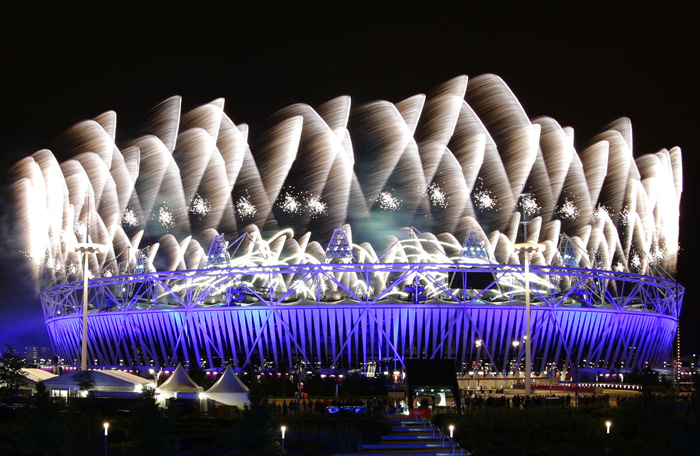
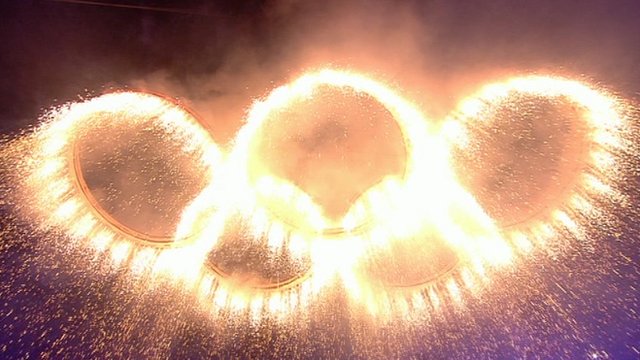
The use of the set to deliver the Olympic Rings was visually magnificent. It had the all-important reveal and there were audible gasps as the audience began to realise how all the pieces fitted together. As the rings started to crackle and spark it was obvious why Boyle demanded a late start. The image of the Olympic Rings built out of British industry and burnt into the night sky will become one of the iconic images of the 2012 Games.

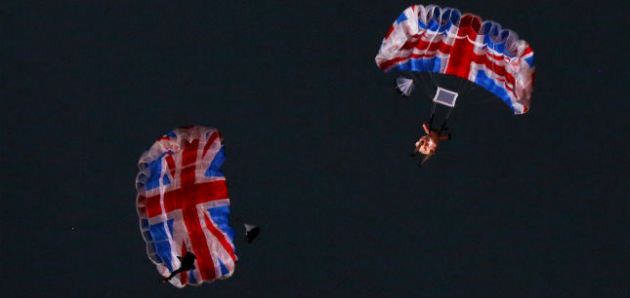
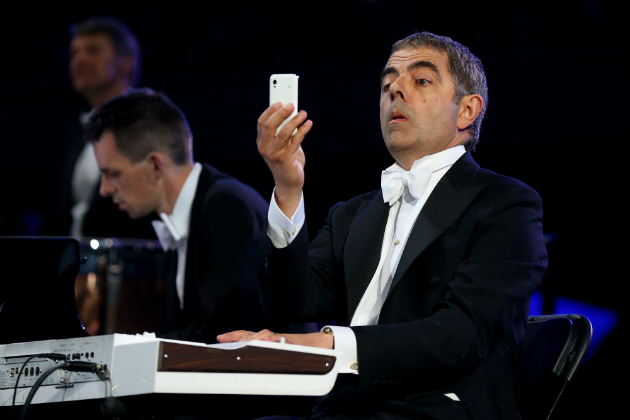
A sense of reminding the world, and Britain itself, of the innovations Britain has given it was at the heart of this show. Brand Britain was on display and Boyle (with an awful lot of help from his long-term collaborators, Underworld) displayed his usual mastery of the magpie approach – cherrypicking his way through our shared history. James Bond was an obvious touchstone and there was clearly a global thrill of showing him meeting the Queen but it is a shrewd move to include Rowan Atkinson as Mr Bean. In this country we recognise Bean but perhaps don’t realise just what a valuable brand Bean has become worldwide. Rowan Atkinson has long-established a legacy as one of the most gifted physical comedians of all time, and deserves to stand alongside true greats like the Marx Brothers and Buster Keaton, and much deserved his slot at the event, alongside slotting in his much needed humour during the Chariots of Fire sequence.

Perhaps the most emotional honour, and clearly a cornerstone of Boyle’s whole vision, was the prominence going to Sir Tim Berners-Lee; perhaps the man who has transformed Britain, if not the world, more than any other at the tail end of the 20th century. His anonymity is as incredible as it is unforgivable considering that he invented the architecture for global communications – the world-wide web. What better stage – a UK audience of at least 26 million and a global audience of up to 2 billion – to give him the status he richly deserves?

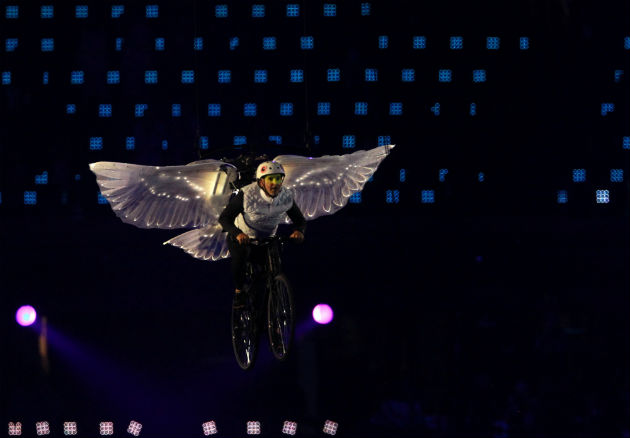
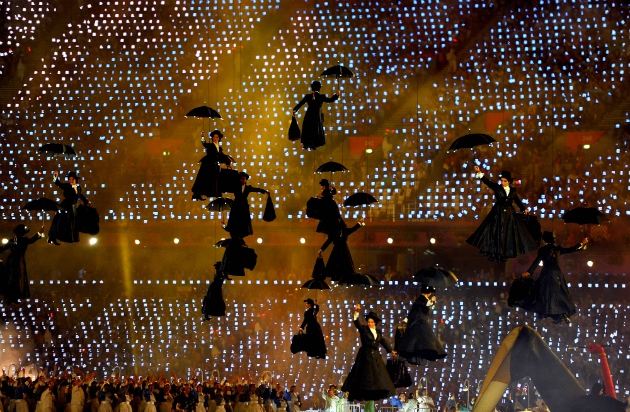
Brand Britain also included two of our crown jewels – the NHS and the BBC. The show started with the uniquely British shipping forecast – unrecognisable to people who don’t live here but a cosy reminder of all things British– and included a long section involving NHS volunteers in a vibrant number that also celebrated the importance of children’s literature. A reminder to the world about how British authors have set the global standard in this field; JK Rowling was given the honour of stage-time but the show harked back to the golden age of Peter Pan, Alice in Wonderland and Chitty Chitty Bang Bang. Here, as throughout, Boyle didn’t take the easy route of simple-minded jingoism but looked deeper into the soul of the nation and realised that Britain has never shied away from looking into the darkness in order to find light.

Lord Coe promised to ‘inspire a generation’ in 2005, and in 2012 this vision was realised with a left-field choice for lighting the Olympic cauldron. Standard practice is to give the torch to an icon or suitable dignitary. Would any other country have decided to abandon this practice and give the torch to unknown young athletes who have been selected by our current greats? What message does this send to the children watching around the world? And how, in 2016, will Brazil manage to top such an audacious, and pretty much uncriticisable, choice?

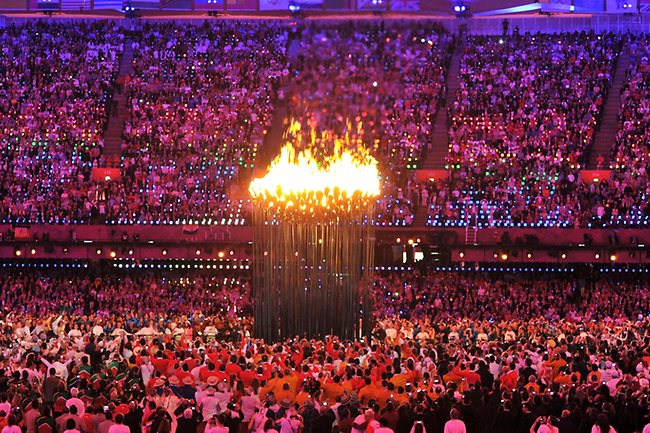
And special mention must be made of the Olympic cauldron. An unbelievably spectacular artwork in its own right; something that almost managed to upstage everything that came before. An art-installation with practical purpose, built with copper petals carried by every nation of the games. Amazing demonstrations of the Olympian ideal of unity and togetherness that towered above the athletes and was a fitting send off to the evening – alongside the spine-tingling sound of 80,000 people booming out the inevitable na-na-na-na’s of Hey Jude.

Danny Boyle was given something that was a chance of a lifetime but, in the wake of Beijing, deeply unenviable. His career to date has displayed an unshakeable knack of hitting the cultural pulse in any genre he has taken on – small-scale urban drama in Shallow Grave, a kinetic slice-of-nation in Trainspotting, global understanding in Slumdog Millionaire and in 127 Hours an audio-visual montage that served as a warm-up for some of the video sequences employed in the show. Here he has cemented his reputation and for him the world becomes his oyster.

He has given a Britain that we can believe in, that we can be proud of and that balances the light and dark of our history in harmony. He has given the world a Britain that recognises its contribution to the world, that has given the world great industrial and social change, that has provided an imaginary world for its children and an audio soundtrack to people’s lives for the past 50 years. And you really can’t ask for more than that.

For more on the global media reaction to the Opening Ceremony click here

The best of the Opening Ceremony

Falstaff take centre stage as The Hollow Crown reveals its brutal truth

The Hollow Crown: Henry IV Part II – BBC 2

So Shakespeare continues on the BBC with Henry IV Part II and Falstaff discovering just how hollow the crown can be. It remains testament to Shakespeare’s talent that despite the clear danger of offending the monarchy he could write a play about kingship that would show it to be an undesirable burden that turns saviours into tyrants.

The old dying king, Henry IV, is laid bare before the audience; his noble persona stripped aware by a ravaging illness and worn down by the internecine rivalries of his nobles and the licentious behaviour of his heir. The regal nature of Jeremy Iron’s Henry has long since disappeared to be replaced by a solitary figure forced to send others to fight his wars and left to restlessly wander the palace at night exhorting that “uneasy lies the head that wears the crown” [III.i].

It is worth mentioning that Irons is magnificent as Henry IV – as it is a part often forgotten under the weight of the Hal/Falstaff relationship. Iron’s Henry captures the viewers’ attention with an exceptional understanding of verse speaking and bringing real intelligence to the dialogue. The great speech where he discovers Hal upon the throne and lashes out with “What! canst thou not forbear me half an hour? / Then get thee gone and dig my grave thyself” [IV.v] proves one of the real highlights of the series so far and brings just a glimpse of a potential King Lear – a  proposition that really does make the mouth water.

Tom Hiddleston’s Hal does not provide the tempting alternative that Shakespeare would later paint with far more grandeur in Henry V. As with last week, Hiddleston gives us a Hal that, for all his revelry and low-flung behaviour, is very much in control of his character. He may feel warmth to these people but he also is self-aware enough to retain a certain detachment as a king would his subjects. Hal is shown to be the kind of figure who would make a good king but possibly an even better tyrant.

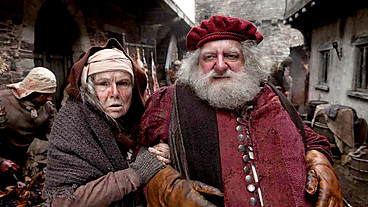
Richard Eyre focusses on melancholy as the central theme of this production of Henry IV Part II. It is a melancholy centred around the relationships Falstaff has throughout the play which draw out his own tragic self-awareness that so often is hidden behind bluster. Simon Russell Beale gives us a Falstaff that continues to scheme but who is fatally unable to change his character and for whom the dead-hand of time continues to advance.

<<Continue to full review>>

Much more on BBC’s Shakespeare Unlocked here