Bold, bravura Bolivian brilliance

Hamlet de los Andes – Teatro de los Andes @ The Barbican Pitpart of the CASA Latin American Festival

If my knowledge of Bolivia is shockingly limited then it is fair to suggest that my knowledge of Bolivian theatre is equally lacking. However if Teatro de los Andes’ breath-taking reimagining of Shakespeare’s Hamlet is any measure of the quality of the Bolivian arts scene then it is an area that needs considerable investigation.

Fast-paced and full of vitality, Teatro de los Andes’ production finds new energy for a play whose radicalness has become blunted by its well-worn familiarity. In the fore-knowledge of its famous quotations and its prototype of Ophelia and Poloniusthe tragic hero, it is telling that it has taken a non-English language company to develop a radical approach that plays with both text and content. In recent years its closest parallel on the English stage has been Thomas Ostermeier’s German production but whereas Ostermeier’s production seems to revel in its willfully abstruse nature, the direction and purpose of Teatro de los Andes is clear throughout.
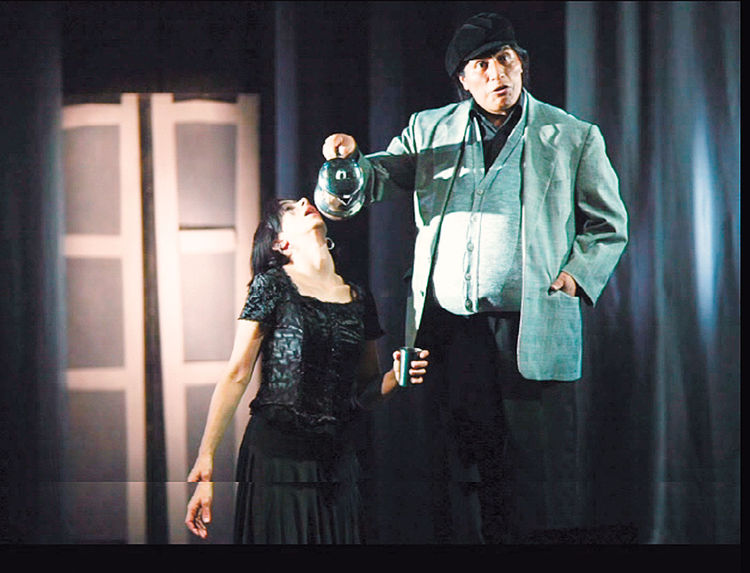

Hamlet of the Andes

There is nothing deliberately complicated about this production. It may be performed in Bolivian with just three actors and a musician. It may have taken a hatchet to the text, rewriting most of the dialogue and weaving altered quotations throughout, cut half the characters and reduced the length to under two hours.

However it also provides a chillingly clear indictment of the politico-military instability that ripped apart Bolivian society throughout the latter-half of the 20th century, which is told through the lens of the paranoia and madness that infects not just Hamlet but the whole household.

Writing in the Guardian, ahead of the publication of The Hamlet Doctrine, Simon Critchley and Jamieson Webster argue that we have either forgotten or misunderstood the true nature of Hamlet and that productions too often focus on safe interpretations; they argue that we should look to the likes of Lacan and Nietzche who took analysis of Hamlet’s character beyond the basic Freudian Oedipal model, and offered far more radical implications for society.

This production demonstrates a fault of Critchley and Webster’s argument, and of many recent audience-friendly versions of the play, which is that it continually focuses Hamlet the play on Hamlet the man. They clearly understand the motivation that affects Hamlet as an individual but ignore the idea that Hamlet is a free agent, and that he operates in a political world full of other free agents; each with their own motivation that exist independently of Hamlet’s actions.

 

<<Continue to the full review>>

The Rehabilitation of Bertolt Brecht

The Resistible Rise of Arturo Ui –Duchess Theatre, booking until 07 Dec 2013

Leaving aside Shakespeare, Chekhov and Ibsen, the popularity of playwrights tends to wax and wane on the London stage; the recent reappraisal of Rattigan as someone unfairly cast aside by the Angry Young Men of the 1950s and the continuing absence of Bernard Shaw are two of the more obvious examples of the way a writer’s fortune remains tied to the whims of producers.

Arturo Ui Poster

The UK has also notably never quite embraced the rich vein of talent that exists in European theatre: Racine is rarely seen; Moliere, a mainly absent figure; and modern continental playwrights virtually non-existent. The thrall of Anglo-American naturalism and the rawness of the grand narratives of O’Neill, Williams and Miller continues to be preferred to the rather more metaphysical questions posed by the likes of Ionesco and Artaud.

Within this structure Brecht cuts a solitary figure, and has increasingly become something of the forgotten man of British theatre. Whilst his position, alongside Stanislavski, as one the pre-eminent figures in the development of modern theatrical practice is assured, it was Stanislavskian concepts that became the dominant mode of theatre and film; championed by Stella Adler and embodied in the work of a young Marlon Brando.

In comparison Brecht’s influence has seemingly ebbed away to the point where a new production of a Brecht play in the West End is something of an event. One must acknowledge that there are resource considerations to this; large casts can be ruinously expensive but that reality is built on the premise that Brecht is deeply unfashionable and cannot be considered an audience draw.

The irony’s that Brecht is perhaps the most American-looking of all the European playwrights. Stanislavski had little desire to cast his eyes across the Atlantic but to Brecht the new world and its eager embrace of democratic and technological progress chime with ideas that were central to his own theatrical philosophy.

arturo_ui_063_Henry_Goodman__Arturo_Ui__and_Michael_Feast__Roma_._The_Resistible_Rise_of_Arturo_Ui._Photo_by_Manuel_Harlan._4ffd4cb1ddfbbAt its heart was the development of an art form that would become pre-eminent for the first five decades of the 20th century: cinema. Silent cinema was the great leveller; reliant on music, gesture and simplified dialogue so it could appeal across the immigrant communities of America, these early pictures represented Brechtian techniques transposed to a medium that could truly be embraced by a mass audience.

It was within the world of cinema that Brecht found a way of telling the story of Hitler. The development of genre pictures – particularly the early gangster movies, starring the likes of James Cagney and George Raft – gave Brecht a mechanism with which the rise of an international dictator could be challenged in a way that did not need threaten the authorities directly and would also appeal to a mass audience.

This is not to say that Arturo Ui is dumbed down; the reverse is in effect true, Brecht is raising the genre picture above its humble origins. He may have gained a reputation as a didactic playwright with a sledgehammer touch but this is to ignore the craft taken over the formal structure of the play and the sly literary references liberally sprinkled throughout the text.

Arturo Ui could be enjoyed for the wonderful pastiche of Mark Antony’s oration at Caesar’s funeral and the knowing nods to pretty much every tragedy in the Shakespearian canon but it does more than this – it recognises the freedom of the theatre, in opposition to the limitations of cinema, to challenge the audience by upturning the established conventions of an entire genre.

<<Continue to full review>>

Writer vs Director vs Actor in Edward’s epic battle

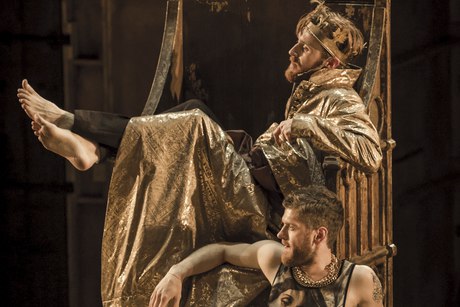
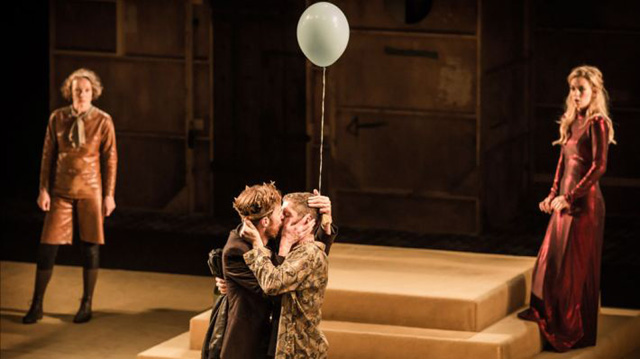
Much of the critical reaction to the National’s production of Marlow’s Edward II has been withering, and for generally mild-mannered reviewers, bordering on the vitriolic. Leading the charge is, inevitably, Quentin Letts in The Daily Mail who suggests the ‘the only thing murdered in Joe Hill-Gibbins’s puerile, inept production is the play itself’ (ouch) and is followed, perhaps rather too stridently, by Tim Walker in The Telegraph who found ‘In almost 10 years of reviewingedward ii and gaveston: not your everyday production theatre, I doubt I have been confronted with a bigger load of indigestible old tosh’ and couldn’t help but the boot into the subsidised sector while he was at it; ‘the kind of production that simply could not happen in the commercial West End.’

Many people would doubtless agree with Mr Walker’s final sentence but the despair being aimed less at the National and more with eyes turned pointedly north of the river at the risk-averse nature of the private sector behemoths; happy to suck up the most profitable of the tried and tested subsidised productions before reverting back to a steady rotation between Noel Coward, Alan Ayckbourn and A.N Musical complete with X-Factor star.

If the overt agenda setting of Mr Walker’s column can be ignored– and the reference to‘comrades’ at the National rather says it all – it makes an important point in reminding us that the licence to put on a production this lavish ultimately comes from the public purse.

Joe Hill-Gibbin’s is a talented director who had great success at the Young Vic but his career trajectory is taking a worrying turn towards the excessive. A bright start led to a stint at the Young Vic where he created a stunning yet simpleEdwardII and Isabel revival of Martin McDonagh’s brilliant Beauty Queen of Leenane and directed the only Tennessee Williams production I have ever managed to enjoy (The Glass Menagerie).

He scored an unexpectedly huge hit with the fun but rather too hyper-kinetic The Changeling, which showed a suffusion of talent but equally there were times where a restraining hand might have been called for. It is troubling that on the grandest stage of all Hill-Gibbin’s has not only failed to adjust his style but that the flaws, rather than being flattened in the vast space of Olivier, have only been magnified.

Whilst we must allow artistic companies the freedom to make mistakes, watching Hill-Gibbin’s exuberant production reminded me of the wisdom of Bob Balaban’s protective mother in A Mighty Wind justifying the use of a Shetland pony to play polo on the grounds that ‘if he has to fall, he shouldn’t fall from so very high’.

<<Continue to full review>>

Fleabag: A very modern heroine

Fleabag – DryWrite @ Soho Theatre, until 22 September 2013

In Fleabag, Phoebe Waller-Bridge has created a terrifying portrait of a person who embodies two of the major movements in modern society; the continuing reverberations of the feminist movement running headlong into society’s obsession with individualism and self-actualisation. It is of a person whose self-involved narcissism and belief in the right to be free to control one’s life-choices blinds them to any impact their actions may have on others. Fleabag continually rejects culpability for the paths she takes and even refines poor decisions into positive self-affirming actions. Fleabag is a 21st century manifestation of the id, rampant and uncontrolled.

It is also the funniest play that has hit London this year.

Rare is the playwright that truly captures the language of real life and turns it into something dramatically interesting. I have regularly extolled the virtues of Nick Payne for his skill in crafting modern, believable dialogue for his Fleabag - our eponymous anti-heroinecharacters; Waller-Bridge shares this talent whilst going further to infuse it with a poetic, heightened language that is rooted in the everyday.

It is startling to be confronted by a modern text that so positively drips with a love for sonorous language but yet doesn’t strive to root itself in the past. Every line feels written by someone with a deep respect for classical theatre but who understands that respect is best shown by not looking backwards and instead immersing yourself in the culture that surrounds you.

Monologues are as pure a form of theatre as it gets for writers and performers; there is no hiding place, the production rests and falls on the skill of the actor and the quality of language. Waller-Bridge spent a fair proportion of her last production, Mydidae, naked on stage so is better placed than most to quibble about the nature of exposure but Fleabag contains a ruthless emotional honesty that is shockingly, brutally, exposing.

Mydidae explored how removing our physical covering makes it easier to create a passage to the emotional core, whereas Fleabag removes all pretence and from its first moments delves into the deepest crevices of the mind of an independent, assured modern woman and probes it for cracks in the surface; the vulnerabilities that face all woman in an age of supposed liberation – political, economic, social and above all else, sexual.

For this is a monologue that is steeped in the current dialogues surrounding feminism and what it means to the generation that did not have to fight for it. It is here that Fleabag demonstrates the elements that have seen it be championed as one of the picks of the Edinburgh Fringe. It studiously avoids the polemics and instead displays its arguments through subtle highlighting of how hard-won equality under the law is still being undermined by socio-cultural norms.

©Richard Davenport 2013. 2nd August 2013. Edinburgh Fringe Festival. Phoebe Waller-Bridge in Fleabag at the Big Belly, Underbelly. Photo Credit: Richard DavenportWaller-Bridge’s Fleabag is a monster – a ravenous sexual entity that seemingly cannot discriminate between friend and conquest, desire and lust, attraction and obsession – but constantly the audience is reminded of how this may be viewed if the person delivering the monologue was a man.

The player/slut debate that Fleabag circles has been around for years and may seem like a hoary old trope but that doesn’t make it any less valid a reference point. A generation of woman have been brought up to believe that the battle has been won but changing the law does not lead to changing lives. The Twitter trolls and the campaigns over the increased use of sexualised imagery on the front covers of lads mags has shown that skirmishes continue.

Waller-Bridge’s Fleabag uses her body as a tool for her own personal gratification and talks in the frankest terms of an obsessive relationship with pornography. Does this debase her or does it set her free? Has she been enslaved by a masculine-fantasy of feminist equality – the idea that freedom to choose means becoming a hedonist to pleasure – or is she is a liberated self-actualised feminist who has rejected the traditional gender values of chastity and purity placed on woman by a patriarchal society?

<<Continue to full review>>

Buy the text from Nick Hern books here

…And happily ever after?

All’s Well That Ends Well – Royal Shakespeare Company, until 26 September 2013

One of the more curious of Shakespeare plays, All’s Well That Ends Well never seems to have sat comfortably with its audience. Even its title can be seen as one of Shakespeare’s playful jokes; riffing, as it does, on the fairy-tale narrative of ‘happily ever after’ despite those watching being left with serious question marks over the likelihood of the future joy to be shared between Helena and Bertram.

At its core All’s Well That Ends Well combines a number of fairy-tale tropes and applies them to the real-world. The healing of the king by someone of lower birth who is granted what their heart desires forms the play-logic that allows Helena, a ward of the Countess of Rossillion, to be granted the hand of Bertram, the Countess’ son.

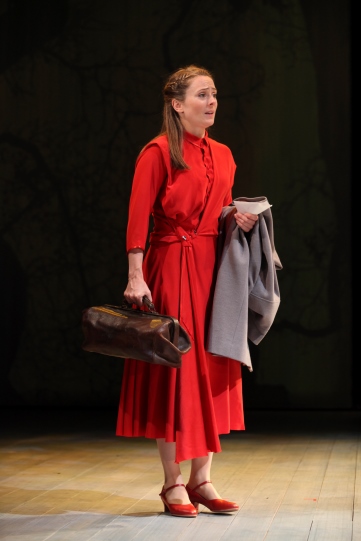
In the world of fairy-tale this would be the ideal marriage and Bertram, the prince, would realise that he loved the woman of lower-birth all along. However by placing the plot in a world where people are not shaped by archetypes, weJoanna Horton as Helena in All's Well That Ends Well. Photo by Ellie Kurttz see Bertram as little more than an indulged trustifarian who runs at the first sight of emotional commitment, who is used to bending the world to his whims and who believes honour is for the battlefield not the bedroom.

This may explain modern concerns with the play; that the resourceful, intelligent and determined Helena would seemingly humiliate herself and traipse across Europe for a man who clearly does not lover her.

It is on this point that Nancy Meckler’s production of the Royal Shakespeare Company comes into its own and in doing so helps to rehabilitate a play that, for its problems, contains, in Parolles, a comic creation of rare intelligence alongside two strong female roles that are pillars of wisdom and virtue.

Meckler’s production updates the plot to the early twentieth century and through this framing device we see the character dynamics in a whole new light. The fairy-tale plotting remains but within a world that is realistic to us.

The background is Europe at war and in Helena we feel any one of the millions of women who stepped into the roles left by men. Helena’s curing of the King of France is a reminder of the importance of women to the war effort and how they carried out job that before the War they would never have been allowed to do.

Bertram’s treatment of Helena and his dismissive rejection of the King’s statement that ‘Tis only title thou disdain’st in her, the which / I can build up’ [II.iii] reflects the wider disintegrating status of hereditary gentry. Bertram has truly never considered Helena within the context of a potential wife despite living in close proximity at court.

There is also a significant amount of comedic irony to a modern audience in his plea that ‘In such a business give me leave to use / The help of mine own eyes’ [II.iii]; it is clear that once the shoe is on the other foot, the male ego struggles with the concept of entering what is effectively a shotgun wedding.

<<Continue to full review>>


Luton: Immortalised

The Same Deep Water As Me – Donmar Warehouse, until 28 September 2013

Set in Luton, featuring personal injury lawyers and conventionally played, Nick Payne’s The Same Deep Water As Me at first glance appears to have an underwhelming premise to follow his sparkly original and hugely successful Constellations. However Nick Payne, despite young in years, has already begun to establish a formidable reputation as a playwright with an ear for the patter of the everyday voices and so it proves with a solid follow-up to one of the more original plays of recent years.

Mark Wooten

Payne’s talent goes farther than the mimicking of the everyday, it is also possible to see him channelling the distinctive voices of the late 20th century. There was a Stoppardian verve to the writing that grounded Constellations and it  is impossible to watch The Same Deep Water As Me and not recognise the muscularity of Mamet lying below the surface.

It is rare, in British playwriting, to find someone who can so convincingly evoke the language of those that may be labelled the working middle-classes. His characters seem to spring from a previously untapped well of working professionals; strong working-class roots but perhaps the first to make use of widening university provision.

By and large Payne writes characters who are near-invisible on the stage, and who are often routinely talked-down and patronised by those who see themselves as the guardians of culture. They do not have a socialist chip on their shoulders but they also are not part of the institutional elites; in short they are not political but are fiercely individual and rarely do playwrights try to illuminate the inner-lives and desires.

At times Payne’s writing is reminiscent of a well-crafted stand-up routine; turning ordinary lives into something faintly surreal and highlighting the hidden absurdity’s in established routines. Rather than grotesque caricatures, Payne finds humanity in the everyday.  A repeat call-back to Greggs – a very modern class touchstone – under Payne’s gentle probing reveals glimpses of a hidden world where relationships develop and life experience is shared. We find the quality of a steak slice is quantified and rated with the same precision that foodies reserve for bread and olives.

The shadow of Mamet is impossible to ignore and these is reinforced through both plot and structure. The ambulance-chasing, insurance scams of In The Same Deep Water As Me operates in a similar moral universal to Glengarry Glen Ross.  They both operate within a macho-office-based culture; they are full of people who are not operating at the margins but are still having to scrap and scramble to survive.

<<Continue to full review>>