An absurd masterpiece or a masterpiece of the absurd

Rhinoceros – Théâtre de la Ville–Paris, Barbican

Théâtre de la Ville–Paris’ production of Ionesco’s Rhinoceros is practically faultless and it is with considerable surprise to discover that it has taken nearly nine years for it to have crossed the Channel; it is very rare for a near-decade old show to appear to contain so much vitality. It is an evening at the theatre that manages to achieve that rarest of blends – an exquisite play meeting an exceptional production. Over the last five years I can think of just two other productions that could lay claim to being of a similar calibre; Jez Butterworth’s Jerusalem anchored by Mark Rylance’s ‘Rooster’ Byron and Rupert Goold’s production of Macbeth with Patrick Stewart and Kate Fleetwood.

We are clearly operating in exulted company and it is perhaps telling that despite barriers of style, language and time the three productions share common traits. They all rely on a strong central male character who across the course of the narrative embarks on what we might recognise as an existential crisis that leads them to stand against the forces of change and modernity. To a greater or lesser extent they are the architects of their own downfall, as they each retain a strong moral code that is a major driver for action and embeds a sense of duty that can seem inexplicable to others, and that will cause them to follow a path that can only lead to isolation and destruction.

Each of the productions also share a perfectly pitched casting for its lead character; there is not one moment where Rylance doesn’t fully convince as Rooster, a man whose self-important sense of being part of a grander element of England’s narrative blinds him – metaphorically and eventually all too literally – to the modern culture of the nation. Stewart, as I have written before, captures the transition of Macbeth from the brutally effective soldier to his existential crisis point and onwards to an acceptance of predetermined resolution.
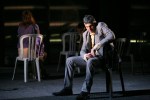
Serge Maggiani as Berenger

In Théâtre de la Ville–Paris’ production we have a central character of equally moral and dramatic weight. Serge Maggiani wonderfully captures the crumpled, unassuming and apathetic Bérenger; a paradoxical figure who is both an everyman and of such inconsequence that his friend, Dudard, feels mindful to provide him with a tie and gives him stern lectures on his social habits. Ionesco has caught in Bérenger a figure that everyone will recognise; the amiable friend who like a drink, and likes an argument alongside it.

Maggiani manages to bring alive a character that is by turns infuriating and charming, capable of great erudition but also a boorish drunk. There is weariness in his actions, a perpetual shrug on his shoulders as he lets life pass him by with a seemingly chronic disregard for the social conventions of those around him. Often striking a rather pathetic figure in sober company, his transformation is a reflection of Kantian virtue as it goes against our sense of his natural manner; where those around him, be they of stronger moral purpose or following a rationalistic instinct, choose to join the Rhinoceroses, Bérenger doggedly becomes the contrarian and rejects the easy path of transformation in favour of humanity.
<<Continue to full review>>

Shakespeare (with added song and dance routines)

Kiss Me, Kate – The Old Vic, until 02 March 2013

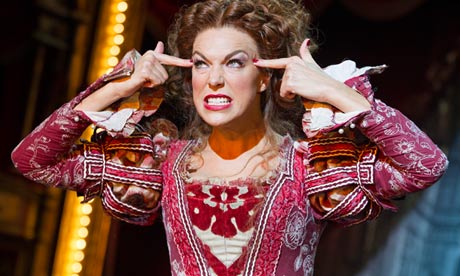
Having now seen two productions of Kiss Me, Kate, separated by more than twelve years, what immediately stands out is that it becomes far more rewarding experience if one arrives forearmed with a strong knowledge of The Taming of the Shrew. Cole Porter’s signature touches are mixed with a far more literate concept than would be expected from his back catalogue, and in doing so it becomes a musical that manages to both please and perplex,

Cole Porter thought of Kiss Me, Kate, along with Anything Goes, as one of his two perfect musicals and Trevor Nunn is a man who clearly thinks along similar wavelengths. Having been responsible for the National Theatre’s stunning revivial of Anything Goes in 2003, he also takes the reigns here and displays the assured hand of a man who is as equally at home in musical theatre as he is in Shakespeare. No mean achievement and one that pays dividends in bringing Porter’s screwball reinvention of Shakespeare’s lacerating take on gender politics to life.

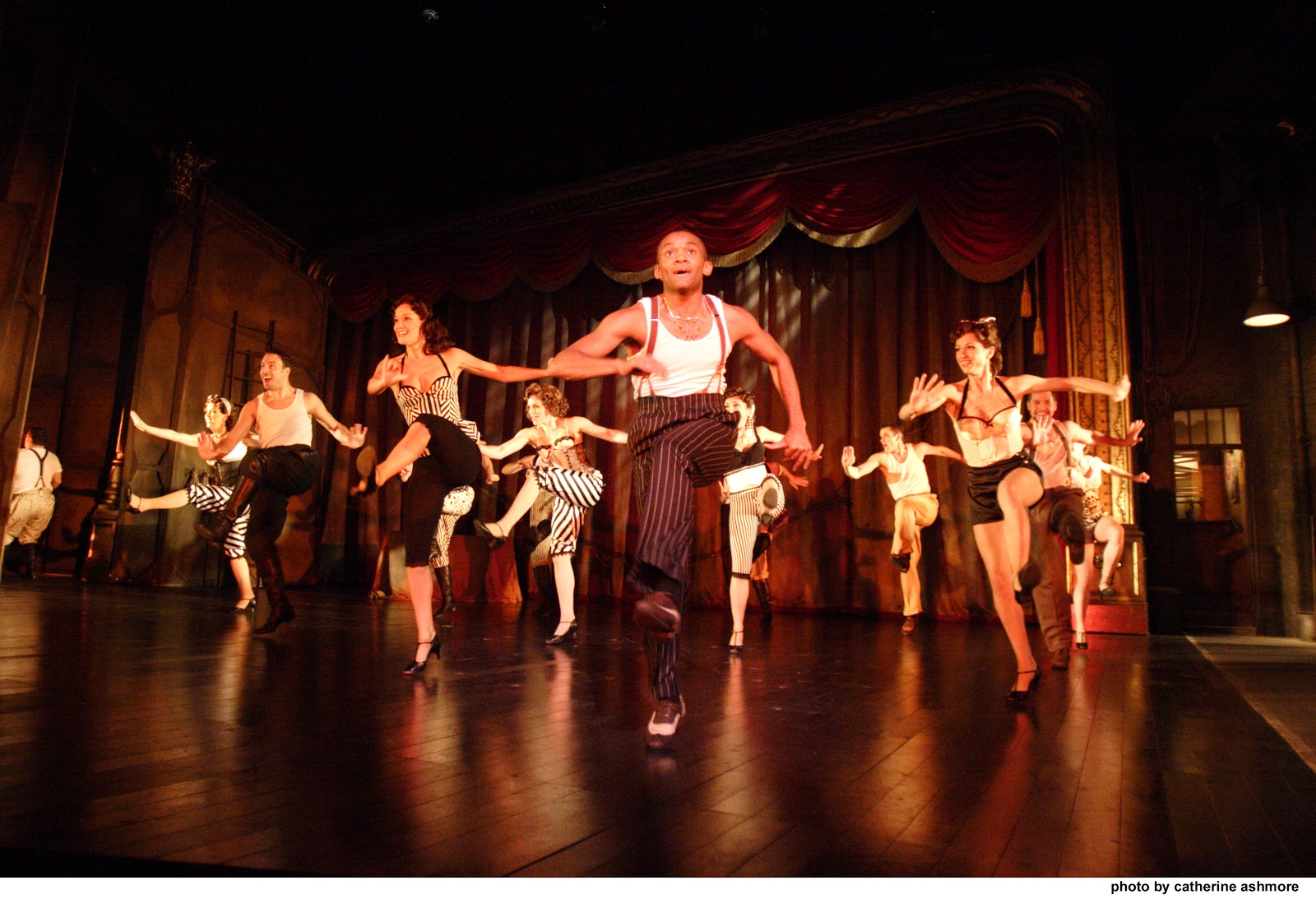
Kiss Me, Kate_2579ashm_1084_Photo credit Catherine AshmoreNot many musicals stand toe-to-toe with Anything Goes, and not many productions can match Nunn’s revival, which has so far proved to be one of the few great musical moments of the 21st century. It was the last of the great examples of chorus-line choreography, Crazy for You, Top Hat and Singin in the Rain being pale comparisons of the form. It also boasted fine central performances, particularly from John Barrowman as Billy Crocker. And of course it had Cole Porter at his irrepressibly brilliant best.

All of which is a roundabout way of pointing out that Kiss Me, Kate is not the equal to Anything Goes. Songs like Wunderbar, Brush Up Your Shakespeare and Kiss Me, Kate are mere shadows of It’s De-Lovely, You’re the Top and Anything Goes. There are occasionally moments where riffs and motifs feel repeated, and parts of We Open in Venice sound like a straight lift from Bon Voyage.

At his best Porter has a verbal dexterity that has only been matched by Stephen Sondheim, a lightness of phrase that can wrap a barb within the most delightful melody and an almost unparelled ability to produce rousing, climaxes that blend dance routines seamlessly with witty lyrics and show-stopping choruses.

Unusually Porter is strongest with the spoken dialogue rather than the music and lyrics. It is without doubt a very intelligent reworking of Shakespeare’s play. There is a level of meta-textual dynamism that is most unexpected from a musical written that was written in 1948 and ran for over 1000 performances. The play presents us with an off-stage version of Kate and Petruchio but also flips the action to show us both faithful, and unfaithful, renditions of the actual Shakespearean parts. Naturally action overlaps between off-stage and on, whilst fictional characters invade the world of the play-within-a-play all the while building to a suitably romantic ending.

<<Continue to full review>>

Hey man, chill out, it’s only religion

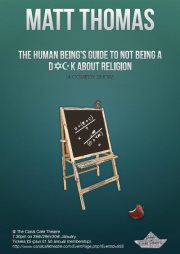
The human being’s guide to not being a dick about religion – Matt Thomas, Canal Café Theatre

I find watching up stand-up comedy an inherently stressful business. Presumably less stressful than for the person performing it, but as the lights go down I find myself with indentations in the middle of my palms where my fingernails have found themselves firmly embedded. Despite having seen plenty of dross in the theatre over the years – from my bad plays, to poor directors and awful actors – I never suffer from anything close to the paroxysms of fear that accompany watching comedy.

It must be something about the different expectations of the audience – a play can mean many things, even a ‘comedy’ does not necessarily lead an audience to assume they will be convulsing in fits of laughter. To put these Matt Thomasdifferences into perspective – there are many who consider Chekov to be quite a comedic playwright. It is fair to say that we are talking about the bar being set at a very different level.

So a one-hour monologue that bills itself somewhere between a play, a stand-up routine and a lecture, and that is also about religion. Are we having fun yet? In the event my fears were mainly without merit; Matt Thomas’ ‘The human being’s guide to not being a dick about religion’ proved an adroit and confident piece that skipped between jokes, set-pieces and information without the slackness that often slips into a one-man show.

If we are to place it on the comedic spectrum we are closer to the introspective intelligence of a Stewart Lee or a Doug Stanhope (without the razor-sharp deliberate audience alienation) than the ‘mates down the pub’ sub-standard preening of a Michael Macintyre or John Bishop. However Matt Thomas treads carefully on unstable ground and whilst routines that ruminate on the allegorical nature of the parables or the importance of the contexualisation of language may sound like a comedy desert, they are located within set-pieces that come across as a Live at the Apollo routine with added smarts.

This is exemplified by the standout routine of the show that demonstrates, with some brilliantly tongue-in-cheek visual aids and examples that subvert mainstream comedy tropes, the difficulty in communication when you are arguing across different planes of emotional engagement. It is a nimble leap of a fertile mind that refreshes a relatively tired genre of comedy and places the rationalism vs faith argument within scenarios that are immediately obvious and, more importantly, funny.

<<Continue to full review>>

The memory of Old Times for newly named theatre

Old Times – Harold Pinter Theatre, until Saturday 06 April [Tickets]

There is nothing wrong with leaving a theatre perplexed. Shakespeare, Ibsen or Chekov may have been storytellers of the highest order, their plays a painstaking work of characters and plots woven together until the strands hang like a medieval tapestry; solid but exquisite. However the 20th century saw the emergence of new writers and new forms; those who use who would use character and language to explore mood and atmosphere. The results of these investigations are equally exquisite but the strands are of gossamer silk and as such one wrong move can destroy their beautiful fragility.

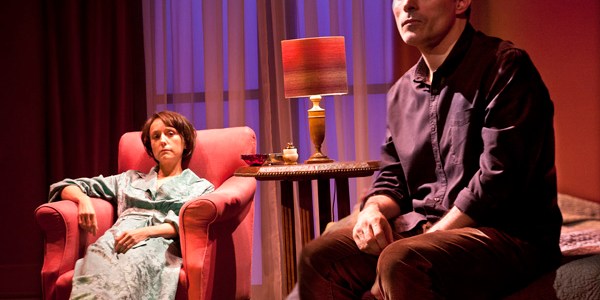
The unmistakable poise of Kristin Scott Thomas

Old Times, written by Pinter in 1971, sits in the middle of his plays that explore ambiguous themes of memory and remembering and that sees characters interrogate their past lives from a present that often appears to exist in a meta-physical hinterland. For his next play, No Mans Land, Pinter would go back to the same ideas again and turn them into the great play of this period of his career.

There is nothing particularly wrong about Old Times but if it is a masterpiece, it is one that is in a minor-key. You get the sense of a playwright stretching out, prodding at ideas that require deeper exploration and as a result you get semi-formed fragments that burst fitfully into life as Pinter’s ability to generate unease through the rhythm of language comes to the surface. However there also exist oddities that seem to jar and where his trademark shifts in tone and interruption appear enforced.

The meaning of the play may be ambiguous but it seems, in Ian Rickson’s decision to alternate the roles of Anna/Kate’s between Kristin Scott Thomas and Lia Williams, that he is following in the interpretation that suggests Anna may be a figment of Kate’s imagination – or even a psychological reference point to an older part of the life that she felt it necessary to ‘kill’ off when marrying Deeley.

<<Continue to full review>>

Say hello to Julia Caesar

Julius Caesar – Donmar Warehouse, until 09 February 2013 Book Tickets

The amount of column inches generated in discussion of Phylida Lloyd’s all-female production of Julius Caesar would be admirable if the content of the articles had done much more than highlight just how deeply conservative the British theatre scene really is and how it still runs far behind Europe when it comes to pushing new boundaries.

It is this reviewer’s opinion that such arguments are so lacking in depth that they brook little need for response. Indeed the best rejoinder is to point across London to the Apollo Theatre where Mark Rylance and Stephen Fry are currently commanding plenty of column inches of their own but mainly on account of their acting abilities rather than any discussion of gender.

The usual argument is that an all-male casts generates its legitimacy through ‘tradition’ but this is somewhat undermined by the plaudits given to the RSC’s superb all-Black production of Julius Caesar, or by idly speculating whether Rylance and Fry are performing under torchlight and with an unruly audience urinating in the stalls.

An all-female production is necessary due to the rather obvious point that Shakespeare, like the majority of pre-20th century playwrights, did not write many great parts for women and considering we have a much greater attachment to the classics than our European neighbours – should we really exclude so much fine actors from some of the greatest roles in the English language?

Indeed let us return to Shakespeare himself to labour the point yet further: ‘the play’s the thing, Wherein I’ll catch the conscience of the King’ Stretching this laborious point to breaking possibly, it reminds us that the purpose of the play is to elicit reaction, to be a delivery mechanism for showing to the audience something that it wasn’t expectingOn this score it is hard to deny that Phylida Lloyd has more than succeeded.

So the reasonable question to ask is whether the decision to use an all-female cast works. Broadly the answer is yes but not with unnecessary problems that seem to have resulted from an attempt to pre-empt questions over the casting decisions.

<<Continue to full review>>

It’s Beauty and the Beast in Young Vic’s alternative Christmas panto

The Changeling – Young Vic, until 22 December 2012

One of the more interesting aspects of going to watch a lot of theatre is the sight of an idea dusted off to be given a new lease of life and then mainstreamed across London until audiences get tired of it again. The current default
position doing the rounds is that staple motif of directors looking for a fresh angle to breathe life into classic texts; playing the play as a play within a play.

The Changeling

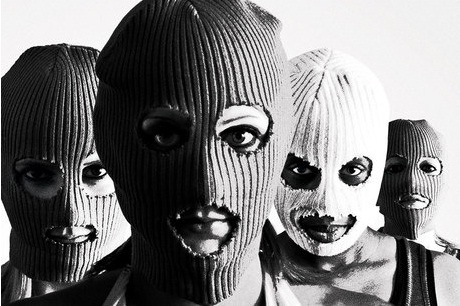
Last year Ian Rickson’s Hamlet was set in the world of 1970’s psychiatry and the action unfolded with references abound to RD Laing, Phyllida Lloyd’s Julius Caesar – currently at the Donmar – is set within the confines of a women’s prison and, not having yet seen it, one would imagine that power structures of the play reflect upon the institutional setting. Joe Hill-Gibbin’s take on The Changeling – Thomas Middleton’s and William Rowley’s Jacobean tragedy – appears to be set within a mental institute with the audience taking on the role of paying guests.

The advantage of doing this is that it liberates the text from the confines of the period in which it was written and it allows space for allusions and references that would not otherwise be possible. The criticism is equally obvious – directorial authority runs roughshod over the intentions of the playwright and their director’s decision-making becomes the critical factor in the production.

This is less of a problem for The Changeling – a play where the plot is so bizarre and bloody that it is hard to understand how it could ever be played with serious intent, seemingly more suited to the plays of Le Theatre du Grand-Guignol. Yet there is an enduring popularity to Jacobean tragedy that seems to be shared by mass audiences and critics alike. The revival of The Changeling has been broadly welcomed, whilst Cheek by Jowl’s equally modern take on ‘Tis Pity She’s A Whore was a critical success and tickets for Punchdrunk’s unique, if fantastically over-hyped, production of The Duchess of Malfi in an abandoned Docklands office block were like gold-dust.

<<Continue to full review>>