Bennett’s People suffer from Trust issues

People – National Theatre, until 02 April 2012

Perhaps it was figures published by the Office of National Statistics that suggested the top 10% of households are now 850 times wealthier than the bottom 10%, or possibly it was the leaks to the media that categorically ruled out a Mansion Tax whilst uplifting the majority of welfare benefits by just 1% but, whatever the cause, it was difficult to warm to Alan Bennett’s latest play, People, that contains some questionably judgements on the balance to be made between those who inherited thePeople - National Theatreir wealth and can’t afford it, and those can afford it but can’t enjoy it.

Alan Bennett has always existed as a very British radical. Not one to follow in the footsteps of the Angry Young Men of the 1950’s and a world away from Edward Bond’s ferocious anger, one suspects that Bennett has always looked to subvert opinion in unexpected ways – right from the earliest days of Beyond the Fringe.

However watching People, it was hard to not question whether the targets of his ire are particularly deserving of it. There is nothing wrong with it as a play, even if it is a little slighter than some of his earlier work. It is an intelligent comedy that contains Bennett’s traditional meshing of farce with wry humour. There are plenty of excellent one-liners and fully-rounded characters that manage to make what are fairly broad comedy tropes (the Bishop and the porn film could have been a terribly tired cliché) seem reasonably fresh.
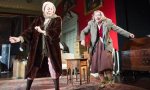
Frances de La Tour and Linda Bassett in PeopleNo-one goes to a Bennett play expecting the uncomfortable laughs of Martin McDonagh or the breathless extreme farce of Joe Orton, but there is a certain softness that at times makes everything a little too comfortable. The play continues to set up quite uncomfortable philosophical positions about class, inherited wealth and the self-importance of organisations that take it upon themselves to reflect the nation, and then edges away to operate the middle ground.

There are targets scattered throughout the script and whilst Bennett is perfectly capable of doing with a stiletto what others would do with a 12-bore shotgun, there are times when the mercy he shows his subjects makes it difficult to gauge where the audience’s sympathies are supposed to lie.


<<Continue to full review>>

A new star shines brightly in Constellations

Constellations – Duke of York’s Theatreuntil January 05 2013

The transfer to the West End of Constellations, the latest play by Nick Payne, caps what has been, by any measure, a remarkably successful year for someone oft-referred to as one of Britain’s brightest young playwrights. With a Stars that I did see at Nick Payne's Constellations (Sally Hawkins and Rafe Spall)bone-fide A-list actor cast in New York and clutching an Evening Standard Best Play Award for Constellations – a play wearing its learning on its sleeve and displaying an innate understanding of the mechanics of plotting far beyond Mr Payne’s 28 years – it can be difficult to tell whether ‘brightness’ is a reference to the current luminosity of his career or the marked intelligence that he brings to the theatre.

To write a play about string theory that looks to ‘show’ as well as ‘tell’ is a sizable task. Given the complexity of the topic and perceived tensions between the two schools of thought, it is perhaps unsurprising that there are relatively few plays about science and so, given the lack of comparators and the formidable confidence required to attempt such a mesh, it is perhaps inevitable that parallels will be made with Tom Stoppard.

It would perhaps be unfair to challenge Mr Payne to step into the shoes of one of Britain’s most eminent post-war playwrights but parallels can be discerned– at the age of 30 Mr Stoppard wrote an audaciously confident of his own in ‘Rosencrantz and Guildenstern are Dead’. It remains one of the few Shakespeare-inspired works of art that can be held up to its inspiration and look it straight in the eye. The ease with which real scientific and philosophical rigour is interweaved with one of drama’s most potent works is frightening.

Stars that I didn't see at Nick Payne's Constellations

To say that Constellations does not quite match that gold standard is no disgrace because Constellations is very good on its own terms. It maintains intellectual ambition whilst driving a more humanist approach to comedy that is far more modern than either the farce of Michael Frayn or the rather mannered intellectualisms of Stoppard. The resultant characters are able to display much more in the way of warmth and manage to avoid the rather calculating artifice that affects much farce.

<<Click here to read full review>>

The Cat that got the Mother but not the cream

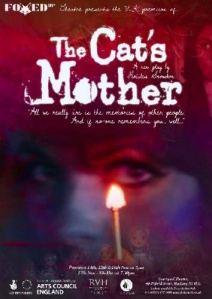
The Cat’s Mother – The Courtyard Theatre, until 08 December 2012

Through poor fortune or poor choice over the last six months there has been a lot of mediocre theatre served up by some of the establishment’s big names performing in London’s highest profile spaces. Having had the misfortune to sit through a disproportionate amount, there has been ample opportunity to muse upon the reasoning that leads to one wrong decision after another contriving to reduce potentially sublime theatre experiences into hollow shells of directorial pretension and actor artifice.

The pendulum of audience response suspended over every production seems to swing heavily towards the director when it is not well received and towards the actor when all is going well. It is perhaps unsurprising that this should be the case. Given that much of London’s theatre is about reviving classics then the director is in a tight spot. There is an expectation that a play should be looked at afresh but too fresh – as Deborah Warner found with the School for Scandal and Charles Spencer’s enraged response to Ian Rickson’s Hamlet at The Young Vic demonstrate – and the critics can be up in arms.

Actors’ are usually not blamed for such decisions and a safe, or even dull, production can generally reap much praise for the traditional performances of the cast –the phenomenally overrated Long Day’s Journey into the Night was stymied by overly naturalistic performances in an interminably conservative productions. The result: no risk and the cast showered in praise.

The key in theatre, as with so much in life, is balance. A director must work harmoniously with the actor to recreate the text in a manner that resonates for the audience and elicits truth in whatever form that should take. This point may work in an academic textbook or possibly in particularly un-radical manifesto for the theatre but halfway through watching The Cat’s Mother the central flaw of this approach became apparent. It may be fine for plays where the author is dead or removed from the production but how about when they are very much involved?

We are currently in the midst of a startling rebirth of new dramatic writing – a process that seems to come in waves every decade or so. It appears that British playwrights have finally thrown off the shackles of Sarah Kane and Mark Ravenhill and are finding their own voice. Lucy Prebble has followed up ENRON with the acclaimed ‘The Effect’,  Simon Stephen’s output has reached prodigious levels and Nick Payne has ‘Constellations’ shortlisted for Evening New Standard Best Play and has enticed Jake Gyllenhall to star in ‘If There Is I Haven’t Found It Yet’ across the pond.

Clearly there is a case that the author cannot be ignored if they are alive, kicking and taking an interest in the end product, and this is what I fear may have happened with The Cat’s Mother. Having seen some of the cast earlier in the year in Girlband, I am fully aware of their talents and a transition to more serious subjects was of interest. Pericles Snowdon is an award-winning writer and so this meeting of minds was an enticing prospect.

<<Continue to full review>>

GIRLBAND: trading on comedy rather than cliche

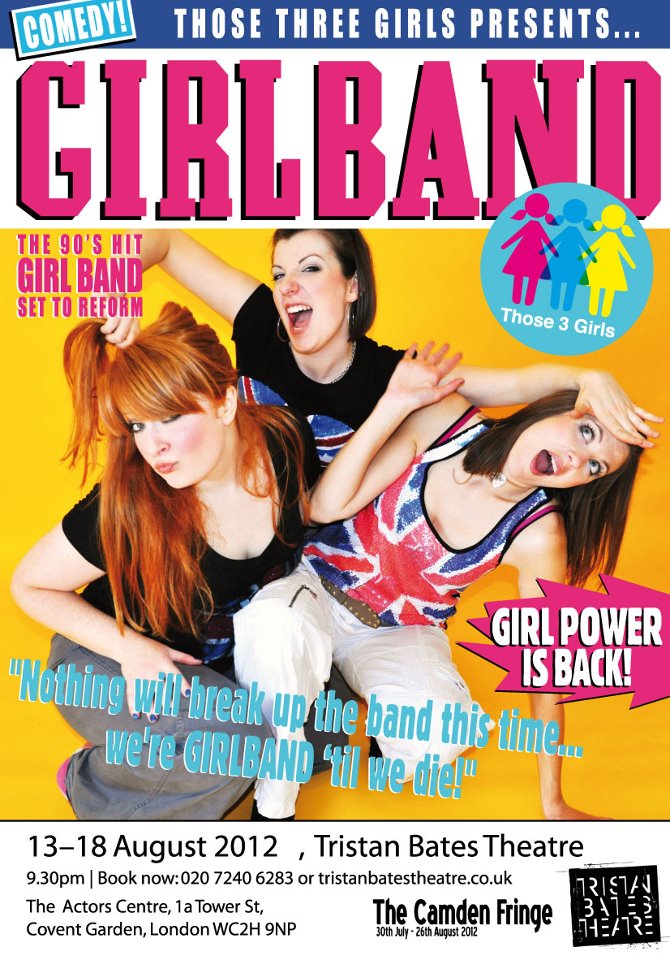
GIRLBAND – Tristan Bates Theatre, until 18 August

Whilst The Spice Girls may have chosen the Olympic Closing Ceremony to remind people what exactly they had been missing for the past 12 years, a small theatre in the heart of the West End was dedicating its space to the story of GIRLBAND – a sassy pop 3-piece that took the charts by storm in the mid-90’s before going their separate ways…

Fortuitous timing may have worked to GIRLBAND’s advantage but with my experiences of WAG: The Musical still painfully raw there was a certain trepidation about launching myself back into the world of spoof musical celebrity culture.

However I need not have worried, Those Three Girls (Carly Sheppard, Lucy Barnett & Susie Peters) have produced a very enjoyable concept that actually relies less on the traditional cliches associated with manufactured pop-bands and more on the wider-impact that fandom has on those that support them.

Whilst not avoiding easy laughs (it is a comedy after all), the production retains poignancy as the central action is focussed on the Fans rather than the Band and the audience is invited to both laugh and feel sympathy for these characters. This is reflected in the script which at times owes a debt to Alan Bennett’s comic monologues, with a style that is primarily direct to-the-audience and containing a wry humour that is often laced with an underlying melancholy.

<<Read full review>>

Ragtime revival appears a little threadbare

Ragtime – Regents Park Open Air Theatre, until 08 September 2012

With The Hollow Crown and Danny Boyle’s Olympic Opening Ceremony giving British audiences the chances for two very different examinations of the national character, it seems almost unpatriotic to be reviewing Regent Park Open Air Theatre’s production of Ragtime – a musical that places itself firmly within that staple of American drama; the great American narrative.

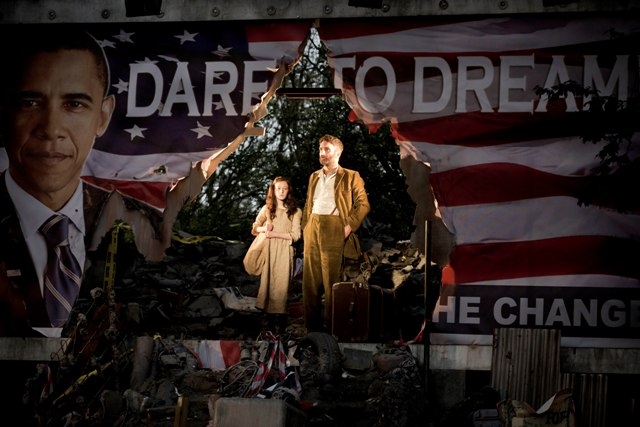
Adapted from E.L Doctorow’s mid-seventies novel, Ragtime offers a panoramic view across early-20th century America. Blending fact and fiction, the musical weaves a loose narrative through the eyes of three rather generic stock characters; the middle-class housewife whose values are transformed through a life changing event, the eternally-optimistic immigrant who only cares about making a life for his daughter and the black musician struggling against institutional racism.

Under Timothy Sheader, the Regent’s Park Open Air Theatre has taken home the award for ‘Best Musical Revival’ in each of the last three years. Stunning productions of Hello, Dolly!, Into the Woods and Crazy for You meant that his 2012 choice was eagerly anticipated.

Despite a reputation for bold takes on American classics, Sheader’s production of Ragtime proves itself to be a rather more awkward piece of work. The tableau approach creates an uneasy balance between fact and fiction, with key events seen through the eyes of Ragtime’s characters whilst historical figures rub shoulders with fictional creations. The plot is a fairly transparent call for social and racial equality and, originally written in the 1970’s, is clearly laudable in its aims. However for those not well-versed in early 20th century American history it was slightly frustrating for never being entirely sure which scenes were real and which imagined, which characters were based in reality and which were the authors invention.

Ragtime’s closest comparator is Gershwin’s masterpiece Porgy & Bess; both are interested in showing audiences the experiences of marginalised members of American society. However where Gershwin was able to put faith in the strength of the music and the lyrics,  through songs that have become integral parts of the 20th century canon – Summertime, Ain’t Necessarily So and I Loves You Porgy – Ragtime is not able to draw from such a well. Despite fine moments the play lacks depth and delivers the narrative in a halting and didactic tone.

<<Continue for full review>>

Musical Theatre: Comparing old with new

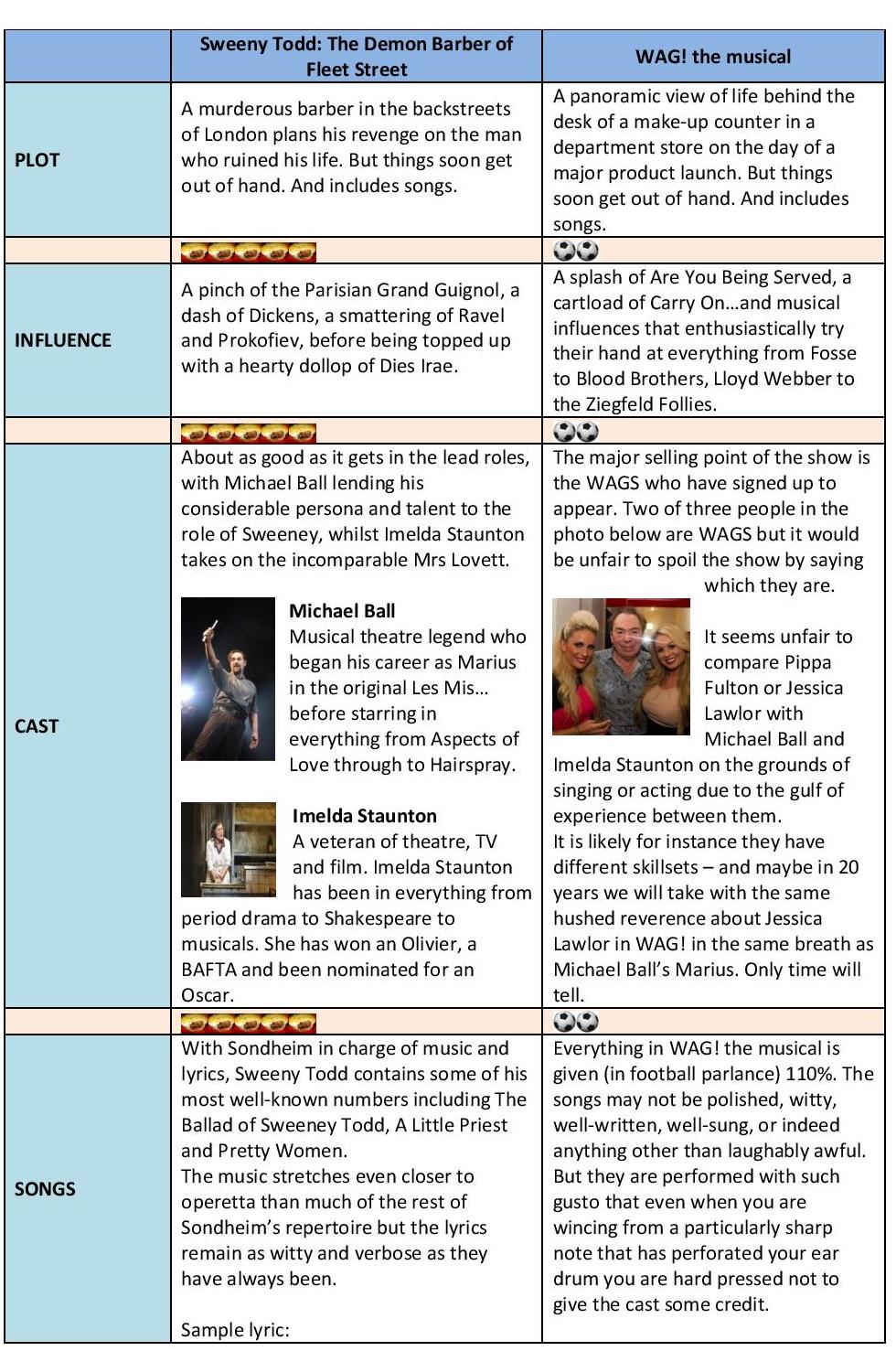
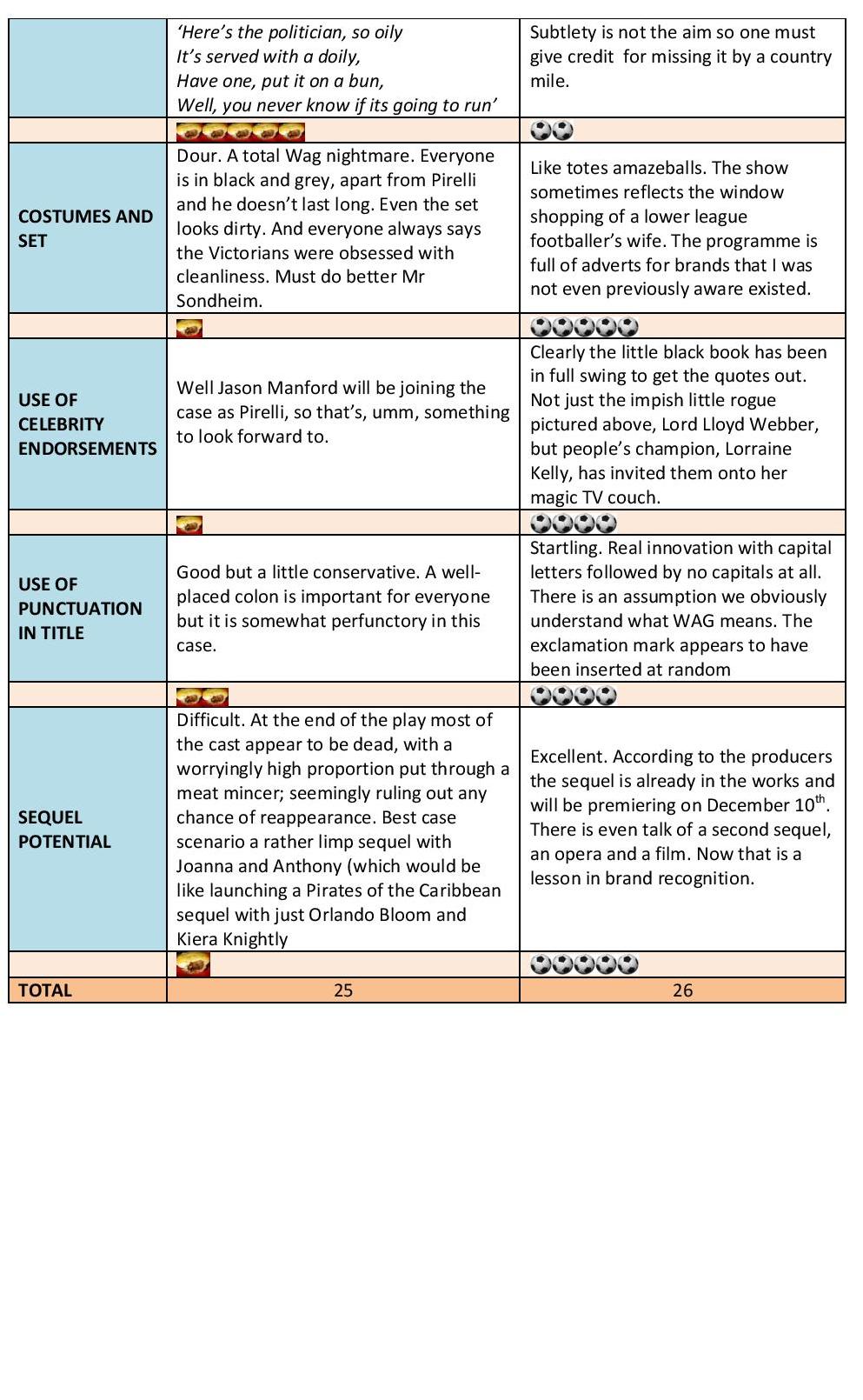
Last week I had the somewhat dubious pleasure of sampling two musicals. One is a scathing social satire on contemporary values whereas the other is a gruesome tale of revenge that ends in a bloodbath for all concerned. One is a complex work that draws on recurring classical motifs whilst the other takes a magpie approach to the classic styles of twentieth century musicals. One is regarded as one of the great musicals by a legend in his field. The other has been championed by Lorraine Kelly. But are we letting reputations get ahead of us?

In the interests of fairness, Civilian Theatre has assessed the merits of both shows to see whether Sweeney Todd: The Demon Barber of Fleet Street, the perennially popular Stephen Sondheim musical that won rave reviews at the Chichester Festival last year and has since transferred to the West End, is really any better than WAG! The Musical, which was enjoying its world premiere at the Ye Olde Rose and Crown in Walthamstow.

So there you have it, a win for the WAGS. The colossus of Broadway has been brought to his knees by some upstart wives of footballers. As any sportsman knows – the stats don’t lie. WAG! the musical has proved itself every inch the equal of Sweeney Todd and Sondheim (lyricist for West Side Story, Academy Award Winner, Pulitzer Prize Winner, Winner of 8 Tony’s, 8 Grammy’s and 6 Olivier Awards and with a theatre named after him) clearly has been humbled by a new challenger for the crown.

See more here:

WAG!

Sweeney Todd

Editors Note: Apologies to Mr Sondheim for the misspelt Sweeney in the above article. If I hadn’t been moved close to despair by uploading gremlins then the amendment would have been made.