Funny but flawed people

All New People – Duke  of York’s Theatre, until 28 April 2012

The tone for the evening is set pretty much immediately; the music playing over the PA system is so hipster-y that you spend the first 5 minutes waiting for Zooey Deschanel to emerge from the wings wearing a vintage polka-dot dress whilst eating a cupcake. Also immediately obvious to a jaded theatre-goer is that the audience waiting expectantly is notably younger than those entering Hay Fever, the Noel Coward-revival currently playing 50 metres down St Martins Lane.

Can we go as far as to make rather-too-obvious allusions about a baton changing hands? Well, yes and no, Braff’s ‘All New People’ is his first attempt at writing for the stage and there is a definite sense that he is a little green around the edges; in Coward the jokes slip down easier than the regularly consumed cocktails that punctuate his plays, for Braff the punchlines are clearly influenced by his background in TV, harsher and with a more obvious break for audience laughter. 
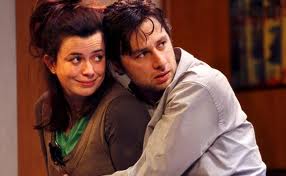
However there are signs that, if Braff sticks with it, he could be a genuinely talented new comic voice for the stage. And it is a voice that is desperately needed. Comedy appears to be treading water in the West End; if you strip out the celebrity revivals (Lenny Henry in Comedy of Errors), the old-hands (the annual Ayckbourn) and the reworkings (One Man, Two Guv’nors) then we are left with a rather bare cupboard.

Braff is a talented writer and knows how to craft a gag, either verbal or visual. The play starts with a well-judged physical comedy routine where Braff, about to hang himself, discovers he has nowhere to ash his final cigarette. The rest of the play is stuffed full of decent punchlines, even if it rather too often veers towards the profane but this could be a natural reaction against the restrictions of TV comedy. Braff has a very referential and post-modern style, which judges its target audience astutely. These are characters that clearly exist in the real-world, even if it is a much abstracted one.
<Click here for the full review>  

A valuable lesson about forbidden love

‘Tis Pity She’s A Whore – Cheek by Jowl at the Barbican, until 10 March

‘Tis Pity She’s A Whore does not make itself the easiest of plays to love; even given the general sense of impending and unbending doom and attendant cast of flawed humanity that appears as a hallmark of Jacobean tragedies, John Ford’s ‘Tis Pity… is unsentimental, hard as flint and packed full of characters that do not exactly strain to gain the audiences sympathy.

It is difficult to imagine what was made of it in the 17th Century but its tale of intrigue, incest, and murder is one that retains a genuinely shocking impact two centuries later, whereas other plays, such as The Revenger’s Tragedy, The Duchess of Malfi or The Changeling struggle to escape the period detail of their plots.

The effectiveness of the impact may have much to do with the key subject matter of ‘Tis Pity. Whereas the actions of characters may appear a little antiquated to a modern audience – suicide and a bloodbath in the course of avenging another seems a little outré these days – incest remains one of the last remaining taboo areas. One needs only watch the end of Polanski’s neo-noir masterpiece Chinatown to see that it retains a visceral power. It maintains a mysterious otherness by sitting so far outside an audience’s range of experience.

Few plays tackle the subject openly; the inexorable slide through its beginnings into initiation and onwards onto final devastation is laid out in front of the audience in an astonishingly frank manner with surprisingly little of the expected moral criticism. Ford’s play wrong-foots the spectator at almost every turn leaving the audience fully engaged in the spectacle despite an awareness that the conventions of drama practically dictate the inevitable conclusion.

<Click here for the full review>

Transcendental Translunar Paradise

Translunar Paradise –  Theatre Ad Infinitum at the Barbican Pit, until 21 January

It takes a little less than ten minutes of Theatre Ad Infinitum’s remarkableTranslunar Paradise, a show that is about death and then process of moving forward, to be assured that its creator, George Mann, has developed an intimate understanding of the rhythms of grieving. The programme provides background but you do not need it to know that this devised work was forged in the pain of experience. It captures, and expresses with sublime beauty, a simple truth that is missed time and time again in lesser works: that the true tragedy of death lies not in the moment of loss but in the moment of realisation that life continues relentlessly onwards.

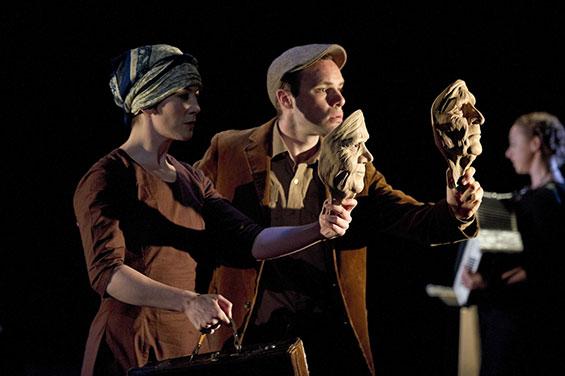
A bravura opening sequence sees two masked performers enact the final moments of a long-lasting relationship. We watch actions that have been repeated so often it is as if they have been instilled in the muscle memory of the characters; a pat on the elbow, an offer to carry the suitcase, a crossword clue. These little touches are what remains after a loss and offer a gateway to the past, where the man can relive the key moments in his life and create a way of holding on to what has been lost. In some ways similar to Pixar-film Up, Translunar Paradise begins in tragedy and then expands the scope to explore how this impacts on the surviving partner.

Continue to full review here

High energy, high kicks and hijinks

Crazy for You – Ivor Novello Theatre, Booking until July 2012

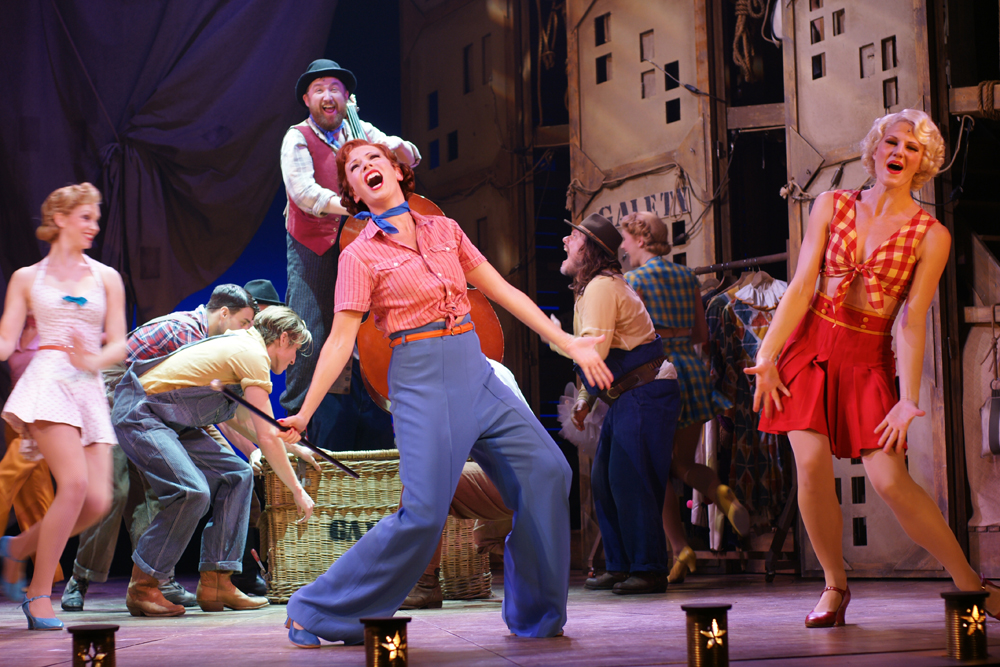
Fresh from its successful run at the Regents Park Open Air Theatre, Crazy for You has since transferred to the Ivor Novello Theatre. It seems a suitable home for a production that showcases the best of the 1930′s musical songbook. Whilst Novello contributed to a very British version of the musical comedy that had little in common with his American counterparts, Crazy for You’s chorus line routines, zinging one-liners and infectious melodies would appear to be closer to his taste than the overblown power chords, million pound sets and star billing of the modern day musical. It is both interesting and depressing to note Shrek: The Musical is in residency just two hundred metres up the road, and a stone’s throw from the Royal Opera House.

Having seen the show in its original run, it is interesting to make comparisons between the two. The Open Air Theatre is a daunting place to stage a show; the director needs to battle a large auditorium where small. intimate gestures are likely to be missed but without access to the same range of special effects and staging techniques available in a more traditional space.

There have been a few alterations during the transfer to the Novello, clearly with the aim of giving the show a little more spectacle, but these are only minor and there is a pleasing sense that there has been a deliberate decision to stay true to the spirit of the period. Whether it is due to being staged indoors, in more familiar surroundings, the dancing has become noticeably tighter. The routines have been slightly rechoreographed for the smaller stage and the chorus line display a uniformity and invention that is a necessity for reviving the true spirit of Broadway.  Click here to read the full review 

For a quick preview see the trailer below

(warning: this trailer contains moving images of Jeffrey Archer)

Even better than Cook’s chocolate cake

Cambridge Theatre, 21 December 2011 – booking until Oct 2012

There is a long and often inglorious history of converting  much-loved books into musical theatre. The temptation for doing so is obvious; flying in the face of overwhelming critical disdain, Les Miserables has provided a template  for financial success. It has a mantelpiece of audience-choice awards, a global army of devoted fans and by January 2010 it was celebrating notching up 10,000 performances in the West End. In short the tills have not stopped ringing since the original Cameron Mackintosh-Trevor Nunn production in 1985.

A salient and oft-overlooked fact by those who sneer at Les Mis is that this success has seen the RSC (producers of Matilda) through the brutal conditions suffered in the 1980’s under a prime minister who held Andrew Lloyd Webber as a shining example of artistic achievement. No doubt Jean Valjean would not have countenanced betraying his principles in such a manner but clearly the financially imperatives of publically subsidised theatre led to Trevor Nunn’s rather more pragmatic vision.

With Les Miserables finally beginning to flag, transferring to the noticeably smaller Queens Theatre and with the famous Barricade seemingly less than impressive in its new surrounds, the RSC have sought to launch a new cash cow in the form of a major new musical adapted from a well-known book. Clearly it was though that the National’s approach of writing a verbatim musical, ‘London Road’, about the serial killing of five prostitutes in Ipswich was not the way to long-term commercial success.

However the road to the West End is paved with the carcasses of plots from their literary womb untimely ripped. Topping this sad and unfestive tree must be Gone With The Wind, critically reviled and starring a woefully miscast Darius (remember him?), but there is also Carrie The Musical, a concept so clearly problematic that the mind boggles at the commissioning process. For most of 2012 we have been entertained by the sorry stories emanating across the Atlantic surrounding the sheer ineptitude of Spiderman: The Musical; a show that could only have come from trouble-shooting consultants who identified a previously unidentified cross over between comic book fans and musical theatre goers.

The RSC must have approached Roald Dahl’s much-loved children’s book with some trepidation. He is an author who, like Enid Blyton, never seems to go out of fashion despite offering a nostalgic view of England that those reading the books will find hard to reconcile with a world of X-Boxes and Club Penguin. With a central premise built on libraries, it even smacks of radicalism that seems very at odds with Dahl’s natural conservatism.

Continue to the full review here

And for a special sneak preview…

New World Order is a terrifying Brave New World

New World OrderHydrocracker, Shoreditch Town Hall, Running until 11 December 2011

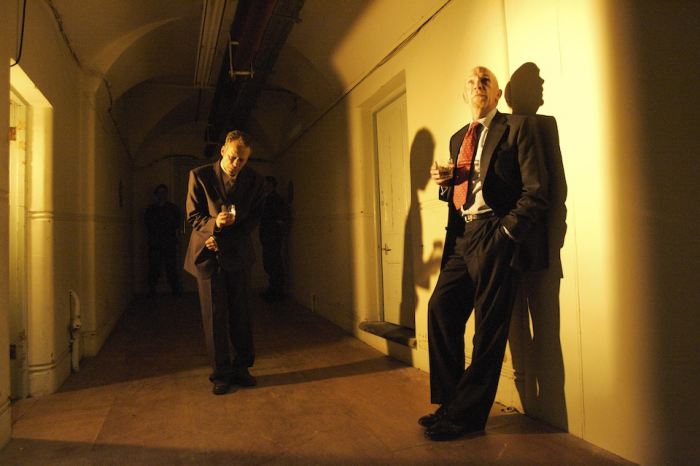
Winding from the ornate meeting rooms and private recesses of power, where bureaucrats discuss policy and the media is entertained, down to the bowels of the building, through long forgotten corridors where concrete crumbles away from the walls and barren rooms echo to the sounds of clanking boilers and the scurrying of mice; Hydrocracker have created a staggeringly potent panorama of institutionalised state power, a lucid dream that unfolds to reveal nightmarish dimensions.

New World Order is an amalgam of five of Harold Pinter’s shorter work, deriving from his later period where his output began to more directly engage in questions of politics and control. Despite being a playwright who took fastidious care over every element of the script, it is hard to believe that Pinter, the political animal, would not have given his support to Ellie Jones’ superb reimagining that knits together five separate pieces so effortlessly that the joins between the work are made practically invisible (the only distinguishing mark being subtle changes in the linguistic character of different scenes).

Most impressive is the use of location to create a unity of action. Site-specific and immersive productions may have boomed in popularity in recent years, and as a result become short hand for companies wishing to demonstrate their innovation, but none has managed the unification of text and place that Hydrocracker have achieved through locating their work within Shoreditch Town Hall.

It is an inspired choice and the building is absolutely integral to the success of the piece. As the audience is led through the site, it becomes a living, breathing character of its own. Everything about the building exists in a contextual history of real politics, so when the audience halt on a staircase to let two policy wonks, deep in conversation pass, it is shocking to realise that rather than discussing the minutiae of planning regulations, they are in fact debating how many opposition supporters can be dealt with before they lose support of the general public.

Hydrocracker has clearly understood that location is everything. Led past a plaque detailing all the former mayors and into a conference room set-up for a press conference, the audience are reassured by familiar sights of the political establishment and are empowered to embrace the realism of the situation. It is only when people begin to speak that everything reveals itself to be off-kilter, and from that point on the audience are drawn ever further into the world of state-mandated terror.

Click here to continue to full review