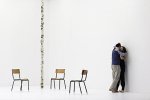
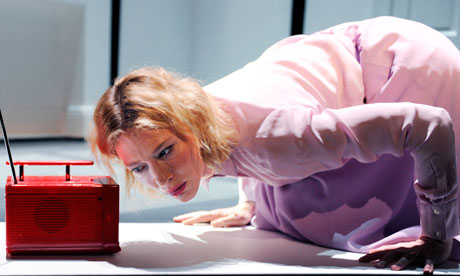
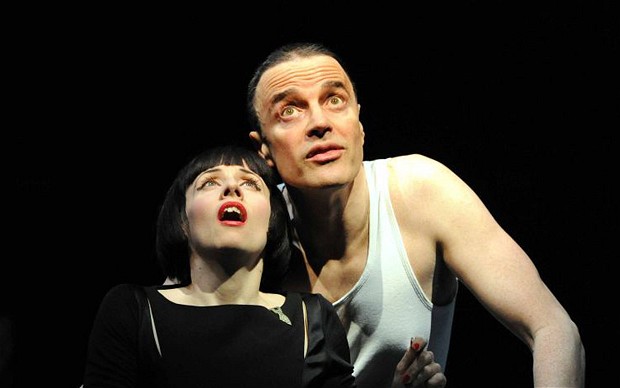
Advance Notice – Highlights of the Autumn Season 2012

In recent days we have had announcements from both the Royal Court and Michael Grandage of their upcoming seasons. Representing the very different ends of the theatrical experience for audiences; the small intimately thrilling Royal Court where so many of our great playwrights were given a space to write and the cavernous and wallet-sapping Noel Coward Theatre, the name alone indicative of its West End heritage. It is heartening to think of Grandage’s past as Artistic Director of The Crucible and a ten-year stint at the Donmar and realise that it is still possible to trace a line from the heart of regional theatre all the way to the money-making centre of the British stage.

One might grumble about the prices of Grandage’s plays but it cannot be denied that a West End line-up containing two Shakespeare’s, a McDonagh and a new play by John Loga, whilst, maybe not groundbreaking, provides rather more interest than the usual fare of rehashed musicals, Coward revivals and vehicles for ageing American celebrities. Ticket prices may be steep at the top end but, as I have commented elsewhere, the £10 tickets actually undercut the National’s Travellex offer and, if star power is what you are after, provide fantastic value for money. Whilst advertised as ‘moderately restricted view’ I have found the seats to be absolutely adequate and you would miss virtually none of the action. Given they are available in both the Royal and Upper Circles they arguably offer better value for money than the Gallery tickets that are the next cheapest but are  already edging towards an uncomfortable £27.50 for seats right up in the gods.

With information about the National Theatre and the Barbican already available we can see that the upcoming months look very rosy indeed. And as a public service, Civilian Theatre is very happy to provide you with a month-by-month guide to the most interesting plays over the coming months (a growing requirement as it is becoming more and more evident that theatre is going the same way as gigs and stand-up comedy and selling its major events anything up to 18 months in advance – Jude Law in Hamlet in November 2013 anyone? Not busy I hope?)

___________________________________________________________________ 

September 2012

London Road (National)

This may be a last chance to catch one of the most interesting and innovative musicals in recent years. It sadly had the misfortune to go up against the Matilda juggernaut in all the major award ceremonies and as a result came home empty-handed but this tale, based on documentary footage taken from Ipswich in the aftermath of the discovery of five bodies in 2006 and put to music by Adam Cork, is one of the most complex and affecting new musicals in a long time. A real slow-burn hit, its success can be seen in the major summer revival it was given by the National just a year after it was first introduced. September is possibly the last time you will be seeing it in quite a while so go while you can.

Mademoiselle Julie (Barbican)

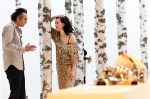
Hopefully not setting myself up for a fall after the general disappointment of Cate Blanchett in Big and Small – where the size of the play failed to meet the stature of the actor – we see Juliette Binoche meet Strindberg as another entry in the Barbican’s generally excellent international programming. Binoche is one of the deserved greats of French acting; an actress capable of turning down Spielberg’s Jurassic Park for a role in Kieslowski’s Three Colours: Blue (now that is range). The set photos are fascinating and suggest a radical take on a work famed for its naturalistic excellence:

love and information (Royal Court)

Whilst not to everyone’s tastes, a new play by Caryl Churchill is certainly not something to be ignored. One of Britain’s leading playwrights over the last 40 years and an icon for the current generation of female writers who grew up on Top Girls and Cloud 9, Churchill returns to the Royal Court with a new play, love and information. Details are scarce other but it looks likely that it will be a continuation of Churchill’s abiding fascination with non-linear story-telling and the use of the less naturalistic elements of theatre, as she creates a panoramic landscape of over 100 characters.

Hamlet (Queen Elizabeth Hall)

In what was very high up Civilian Theatre’s ‘Must Watch’ list was this import from Denmark – The Tiger Lillies performing Hamlet. Unfortunately recent news tells us that it has been cancelled for ‘scheduling issues’ but if they can find a slot for it in 2013 then I urge all to go and see it. The Tiger Lillies describe their own music as Brechtian street opera and are instantly memorable for all of those who had the fortune to see their version of Shockheaded Peter many moons ago. For those who have missed their vaudevillian morality tales then here is a performance of a song from Shockheaded Peter:

___________________________________________________________________
For more on the Autumn Season, including highlights from October and November then please click through for more.

Shakespeare’s Cymbeline finally turned into a true work of art

Cymbeline – Barbican Theatre

The Ninagawa Company, under the stewardship of Yukio Ninagawa, has built up a fearsome reputation in world theatre. They stand as the equal of any post-war company from Joan Littlewood’s Theatre Workshop through to Chicago’s Steppenwolf, whilst stylistically they are as uniquely identifiable as anything from Peter Brook or Simon McBurney.

Famed for his Shakespeare, Yukio Ninagawa has turned his attention to one of the most problematic plays in the Bard’s canon; Cymbeline. It is a difficult play to love and one that comes packaged with all kinds of traps for a modern audience. The plot winds and winds and seems unsure of what it wants to be, containing elements of romance, farce and tragedy. It has simplistic plot devices, like cross-dressing and misidentification, reminiscent of earlier plays but also contains the heavily allegorical language and non-human elements, in this case Jupiter descending on an eagle, that place it alongside The Winter’s Tale and The Tempest as one of the later plays.

Frank Kermode described the play as a tragi-comic romance and suggests that it may have been an in-joke for audiences who would have had a much better understanding of the text and references to earlier plays. None of which makes it any easier for a modern audience to unpick the complexities of the plot.

Luckily going to see a Ninagawa production is to have your visual senses wrapped in cotton wool and taken on a journey where the simplicity of images masks the masterful craftsmanship working behind the scenes. The technical understanding of balance is superbly illustrated again and again throughout the evening; light and shade, simplicity and complexity, the tonality is in harmony so that everything works towards the whole and the audience is never aware of the mechanics. Like other Japanese traditions that have bewitched Europeans over the years, from woodcuts to sushi, the skill rests on the ability to hide an incredible complexity behind a deceptively simple front.

It is difficult to fairly assess the skill of the actors without speaking Japanese and since the production leans so heavily on the visual, the rest of this review will take a radical detour and will look to provide a sense of the evening through the images it has left behind.

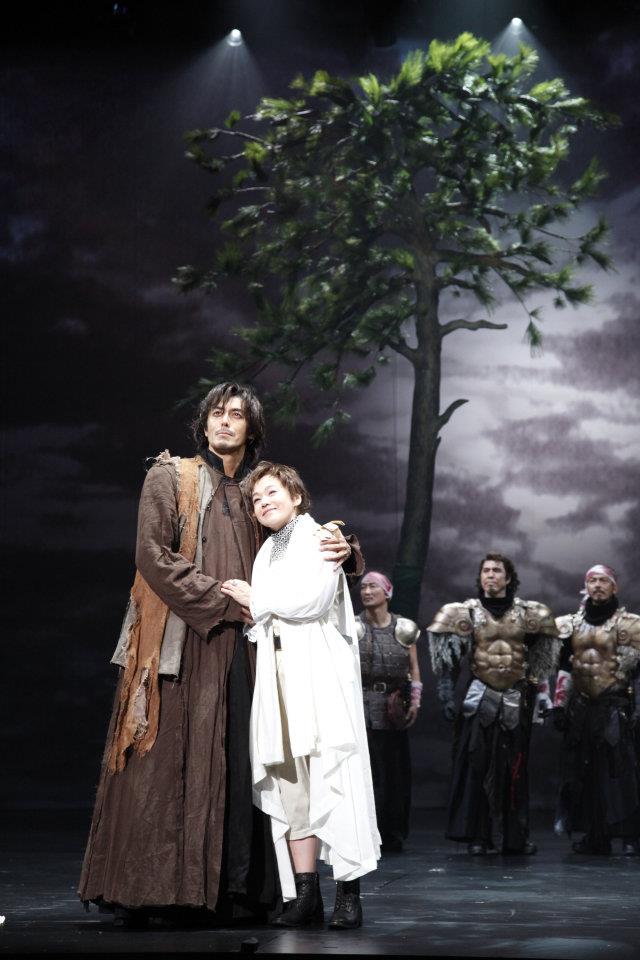
You can choose any one of a number of plot strands to call the centre of Cymbeline. Above we see the romance at the heart of the play, that of Posthumus and Imogen, as they are parted and again as they are reunited. As is traditional in Shakespeare the lovers must face many barriers before finally winning through in the end. However the play is made problematic, particularly to a modern audience, by the fact that Posthumus acts in such an unreasonable manner for much of the play, doubting his wife’s fidelity almost as soon as he leaves England before hiring his servant to murder her. That kind of level of trust does not always lead to happy relationships.

As the beating heart of the play, Hiroshi Abe, as the exiled Posthumus, and Shinobu Otake’s Imogen, bring the romance to life despite spending most of the play separated. They draw out the character traits despite the language barrier, with Hiroshi embodying the stoic and duty-bound Posthumus,  accepting of the State’s decision to banish him before later preparing to sacrifice himself in realisation at the fate he believes he inflicted on Imogen.

<<Continue to the full review>>

Around Town: Next Week in London

The lack of an update for over a week is a sign that Civilian Theatre has been taking a well-earned break following the enduring trauma experienced by watching Babel. However the reviewing season kicks off again in earnest next week with three plays lined up, each of which I am quietly confident about.

Antigone has the enticing prospect of Christopher Ecclestone returning to the National Theatre after a 22-year absence. Performing in one the great plays of the classical era, Ecclestone has the craggy and worn features that seem ideally suited to play Creon, a man who has spent years charged with the responsibility of holding together the state over and above any call to personal desires. He is one of our great character actors who actually appears in a lot less work than you probably remember but whose appearance is usually a clue that we are going to be watching some quite special – he is superb as Derek Bentley in Let Him Have It; one of those rare films where you can feel the anger of injustice bubbling through every scene, and equally good in the seminal 90’s TV series, Our Friends in the North.   

The Physicists will be the next play under Josie Rourke’s tenure at the Donmar. Having scored a big hit with The Recruiting Officer but perhaps underwhelmed slightly for many with Making Noise Quietly, Rourke will be looking to come back strongly with Durrenmatt’s The Physicists. It is hard to think of a playwright, or indeed style, that has fallen more out favour in recent years than Durrenmatt’s slightly avant-garde, philosophical work. However I can remember being absolutely blown away by a production of The Visit and the staging possibilities that such a play open’s up. When you take time to sit back and survey London’s theatrical landscape do you realise the striking absence of such originality- even if plots and narrative can still remain freewheeling and anarchic, there is a sense that dramatically everything looks a little a bit conservative. Admittedly Complicite are still pushing boundaries but, for all the positive reviews, plays like Laura Wade’s Posh appear very formal in style. One hopes that a strong production of The Physicists will help start getting director’s to re-embrace the experimental in formal settings rather than feeling that experimental necessarily means site-specific pieces and audience engagement. Time was when director’s used a theatre to recreate an atmosphere, currently it feels that the audience aren’t trusted to suspend our disbelief and will only understand that we are in an abattoir if we see real cows hanging off hooks around us.

The Ninagawa’s Company production of Cymbeline at the Barbican promises to finally kick start what has been so far a rather disappointing World Stage Festival. Little more needs to be said about Babel, and Three Kingdoms, whilst interesting, did not set the world alight with a mixture of fantastic ideas and, at times, incoherent structure. Having previously missed all of Ninagawa’s English productions, I am tremendously excited by a company that has a global reputation for Shakespeare and a history of producing visually spectacular tableaux that meld together Shakespearian storytelling with traditional Japanese techniques. Cymbeline is a particualarly interesting choice of play, as it is one of Shakespeare’s more problematic narratives and seems to be one that is alighted on more frequently by companies that often take an angle slightly askance of the traditional – the last major London production being Kneehigh’s version at the Battersea Arts Centres, which included all its usual visual flair but perhaps provided a little too much fun over substance.

Stills from Ninagawa’s Cymbeline

This slideshow requires JavaScript.

Cillian Murphy mixes characters in stodgy Irish stew

Misterman – National Theatre, Selected dates until May 28 2012

Watching Cillian Murphy’s Thomas Magil, Inishfree’s one-man self-appointed morality committee, in Enda Walsh’s Misterman, I found myself transported back to two days previously to the Barbican where Cate Blanchett was the actor and Boho Strauss the playwright.  The parallels, as both plays hit London in the run-up to the Cultural Olympiad, perhaps reveal more about the process of staging a difficult play in the current climate than they reveal about the plays themselves.

The heavily-advertised cherry on top of each production is a bona fide Hollywood actor but not in the classic star mould that so often has the critics sharpening their knives. Both began their career in another country and grew up with one foot in the theatre rather than the Hollywood Hills. Neither has fully embraced the movie system despite Blanchett winning an Oscar for her role as Katharine Hepburn in Scorsese’s The Aviator; as close to embodying Hollywood royalty as it gets. Murphy has never embraced his potential leading man status whilst building a body of work that includes the huge Christopher Nolan blockbusters of the Dark Knight and Inception.

It is intriguing that in their return to stage both have chosen roles that focus almost exclusively on the isolation of the leading characters. Blanchett’s Lotte is a woman cast adrift from society following the break-up of her marriage; she is unable to effectively anchor herself and drifts along engaging in surreal encounters with friends and families that only heighten her growing isolation.

On the surface Murphy’s Thomas is suffering from an imposed isolation. He is literally rather than metaphorically alone; forced into making conversation with tape-recorded voices. However even in these interactions it is clear that Thomas was always out of kilter with those around him. It is a fantastical set-up but there is realism within the structure of the conversations that sets it apart from Big and Small.

It is difficult not to speculate what led the actors to these roles. They are not well-known plays and it seems unlikely that either would enjoy the same positioning and budget without their leads. The roles allow a freedom to an actor that is rarely granted, even in the theatre, but under the surface they are also strangely inflexible and a little one-note. As neither play really sketches out anything more than a caricature of secondary characters, the actors have no-one to play off and at times it can feel like an intense therapy session.

<<Read the full review here>>

And you can even watch a trailer here:

Alice’s Germanic Wonderland

Big and Small – Sydney Theatre Company, Barbican Theatre until April 29 2012

Boho Strauss’1970’s play Big and Small has been given a new translation by every A-level student’s favourite writer, Martin Crimp, and a major box office draw has been added in the form of Cate Blanchett. Sporting a spare but striking visual motif that weaves in moments from Alice in Wonderland, the resulting production is crisp and clean but remains a mixed-bag; both in terms of structure and in terms of quality. Director Benedict Andrews introduces some lovely elements throughout but it often feels that he is having to work very hard with not a great deal of material – although it should be pointed out that ‘not a great deal of material’ manages to fill over 2½ hours of stage time.

The main challenge for the production is its unevenness; a fragmented, dream-like structure is an appropriate choice for a play charting an individual’s experience of social alienation, and a lack of an obvious direct narrative helps capture the essence of isolation rather than the reasons behind it. It is attempting a theatre of poetry rather than a theatre of stories.

The unevenness relates to a lack of balance; the first half feels ponderous and slow, a series of scenes acting as snapshots of a multi-occupancy house induced a level of tedium due to scene changes that took longer than the actual scenes, and there is a free-wheeling lack of focus that suggests a play that is struggling to understand what it wants to be.

<<Continue to the full review>>

The Master and Margarita – a devilish concoction of imagery

The Master and Margarita – Complicite at the Barbican, until 07 April (Sold Out)

Few companies generate the same level of excitement before a new production as Complicite. There is a noticeable frisson of energy circulating the foyer before the audience takes it seat that is the result of a reputation for innovation and startling coup de theatre. It is a position that is very much deserved, as for three decades Complicite have pushed at the boundaries of the possible in both staging and story-telling; they have championed physical theatre and challenged the standardly linear model of naturalistic performances as a mechanism for exploring deeper metaphysical questions in their work.

This approach has been extraordinarily effective in tackling themes and stories that would otherwise be far too complex to bring to stage. Who else would have attempted A Disappearing Number, a play that shone a light on the 20th century mathematical genius, Ramanujan, and engaged the audience with the complexities of sting theory? Or attempted Mnemonic, a play that was part anthropological lecture told through the story of a corpse entombed in ice, part-character study of those involved in his later discovery and throughout an examination of memory and its mutability, fragmentation and unreliability.

Mikhail Bulgakov’s 1930’s Soviet satire, The Master and Margarita, often held up alongside the greatest novels of the 20th century, has defeated visionaries from Polanski to Fellini. It’s digressive storylines and recursive plotting variously tells the story of the titular characters, The Master and Margarita, and the lengths they would go to for love, whilst also featuring the devil in the shape of Woland and a retinue of associates who wreak havoc on the Soviet literature establishment, whilst a dialogue between Pontius Pilate and Christ interweaves and informs the narrative throughout.

<Click her for the full review>