An evening with…The Beatles

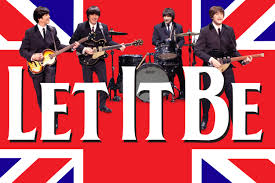
Let It Be – Garrick Theatre (and variously on tour) [Tickets]

Let it be…said that this reviewer does stray out of their comfort zone occasionally. Children murdered by the mother? Check. Libertarian ethics of avatar paedophilia? Check. An absurdist Bolivian redux of Hamlet? Check. An evening at the Garrick Theatre spent listening to faithful renditions of songs by the most influential band of all time? Well, there is a first time for everything.
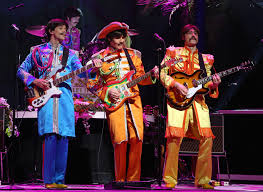
beatMany people hate on jukebox musicals but this reviewer does have time for the concept; Buddy, Mamma Mia and Our House all prove that given care and attention, and a back catalogue that can sustain a two hour plundering, it doesn’t have to be an excruciatingly painful evening. Indeed in my opinion the general terribleness of We Will Rock You says more about the quality of Queen’s songbook than it does about the show itself – and the fact that listening to 120 minutes of overblown bombast is more than enough for most people.

Well, no-one is going to claim that The Beatles don’t have the quality to cover the running time of a tribute concert. Indeed quite a fun little game to play on the tube ride home is to come up with a playlist that is just as strong as the one they left in – Oh Darling, I Want You, Nowhere Man, You’ve Got To Hide Your Love Away, She’s Leaving Home, Dear Prudence & Helter Skelter are just some I would have tried to slot in somewhere.

Perhaps it is already a well-known fact but Let It Be is not a musical in any meaningful sense of the word. This is a full blown ‘evening with The Beatles’ affair (except, rather excruciatingly and presumably for copyright reasons, they seem to be called ‘Let It Be’ which does dull some of the mystique).

There is no semblance of plot excepting an intermittent narrator guiding the audience through the years and ticking off all the big non-controversial Beatles milestones. Invading America? Yes. Bigger than Jesus? No. Hippies? Yes. Any overt references to mind-splitting amounts of acid? No. Gently mocking Ringo? Yes. Any mention of Yoko Ono? No.

Really though none of this matters. The producers have drilled to the core of what people want. And that is for those who never got to hear The Beatles the first time round, it is a chance to hear entirely competent covers of classic songs. And that is what you get – a relentless tidal wave of hit-after-hit performed with verve and energy. The music is so good that you cannot help but tap your toes, clap along and join the gustily sung, surprisingly tuneful audience-led rendition of Yesterday.

<<Continue to full review>>


I must thank the good people at Official Theatre for the tickets. Even without this shameless plug, please do check out their website to find out what is going on across the West End; it has links to tickets, venue contact details and bits ‘n bobs about all the theatres – the sort of thing I would do if I wasn’t so damn lazy.  (www.officialtheatre.com)

A whistle-stop tour of the antebellum South

Dessa Rose – Trafalgar Studios, until 30 August 2014 (tickets)

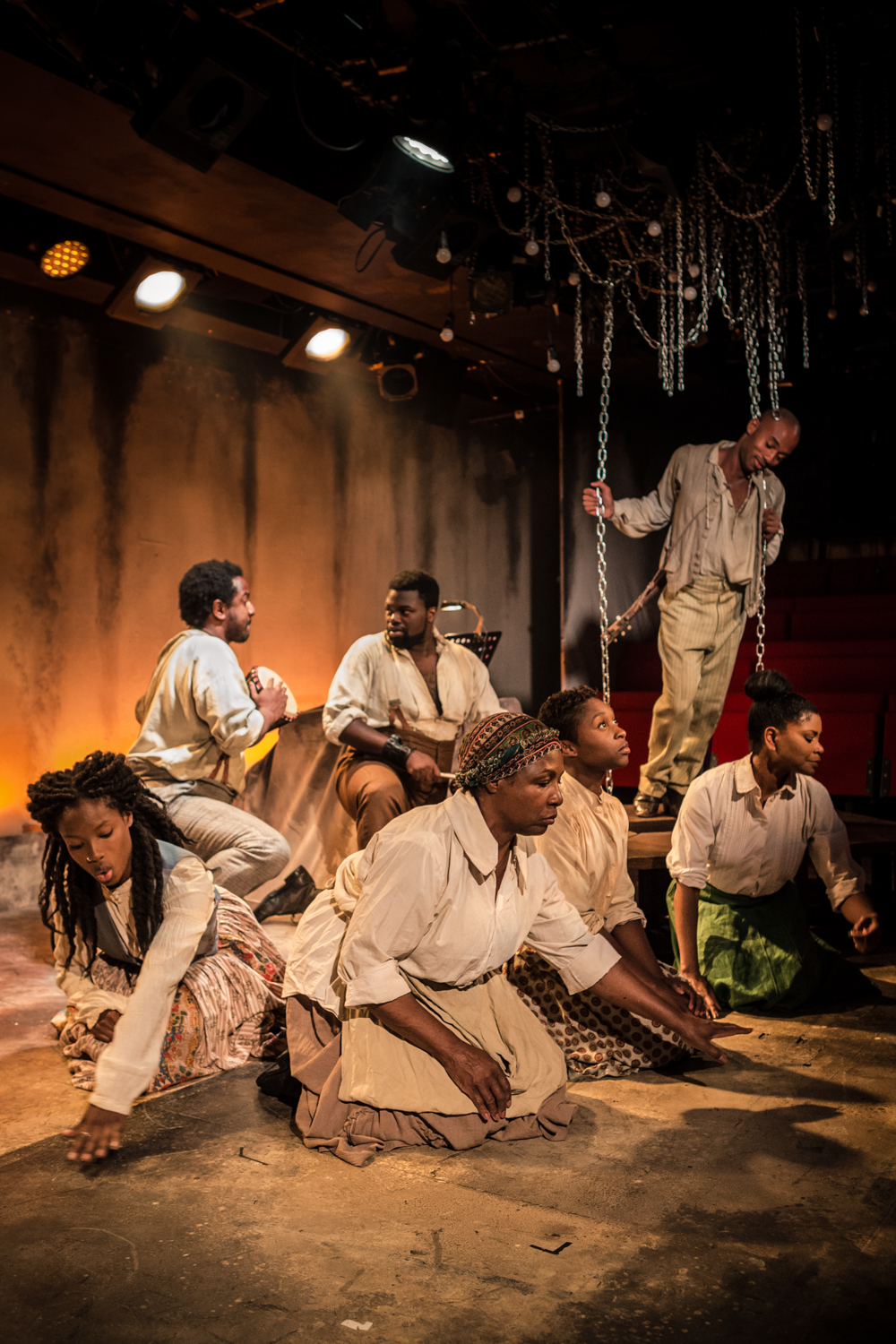
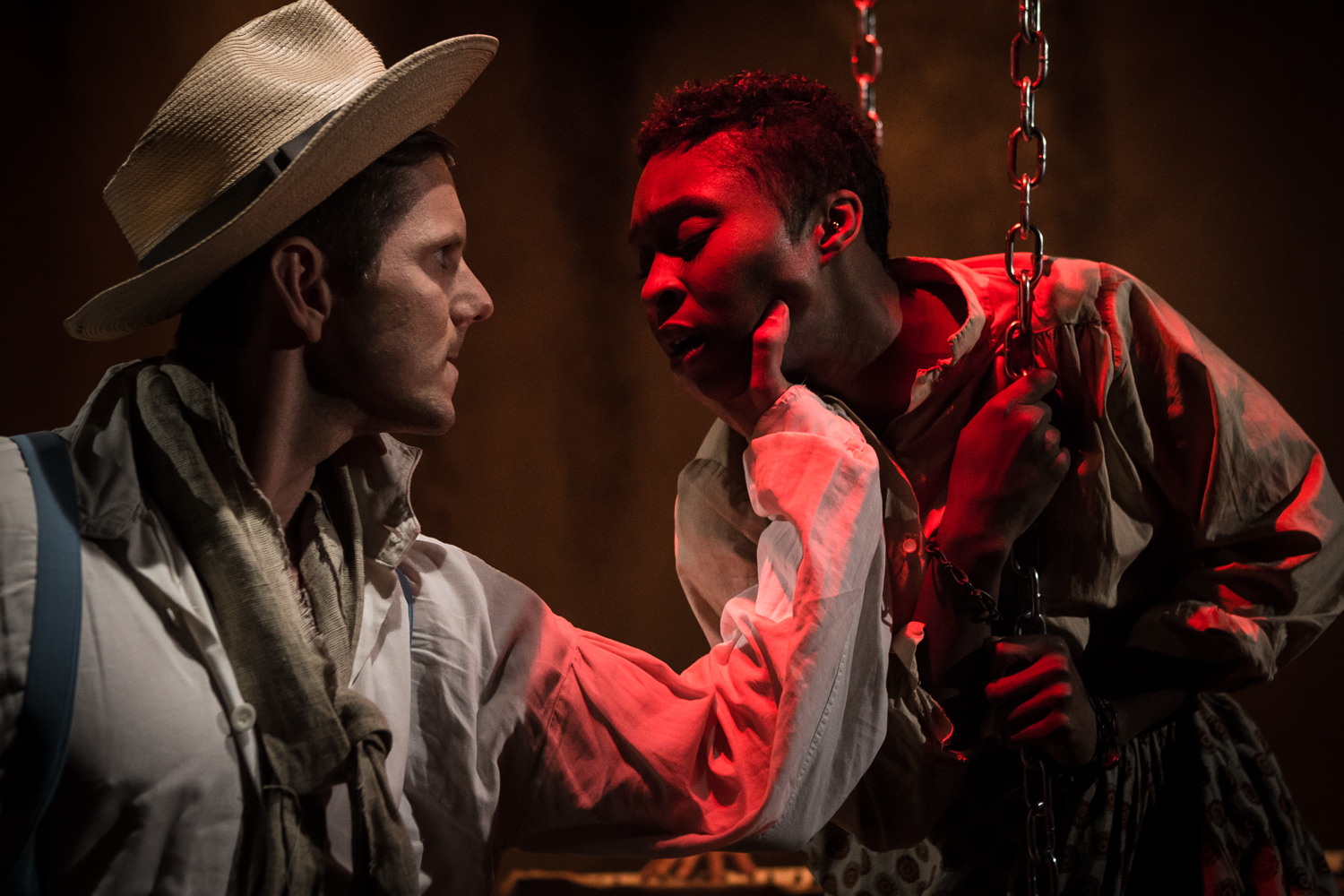
At the start of a new musical there is often a frisson of excitement that doesn’t often occur with new plays; the rarity of a new book, and the possibility that you could be in the audience for the next Chicago, Cats or Sound of MusicDessa Rose, Trafalgar Studios, Courtesy Scott Rylander,10 or, alternatively, Gone with the Wind or (fingers crossed) Carrie: The Musical seems to add a certain expectation to the evening.

As a result it is with something approaching disappointment that it must be reported that Dessa Rose proves itself to be an entirely functional musical, with performers and musicians’ skilfully executing what is, in the main, a rather humdrum book from Lynn Ahrens and Stephen Flaherty.

Whilst the production has a number of highlights it covers so much ground that you are pulled across decades as quickly as you are across musical styles. It is often not clear when or where you are, and this causes its central theme – that there is a bond between ‘women’ that can cut across the race and income divide of the prejudiced 18th century South – to never be satisfactorily addressed.

Ahrens and Flaherty have some form in producing surface-level musicals that work more as a Wikipedia summation of American history than as a complex emotionally engaging narrative. Ragtime, last seen in the summer of 2012 at Regent’s Park Open Air Theatre, was taken from E.L Doctorow’s novel, and was similarly fated to be rendered down into a deeply and problematically oversimplified tale of the oppressed masses instead of a complex view on America’s rich social-cultural history.

Musicals have taken a leading role in addressing racial prejudice and the experience of black people in America. Porgy and Bess is often held up as one of the greatest American musicals, The Scottsboro Boys finally emerged in the last couple of years as one of Kander & Ebb’s finest creations and, in the same year Ahrens & Flaherty produced Dessa Rose, The Colour Purple was also adapted for the stage.

Dessa Rose, Trafalgar Studios, Courtesy Scott Rylander,28These are not small shoes to fill and Dessa Rose, for all the heart of its performers, never comes close to filling them. There is nothing that comes close to matching Summertime or It Ain’t Necessarily So as musical numbers, it doesn’t have the natural, shocking wit of The Scottsboro Boys and the twin themes of racism and sexism are far more clearly articulated in The Colour Purple.

Dessa Rose is strongest when the performers and musicians are doing what they do best and the message gets forgotten about for a while. There is a tight-knit quality to the ensemble that suggests a strong rehearsal process and credit must go to Andrew Keates (Director) and Sam Spencer Lane (Choreographer) for some remarkably agile set-pieces on the tiny Trafalgar stage. It is not easy to work on a thrust stage with a cast of twelve but it is an impressively fluid production, and rarely do the actors get under each other’s feet.

<<Continue to full review>>

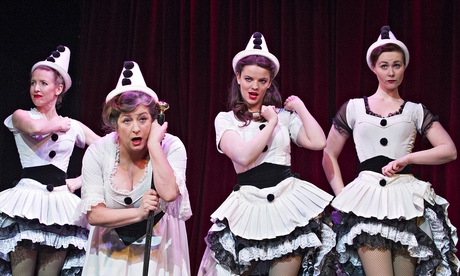
Rebecca Howell, Caroline Quentin, Alice Bailey Johnson and Zoe Rainey in Oh What A Lovely War

Michael Gove: A donkey in lions clothing

Oh What A Lovely War, Theatre Royal Stratford East

There can’t be many productions playing in London that begin with an announcement that the evening’s entertainment will be dedicated to Tony Benn – a statement followed by an unprompted and hearty ovation. With top oh what a lovely warprice tickets for the revival of Noel Coward’s Blithe Spirit with, soon to be Dame, Angela Lansbury clocking in at £92.50 (plus booking fee, naturally) one can’t begin to imagine why the trend hasn’t caught on.

Somewhere Michael Gove would be pursing his lips at the news and busying himself with the retrieval of the hatchet he had carefully placed in Boris Johnson’s back before steadying himself for another swing at the leftist establishment. This is the combined massed ranks of the cultural elite and academia who have the temerity, if his recent diatribe is to be believed, to suggest that Britain is not necessarily as ‘great’ as Mr Gove thinks it is.

Mr Gove is one of those unfortunate politicians that have managed to hold onto the illusion of the Edwardian gentleman that saw Britain truly as the empire on which the sun never sets and, unlike those pesky Europeans from across the channel, a country that left behind a colonial legacy of democracy, fair play and cricket. No matter that there are those in Kenya and Malaysia who may choose to disagree with this assessment.

That people still express these opinions in the 21st century points to the continuing necessity of productions like Oh What A Lovely War. 50 years from its debut, 100 years from the start of World War One, it is clear that proximity to power still seems to blind our political leaders to some painful home truths about our nation’s history. Indeed the myopia of Mr Gove is not a million miles from the delusions of Field Marshall Haig that allowed him to happily order men to walk into the field of fire whilst declaring there must be ‘no squeamishness over losses’.

There is no-one who can seriously engage in the content of Oh What A Lovely War and see a show that reflects at best an ambiguous attitude to this country  and, at worst, an unhappy compulsion on the part of some to denigrate virtues such as patriotism, honour and courage’.

Rebecca Howell, Caroline Quentin, Alice Bailey Johnson and Zoe Rainey in Oh What A Lovely WarIt may be true that Littlewood’s original production could have at least mentioned that the sense of traditional values of a large part of the embedded aristocracy meant that they were among the first to volunteer for the front and as a result suffered absolutely catastrophic losses, and far disproportionate to any other social class.

However this is a straw man argument and deliberately ignores the fact that the show quite clearly shows a deep and abiding love of Britain, and most particularly the men and women of Britain. It shows only compassion for the hapless men who were destined to be pinned between German machine gun fire and the equally lethal artillery of their own lines. It demonstrates every virtue that Mr Gove accuses it of undermining. There is never any doubting that Littlewood believes in the courage and virtue of the men who signed up to go to war, even when the lies and insanity of decision-making of their superiors, far from the front, must have been clear to them.

Has the show lost its power? Part of what made the original a revelation was that these attitudes were genuinely radical. They were telling stories that felt totally anti-establishment, that did not fit with the myth of the just and true war, of heroic stands and grand plans. However the seismic shift in history scholarship, away from the ‘great man’ theory of leadership and towards the narratives of everyday men and women has meant that World War One has been mined from every conceivable angle.

We now know ‘Tommy’s story’ inside-out; we recognise the deprivations of the trenches and the incompetence of the commanders. Increasingly the pendulum has begun to swing towards the middle-ground and new arguments highlight the complexity of the war and go further than the cheap jibes and easy solution found on both sides of the debate. This then begs the question of whether there is still a purpose for Littlewood’s production or has its iconic status turned it into the very thing that it probably most wants to avoid – something co-opted by the establishment as one of the official narratives for understanding the war?

<<Continue to full review>>

The power of art: an always timely reminder

The Scottsboro Boys – Young Vic, until 21 December 2013 (Day Seats and Returns only)

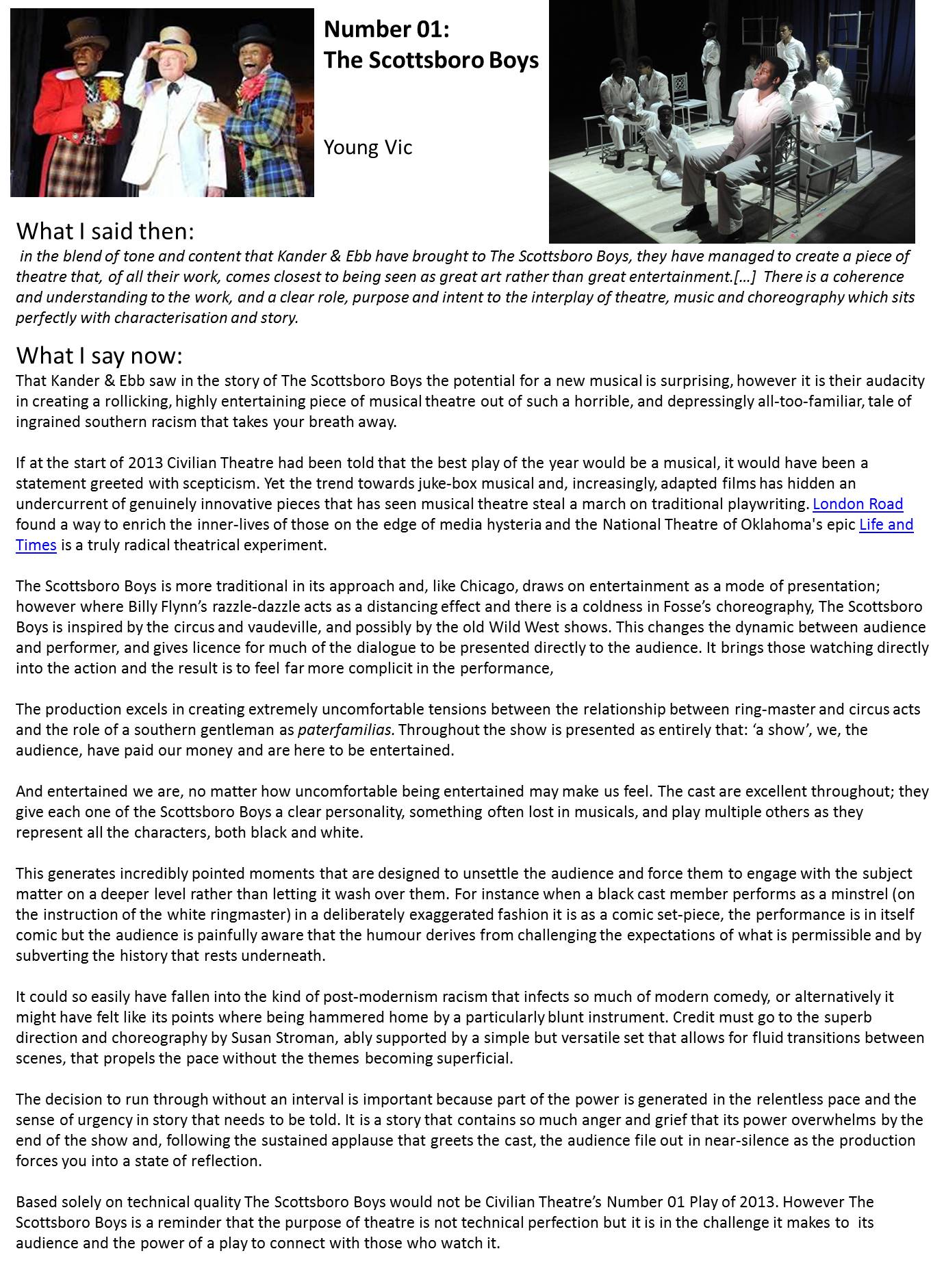
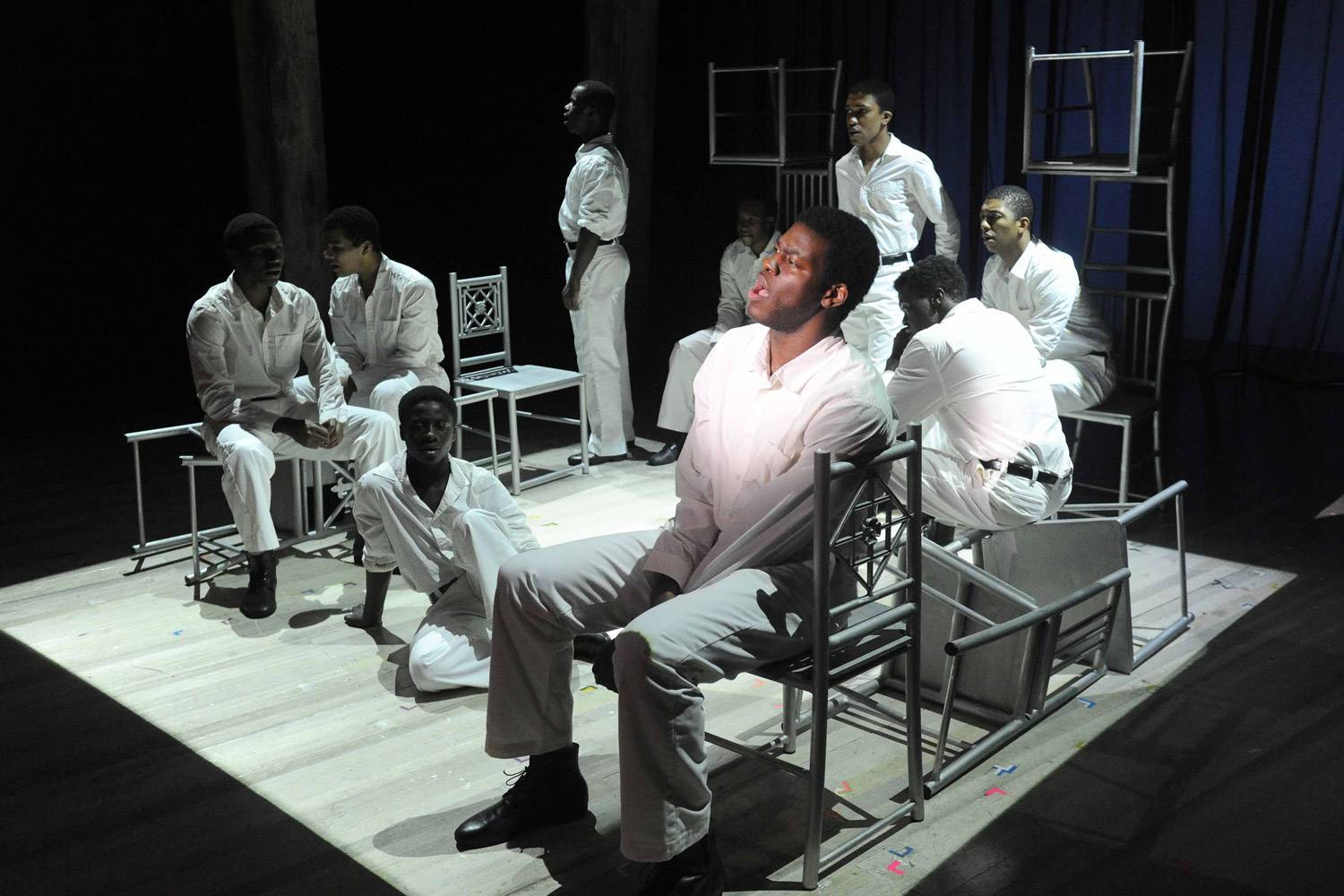
One only needs the barest grasp of American history to understand the incendiary effect Kander & Ebb’s The Scottsboro Boys was likely to have; a one sentence description ‘it is a musical about nine black men travelling The Scottsboro Boysthrough a 1930’s Alabamian town’ is enough to give significant pause.

Add in that it would take the form of a musical revue featuring a black minstrel show and a white southern host and one can begin to understand that The Scottsboro Boys is risky proposition, even by the standards of the team that brought Chicago, Cabaret and a musical interpretation of Manuel Puig’s modernist classic, Kiss of the Spider Woman to the stage.

When you have reinvented the musical, as they did with Chicago, and created a rival to Singing in the Rain as the greatest film musical, Cabaret, it is hard to imagine that the last blooming of creativity would be in the same league. This seems particularly true with the output of musical writers; one only needs to look at the careers of Cole Porter, Irving Berlin, Stephen Sondheim and even Andrew Lloyd-Webber to see a marked drop-off in the quality of their output as the years tick by.

However in the blend of tone and content that Kander & Ebb have brought to The Scottsboro Boys, they have managed to create a piece of theatre that, of all their work, comes closest to being seen as great art rather than great entertainment.

Technically it may not have the brilliance of Cabaret and it may not have the sheer enjoyment of a Fosse-choreographed Chicago, but what The Scottsboro Boys does, in a way not dissimilarto London Road, is to blow away the audience’s preconceptions and retains the force of a story that needs to be told being told in the only way that it can be. There is a coherence and understanding to the work, and a clear role, purpose and intent to the interplay of theatre, music and choreography which sits perfectly with characterisation and story.

The depressing thing is that The Scottsboro Boys was nominated for 12 Tony Awards and won none. In the same year The Book of Mormon was nominated for 14 Tony Awards, winning nine. The interesting thing is that both aim to cover very similar ground despite their plots being a world apart. In a not shocking turn of events, it seems that those giving out the awards got it totally wrong.

Both aim to utilise the time-honoured construct of Juvenalian satire to address prejudices in society, and whilst Trey Stone and Matt Parker’s humour, honed after fourteen years of South Park, takes swings at the big topics it often seems to confuse the scatological for the satirical. At times its views are surprisingly conservative, which perhaps is a reflection of the need to sell those expensive tickets on Broadway to out-of-towners coming across from Middle America. After all there are only so many wise-cracking, elitist New York liberals to sell tickets too.

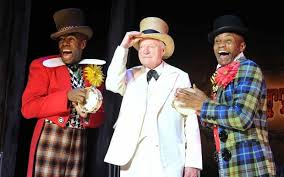
The ringmaster and his 'sidekicks'The Scottsboro Boys, on the other hand, is about as close as one can get to a modern example of this form of satire. It understands implicitly that the purpose of the technique is not to make the audience laugh but to provoke a reaction. Kander & Ebb are well aware of the power of humour to shock and use jokes like verbal hand grenades; the audience often confronted with the sight of two black men forced into playing the archetypal ‘uncle Tom’ roles for their entertainment and internally reconcile the fact that they have laughed at their ‘antics’. This is comedy operating at the very edge of tragedy, and it is all the more powerful for it.

<<Continue to the full review>>

Mission: Accomplished

Mission Drift – The Shed, National Theatre, until 28 June (some tickets available)

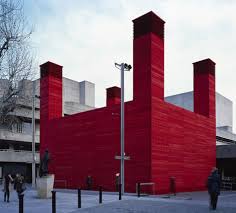
You can’t fail to notice the The Shed, the National Theatre’s striking addition to London’s Southbank. It looks a little like a student’s upturned IKEA table. In bright red. Walking into this new temporary venue, which on the inside is somewhat reminiscent of The Young Vic, is quite an adventure in itself; the smell of new wood, a wonderfully up close and personal stage area, visible stage management and technical. I like it already.

The Shed or Battersea Power Station after an elaborate student prankThe idea behind The Shed is for The National Theatre to celebrate original, ambitious and unexpected new theatre in an excitingly small venue. And on this level, boy does Mission Drift deliver.

Created by New York based The TEAM, Mission Drift is a stunning, well-crafted and inventive musical, yes it’s a musical, which takes us on a whirlwind journey through the American dream. From Las Vegas to New Amsterdam, covering 400 years of political and economic history (atomic bombs, economic downturns, slavery, prospecting, gambling; it’s all here), we follow two couples on their pioneering adventures.

In the world we recognise is Joan; a cocktail waitress laid off from her job and alienated from Las Vegas – the city she once lived for. Joan’s life is changed by the arrival of a mysterious and beguiling

Mission Drift's take on Americana

stranger who offers her a way out of everything she knows. And loves. This is equated to the mythical journey undertaken by two 14 year olds, Catalina and Joris, setting sail from Europe with the Dutch West India Company to start a new dream, in a land where space, as well as life, is cheap.

All of this is overseen by Miss Atomic (Heather Christian), an all at once alluring and repulsive figure who epitomises the best and worst of American capitalism. Her narration is funny, sleazy and engaging – a clever way of holding this bubbling pot of ideas together. She has a voice that grabs you by the balls and dominates the space. I wish her character could have been more intertwined with the two couples but it was a stunning and strong performance that captured the fragility of the American Dream perfectly.

<<Continue to full review>>