The Shape of Things to come? We may already be there.

The Shape of Things – Arcola Theatrebooking until 21 December

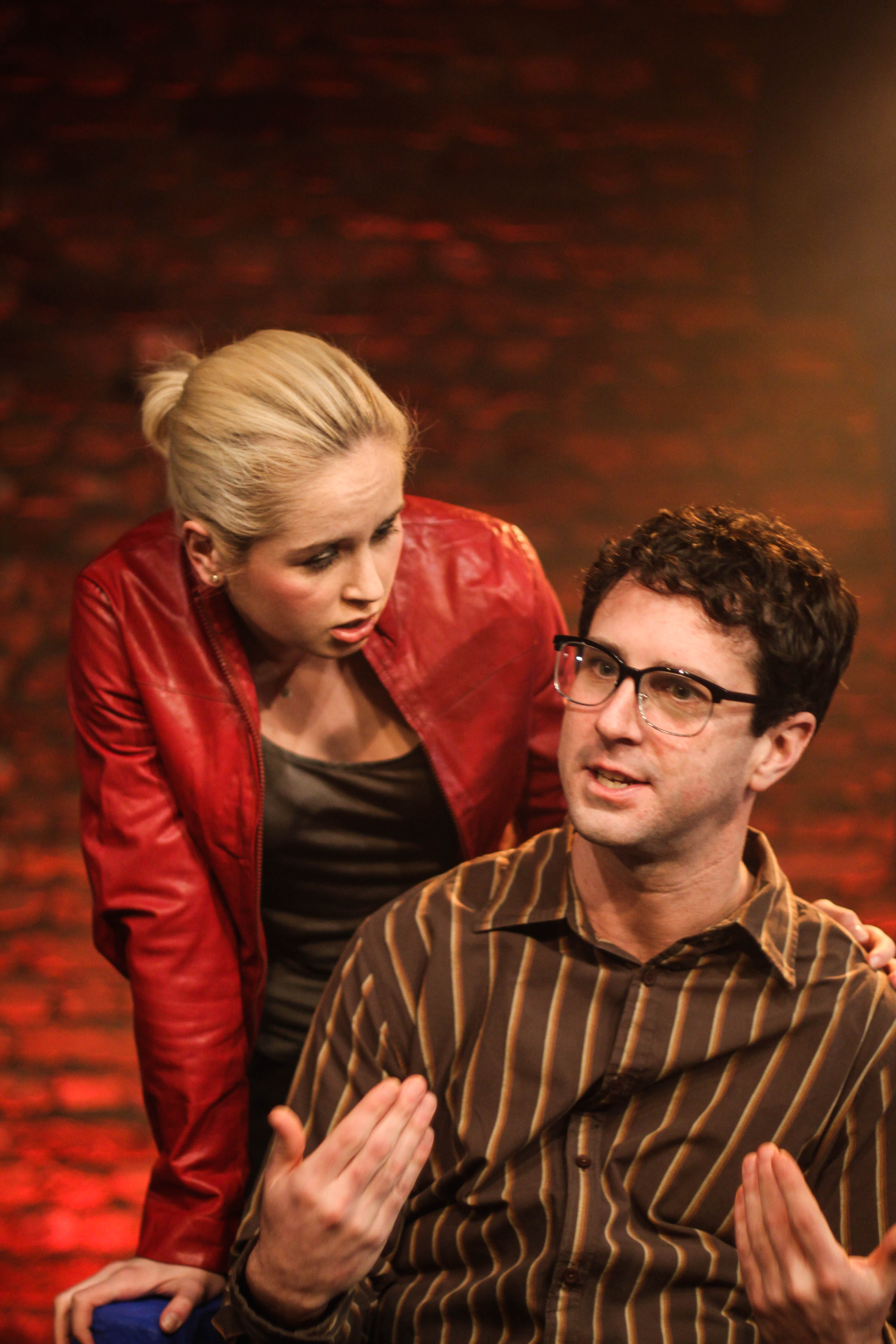
Somewhat eschewing the traditions of the season the Arcola Theatre is currently injecting a strain of mordant black humour into the midst of this period of good cheer by reviving Neil LaBute’s The Shape of Things; an acidic examination of the nature of art and the nature of human relationships.

Over a decade old, it is strikingly, and depressingly apparent, that it has not just avoided ageing but actually feels more relevant now than when it was written. Society’s obsession with the value of appearance over substanceThe Shape of Things, Arcola, Dec 2013, IMG_1858 - courtesy Maximilien Spielbichler has only increased over the last ten years and shows no sign of abating in a world of viral memes and 160 character assassinations.
We were given a timely reminder of how proud we should feel about what humanity has accomplished in the recent admission by a double-gold medal winning Olympian that they feel insecure next to someone whose only achievement comes from winning Miss UK. It is unclear whether this admission is made more or less powerful by it coming in the middle of show where viewers vote to choose which celebrity eats a kangeroo’s anus.

Neil LaBute’s play opens with a discussion on the vandalism, or potential transformation, of a sculpture. It has already been vandalised/transformed once, to cover the genitals, and so the question arises of whether spray-painting a penis back on counters as further vandalism or is closer to the originally artistic intention. In its questioning of an artist’s right to transform, without permission, a body of work if the effect is to elevate it to a higher plane, LaBute is capturing the spirit of the entire play in a nutshell.

Transformation is the theme that recurs again and again throughout the play. Adam makes constant reference to literary transformations and they act as a reflection on his changing relationship with what is occurring. Early on he refers to Evelyn, playfully, as his Henry Higgins as he begins to see a world of possibilities opening up before him but towards the end of play this opinion has been modified and he sees himself as Kafka’s Gregor Samza; transformed into something that is to be despised.
<<Continue to full review>>

A timeless – or should that be conservative – production

Henry V – Noel Coward Theatrebooking until 15 February 2014

So the Michael Grandage season draws to a close with Henry V; one of Shakespeare’s most popular plays and one that sees Grandage reunite with Jude Law following their Hamlet in 2009, itself a reminder of Law’s theatrical qualities – something that always feels at risk of being buried among the dead weight of his often mediocre Hollywood movies.

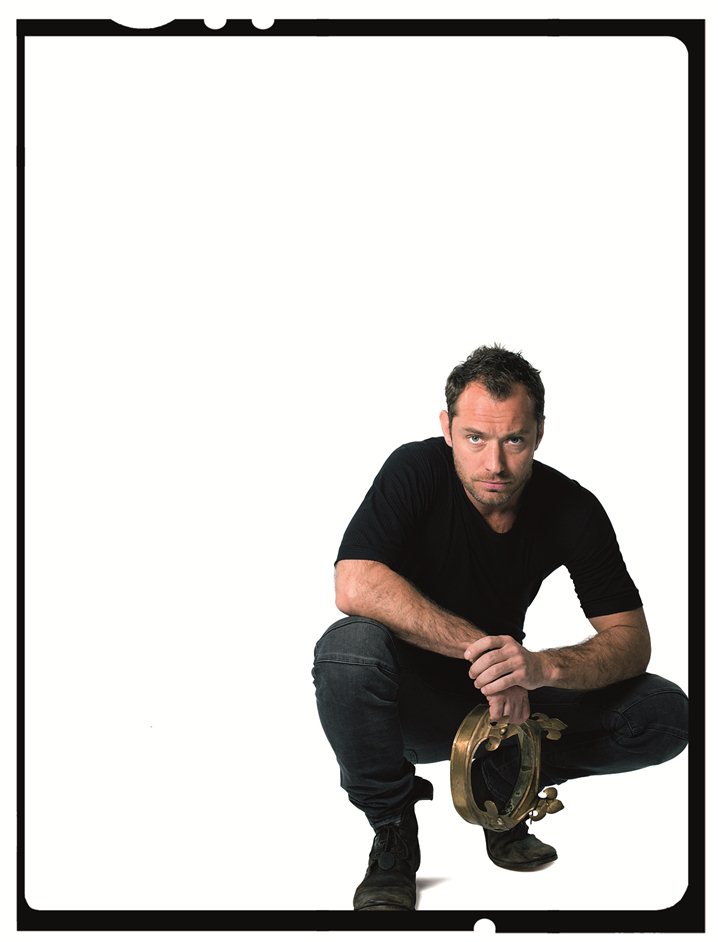
The cinema is a useful starting point for Henry V and possibly one reason why Jude Law was approached for the role, because the play itself is one that feels strangely uncomfortably suited to the stage and its ongoing Jude Law in Henry V, Noel Coward Theatrepopularity is perhaps more due to the rousing film versions of Olivier, Branagh and, more recently, Tom Hiddleston.

The main difficulty of staging Henry V lies in the fact that a large proportion of the plot is set directly in, and around, live battles. Fight scenes (between armies rather than individuals) are very difficult to recreate convincingly on stage.

The playwright or director is left with two choice; to attempt to find a way of portraying the battle on stage, something that is fraught with difficulty and which rarely emerges coherently or providing any sense of the brutality and terror of war, or to stage the battle offstage and intercut with appropriate scenes. Choosing the second option, as Shakespeare creates a problem in that the audience is always aware that the real excitement is happening elsewhere and it is a struggle to maintain focus.

Film has the advantage of having it both ways; jump-cuts can propel the action without the need for laborious changes of scene, the bewilderingly frenetic action of a medieval battle at ground level can be interweaved with a top-down view that allows the viewer to pick up the rhythm and flow of a wider military operation in progress. The editing room also allows for the surging music to flow through the veins and for the hero to be heard amidst the clamour of war.

The ability of this to manipulate the audience is abundantly clear in the music that underpins the fairly basic structure of Branagh’s St Crispin’s Day speech and amongst the pomp and pageantry captured in the Olivier’s classic version of 1944; two scenes that must rank amongst the most watched of any recorded Shakespeare.

And

The legend of Henry V, be it the battle of Agincourt or Shakespeare’s note that tells of ‘ten thousand French / That in the field lie slain’ against the English ‘Edward the Duke of York, the Earl of Suffolk /Sir Richard Ketly, Davy Gam, esquire:/ None else of name; and of all other men / But five and twenty’ [IV.viii], has laid deep roots in what it means to be English and serves to reinforce the enduring myth of the noble island standing up in the face of overwhelming odds to foreign foes.

Shakespeare’s quill is capable of casting long shadows over England’s history. The rehabilitation of Richard III is still a work in progress and Henry VI has no real place in our history following the magnificently succinct dismissal of his legacy in just four lines at the very end of Henry V: ‘Henry the Sixth, in infant bands crown’d King / Of France and England, did this king succeed; / Whose state so many had the managing, / That they lost France and made his England bleed’ [V.V]  

So Henry V, with its multi-purpose king who is at home walking among the common man and issuing rousing speeches to inspire the troops as he is seducing French princesses and charming ambassadors, was always likely to chime with the public. He may as well have come straight out of Geoffrey of Monmouth’s History of the Kings of Britain, lending a helping hand to Arthur as he attempts to pull Excalibur out of a handily placed stone.

Yet for all of this Henry V remains a very curious play, perhaps not in the sense of the grand complexity of King Lear or the later plays, The Tempest and Cymbeline, which play on a strange magical realism at odds with his earlier realism. In comparison Henry V has a plot of the utmost simplicity and which only touches on the psychological depths of his later work. However it is also structured in a way that is oddly obtuse and can test the patience of an unsuspecting audience; it is telling that Frank Kermode spoke of it as a ‘a play that is many respects unloveable but of cunning construction’.

<<Continue to full review>>

The power of art: an always timely reminder

The Scottsboro Boys – Young Vic, until 21 December 2013 (Day Seats and Returns only)

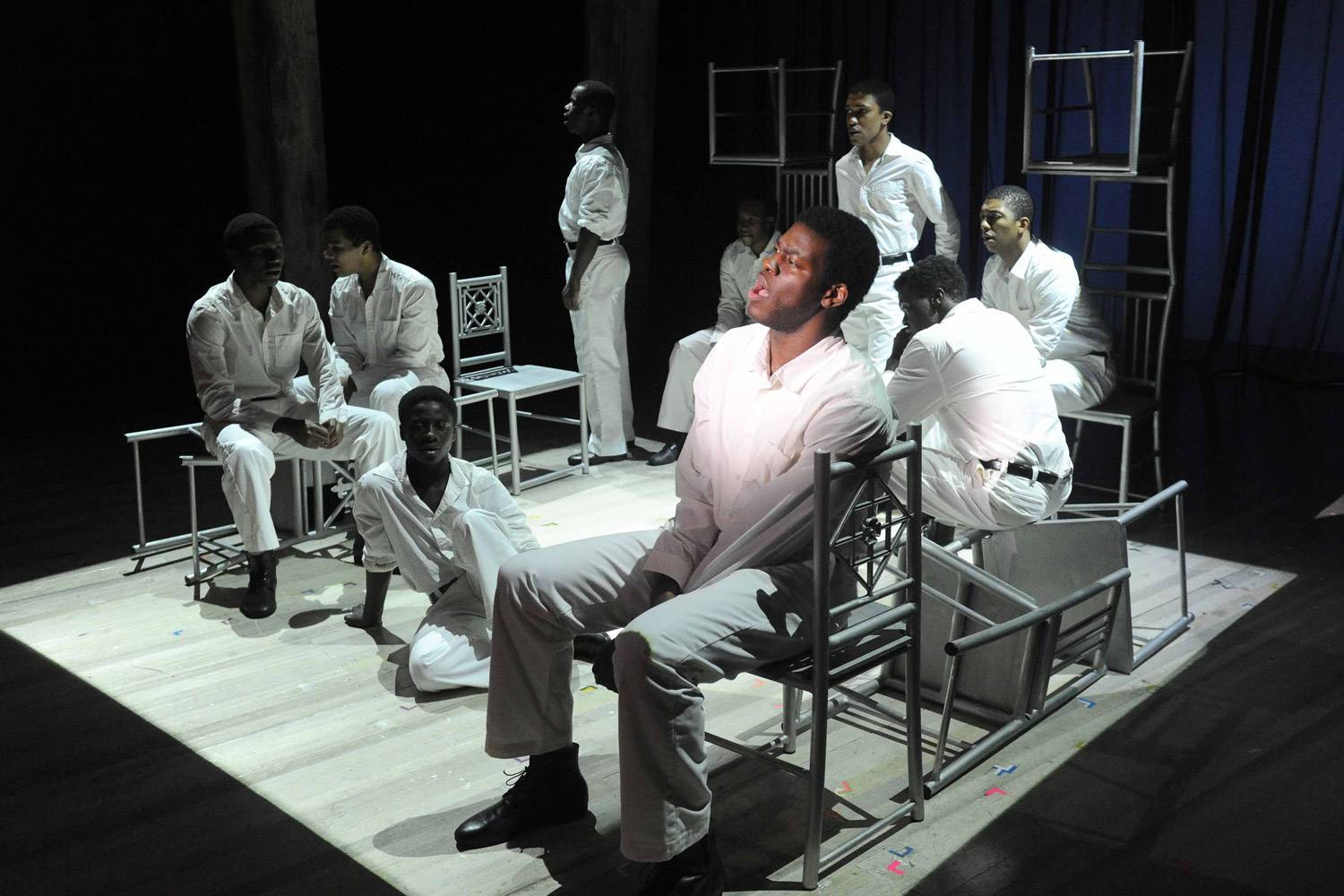
One only needs the barest grasp of American history to understand the incendiary effect Kander & Ebb’s The Scottsboro Boys was likely to have; a one sentence description ‘it is a musical about nine black men travelling The Scottsboro Boysthrough a 1930’s Alabamian town’ is enough to give significant pause.

Add in that it would take the form of a musical revue featuring a black minstrel show and a white southern host and one can begin to understand that The Scottsboro Boys is risky proposition, even by the standards of the team that brought Chicago, Cabaret and a musical interpretation of Manuel Puig’s modernist classic, Kiss of the Spider Woman to the stage.

When you have reinvented the musical, as they did with Chicago, and created a rival to Singing in the Rain as the greatest film musical, Cabaret, it is hard to imagine that the last blooming of creativity would be in the same league. This seems particularly true with the output of musical writers; one only needs to look at the careers of Cole Porter, Irving Berlin, Stephen Sondheim and even Andrew Lloyd-Webber to see a marked drop-off in the quality of their output as the years tick by.

However in the blend of tone and content that Kander & Ebb have brought to The Scottsboro Boys, they have managed to create a piece of theatre that, of all their work, comes closest to being seen as great art rather than great entertainment.

Technically it may not have the brilliance of Cabaret and it may not have the sheer enjoyment of a Fosse-choreographed Chicago, but what The Scottsboro Boys does, in a way not dissimilarto London Road, is to blow away the audience’s preconceptions and retains the force of a story that needs to be told being told in the only way that it can be. There is a coherence and understanding to the work, and a clear role, purpose and intent to the interplay of theatre, music and choreography which sits perfectly with characterisation and story.

The depressing thing is that The Scottsboro Boys was nominated for 12 Tony Awards and won none. In the same year The Book of Mormon was nominated for 14 Tony Awards, winning nine. The interesting thing is that both aim to cover very similar ground despite their plots being a world apart. In a not shocking turn of events, it seems that those giving out the awards got it totally wrong.

Both aim to utilise the time-honoured construct of Juvenalian satire to address prejudices in society, and whilst Trey Stone and Matt Parker’s humour, honed after fourteen years of South Park, takes swings at the big topics it often seems to confuse the scatological for the satirical. At times its views are surprisingly conservative, which perhaps is a reflection of the need to sell those expensive tickets on Broadway to out-of-towners coming across from Middle America. After all there are only so many wise-cracking, elitist New York liberals to sell tickets too.

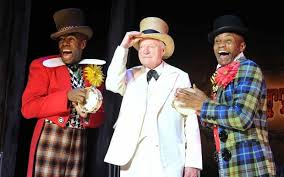
The ringmaster and his 'sidekicks'The Scottsboro Boys, on the other hand, is about as close as one can get to a modern example of this form of satire. It understands implicitly that the purpose of the technique is not to make the audience laugh but to provoke a reaction. Kander & Ebb are well aware of the power of humour to shock and use jokes like verbal hand grenades; the audience often confronted with the sight of two black men forced into playing the archetypal ‘uncle Tom’ roles for their entertainment and internally reconcile the fact that they have laughed at their ‘antics’. This is comedy operating at the very edge of tragedy, and it is all the more powerful for it.

<<Continue to the full review>>

The Age of Innocence

Passing By – Tristan Bates Theatrebooking until 30 November 2013

The Tristan Bates Theatre, currently home to a revival of Martin Sherman’s Passing By, is a curiously anachronistic fixture in the West End. It is one of the few theatres in London that could possibly lay claim to that most American of terms – ‘off-Broadway’. Unlike the Arcola, the Southwark Playhouse and even the Almeida, the Tristan Bates Theatre is genuinely situated in the heart of the West End and surrounded by some of the biggest theatres in the country.

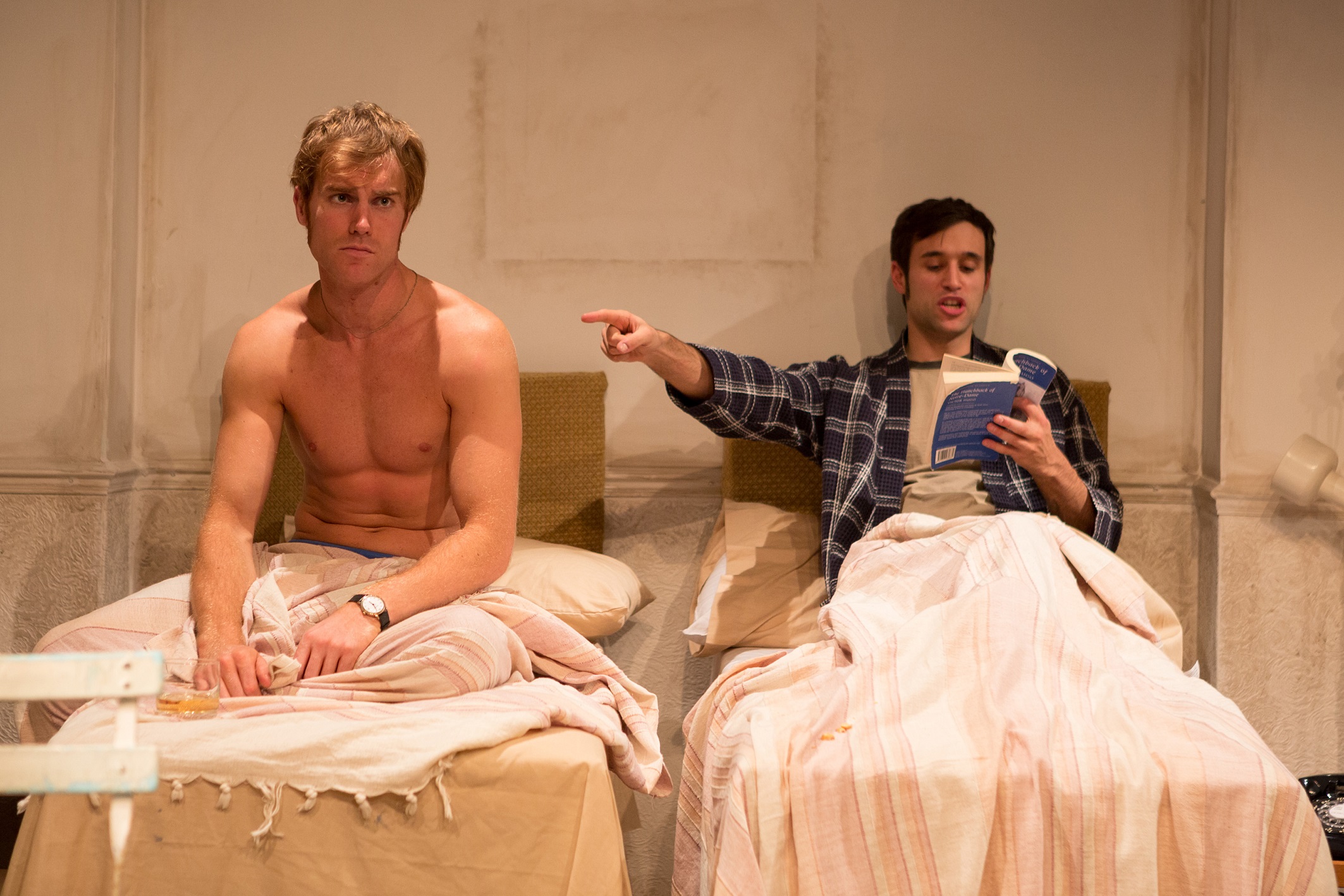
It also has a bracingly uncommercial sensibility that sets it apart from other non-traditional West End theatres; the Donmar Warehouse by way of comparision, barely two minutes away, can hardly lay claim to such a passing-by-photo-scott-rylanderperspective when the cheapest of their friend’s packages clocks in at £350. It is a theatre that feels, and attempts to be, dedicated to playwriting and acting. The black box space and the, presumably, limited budgets leads to a much reduced directorial hand and a focus on the play and performance. As a result the Tristan Bates is an ideal home for Sherman’s 1972 two-hander about two gay men coming together in 1970’s New York.

Passing By is play that rests on the naturalism of its dialogue and the interplay between the two lead characters. It has been quite a long time since I have seen a production that allows the play to seem so unencumbered; in part this is because the majority of the play is set in one location but credit must also go to Andrew Keates unfussy direction.

Intentionally or not Keates has managed to capture something of the uninhibited freedom of the golden age of American cinema; Robert Altman’s Nashville immediately springs to mind or perhaps more appropriately given its New York setting, the criminally underrated Klute. In these 1970’s films, as in Sherman’s play, the audience gets the sense that they are capturing snippets of a life, fading in and out of conversations whose intangibility only serves to reinforce the grounding in reality.

There are one or two scenes that are set outside of Toby’s apartment but Keates makes no real attempt to change the setting; a couple of seats and the whir and flicker of a projector is enough to take us into a cinema, a sideboard repositioned tells us that we are now in a wine-shop. These small touches allow the play to keep up its natural pace and the audience doesn’t get sidetracked by the immaterial.

That is not to say that the set is not worthy of mention. If anything it operates as a third actor; it is the most superb evocation of an apartment in the heart of 1970’s New York. Every element feels steeped in the period without running into pastiche. It is not just pleasing that this has been achieved, it is an essential element of bring the period to life as the naturalistic nature of the play dictates.

<<Continue to full review>>

The Rehabilitation of Bertolt Brecht

The Resistible Rise of Arturo Ui –Duchess Theatre, booking until 07 Dec 2013

Leaving aside Shakespeare, Chekhov and Ibsen, the popularity of playwrights tends to wax and wane on the London stage; the recent reappraisal of Rattigan as someone unfairly cast aside by the Angry Young Men of the 1950s and the continuing absence of Bernard Shaw are two of the more obvious examples of the way a writer’s fortune remains tied to the whims of producers.

Arturo Ui Poster

The UK has also notably never quite embraced the rich vein of talent that exists in European theatre: Racine is rarely seen; Moliere, a mainly absent figure; and modern continental playwrights virtually non-existent. The thrall of Anglo-American naturalism and the rawness of the grand narratives of O’Neill, Williams and Miller continues to be preferred to the rather more metaphysical questions posed by the likes of Ionesco and Artaud.

Within this structure Brecht cuts a solitary figure, and has increasingly become something of the forgotten man of British theatre. Whilst his position, alongside Stanislavski, as one the pre-eminent figures in the development of modern theatrical practice is assured, it was Stanislavskian concepts that became the dominant mode of theatre and film; championed by Stella Adler and embodied in the work of a young Marlon Brando.

In comparison Brecht’s influence has seemingly ebbed away to the point where a new production of a Brecht play in the West End is something of an event. One must acknowledge that there are resource considerations to this; large casts can be ruinously expensive but that reality is built on the premise that Brecht is deeply unfashionable and cannot be considered an audience draw.

The irony’s that Brecht is perhaps the most American-looking of all the European playwrights. Stanislavski had little desire to cast his eyes across the Atlantic but to Brecht the new world and its eager embrace of democratic and technological progress chime with ideas that were central to his own theatrical philosophy.

arturo_ui_063_Henry_Goodman__Arturo_Ui__and_Michael_Feast__Roma_._The_Resistible_Rise_of_Arturo_Ui._Photo_by_Manuel_Harlan._4ffd4cb1ddfbbAt its heart was the development of an art form that would become pre-eminent for the first five decades of the 20th century: cinema. Silent cinema was the great leveller; reliant on music, gesture and simplified dialogue so it could appeal across the immigrant communities of America, these early pictures represented Brechtian techniques transposed to a medium that could truly be embraced by a mass audience.

It was within the world of cinema that Brecht found a way of telling the story of Hitler. The development of genre pictures – particularly the early gangster movies, starring the likes of James Cagney and George Raft – gave Brecht a mechanism with which the rise of an international dictator could be challenged in a way that did not need threaten the authorities directly and would also appeal to a mass audience.

This is not to say that Arturo Ui is dumbed down; the reverse is in effect true, Brecht is raising the genre picture above its humble origins. He may have gained a reputation as a didactic playwright with a sledgehammer touch but this is to ignore the craft taken over the formal structure of the play and the sly literary references liberally sprinkled throughout the text.

Arturo Ui could be enjoyed for the wonderful pastiche of Mark Antony’s oration at Caesar’s funeral and the knowing nods to pretty much every tragedy in the Shakespearian canon but it does more than this – it recognises the freedom of the theatre, in opposition to the limitations of cinema, to challenge the audience by upturning the established conventions of an entire genre.

<<Continue to full review>>

Writer vs Director vs Actor in Edward’s epic battle

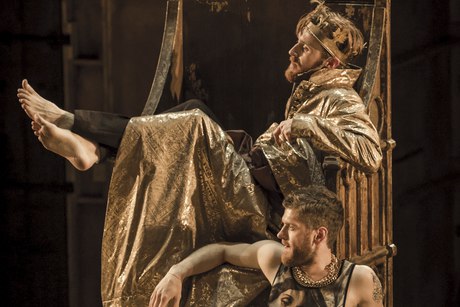
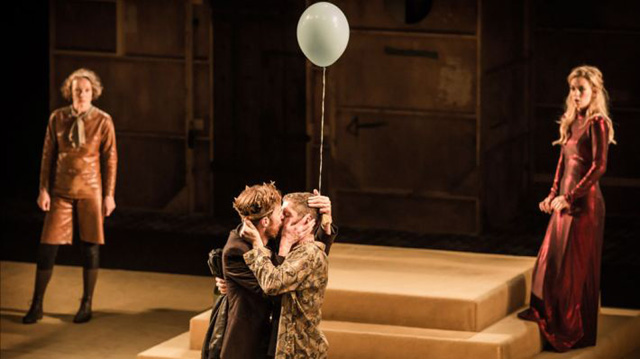
Much of the critical reaction to the National’s production of Marlow’s Edward II has been withering, and for generally mild-mannered reviewers, bordering on the vitriolic. Leading the charge is, inevitably, Quentin Letts in The Daily Mail who suggests the ‘the only thing murdered in Joe Hill-Gibbins’s puerile, inept production is the play itself’ (ouch) and is followed, perhaps rather too stridently, by Tim Walker in The Telegraph who found ‘In almost 10 years of reviewingedward ii and gaveston: not your everyday production theatre, I doubt I have been confronted with a bigger load of indigestible old tosh’ and couldn’t help but the boot into the subsidised sector while he was at it; ‘the kind of production that simply could not happen in the commercial West End.’

Many people would doubtless agree with Mr Walker’s final sentence but the despair being aimed less at the National and more with eyes turned pointedly north of the river at the risk-averse nature of the private sector behemoths; happy to suck up the most profitable of the tried and tested subsidised productions before reverting back to a steady rotation between Noel Coward, Alan Ayckbourn and A.N Musical complete with X-Factor star.

If the overt agenda setting of Mr Walker’s column can be ignored– and the reference to‘comrades’ at the National rather says it all – it makes an important point in reminding us that the licence to put on a production this lavish ultimately comes from the public purse.

Joe Hill-Gibbin’s is a talented director who had great success at the Young Vic but his career trajectory is taking a worrying turn towards the excessive. A bright start led to a stint at the Young Vic where he created a stunning yet simpleEdwardII and Isabel revival of Martin McDonagh’s brilliant Beauty Queen of Leenane and directed the only Tennessee Williams production I have ever managed to enjoy (The Glass Menagerie).

He scored an unexpectedly huge hit with the fun but rather too hyper-kinetic The Changeling, which showed a suffusion of talent but equally there were times where a restraining hand might have been called for. It is troubling that on the grandest stage of all Hill-Gibbin’s has not only failed to adjust his style but that the flaws, rather than being flattened in the vast space of Olivier, have only been magnified.

Whilst we must allow artistic companies the freedom to make mistakes, watching Hill-Gibbin’s exuberant production reminded me of the wisdom of Bob Balaban’s protective mother in A Mighty Wind justifying the use of a Shetland pony to play polo on the grounds that ‘if he has to fall, he shouldn’t fall from so very high’.

<<Continue to full review>>