Introducing the ‘Civil Awards’

Over the next few days, and in keeping with all the other blogs and newspapers that got there already – and in the right year – Civilian Theatre will be unveiling its inaugural annual awards and revealing our Top 10 plays for 2013.

Given the sheer amount of theatre available it is not difficult to find plays that were fantastic, moving and challenging but reflecting on what Civilian Theatre has been to see across the year (and the expectations that had built up in advance), it does not feel that 2013 was a vintage year for theatre.

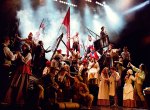
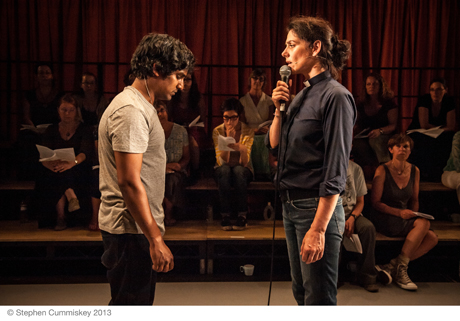
It would be easy to equate the drop-off in quality with the cuts to Arts Council funding; the first cracks beginning to appear as the money begins to run out. However this only tells one half of the story – and if anything The Events by David Greig  An Actors Touring Company, Young Vic, Brageteatret & Schauspielhaus Wien Co-Production 9 October - 2 November 2013much of the best of the year’s theatre occurred in unexpected locations and in new voices that are beginning to emerge. Good theatre does not big budgets or big stars, it needs ideas and the willingness to take risks; in very different ways The Events and Fleabag proved this point.
Indeed the drop in quality, if anywhere, appeared at the top-end. The gap between bloggers and newspaper critics never appeared wider than in the debate around the Michael Grandage season. Routinely given 4/5* reviews in the press, the majority of the programme provoked the ire of seasoned bloggers who felt it promised much and then failed to deliver.

Civilian Theatre lauds elements of the programme: a West End season that was committed to drama and even included a new play; the sheer number of £10 seats, which if booked early enough didn’t have to be back of the balcony where the most pressing concern is not seeing the stage but rather calculating the risks of deep-vein thrombosis. However the dull production and conservative directions produced lifeless and leaden work that challenged the audience’s endurance rather than their intellect.

One rarely looks to the West End for intellectual challenge and radical drama but the publically-subsidised sectors also appeared more unfocused than usual. It is a transitory time in British Theatre and whilst this may bear fruit in the coming years, it felt that many people were still finding their feet. An honourable exception goes to the Almeida who – in snagging Rupert Goold – may have pulled off the biggest coup of all, and also managed a season that gave audiences, successively, Chimerica, Ghosts and American Psycho at non-West End prices.
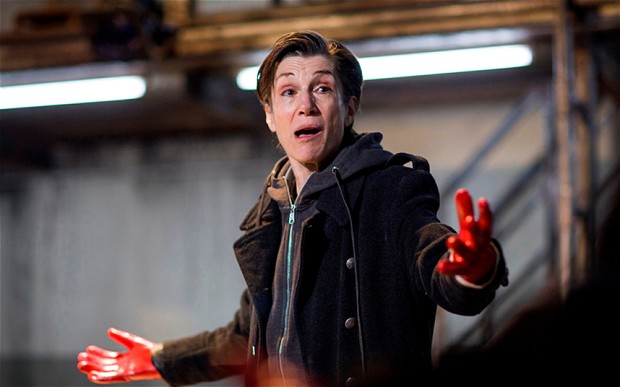
Harriet Walter as  BrutusJosie Rourke’s tenure at the Donmar Warehouse has so far produced interesting plays in isolation but there has been little sense of coherence in the overall scheduling, and some productions that were just hard work full stop;Trelawny of the Wells proving that just because a play is forgotten doesn’t necessarily make it a classic in waiting.

That the National Theatre had an uneven year was unsurprising given all the speculation around the top job. Rufus Norris is a bold choice and one that is likely to bring a very different feel to the National and perhaps reshape to more accurately reflect a modern British theatre. He, like audiences, should benefit from the development of The Shed, particularly if its early inventive and innovative programming continues into 2014.

Outside of London, (or into the hinterland for this blog), the argument about funding distribution continues unabated. There was more change at the top as the National Theatre of Scotland lost Vicky Featherstone to the Royal Court (a canny move to breathe fresh, non-London-centric life into an organisation that is always at the risk of being subsumed by the voice of the metropolitan middle-class).

The other powerhouse, the RSC, have crafted a seamless transfer into handing the reigns to Gregory Doran. The RSC seem reinvigorated and scored a big hit with David Tennant in Richard II, and Doran seems to be keen to move through the history cycle as Henry IV Parts I and II are planned for 2014, which mark both the return of Antony Sher to the RSC and the continuance of a partnership with the Barbican that will seem them return as part of a 3-year deal.
Anyone winning 'A Civil' can expect a fine certificate as proof of their excellence. Lucky them.

The Civil Categories

  • Best Production
  • Best Actor – Male
  • Best Actor – Female
  • Best Supporting Actor
  • Best Director
  • Theatre / Theatre Company of the Year
  • Surprise of the Year
  • Best thing to happen in theatre in 2013
  • Biggest disappointment of the year
  • Worse thing to happen in theatre in 2013

ccc

<<You can find out everything that happened in 2013 here>>

ccc
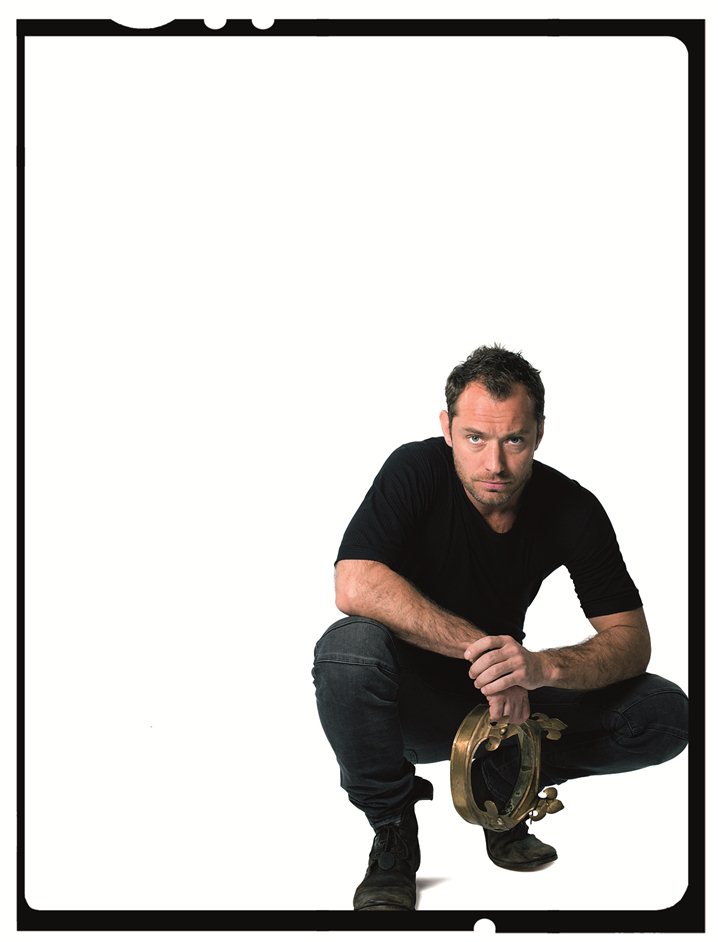
A timeless – or should that be conservative – production

Henry V – Noel Coward Theatrebooking until 15 February 2014

So the Michael Grandage season draws to a close with Henry V; one of Shakespeare’s most popular plays and one that sees Grandage reunite with Jude Law following their Hamlet in 2009, itself a reminder of Law’s theatrical qualities – something that always feels at risk of being buried among the dead weight of his often mediocre Hollywood movies.

The cinema is a useful starting point for Henry V and possibly one reason why Jude Law was approached for the role, because the play itself is one that feels strangely uncomfortably suited to the stage and its ongoing Jude Law in Henry V, Noel Coward Theatrepopularity is perhaps more due to the rousing film versions of Olivier, Branagh and, more recently, Tom Hiddleston.

The main difficulty of staging Henry V lies in the fact that a large proportion of the plot is set directly in, and around, live battles. Fight scenes (between armies rather than individuals) are very difficult to recreate convincingly on stage.

The playwright or director is left with two choice; to attempt to find a way of portraying the battle on stage, something that is fraught with difficulty and which rarely emerges coherently or providing any sense of the brutality and terror of war, or to stage the battle offstage and intercut with appropriate scenes. Choosing the second option, as Shakespeare creates a problem in that the audience is always aware that the real excitement is happening elsewhere and it is a struggle to maintain focus.

Film has the advantage of having it both ways; jump-cuts can propel the action without the need for laborious changes of scene, the bewilderingly frenetic action of a medieval battle at ground level can be interweaved with a top-down view that allows the viewer to pick up the rhythm and flow of a wider military operation in progress. The editing room also allows for the surging music to flow through the veins and for the hero to be heard amidst the clamour of war.

The ability of this to manipulate the audience is abundantly clear in the music that underpins the fairly basic structure of Branagh’s St Crispin’s Day speech and amongst the pomp and pageantry captured in the Olivier’s classic version of 1944; two scenes that must rank amongst the most watched of any recorded Shakespeare.

And

The legend of Henry V, be it the battle of Agincourt or Shakespeare’s note that tells of ‘ten thousand French / That in the field lie slain’ against the English ‘Edward the Duke of York, the Earl of Suffolk /Sir Richard Ketly, Davy Gam, esquire:/ None else of name; and of all other men / But five and twenty’ [IV.viii], has laid deep roots in what it means to be English and serves to reinforce the enduring myth of the noble island standing up in the face of overwhelming odds to foreign foes.

Shakespeare’s quill is capable of casting long shadows over England’s history. The rehabilitation of Richard III is still a work in progress and Henry VI has no real place in our history following the magnificently succinct dismissal of his legacy in just four lines at the very end of Henry V: ‘Henry the Sixth, in infant bands crown’d King / Of France and England, did this king succeed; / Whose state so many had the managing, / That they lost France and made his England bleed’ [V.V]  

So Henry V, with its multi-purpose king who is at home walking among the common man and issuing rousing speeches to inspire the troops as he is seducing French princesses and charming ambassadors, was always likely to chime with the public. He may as well have come straight out of Geoffrey of Monmouth’s History of the Kings of Britain, lending a helping hand to Arthur as he attempts to pull Excalibur out of a handily placed stone.

Yet for all of this Henry V remains a very curious play, perhaps not in the sense of the grand complexity of King Lear or the later plays, The Tempest and Cymbeline, which play on a strange magical realism at odds with his earlier realism. In comparison Henry V has a plot of the utmost simplicity and which only touches on the psychological depths of his later work. However it is also structured in a way that is oddly obtuse and can test the patience of an unsuspecting audience; it is telling that Frank Kermode spoke of it as a ‘a play that is many respects unloveable but of cunning construction’.

<<Continue to full review>>

Olivier Awards 2012…and the winners are…

Tomorrow night sees the stars of the stage descend upon the Royal Opera House for what is arguably the biggest night in England’s (or perhaps more contentiously given the list of nominees – London’s) theatre world: the Laurence Olivier Awards. It will be possible to watch the event live via the red button on the BBC, or listen to Radio 2, from 19:30.

As is often the case the list of nominees make for interesting reading and arguably casts a brighter light on the theatre scene than the list of those who actually win. Rather than going through the complete list of the  runners and riders, a quick glance across the categories does raise some interesting talking points.

8 Key Questions

  1. In what can only be seen as a damning indictment of the non-subsidised West End stomach for risk-taking, the only nominated new play that premièred outside of the subsidised sector was an adaptation of the most famous of all Ealing comedies. Whilst well-received by the critics, is it not possible for a playwright to be allowed to stage new work in the West End (special exemptions for famous Hollywood actor/writers not withstanding)?
  2. Is it a thin year dramatically? Even the revivals don’t seem to have their usual vim. Hopefully Anna Christie will be recognised for its fine work and it will be up against a strong revival of Rattigan’s Flare Path; a playwright very much in vogue.  However Noises Off seems to be a rather populist choice when you consider the fine year the Donmar had with the rarely performed and excellently executed ‘Inadmissable Evidence’ directly following Anna Christie.
  3. Will London Road be able to withstand the Matilda charge? It lost out to populism at the Evening Standard Awards, and whilst Matilda is a fine and deserving winner in its own right isn’t it time that London Road was recognised for the stunningly brave and unique production it is (and for those who missed it first time, it is coming back to the Olivier this summer – a portent perhaps?)
  4. Can the Sheridan Smith success story continue? Everyone’s favourite 2 Pints of Lager…breakout star is up for a fairly unique double; after picking up Best Musical Actress at the first time of asking for Legally Blonde, Ms Smith will be hoping to make it two in two years for her fine performance in Flare Path. However competition is tough in a category that also includes Mark Addy, Bryony Hannah and Johnny Flynn; all of whom should be regarded as excellent contenders in their own right.
  5. Just how many can Matilda win? The remarkable story continues and you don’t fancy anyone coming up against them. Best new musical to edge out London Road? Bertie Cavill is surely a lock-in for Best Actor Musical. Does anyone have the heart to deny the Matilda’s their moment as Best Actress Musical? Paul Kaye could be on shakier ground as he is up against Katherine Kingsley’s Lina Lamont – a scene-stealing role if  ever there was one. And after all that there is a raft of technical awards that someone has to win.
  6. The Best Actress/Best Actor awards seem totally up for grabs. Desperately hope that the double-header Cumberbatch/Lee Miller is overlooked as Frankenstein wasn’t that great.  My personal preference would be a Ruth Wilson/Jude Law double for Anna Christie. However Douglas Hodge in Inadmissible Evidence would be a worth winner.
  7. What is the point, I mean really, what is the point of the BBC Radio 2 Oliver Audience Award when you have to chose between Jersey Boys /  Wicked / Les Freakin  Mis and Billy Elliot? How about giving us a write-in winner?
  8. How much more alive does theatre feel when you look at the nominees in Outstanding Achievement in an Affiliate Theatre? Mogadishu and Roadkill could have been strong contenders in the main categories but here they feel punted to the sidelines.

And finally good luck to all the nominees.

Laurence Oliver Awards 2012

You don’t have to be mad to extemporise here but it helps

Hamlet – Young Vic, Running until 21 January 2012

Ian Rickson’s production of Hamlet at the Young Vic begins with an elaborate entrance through the backstage area, which has been transformed into a passage through a mental hospital. As you wind through narrow corridors, you catch glimpses of action through windows and the pervading sense from the TV screens and telephones on display that we are entering the 1970s.

To be honest all this effort feels a little laboured although it does help to immediately ground the play in its overarching theme: is Hamlet mad?  It is a question that has been raked over many times, be it in productions, literary criticism or psychological analysis. However through Ian Rickson’s radical interpretative staging, it is a question that delivers a revelatory redefinition of how the play can be understood.

The play begins with a striking image; Michael Sheen’s Hamlet appears out of nowhere in long shot, trapped in a solitary light shining upstage. Rickson’s exquisite framing is a feature that runs throughout the play but this first image, with a clear allusion to Carol Reed’s The Third Man is particularly notable. It is a potent reference point, immediately conjuring up thoughts of Vienna; the spiritual home of Freud and the psychology movement. The Third Man itself is indebted to German expressionists of early cinema, such as  Fritz Lang and FW Murnau, who were fascinated by madness and its effect on the human condition.

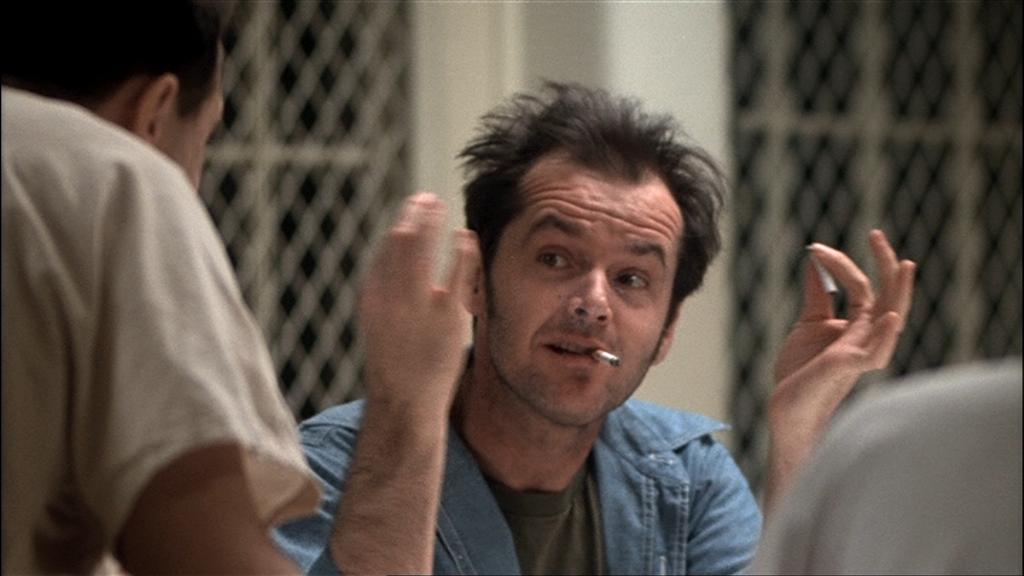
References abound in this play; the 1970’s institutional setting brings to mind One Flew Over the Cuckoo’s Nest and, compared to the recent Hamlets of David Tennant and John Simm, Sheen has an alpha-male muscularity that is redolent of Jack Nicholson without, thankfully, adopting any more of Nicholson’s mannerisms.

The other crucial reference point is the work of RD Laing. In a play that has at its heart the discussion and understanding of madness, Laing’s work has a relevance that underpins the perspective that Rickson takes to the play. At the centre of Laing’s theories is the idea that psychosis is not a biological or psychic response but something that can develop out of socio-cultural situations. This has a direct relevance to the understanding of Hamlet. Hamlet is not ‘mad’ per se but he may have become mad due to the conditions that he has found himself within and the drama of the play may be an attempt to break him of that psychosis.

This reading is reinforced through Laing’s idea that ‘going crazy’ can be the sane response to an insane situation. In this, as in so many other cases, we can infer that Shakespeare touched on the principle a few hundred years before the development of psychology as a science. This may be a stretch but it does appear to reflect Hamlet’s understanding of himself; he wishes to assert his own identity, ‘to thine own self be true’, through his understanding and response to his father’s death. However Hamlet’s ideas conflicts with the response demanded by his ‘uncle-father’ Claudius; Laing would argue that Hamlet is stuck between the persona he has created, the avenger of his father, and the one demanded by parental authority and it is in this bind that the context for Hamlet’s ‘madness’ should be understood.

Click here to read full review

London Riots: Theatre Special

So with the world, his wife  and their media entourage encamped in Edinburgh for the next few weeks, it asks the question of how those cosmopolitan metrosexuals of the capital can keep themselves entertained.

Well having asked the question, this week we got our answers… And our survey said that out of 100 participants the top two responses were:

 1) Looting

                               2) Appearing in court for looting

However for those who believe that life may have more to offer than G-Star Jeans, shiny new Nikes and £3000 of Rothman Superkings then there  is still the vibrant London theatre-scene…or not, an unfortunate consequence of the rioting meant that much of theatreland closed early to avoid the less than desirable impact of having your audience flambéed during the climax to Love Never Dies (the relief at being put of your misery twenty minutes early notwithstanding).

Having said that, every good rioter deserves favour now and again. And doing my bit to save London’s theatre, I suggest the following West End plays that are suitable for both rioters and vigilantes alike:

1) Hamlet – Young Vic

Shakespeare’s masterpiece about an emotionally troubled young man with an absent father. Watch as Hamlet slowly goes off the rails without the existence of strong familial discipline. Attempts from wise elders, young friends and even his own mother are unable to reign him in and the end, when it comes, is as tragic as it is sadly predictable.

2) Aladdin – Lyric Hammersmith

Experience the thrills and spills of Aladdin’s adventure to steal a magic lamp from a hardworking small business owner. Gasp in awe and laugh with delight as you watch Aladdin’s hilarious mishaps as he attempts to escape the local fuzz while holding on to a bin-liner stuffed with swag. And don’t worry folks, its just a pantomime so we can rest assured that Aladdin will get away with it and get the girl in the end.

3) Jerusalem – Apollo Theatre

A vision of life in our green and pleasant land. Follow Johnny Byron, spokesman for the everyday man as he faces eviction by the Council and hostility from the local community.

4) Les Miserables – Queen’s Theatre

Follow Jean Valjean,our hero and a former prisoner, who is pursuedrelentlessly by his nemesis, the policeman, Javert. Featuring the most convincing portrayals of civil disorder ever captured on the London stage and stuffed full of famous songs that you will have heard at riots up and down the land, you too can sing along with popular classics such as ‘Do you hear the people sing?’ and ‘At the barricades’

5) Accomplice – Menier Chocolate Factory

Described as part-tour, part-game, part-theatre, this innovative production takes people on a tour of Southwark. Constantly evolving, what started as a rather staid interactive mystery on the streets of London has turned into the capital’s hot ticket with new attractions including a burned out cornershop and a ransacked Lush. In this uniquely immersive productions, participants are able to throw bricks at police and indulge in a spot of light GBH in full-view of the much-loved London CCTV network. Smile for the camera guys!

Honorable Mention

Betty Blue Eyes – Novello Theatre

10% discount for English Defence League members.


Something for the weekend sir?

Not sure what to do over the Bank Holiday? The idea of wall-to-wall sport proving too much to bare? Well here are a couple of suggestions for things to go and see discover some theatre that you never even knew existed.

ONE MAN, TWO GUVNORS

Who? James Cordon returns to the stage at the National. Last seen on stage in Alan Bennett’s phenomenally successful The History Boys playing a schoolboy, subsequently seen practically everywhere else. His omnipresence has meant that he has been known to appear in dreams, flashbacks and in the corner of your eye at tube stations.
What? One Man, Two Guvnors is closely based on the 18the Century play The Servant with Two Masters by Carlo Goldoni. It contains many of the classical elements of comedies from this period; class systems, women dressing up as men and general confusion and farcical misunderstandings. James Cordon is a man who (rather unsurprisingly) has two employers (one of whom is a woman pretending to be her dead brother) and you may not be surprised to learn that hilarious shenanigans ensue.
Why? Given Lesbian Vampire Killers and the Horne & Cordon sketch show, people can be forgiven for being wary of seeing a play that seems to be set-up as a celebrity vehicle for James Cordon. However this forgets the naturalism of his performance in Gavin and Stacey and the stagecraft he demonstrated in The History Boys. Reviews have been uniform in praising the production and it seems the National has one of the hits of the Summer on its hand.
Where? National Theatre
When? Until 26 July
How much? £12 – £45 (£5 tickets available for 16-25 year olds)
Tedious one sentence deconstruction: Over-exposed TV actor returns to the stage in an adapted play that has surprised many critics by funnier than imagined.

TACTICAL QUESTIONING

Who? The Tricycle Theatre has developed a reputation for being one of London’s premiere venues for breaking political theatre. Tactical Questioning is the 8th tribunal play that has been produced at the venue and previous subjects have included the Hutton Inquiry, the Saville Inquiry and Guantanamo Bay.
What? There is no denying that Tactical Questioning will be a grim, painful and intense evening at the theatre. It couldn’t be any other way. It is an edited but verbatim account taken from the transcripts of a Public Inquiry into the death of Baha Mousa whilst in the custody of the British army. These performances have come after the closure of the inquiry but before it reports its findings and only contains excerpts from statements taken from those interviewed.
Why? Some plays are enjoyable and some are important. The Tricycle’s Tribunal plays are very much in the latter category. Their importance can be summed up by noting that Guantanamo (2004) was performed at both the Houses of Parliament and on Capitol Hill in Washington, whilst Archbishop Desmond Tutu appeared in their New York production. These plays are a raw and painfully real – real events are depicted with real dialogue, and in doing so drama is created out of what is in reality interminably long and complex proceedings.
Where? Tricycle Theatre
When? June 2nd – July 2nd
How much? £12 – £22
Tedious one sentence deconstruction: Blurring the line between drama and reality, the tribunal productions are unlike anything else on the british stage and Tactical Questioning should be mandatory viewing for anyone with an interest in the workings of international justice.