Edward Bond tends to write exactly the sort of plays that you would imagine a British Marxist growing up in a declining post-war England to write. Heavily influenced by Brecht, Bond’s writing operates with a rigidly mechanistic quality that wouldn’t seem out of place in a Soviet factory. There is a brutalism to life in Bond that may have reached its apotheosis in Saved and its infamous scene of a baby stoned to death. Saved, his second play, cemented Bond’s legacy due to the role it played in the battle to overturn the Lord Chamberlain’s Office right to censor works for the stage.
Deliberately challenging his audience and a notoriously prickly individual to work with, Bond has fallen from the public eye and in recent years has worked outside of the mainstream. However the Cock Tavern in Kilburn, now sadly closed, staged a number of older plays alongside new work in 2010 and the Lyric Hammersmith took on Saved in 2011 to suggest that we may finally be rehabiliting ourselves towards one of our most overtly political playwrights.
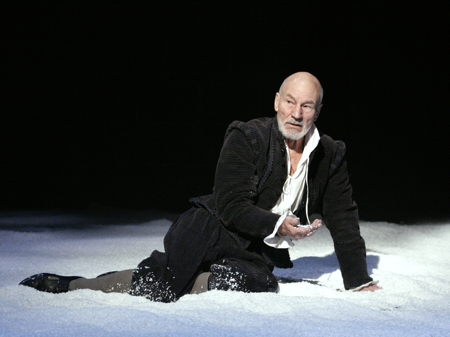
The Young Vic has continued this process with Bingo; it is seemingly an astute choice, one of Bond’s most accessible plays featuring Shakespeare as its central protagonist, and the casting of Patrick Stewart, who originally played the role in the 1970’s, guaranteed to bring in an audience that might otherwise avoid such austere fare.
Shakespeare retains central to Britain’s cultural heritage and represents the country’s main claim to a true cultural genius to rank alongside Da Vinci and Mozart. Those individuals that command an international agreement of their stature are rare indeed and whenever their legacy is challenged people have a tendency to react defensively.
Ian Rickson’s production of Hamlet at the Young Vic begins with an elaborate entrance through the backstage area, which has been transformed into a passage through a mental hospital. As you wind through narrow corridors, you catch glimpses of action through windows and the pervading sense from the TV screens and telephones on display that we are entering the 1970s.
To be honest all this effort feels a little laboured although it does help to immediately ground the play in its overarching theme: is Hamlet mad? It is a question that has been raked over many times, be it in productions, literary criticism or psychological analysis. However through Ian Rickson’s radical interpretative staging, it is a question that delivers a revelatory redefinition of how the play can be understood.
The play begins with a striking image; Michael Sheen’s Hamlet appears out of nowhere in long shot, trapped in a solitary light shining upstage. Rickson’s exquisite framing is a feature that runs throughout the play but this first image, with a clear allusion to Carol Reed’s The Third Man is particularly notable. It is a potent reference point, immediately conjuring up thoughts of Vienna; the spiritual home of Freud and the psychology movement. The Third Man itself is indebted to German expressionists of early cinema, such as Fritz Lang and FW Murnau, who were fascinated by madness and its effect on the human condition.
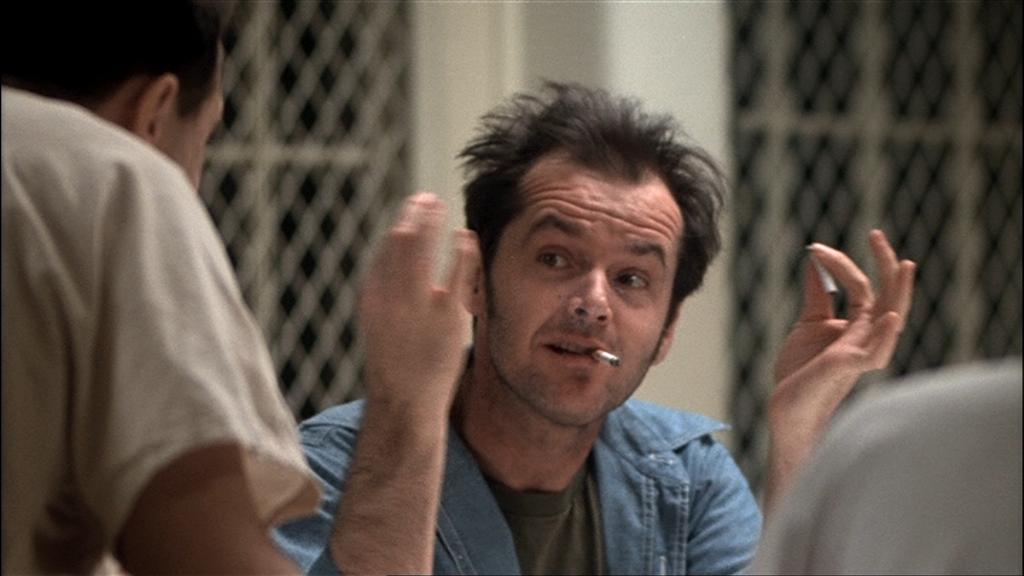
References abound in this play; the 1970’s institutional setting brings to mind One Flew Over the Cuckoo’s Nest and, compared to the recent Hamlets of David Tennant and John Simm, Sheen has an alpha-male muscularity that is redolent of Jack Nicholson without, thankfully, adopting any more of Nicholson’s mannerisms.
The other crucial reference point is the work of RD Laing. In a play that has at its heart the discussion and understanding of madness, Laing’s work has a relevance that underpins the perspective that Rickson takes to the play. At the centre of Laing’s theories is the idea that psychosis is not a biological or psychic response but something that can develop out of socio-cultural situations. This has a direct relevance to the understanding of Hamlet. Hamlet is not ‘mad’ per se but he may have become mad due to the conditions that he has found himself within and the drama of the play may be an attempt to break him of that psychosis.
This reading is reinforced through Laing’s idea that ‘going crazy’ can be the sane response to an insane situation. In this, as in so many other cases, we can infer that Shakespeare touched on the principle a few hundred years before the development of psychology as a science. This may be a stretch but it does appear to reflect Hamlet’s understanding of himself; he wishes to assert his own identity, ‘to thine own self be true’, through his understanding and response to his father’s death. However Hamlet’s ideas conflicts with the response demanded by his ‘uncle-father’ Claudius; Laing would argue that Hamlet is stuck between the persona he has created, the avenger of his father, and the one demanded by parental authority and it is in this bind that the context for Hamlet’s ‘madness’ should be understood.
Well the big news of the day is the announcement of some major theatre projects that will be heading our way in 2012. One of the elements of the Olympic legacy that never really seem to have caught the public imagination is the Cultural Olympiad – something aptly skewered in the BBC’s painfully accurate picture of life as a middle-manager on the Olympics (something that I have at times had the questionable fortune to view first hand).
World Stages London is (and this sounds does sound a little to close to the clip above for comfort) “…a once-in-a-lifetime celebration through theatre of the exhilarating cosmopolitan diversity of London’s people and culture”. Well okay, in fairness London is one of the great international cities of the world – and what sets it apart on the cultural stage is it is ability to be a melting pot that blends the ingredients of the art and world view of different cultures to create something unique – in a way that only New York can really claim to challenge..
With talents as varied as Peter Brook and Jonathan Dove, and pieces including a 500 strong site-specific work about Babel and the first-ever production of Wild Swans, it seems pretty certain that there will be something for everything in the run-up to the Olympics (where it will be wall-to-wall British sporting patriotism for the best part of six weeks).
Reasons to be cheerful…
The Suit
Peter Brook, in a collaboration with Marie Helene Estienne, continues his exploration of fables and the art of story-telling and myth-making with this adaptation of a short-story by Can Themba. Now personally I have found Brook’s last two outings at the Barbican insubstantial and well below the standards that he is capable of. Lately his reduction of the stage to its barest essentials have taken on the feel of an ascetic. However one always lives in hope of a return to the form that made him a colossus of 20th century theatre.
It runs from 21 May to the 16 June. More details can be found here
Babel
In what looks like a very special production and the possible flagship event of the whole project, Battersea Arts Centre and WildWorks (responsible for the critically acclaimed The Passion at Port Talbot) are teaming up for Babel, which includes a cast of 500 community and professional actors, musicians and performers. It is site-specific and the location is yet to be revealed, but it seems likely that a famous London landmark is involved and one imagines that it will have to be somewhat tower-shaped (my personal hope is Big Ben but one imagines security concerns may make that one tricky)
It runs from 08 – 20 May. More details can be found here
Wild Swans
A literary classic and a world-wide best seller (no hyperbole here, over 30 translations and 10 million copies – thanks Wikipedia!), Juna Chang’s novel looks set to be one of the more popular smash hits of the festival. Telling a story of one family’s multi-generational struggle against the backdrop of an ever-changing China, it effectively contains the biographies of three generations of women in the Chang family.
I must admit it has never held any interest for me whatsoever. I haven’t read it and can’t imagine doing so soon. No doubt it is my loss but then so are many of the other books I have never, and sadly will never, read. It is almost certain going to be a complete sell-out and if you want to go, you should get your tickets soon.
It runs from 13 April to 13 May. More details can be foundhere
Three Kingdoms
Despite being one of the more mysterious offerings on the programme, its sheer intriguing nature has me hooked and will be what I will be most looking forward to this spring. Written by Simon Stephens and exploring the trade in trafficked women and organised crime across Europe, it doesn’t profess to being the most uplifting evening you are likely to spend in the theatre. However a new play by Stephens is always worth catching and it is interesting to see a plotline that seems more suggestive of a film being given the stage treatment – throw in the puzzling trail picture (above) and you can count me in.
It runs from 03 – 19 May. More details can be found here
So with the world, his wife and their media entourage encamped in Edinburgh for the next few weeks, it asks the question of how those cosmopolitan metrosexuals of the capital can keep themselves entertained.
Well having asked the question, this week we got our answers… And our survey said that out of 100 participants the top two responses were:
1) Looting
2) Appearing in court for looting
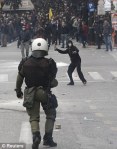
However for those who believe that life may have more to offer than G-Star Jeans, shiny new Nikes and £3000 of Rothman Superkings then there is still the vibrant London theatre-scene…or not, an unfortunate consequence of the rioting meant that much of theatreland closed early to avoid the less than desirable impact of having your audience flambéed during the climax to Love Never Dies (the relief at being put of your misery twenty minutes early notwithstanding).
Having said that, every good rioter deserves favour now and again. And doing my bit to save London’s theatre, I suggest the following West End plays that are suitable for both rioters and vigilantes alike:
Shakespeare’s masterpiece about an emotionally troubled young man with an absent father. Watch as Hamlet slowly goes off the rails without the existence of strong familial discipline. Attempts from wise elders, young friends and even his own mother are unable to reign him in and the end, when it comes, is as tragic as it is sadly predictable.
Experience the thrills and spills of Aladdin’s adventure to steal a magic lamp from a hardworking small business owner. Gasp in awe and laugh with delight as you watch Aladdin’s hilarious mishaps as he attempts to escape the local fuzz while holding on to a bin-liner stuffed with swag. And don’t worry folks, its just a pantomime so we can rest assured that Aladdin will get away with it and get the girl in the end.
A vision of life in our green and pleasant land. Follow Johnny Byron, spokesman for the everyday man as he faces eviction by the Council and hostility from the local community.
Follow Jean Valjean,our hero and a former prisoner, who is pursuedrelentlessly by his nemesis, the policeman, Javert. Featuring the most convincing portrayals of civil disorder ever captured on the London stage and stuffed full of famous songs that you will have heard at riots up and down the land, you too can sing along with popular classics such as ‘Do you hear the people sing?’ and ‘At the barricades’
Described as part-tour, part-game, part-theatre, this innovative production takes people on a tour of Southwark. Constantly evolving, what started as a rather staid interactive mystery on the streets of London has turned into the capital’s hot ticket with new attractions including a burned out cornershop and a ransacked Lush. In this uniquely immersive productions, participants are able to throw bricks at police and indulge in a spot of light GBH in full-view of the much-loved London CCTV network. Smile for the camera guys!
Sitting around on a Saturday night? Reconciling yourself to an evening spent watching manic depressive Irish twins and a faded noughties boyband systematically deconstruct the meaning of what music has to be? Well this glimpse of what’s on the London stage may encourage you to put on your gladrags and discover some theatre that you never even knew existed.
I AM THE WIND
Who?
A bit of a high-culture European super-group; acclaimed French director Patrice Chereau (La Reine Margot) works with Simon Stephens (Wastewater, Punk Rock) and Jon Fosse (by all accounts Europe’s most performed playwright – who knew?). It’s basically a bit like when John Lennon formed a band with Keith Richards, Eric Clapton and Mitch Mitchell but probably a lot less cool.
What?
Two nameless characters are alone on a boat, they drift into the ocean and into the world of the unknown. They are entering a world of metaphor, allusion and philosophical questions about man’s relationship with itself and with nature.How much you enjoy this play probably rests on whether you got to the end of the previous sentences without raising your eyebrows at the pretentiousness of it all.
Why?
With such a strong British tradition and the constant influx of big names from America, this is a chance to see how they do it on the continent. A legendary director meeting a prolific playwright (over 900 productions in 40 languages) would be cause for celebration across Europe but here it has received a decidedly mixed reception. Fosse is seen by many as a sub-Ibsen or Beckett but you do not get translated that many times without being able to tap into certain universality.
Where?
The Young Vic
When?
Until 21st May (and then on an international tour)
How much?
£10 – £27.50
Tedious deconstruction of the play to one sentance:An existentialist play directed by a Frenchman where there are two characters called ‘the one’ and ‘the other’; you can’t argue you didn’t know what you were letting yourself in for when you bought the tickets.
TENDER NAPALM
Who?
Tender Napalm is the first play in three years by Phillip Ridley, winner of Time Out, Evening Standard and Critics’ Circle awards and includes Jack Gordon (Fish Tank, War Horse) who won the Screen International Star of Tomorrow award.
What?
Taking its influences from a number of playwrights, including Pinter & Coward and with nods towards Shakespeare and the ancient Greeks, Tender Napalm is more than a string of cultural reference points. It presents an intelligent study of the lines (in reality, in language and in metaphor) that pull a relationship through love and hate. A stripped back stage and fully committed performances by the actors draw the audience into the action.
Why?
Ridley’s ear for language draws you into the hidden depths and finds ways of vocalising those places in the mind that in real life remain unsaid, this leads to a play that has a vitality and a rawness that is too often missing from similar plays. Rather than clunky realist plotting, Ridly manages to draw the life out the play out of the emotion and imagination of his characters.
Where?
Southwark Playhouse
When?
Until 14th May
How much?
£8 – £18
Tedious deconstruction of the play to one sentence
A brutal, excoriating but often very funny examination of a relationship and the fine lines drawn between love and hate; stellar performances and intelligent staging underpin a play by one of Britain’s most exciting writers.
 Deliberately challenging his audience and a notoriously prickly individual to work with, Bond has fallen from the public eye and in recent years has worked outside of the mainstream. However the Cock Tavern in Kilburn, now sadly closed, staged a number of older plays alongside new work in 2010 and the Lyric Hammersmith took on Saved in 2011 to suggest that we may finally be rehabiliting ourselves towards one of our most overtly political playwrights.



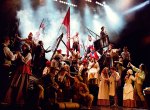 Follow Jean Valjean,our hero and a former prisoner, who is pursuedrelentlessly by his nemesis, the policeman, Javert. Featuring the most convincing portrayals of civil disorder ever captured on the London stage and stuffed full of famous songs that you will have heard at riots up and down the land, you too can sing along with popular classics such as ‘Do you hear the people sing?’ and ‘At the barricades’
 Civilian Theatre