Grieg finds sublimity amidst the grief

The Events – Maria Room @ Young Vic, until 02 November 2013

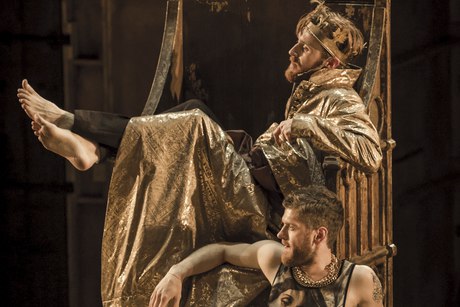
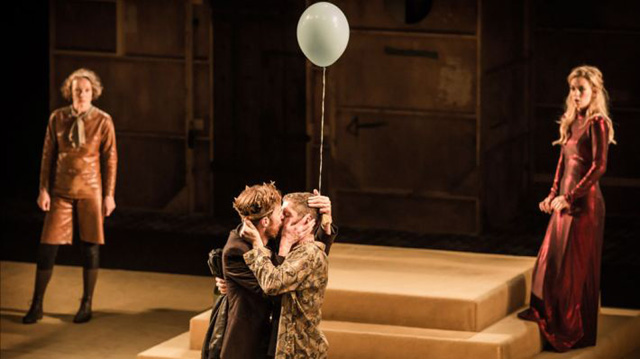
A rather unusual thing happened to David Grieg whilst he was researching material for The Events (winner of a Fringe First, subject to rave reviews and currently playing at the Young Vic until November); following a feature interview in The Observer he was forced into the position of an issuing a statement via his blog to clarify that his latest work was both not a musical and not about Anders Breivik.
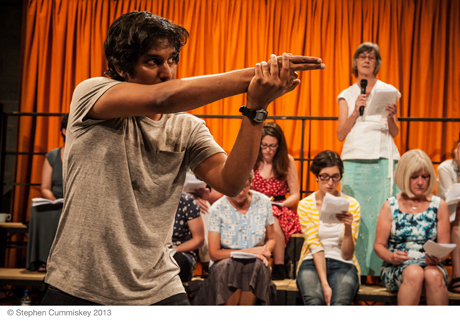
The Events by David Greig  An Actors Touring Company, Young Vic, Brageteatret & Schauspielhaus Wien Co-Production 9 October - 2 November 2013

It is a telling moment in the creation of this subtle and quietly devastating work that one of our leading contemporary playwrights felt the need to publically justify his work; it was a moment that was indicative of the undercurrent of sensationalism that surrounds mass public tragedies and which makes it so difficult to discuss them in anything other than the most binary of terms.

There is nothing in The Events that is suggestive of the Breivik shootings, however the themes are as much about that tragedy as it is about Dunblane, Columbine or Sandy Hook. As a play it is at once singular and all-encompassing; Grieg allows the audience to only see glimpses of the tragedy as the play instead looks at the deeper, more powerful questions that arise in the response to a tragic event.

The play is neither cast nor structured in a traditional way; perhaps rightly assuming that to tell the story through a linear narrative would lead to difficulties in ensuring each viewpoint was treated with equal weight, Grieg has chosen to refract a number of positions through his cast of two, and the community choir.

The result is an audience that remains distanced from the emotional impact of the action; an alienating technique that enables the play to take the form of a Socratic dialogue between the two actors. This is developed further in brief, direct interventions with the community choir, who often resemble a Greek chorus providing commentary on the action.

Claire (Neve McIntosh) is ATC / The Events, 2013the community’s priest who set up the choir that was the focal point of the events, and who acts as a mirror to the audience in looking for answers and explanations for the Boy’s actions. Rudi Dharmalingham plays the Boy – always nameless – and all the other characters in the play.
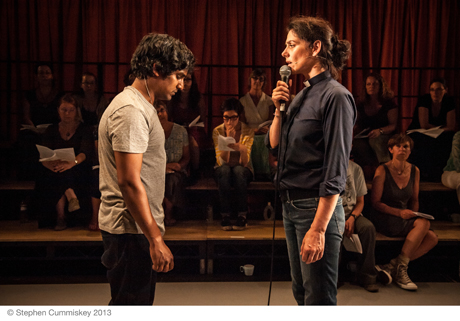
Claire is on a redemptive quest to find understanding in the Boy’s actions in the belief that doing so will liberate her from a perceived survivor’s guilt. The audience follows her through brief, fragmentary scenes, as Claire tries to gain answers that will provide some form of justification for the events rather than them appearing a senseless act of brutality from which survival was little more than pure luck.

However Claire’s crisis of faith (in both the secular and religious world) helps to shape the deeper narrative, which is a dialogue that sets out the precariousness of modern liberalism when it comes under an extreme and sustained attack.  As a lesbian priest with partner and penchant for homemade bread, Claire may be something of a liberal caricature but in her belief and values Claire is reflective of the country that many of the university-educated, metropolitan middle-class assumes Britain to be.
<<Continue to full review>>

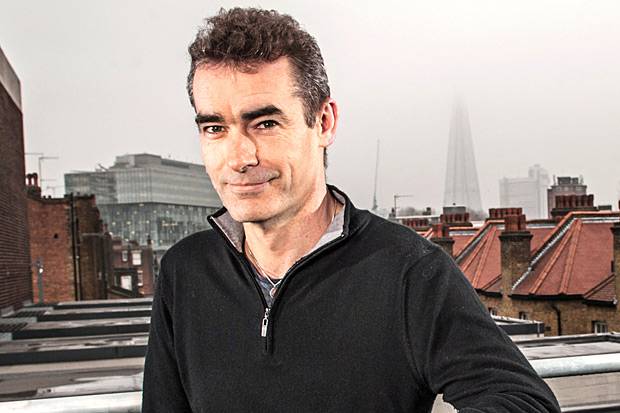
Rufus Norris: New Artistic Director of the National Theatre

Congratulations to Rufus Norris on the news that he has been appointment to follow in the footsteps of NicholasRufus-Norris Hytner to become the next artistic director of the National Theatre. Generally seen as just about favourite for the role, he has clearly exuded a behind-the-scenes confidence that has outshone his relative lack of experience.

I have read more about his work than seen it – but what I have seen has been absolutely first rate, and whilst the National has looked to broaden its horizons in recent years it has always felt that it was just dipping its toe in the waters. With Norris in post it is perhaps time that the National will truly dive headlong in what it is to produce theatre in, and for, modern Britain.

Hytner has left some big shoes to fill – and clearly they decided not to fill them with more of the same, the National have also sidestepped the opportunity for a ‘big name’. However in all reality what chance did Daldry, Mendes and Branagh really have if they were not willing to forego their cinematic commitments? Watch the bun fight when Kevin Spacey steps down at the Old Vic; a theatre that has more than understood how a ‘celebrity’ name can be a huge draw, vastly outweighing any accompanying problems.

In leaving Norris the Shed space, Hytner’s has bequeathed an excellent legacy that will pay dividends. It gives him room, in those important early years, to work in a smaller, less pressurised space to develop innovative work that may be initially hard to put though the Olivier. It gives Norris breathing space whilst he sets about changing any internal negative attitudes to his direction, and to clear house where houses need clearing.

A couple of years down the line, we may be looking at a National that really does reflect Britain today, and whilst the lack of Shakespeare is a concern (or at least it is for the purists) but perhaps fresh eyes on the playwright is really what is needed.

Norris is an excellent choice and I can’t wait to see how he leaves his mark.

Bold, bravura Bolivian brilliance

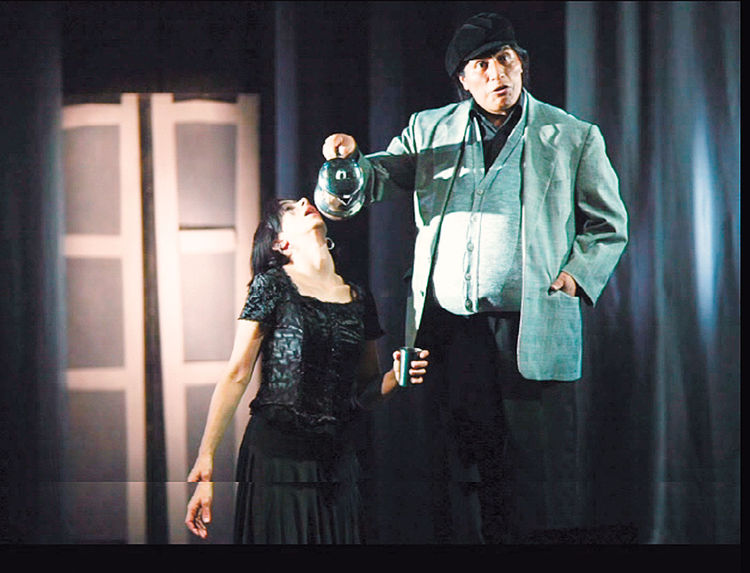
Hamlet de los Andes – Teatro de los Andes @ The Barbican Pitpart of the CASA Latin American Festival

If my knowledge of Bolivia is shockingly limited then it is fair to suggest that my knowledge of Bolivian theatre is equally lacking. However if Teatro de los Andes’ breath-taking reimagining of Shakespeare’s Hamlet is any measure of the quality of the Bolivian arts scene then it is an area that needs considerable investigation.

Fast-paced and full of vitality, Teatro de los Andes’ production finds new energy for a play whose radicalness has become blunted by its well-worn familiarity. In the fore-knowledge of its famous quotations and its prototype of Ophelia and Poloniusthe tragic hero, it is telling that it has taken a non-English language company to develop a radical approach that plays with both text and content. In recent years its closest parallel on the English stage has been Thomas Ostermeier’s German production but whereas Ostermeier’s production seems to revel in its willfully abstruse nature, the direction and purpose of Teatro de los Andes is clear throughout.

Hamlet of the Andes

There is nothing deliberately complicated about this production. It may be performed in Bolivian with just three actors and a musician. It may have taken a hatchet to the text, rewriting most of the dialogue and weaving altered quotations throughout, cut half the characters and reduced the length to under two hours.

However it also provides a chillingly clear indictment of the politico-military instability that ripped apart Bolivian society throughout the latter-half of the 20th century, which is told through the lens of the paranoia and madness that infects not just Hamlet but the whole household.

Writing in the Guardian, ahead of the publication of The Hamlet Doctrine, Simon Critchley and Jamieson Webster argue that we have either forgotten or misunderstood the true nature of Hamlet and that productions too often focus on safe interpretations; they argue that we should look to the likes of Lacan and Nietzche who took analysis of Hamlet’s character beyond the basic Freudian Oedipal model, and offered far more radical implications for society.

This production demonstrates a fault of Critchley and Webster’s argument, and of many recent audience-friendly versions of the play, which is that it continually focuses Hamlet the play on Hamlet the man. They clearly understand the motivation that affects Hamlet as an individual but ignore the idea that Hamlet is a free agent, and that he operates in a political world full of other free agents; each with their own motivation that exist independently of Hamlet’s actions.


<<Continue to the full review>>

The Rehabilitation of Bertolt Brecht

The Resistible Rise of Arturo Ui –Duchess Theatre, booking until 07 Dec 2013

Leaving aside Shakespeare, Chekhov and Ibsen, the popularity of playwrights tends to wax and wane on the London stage; the recent reappraisal of Rattigan as someone unfairly cast aside by the Angry Young Men of the 1950s and the continuing absence of Bernard Shaw are two of the more obvious examples of the way a writer’s fortune remains tied to the whims of producers.

Arturo Ui Poster

The UK has also notably never quite embraced the rich vein of talent that exists in European theatre: Racine is rarely seen; Moliere, a mainly absent figure; and modern continental playwrights virtually non-existent. The thrall of Anglo-American naturalism and the rawness of the grand narratives of O’Neill, Williams and Miller continues to be preferred to the rather more metaphysical questions posed by the likes of Ionesco and Artaud.

Within this structure Brecht cuts a solitary figure, and has increasingly become something of the forgotten man of British theatre. Whilst his position, alongside Stanislavski, as one the pre-eminent figures in the development of modern theatrical practice is assured, it was Stanislavskian concepts that became the dominant mode of theatre and film; championed by Stella Adler and embodied in the work of a young Marlon Brando.

In comparison Brecht’s influence has seemingly ebbed away to the point where a new production of a Brecht play in the West End is something of an event. One must acknowledge that there are resource considerations to this; large casts can be ruinously expensive but that reality is built on the premise that Brecht is deeply unfashionable and cannot be considered an audience draw.

The irony’s that Brecht is perhaps the most American-looking of all the European playwrights. Stanislavski had little desire to cast his eyes across the Atlantic but to Brecht the new world and its eager embrace of democratic and technological progress chime with ideas that were central to his own theatrical philosophy.

arturo_ui_063_Henry_Goodman__Arturo_Ui__and_Michael_Feast__Roma_._The_Resistible_Rise_of_Arturo_Ui._Photo_by_Manuel_Harlan._4ffd4cb1ddfbbAt its heart was the development of an art form that would become pre-eminent for the first five decades of the 20th century: cinema. Silent cinema was the great leveller; reliant on music, gesture and simplified dialogue so it could appeal across the immigrant communities of America, these early pictures represented Brechtian techniques transposed to a medium that could truly be embraced by a mass audience.

It was within the world of cinema that Brecht found a way of telling the story of Hitler. The development of genre pictures – particularly the early gangster movies, starring the likes of James Cagney and George Raft – gave Brecht a mechanism with which the rise of an international dictator could be challenged in a way that did not need threaten the authorities directly and would also appeal to a mass audience.

This is not to say that Arturo Ui is dumbed down; the reverse is in effect true, Brecht is raising the genre picture above its humble origins. He may have gained a reputation as a didactic playwright with a sledgehammer touch but this is to ignore the craft taken over the formal structure of the play and the sly literary references liberally sprinkled throughout the text.

Arturo Ui could be enjoyed for the wonderful pastiche of Mark Antony’s oration at Caesar’s funeral and the knowing nods to pretty much every tragedy in the Shakespearian canon but it does more than this – it recognises the freedom of the theatre, in opposition to the limitations of cinema, to challenge the audience by upturning the established conventions of an entire genre.

<<Continue to full review>>

The Tragicomedy of Mac-beth; or how I learnt to stop whining and love the cuts to Arts Council funding

It is no secret that Civilian Theatre has long been troubled by the myopia and self-interest shown in the annual letter-writing campaigns to the Guardian and the Independent from the great-and-good decrying the scandalous cuts to Arts Council funding and how it will endanger the very lifeblood of the craft itself.  Whilst Civilian Theatre is not by nature a callous man and, unsurprisingly, would love to see theatre funded to the hilt in this country – with regional theatres prosperous, village halls packed to the rafters with touring companies and every worthy project that supports a vulnerable group given the financial sustenance they desperately need, it also can’t help but feel if these people of letters are looking rather closer to home for where they feel the funding should be going.

Alongside the cuts, the dramatic rebalancing of Arts Council funding towards more sustainable projects is something that has slipped under the radar. There will always be the need to finance some projects that have great worth but are unlikely to ever be sustainable, but there are plenty of other companies who seem to have grown fat on the years of plenty and seem to have given little thought to what might happen when the tap is turned off.

So what has happened? I don’t see any great decrease in the quality of productions, I don’t see any great decrease in the number of productions, we seem to be in a mini-golden age of playwrights who have broken out of the long shadow cast by Mark Ravenhill, Sarah Kane et al; Nick Payne, Lucy Kirkwood and Lucy Prebble have all put forward plays that don’t look to the past and that engage with the events of our time – be it Enron, Quantum Physics or China. Are we perhaps seeing the emergence of playwrights who can write truly international plays in global times? Time will tell but these are the people that are moving forwards rather than looking backwards.

And for those companies that have the most part always scraped by; who do theatre for the passion and for the possibility of that break. Some no doubt, funding unsecured, have fallen by the wayside, or accepted their fate is to be a strong amateur company (and there is no shame in that whatsoever). And then there are the dynamic and the proactive; the ones that are utilising every avenue to raise money to put on their shows; who are embracing the modern world in search of funding; who realise that a thousand smaller voices can make as loud a noise as one large one.

Which brings us back to the point of this post. My attention was drawn to The Tragicomedy of Mac-Beth. I have no idea if its good, if it will be good or if it has legs but that isn’t going to stop me dipping my hand in my pocket. And why not? Instead of wasting £20 on 5 pints of beer (yes, thanks London), why not help someone realise their dream, feel good about yourself and experience that smug sense of self-satisfaction when you see yourself listed in the programme?

Want to know more – check out more here

NB: It’s probably worth noting that Civilian Theatre (other than giving money) is no way linked to this production, or any of the companies involved.

Writer vs Director vs Actor in Edward’s epic battle

Much of the critical reaction to the National’s production of Marlow’s Edward II has been withering, and for generally mild-mannered reviewers, bordering on the vitriolic. Leading the charge is, inevitably, Quentin Letts in The Daily Mail who suggests the ‘the only thing murdered in Joe Hill-Gibbins’s puerile, inept production is the play itself’ (ouch) and is followed, perhaps rather too stridently, by Tim Walker in The Telegraph who found ‘In almost 10 years of reviewingedward ii and gaveston: not your everyday production theatre, I doubt I have been confronted with a bigger load of indigestible old tosh’ and couldn’t help but the boot into the subsidised sector while he was at it; ‘the kind of production that simply could not happen in the commercial West End.’

Many people would doubtless agree with Mr Walker’s final sentence but the despair being aimed less at the National and more with eyes turned pointedly north of the river at the risk-averse nature of the private sector behemoths; happy to suck up the most profitable of the tried and tested subsidised productions before reverting back to a steady rotation between Noel Coward, Alan Ayckbourn and A.N Musical complete with X-Factor star.

If the overt agenda setting of Mr Walker’s column can be ignored– and the reference to‘comrades’ at the National rather says it all – it makes an important point in reminding us that the licence to put on a production this lavish ultimately comes from the public purse.

Joe Hill-Gibbin’s is a talented director who had great success at the Young Vic but his career trajectory is taking a worrying turn towards the excessive. A bright start led to a stint at the Young Vic where he created a stunning yet simpleEdwardII and Isabel revival of Martin McDonagh’s brilliant Beauty Queen of Leenane and directed the only Tennessee Williams production I have ever managed to enjoy (The Glass Menagerie).

He scored an unexpectedly huge hit with the fun but rather too hyper-kinetic The Changeling, which showed a suffusion of talent but equally there were times where a restraining hand might have been called for. It is troubling that on the grandest stage of all Hill-Gibbin’s has not only failed to adjust his style but that the flaws, rather than being flattened in the vast space of Olivier, have only been magnified.

Whilst we must allow artistic companies the freedom to make mistakes, watching Hill-Gibbin’s exuberant production reminded me of the wisdom of Bob Balaban’s protective mother in A Mighty Wind justifying the use of a Shetland pony to play polo on the grounds that ‘if he has to fall, he shouldn’t fall from so very high’.

<<Continue to full review>>