Democracy under the microscope in Ibsen reworking

Public Enemy – Young Vic Theatrebooking until 08 June

Continuing from where he left off with Gogol’s The Government Inspector, Richard Jones’ production of a Public Enemy at the Young Vic delves deeper into small town communities and how the introduction of an outside force – be it the arrival of a government official or a report of a contaminated water supply – inexorably leads to the exposure of the venality and hypocrisy of those in positions of responsibility, and those who are able to exercise power.

Running at a brisk 100 minutes and dispensing with the interval in order to allow the play to build towards a frenetic and frenzied conclusion, David Harrower’s updated text reworks Ibsen’s Enemy of the People into a 1970’s Public Enemy logosetting. In this he is aided by a superb set design from Miriam Buether and costumes from Nicky Gillibrand that immediately places the location in a Scandinavia of the 1970s.

Updating Enemy of the People has an advantage of other Ibsen plays in that the central plot device feels as relevant today as when it was written. The tainting of the water supply is something that doesn’t seem so unlikely to a society who has seen the Yangtze River turned the colour of blood and minor earthquakes hit Blackpool following adventures in fracking.

Jones’ Public Enemy reminds us once again of Ibsen’s skill of placing characters in the most exquisite of personal dilemmas – forced into positions that expose their venality and corruption to the world. Each passes under the lens of his microscope, and each ultimately fails to take the action that would potentially redeem them.

<<Continue to full review>>

Charming production that wears its art on its sleeve

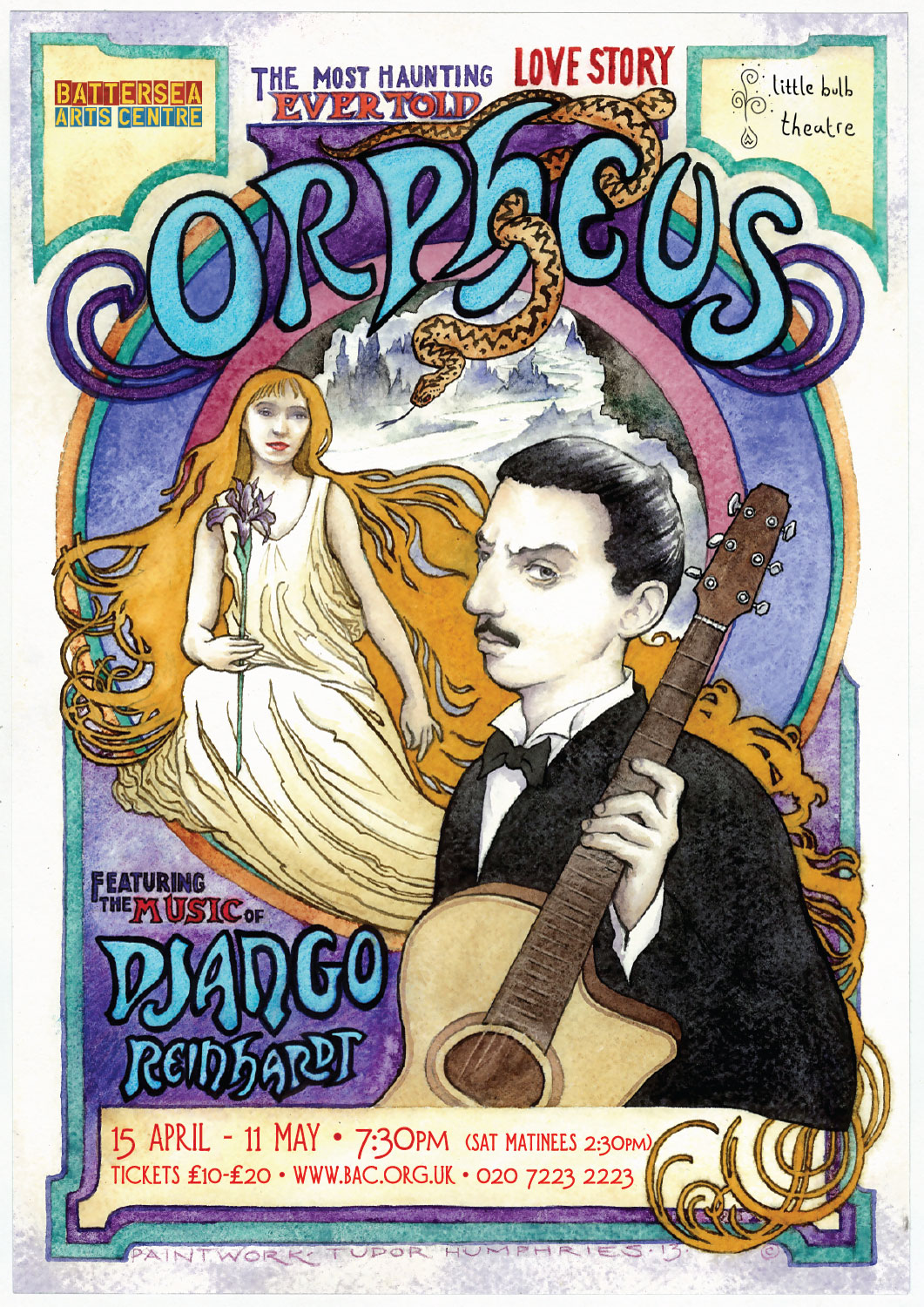
Flyer for OrpheusOrpheus – Little Bulb Theatre @ Battersea Arts Centre, until 11 May

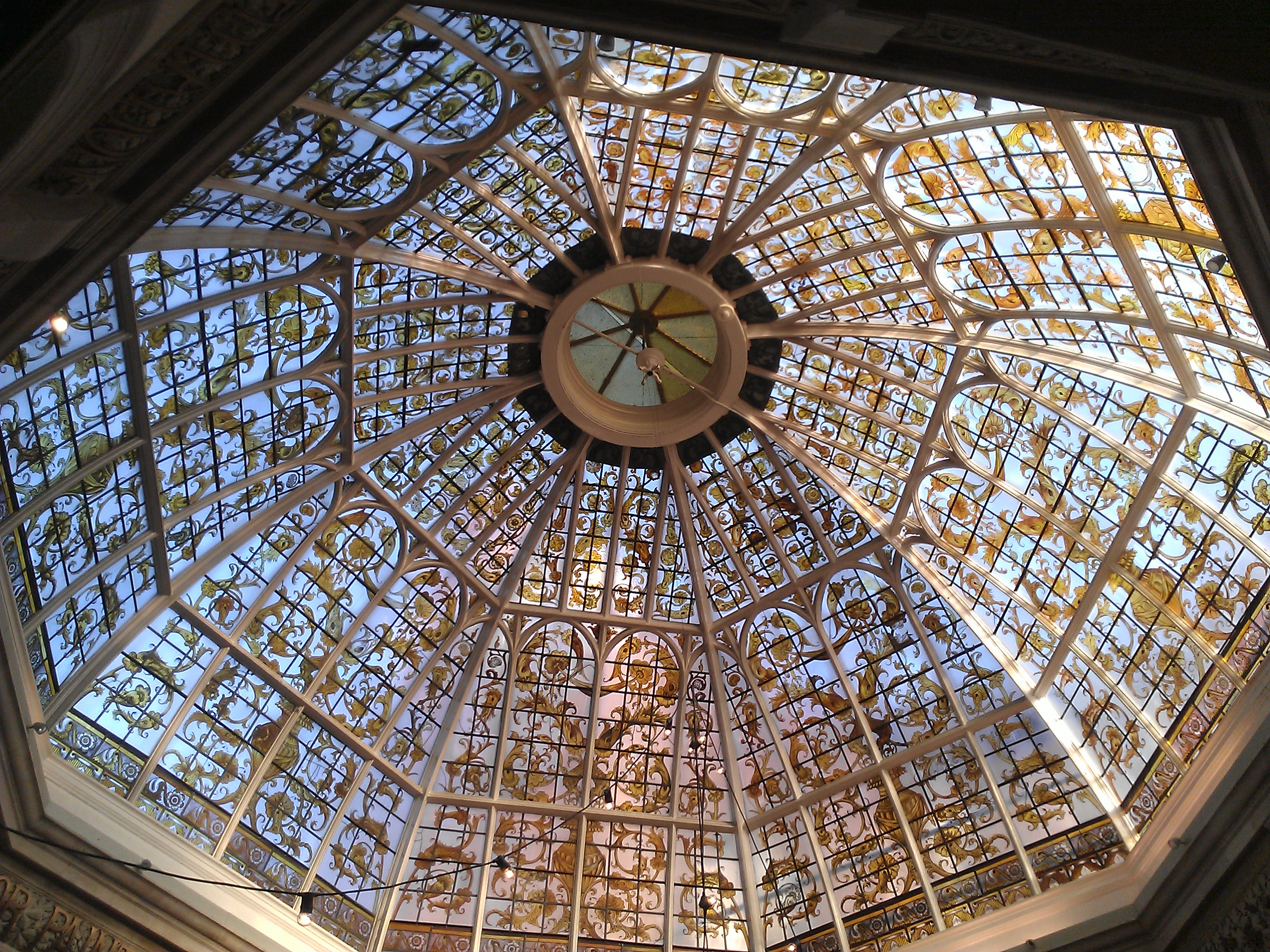
It is always a joy to spend an evening at the Battersea Arts Centre as, no matter the quality of the production, it provides an opportunity to spend an evening inside one of London’s great Victorian buildings. Many companies have looked to make the space an integral part of the performance; Punchdrunk exploded into the public consciousness with the Masque of the Red Death, a production that exposed the development of their unique style to a wider audience. They turned the BAC on its head – celebrating its beautiful interiors whilst building pocket worlds within it and ending with a strange blend of gothic classicism.

The BAC has a strong history of supporting new companies and providing spaces for those whose work doesn’t fit into more obvious spaces. The roll-call of success stories show a keen eye for understanding what works and what has audience appeal; providing a London-base for Kneehigh and partnering with Ridiculusmus, Complicite and Told by an Idiot demonstrates an important ability to spot the difference between the threadbare and the deliberately ramshackle.

WP_000121It remains to be seen where the emerging company, Little Bulb Theatre, slots into this picture but if awards were given for fitting productions to locations then their charming and quirky take on the tale of Orpheus and Eurydice would be walking away with a basketful of silverware. The BAC proves a lovely backdrop to an evening that strives valiantly to give a flavour of the 1930’s Parisian scene but knows enough of its flaws to have its tongue placed firmly in cheek throughout.

The problem, encountered in dreamthinkspeak’s latest production, with site-specific work is often they try to shoehorn a concept into a space that does not fit, or that the budget cannot do justice to. What remains is often a po-faced production that hopes you won’t notice that more time was spent dressing the set then developing characters.

Little Bulb’s Orpheus has similarly paper-thin characters – Orpheus is apparently Django Reinhardt but, other than explaining his ability with the guitar, that fact has no bearing on the play and is not developed with any real sense of purpose – but it spends a great deal of energy winning over its audience with an exuberance that is in keeping with the vaudeville staging.

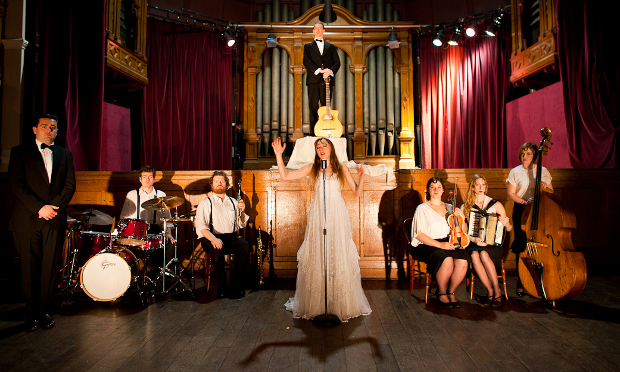
The cast perform and the BAC is transformedThe silent movie backdrop is another way of avoiding explicit character development in favour of style without undermining the production. It allows for big, expressive gestures and emotion demonstrated through action rather than internalised – another reminder to the world of the music hall. This creates a deliberate undercurrent of comedy that runs through the production; to the modern audience this style of acting seems so alien – a strange hybrid of Victorian stage-acting, mime and early 20th century cinema – that it is difficult not to warm to despite it undermining the tragedy within the Eurydice story.

Little Bulb are well supported in their endeavours by beguiling central performances; Eugenie Pastor as Eurydice and Dominic Conway as Orpheus look as if they have just stepped of the set of the latest Dietrich film. Pastor’s doe-eyes deserve a special mention of their own, as they retain a now almost-lost Clara Bow-like ability to portray a moving tableaux of longing to tragedy to absurdity in one fluid movement, whilst Conway’s profile is every-inch the slightly louche heartthrob – never the matinee idol but the one that parents would warn their daughters about.

<<Continue to full review>>

Radical naturalism in haunting reinvention of a classic

Fraulein Julie – Barbican, until 04 May

Strindberg’s Miss Julie never seems to quite fall out of fashion but even by its standards, London has been awash with the play. This is the third major version in less than a year, and it has been only six months since audiences at the Barbican were left underwhelmed by the high-profile casting of art-house favourite Juliette Binoche in the title role, whilst those who saw Mies Julie were rather more  thrilled by the South African reinvention and the Young Vic took it upon themselves to revive Patrick Marber’s After Miss Julie.

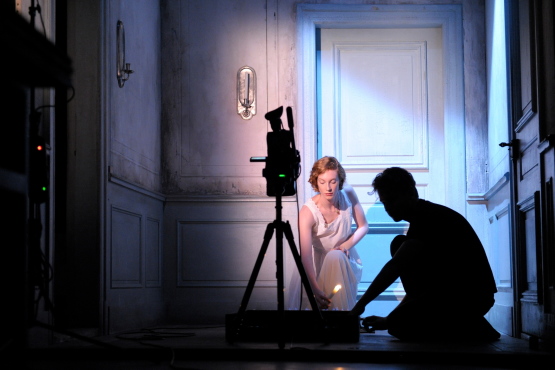
For all the different qualities these productions brought to Strindberg’s original they must be regarded to be drifting in the wake of Katie Mitchell’s exceptional production, which contains a lacerating truthfulness that Fraulein Julie in Katie Mitchell's radical reinventionmakes it almost unbearable to watch. The most remarkable element of the exposure of the truth in this most naturalistic of plays is that Mitchell’s deliberately subverts audience expectations of naturalism by introducing many layers of artifice in order to produce a dislocating, alienating experience.

Fraulein Julie contains all of the directorial tics of a Katie Mitchell production; television cameras are used almost continuously alongside the action, a set creates physical barriers between audience and actors, sound booths overlay conversation and Foley artists provide live sounds effects. The audience are left in the position of watching both the back of a TV studio at the same time as watching a radical reinvention of the Strindberg play – and yet despite all this feel no dissonance as the events unfold.

These traits in Mitchell seem appropriate – in so far as there are auteurs in theatre, it is hard to imagine many British directors fitting the bill better. Her natural reference points seem to be from Russian cinema – with the slightly woozy quality of Sokurov’s The Sun and its obsessive focus on Hirohito being particularly reminiscent in the utter focuus on one character even as events of more dramatic significance happen external to the action. .

It is not that Mitchell has a filmic quality to her work but that she has the auteur’s passion for pursing a singular vision with seemingly little regard for the enjoyment of the audience. It expresses a confidence in her own belief, and that if the belief is proved correct then the audience will be taken with her. Fraulein Julie is an experience and rarely a particularly pleasant one; it is draining, august and defiant in its lack of concession to those watching. It seems a rare person who can increase the level of austerity attached to Strindberg but this is what Mitchell has achieved.

A day after performance it is still impossible to attach a sense of how ‘good’ it was – even in tragedy there is usually a way to qualify enjoyment, be it through plot, character or performance. Here the plot is stripped away to focus entirely on one character, but the character is provided with very little interior life and the performances themselves are muted through their heightened naturalism.

However there is something about the whole affair that is undoubtedly brilliant and possibly makes it the most genuinely ground-breaking production of the year. In Mitchell’s previous work there has been an attempt to force her ideas onto plays that are not best suited to the technique. With Fraulein Julie, Mitchell has found the content to harmonise with form.

<<Continue to full review>>

A Night at the Theatre – Olivier Awards 2013

So the Olivier Awards have been and gone for another year, and as a result what have we have learnt the state of theatre – London theatre, sorry to anyone reading further afield but it is a very parochial affair – in 2013. Well their own website leads with ‘A curious night at the Olivier’s’, which rather sums it up for me. It was a list of winners that doesn’t reflect the experiences of this website’s year in theatre.

To look at those celebrating last night would be to imagine a rather staid and conservative theatre scene. However there has been a vitality and verve to theatre – witness the excitement over Punchdrunk announcements, A Curious Incident...winner of 7 Awardstickets to see Branagh’s Macbeth selling out in less than 10 minutes in Manchester or new plays by young playwrights that embraced quantum theory (Payne), neuroscience (Prebble) or a play that covers everything and nothing in eighty minutes (Butterworth) – that is broadly absent from the list of winners.

Perhaps this could have been guessed at by looking at a nominations list where Lucy Prebble’s The Effect was almost shut out and where the Best New Play category included just one play not reflecting on historical events or retooling an existing story for the stage.

One may argue that last year’s big winner – Matilda – is hardly a broadside against conservatism. However Matilda was the first time anything had walked home with seven awards and it was deservedly seen as a stunning achievement and that a brilliant production had been rewarded for managing the rare feat of capturing hearts, minds and wallets of critics and the public alike.

It does rather undermine the perceived value of the achievement if the next year we see another play walk-off with exactly the same number. Whilst critics have warmly received ‘A Curious Incident…’ and the public continue to throng through the doors, it does not seem to have reached the groundswell of public love and critical affirmation that marked the success of Matilda – which swept everything before it and which was the must-see performance from its very first outing in Stratford.

It is clear A Curious Incident… is good but is it seven awards good? Is it so good that we feel happy that the ‘A Dolls House’ at the Young Vic, ‘Constellations’, ‘This House’ and Complicite’s ‘Master and Margarita’ walk away with nothing? And when we talk about magnificent interpretations of novels, how did the adaptation of Bulgakov’s impossible Master and Margarita not even get a mention? The problem with placing so much attention on just three productions – A Curious Incident, The Audience and Sweeney Todd – is that it doesn’t even remotely capture the spectrum of success of what has been, in all honesty, a relatively mediocre year for theatre in London.

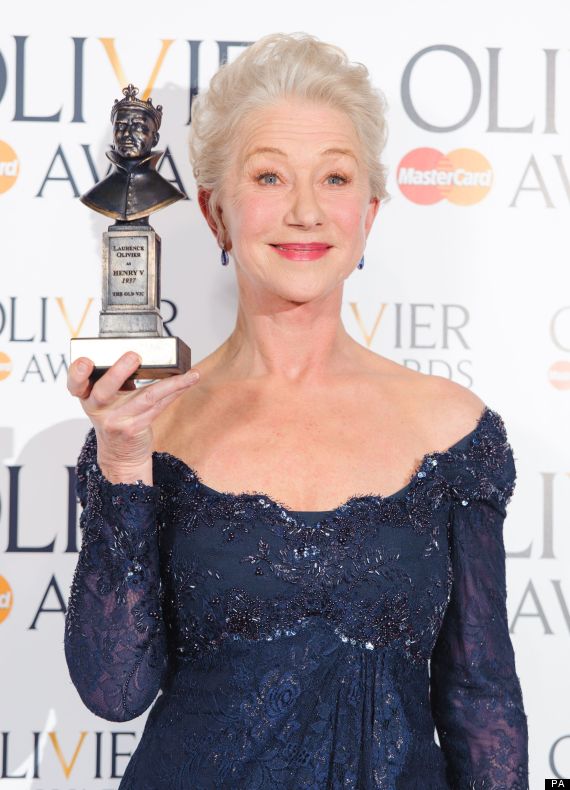
Another award for Helen Mirren, The Queen or possibly bothThe success of The Audience has more than a little of a smattering of one eye on the need to reward the private sector for at least trying a new play, and a more cynical person may suggest that the value of the international market may have had a role to play. Helen Mirren as Best Actress? She might have won it for her awards speech more than the actual part.

It was a pleasure to see Nicola Walker win for ‘A Curious Incident’, a stalwart of TV and of downtrodden wives and mothers everywhere, and without having seen the production it is hard to imagine a more perfect piece of casting for the mother of the 15-yr old lead. Equally commentary seems satisfied with the victory of Luke Treadaway in the role;  a part that is catnip for award judges, as it is basically the modern day answer to the ‘idiot savant’ – something that is a little bit out-of-kilter with modern understandings of mental health. As usual it was a strong year and personally a win for Rupert Everett would not have been amiss but Treadaway seems deserving of the accolades.

With an equally impressive set and technical team it suddenly becomes easier to count up those seven awards. However the Complicite team can feel short-changed not to have picked up a single technical award for their visually stunning take on Bulgakov’s masterpiece. As usual it is mind-boggling that Cheek By Jowl were not nominated for anything – despite the Barbican being a home from home.

Everyone on the Best New Play shortlist can feel hard done by for losing out to something that restaged an existing story – surely there are so many adaptations that this can be a separate category. And ‘Long Day’s Journey into Night’ Best Revival – a truly interminable evening that deserved nothing and for which the praise of critics from every quarter is something that is genuinely unfathomable, even the cast – Suchet, Metcalfe, Soller, all usually so excellent – were dire.

If this year’s Olivier Awards has proved anything to me, it is that this was not a stand-out year for British Theatre; that this reviewer has, Sweeney Todd excepted, has missed most major plays of the year; and that the Donmar needs to re-establish its identity with great haste. A lot of attention has come Josie Rourke’s way and so far the response has been muted at best – where is this year’s Inadmissible Evidence or Anna Christie?
The Full Awards List

What does the Guardian say…

What does the Telegraph say…

McAvoy shines through a dank and dirty Macbeth

Macbeth – Trafalgar Studios, until 27 April 2013

Macbeth, by virtue of its perennial presence on the national curriculum and its pulpy plot that might just possibly hold the attention of recalcitrant teenagers who would rather be playing Call of Duty than sitting in a darkened theatre listening to verse-speaking for over two hours, is a Shakespeare play that never seems far from reach. It also has the added advantage of lead role that can be tailored to actors as apart in their careers as Kenneth Branagh and James McAvoy.

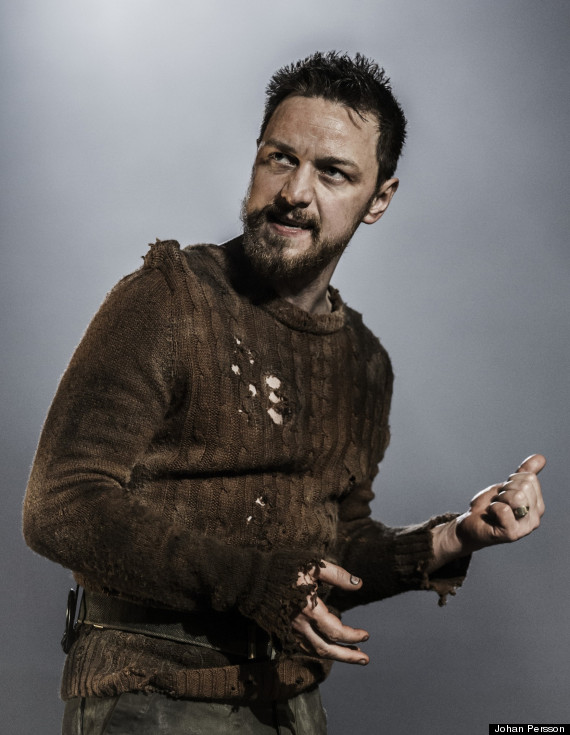
This sense of over-familiarity has harmed the play’s standing in the canon of Shakespearian tragedy, where it is rarely considered to be on the same level as Hamlet and King Lear. This distinction is hard to deny if the sole value for the tragedies is driven by the psychological complexity of its lead characters. However in Macbeth, which post-dates both plays, Shakespeare seem less interested in this then it exploring man as a primal force of nature. Where Hamlet ruminates on the moral legitMACBETH by Shakespeare,   Credit: Johan Persson - www.perssonphotography.com /imacy of his actions and the imperatives that drive him, Macbeth is driven by the emotion that eventually subsumes him – the tragedy lies precisely in this lack of reflection.

One of the joys of Macbeth for a director is that it provides an appealingly blank canvas; the landscape is sketched out as roughly as the country it is set in, and the setting is not tied to any significant fixed points in history. The result allows freedom for the director to overlay an idea onto the play without destroying the sheer enjoyment of Macbeth’s whirlwind central performance.

Jamie Lloyd’s production embraces the wild and primitive nature of the text – it is a Macbeth that lives and breathes the visceral and savage world in which it is set. There is no re-imagining Macbeth as a modern-day dictator or gangland crime boss; this is a Macbeth of history but a history that is rarely seen – when kings were a long way from assuming a divine right and living in a world of pomp and pageantry. In this Macbeth, you are king in so far as you assert a brutal right to supremacy. You are king of what you can hold and no further.

At its heart is Hobbes’ maxim that life without a settled community is a life of ‘continual fear, and danger of violent death, and the life of man, solitary, poor, nasty, brutish and short’.The set could be described as post-apocalyptic, post-climate change, post-fall of civilisation but it could easily reflect the nature of Britain prior to the establishment of a settled state. It is dank, dirty and decaying, and suits the purposes of those rule it. From the outset it is clear that these hard men living in hard times; when Duncan exclaims ‘what bloody man is that?’ [I.ii] it is not out of concern for his condition but out of wariness over his allegiance. Until Malcolm confirms that he is the Sargent he is welcomed only by the barrel of a rifle.

Similarly when Duncan reaches Glamis it seems more in keeping with a temporary base of a raging civil war; people sit on fold-up chairs and the ‘throne’, in a playful twist, is a toilet. The castle stands as a base of operations and nothing further. These men embody thec tribes forced north of the wall centuries earlier by the Romans than the contrasting civilisation of southern England. A point made by Lloyd as he bathes the set in an almost spiritual light during the play’s foray south of the border to hear Macduff and Malcolm debate the values of kingship.

This imagined world revolves around Spinoza’s belief that ‘peace is not the absence of war, but a virtue based on strength of character’. The play begins as war is concluded and the opportunity for peace to descend, yet it appears inevitable that it will only act as a temporary cessation of hostilities. It is so embedded that Macduff, who represents the forces of moral legitimacy, ultimately fails to demonstrate the virtues that can allow peace to flourish. The stark imagery of Macduff lifting Macbeth’s severed head above his own, face slowly covered by the blood of the defeated King, resembles the savagery of all that was fought against than the kingly virtues that Malcolm extols.

It is essential to understand that McAvoy’s Macbeth exists against this backdrop, as it is an explanation to the question of why Macbeth cannot turn away once he has achieved everything that was promised to him. Even before the Witches’ promise him the title of King it seems apparent that this Macbeth would not have been satisfied with his lot. Like those around him, he is a man of war and his achievements breed an emptiness rather than satisfaction.

<<Continue to full review>>

Cheek by Jowl remove excess fat from aburdist Ubu

Ubu Roi – Cheek by Jowl @ Barbican, until 20 April 2013

It is easy to imagine that many directors view Jarry’s Ubu Roi as the poisoned chalice of theatre. It is a play whose own history has overwhelmed any value the original content may have had. A play that managed to start a riot after just one word of dialogue had been spoken. A play that managed to get itself outlawed from the stage after just one performance. How can a play with that much power ever be resisted for long?

However power relies on content and context, and even directors blinded by its potential must realise that theatre audiences of the 21st century are not going to tear up the stalls upon the utterance of a single swearword. So the question always remains over how to make Ubu relevant whilst maintaining its sense of absurdity; this must be the prerequisite of any company attempting to refresh the play.

So then we must be glad that it is Cheek by Jowl who are the latest in a long line of companies to have picked up the gauntlet, as it is questionable whether there are more potent re-interpreters working in theatre today than the formidable pairing of Declan Donnellan and Nick Ormerod.Ubu Split -Christophe Gregoire Photo -Johan Persson

Over the last few years they have put their unique design and directorial decisions to plays as unfashionable as Troilus and Cressida and Racine’s Andromaque. They have also delivered stylish but substantial productions of The Tempest, Macbeth and Tis Pity She’s A Whore. Most impressively of all, this has been achieved whilst working across three languages, using British, French or Russian almost on a whim.

One of the joys of a new Cheek by Jowl production is the anticipation of what you are going to get. Each new play feels unique in itself but also contains an essence that is instantly recognisable as Cheek by Jowl; there is a coherence and balance in the interplay between design and direction, style and function, which means that each individual element has a purpose and a decision that runs through and underpins the unifying themes. This ability is particularly noticeable in Ubu Roi where the need to produce unnaturally large characters means that there is a constant tension that they could overwhelm the play as a whole.

<<Continue to full review>>