The Cat that got the Mother but not the cream

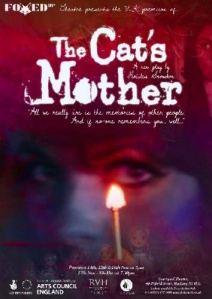
The Cat’s Mother – The Courtyard Theatre, until 08 December 2012

Through poor fortune or poor choice over the last six months there has been a lot of mediocre theatre served up by some of the establishment’s big names performing in London’s highest profile spaces. Having had the misfortune to sit through a disproportionate amount, there has been ample opportunity to muse upon the reasoning that leads to one wrong decision after another contriving to reduce potentially sublime theatre experiences into hollow shells of directorial pretension and actor artifice.

The pendulum of audience response suspended over every production seems to swing heavily towards the director when it is not well received and towards the actor when all is going well. It is perhaps unsurprising that this should be the case. Given that much of London’s theatre is about reviving classics then the director is in a tight spot. There is an expectation that a play should be looked at afresh but too fresh – as Deborah Warner found with the School for Scandal and Charles Spencer’s enraged response to Ian Rickson’s Hamlet at The Young Vic demonstrate – and the critics can be up in arms.
Actors’ are usually not blamed for such decisions and a safe, or even dull, production can generally reap much praise for the traditional performances of the cast –the phenomenally overrated Long Day’s Journey into the Night was stymied by overly naturalistic performances in an interminably conservative productions. The result: no risk and the cast showered in praise.

The key in theatre, as with so much in life, is balance. A director must work harmoniously with the actor to recreate the text in a manner that resonates for the audience and elicits truth in whatever form that should take. This point may work in an academic textbook or possibly in particularly un-radical manifesto for the theatre but halfway through watching The Cat’s Mother the central flaw of this approach became apparent. It may be fine for plays where the author is dead or removed from the production but how about when they are very much involved?

We are currently in the midst of a startling rebirth of new dramatic writing – a process that seems to come in waves every decade or so. It appears that British playwrights have finally thrown off the shackles of Sarah Kane and Mark Ravenhill and are finding their own voice. Lucy Prebble has followed up ENRON with the acclaimed ‘The Effect’,  Simon Stephen’s output has reached prodigious levels and Nick Payne has ‘Constellations’ shortlisted for Evening New Standard Best Play and has enticed Jake Gyllenhall to star in ‘If There Is I Haven’t Found It Yet’ across the pond.

Clearly there is a case that the author cannot be ignored if they are alive, kicking and taking an interest in the end product, and this is what I fear may have happened with The Cat’s Mother. Having seen some of the cast earlier in the year in Girlband, I am fully aware of their talents and a transition to more serious subjects was of interest. Pericles Snowdon is an award-winning writer and so this meeting of minds was an enticing prospect.
<<Continue to full review>>

Miniature plays for people of any size

So what are you planning to do on Sunday? Recover from Saturday’s exertions, watch the EastEnders omnibus, iron your shirts, lose yourself on the internet. These may all be fine outcomes but if you are looking for something more then I suggest wandering down to the Arcola to dabble in the world of the short-form play.

The Miniaturist Programme has been running since 2005 and is the theatrical equivalent of a bag of Revels. You know that, with five plays clocking in  at under 2o minutes each, if you keep going you will eventually find the coffee cream. The short-play format, like the short-story, has struggled to attract the mainstream but the beauty of the form is that it could widen access to theatre to a non-traditional crowd, as in one evening you can showcase a myriad number of possibilities about what the theatre can achieve.

Working as a great showcase for those involved, it also teaches discipline in writing and a ruthless focus on cutting out the extraneous – this is an oft-lost skill for those with resources behind them and many has been the play where fingernails make long-lasting impressions into my palms as scene after scene rolls on with no purpose other than highlighting the vanity of the writer. It is little surprise that two modern masters who sit at different ends of the spectrum – Tom Stoppard and Harold Pinter – can both point to superb early work in one-act plays.

So if you’re bored than you could do worse than find yourself at The Arcola at either 17:00 or 20:00 on Sunday 25 November.

Check out more here: http://www.miniaturists.co.uk/index.htm 

And so goodbye to summer…

For regular theatre goers there can be few markers that you have passed the last dregs of summer than no longer suffering a twinge of jealousy as you walk past all the tourists drinking merrily on the South Bank as you take your seat in the hot, sweaty and dark auditorium.

Not that, as we were constantly reminded, this was a summer like any other. In effect normality went into a two month hiatus as London, and in time the rest of the country, came to a complete standstill as we eventually recognised that we are not nearly as useless as we enjoy telling each other we are. The trains arrived, the people were friendly, we avoided being blown up by terrorists or trigger-happy missile silos, the army ran the logistics and G4S ran nothing and the Mo-Bot became a meme. In short the Olympics and the Paralympics happened and everyone forgot about the rain.

In between all of this excitement the London theatre scene quietly ticked over in the background. Unsurprisingly Andrew Lloyd-Webber’s predictions of audience carnage proved entirely wrong as the West End’s goal of relieving punters of ever increasing amounts of money from their cash-strapped wallets in exchange for third-rate musicals culled from second-rate films continued remorselessly onwards. Luckily for the rest of us the National Theatre proved that affordable theatre can have depth, resonance and even the odd sprinkling of star power.

The revival of London Road – transplanted to the Olivier – was an example of how to draw on a weighty subject with a lightness of touch that is rare among those more used to the deadening hand of television. Having somehow contrived to miss the first run, despite being aware of the sacksful of critical praise that it gathered meant that this was a must see. The fact that the engrossing Katherine Fleetwood reprised her role only added as an extra incentive – an actor indelibly marked in my brain following her unforgettable turn as the strongest Lady Macbeth I have had the fortune to see, and surely a match for Judy Dench’s classic portrayal, in Rupert Goold’s memorable production.

How unfortunate to have been released in the same year as the equally critically-acclaimed and certainly rather more family-friendly Matilda, London Road never received the awards it richly deserved but the fact it could sell out the Olivier for a musical based on interviews with people who lived on the same road as Richard Wright, the Ipswich serial killer, tells its own story about the power of the production.

A truly haunting piece, skilfully manipulated and never less than engaging, it raises many interesting questions about the stories that aren’t told; the impact on the community, the everyday people, of a media circus and a major police operation. Whilst there are legitimate questions over how composite characters reflect the truth and whether they bring forward narrative interest over narrative truth, there is enough in the words and the playful skill with which they are turned into song that sets this apart as a musical of rare power and intelligence.

Alongside this, the Olivier season included Simon Russell Beale giving us Timon of Athens. Without fail described as a difficult play, Timon of Athens has so many contemporary resonances that it should mean more to us. The parallels of the first half to the modern day are so clear, so apparent, that one almost hopes that the play doesn’t resume after the interval. This production, like so many before it, faced and failed the classic problem of trying to unpick and restitch Shakespeare to craft a specific relevance to modern times.

Watching the rise and inevitable fall of Timon, one is both appalled by the actions of Athenians but also frustrated by Timon’s obvious naiveté. It is hard to truly accept that Timon could have fared so well in society based on the actions we see in the play. The fault here is part Shakespeare and part Simon Russell Beale – who was a strangely passive and reedy presence in a play that really demands a lot of heft. His slightly cherubic public school persona – so perfect as Widmerpool in A Dance to the Music of Time – feels out of place in his hermit hovel on the outskirts of the city.

The most interesting aspect of the play is to follow the generally accepted fact that the play was written by two different playwrights. Shakespeare, it is assumed, is responsible for the grandstanding and most of the second half, and Middleton, who is believed to behind the city-based Athenians. It is clear that when one thinks of the play in these terms, it is Shakespeare who comes off worst. Middleton’s play fizzes with a comic satire and adds to his reputation as one of the great comic playwrights of the Elizabethan era. His background characters hit the stage fully formed and when interacting with one another there is a robust and fascinating take on the avarice of Athenian society but the play too often grinds to a deathly halt once the moralising fury of Timon takes centre stage.

It was a disappointing production underpinning a disappointing play. There are many who call Simon Russell Beale one of our finest character actors, yet the case is still to be made of his credentials as a great Shakespearian actor following his rather undercooked Falstaff with this forgettable Timon.

Civilian Theatre: Back from the void

One may think that returning to the blog after a long absence would be like finding yourself wrapped in the enthusiastic embrace from an old friend – comforting if not a little suffocating – but the reality is closer to the disquieting unease felt when faced with a locked door in an empty house. There is nothing behind it clearly – the world of ghosts and gremlins and ghouls is one that gives little concern – but subconscious tremors still create a paralysis that ripple across the keyboard and threaten the ability to make words out of thought and action.

A play is seen, an idea is sprung and an excuse is given – continuing in an ever more vicious cycle of procrastination and self-doubt until the author is left in a pitiful state, unable to even manage a pithy 140 character tweet to express dissatisfaction at another evening of psychological toss thrown up by the Barbican’s ever growing adventures into the realms of European pretension (currently standing at four plays in under 10 months shared between a German Australian, a French Strindberg, a Polish Vampire and a Spanish Shakespeare).

Luckily the success and dynamism of others have had a revitalising effect. Vicariously experiencing someone being nominated for the Evening Standard Best Play award, others nominated for a short film at the Milano Film Festival, a graphics showcase and another’s photo portfolio. They have rammed home the point that the world doesn’t slow down even if a blogger does.

And so Civilian Theatre returns…

GIRLBAND: trading on comedy rather than cliche

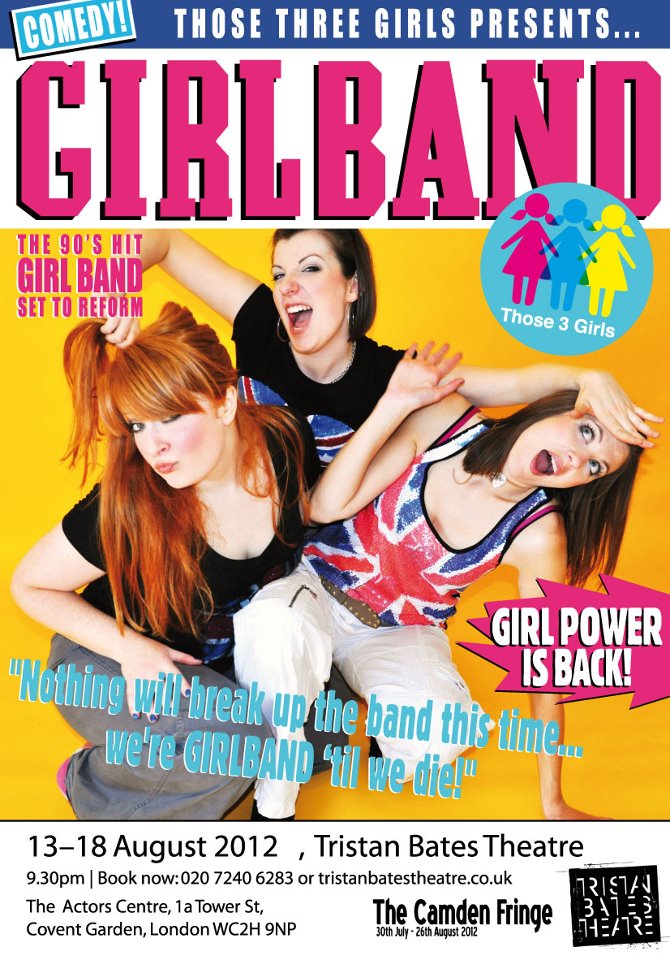
GIRLBAND – Tristan Bates Theatre, until 18 August

Whilst The Spice Girls may have chosen the Olympic Closing Ceremony to remind people what exactly they had been missing for the past 12 years, a small theatre in the heart of the West End was dedicating its space to the story of GIRLBAND – a sassy pop 3-piece that took the charts by storm in the mid-90’s before going their separate ways…

Fortuitous timing may have worked to GIRLBAND’s advantage but with my experiences of WAG: The Musical still painfully raw there was a certain trepidation about launching myself back into the world of spoof musical celebrity culture.

However I need not have worried, Those Three Girls (Carly Sheppard, Lucy Barnett & Susie Peters) have produced a very enjoyable concept that actually relies less on the traditional cliches associated with manufactured pop-bands and more on the wider-impact that fandom has on those that support them.

Whilst not avoiding easy laughs (it is a comedy after all), the production retains poignancy as the central action is focussed on the Fans rather than the Band and the audience is invited to both laugh and feel sympathy for these characters. This is reflected in the script which at times owes a debt to Alan Bennett’s comic monologues, with a style that is primarily direct to-the-audience and containing a wry humour that is often laced with an underlying melancholy.

<<Read full review>>

Ragtime revival appears a little threadbare

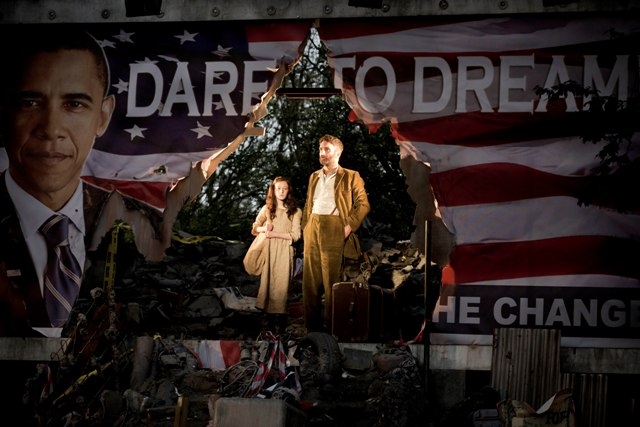
Ragtime – Regents Park Open Air Theatre, until 08 September 2012

With The Hollow Crown and Danny Boyle’s Olympic Opening Ceremony giving British audiences the chances for two very different examinations of the national character, it seems almost unpatriotic to be reviewing Regent Park Open Air Theatre’s production of Ragtime – a musical that places itself firmly within that staple of American drama; the great American narrative.

Adapted from E.L Doctorow’s mid-seventies novel, Ragtime offers a panoramic view across early-20th century America. Blending fact and fiction, the musical weaves a loose narrative through the eyes of three rather generic stock characters; the middle-class housewife whose values are transformed through a life changing event, the eternally-optimistic immigrant who only cares about making a life for his daughter and the black musician struggling against institutional racism.

Under Timothy Sheader, the Regent’s Park Open Air Theatre has taken home the award for ‘Best Musical Revival’ in each of the last three years. Stunning productions of Hello, Dolly!, Into the Woods and Crazy for You meant that his 2012 choice was eagerly anticipated.

Despite a reputation for bold takes on American classics, Sheader’s production of Ragtime proves itself to be a rather more awkward piece of work. The tableau approach creates an uneasy balance between fact and fiction, with key events seen through the eyes of Ragtime’s characters whilst historical figures rub shoulders with fictional creations. The plot is a fairly transparent call for social and racial equality and, originally written in the 1970’s, is clearly laudable in its aims. However for those not well-versed in early 20th century American history it was slightly frustrating for never being entirely sure which scenes were real and which imagined, which characters were based in reality and which were the authors invention.

Ragtime’s closest comparator is Gershwin’s masterpiece Porgy & Bess; both are interested in showing audiences the experiences of marginalised members of American society. However where Gershwin was able to put faith in the strength of the music and the lyrics,  through songs that have become integral parts of the 20th century canon – Summertime, Ain’t Necessarily So and I Loves You Porgy – Ragtime is not able to draw from such a well. Despite fine moments the play lacks depth and delivers the narrative in a halting and didactic tone.

<<Continue for full review>>