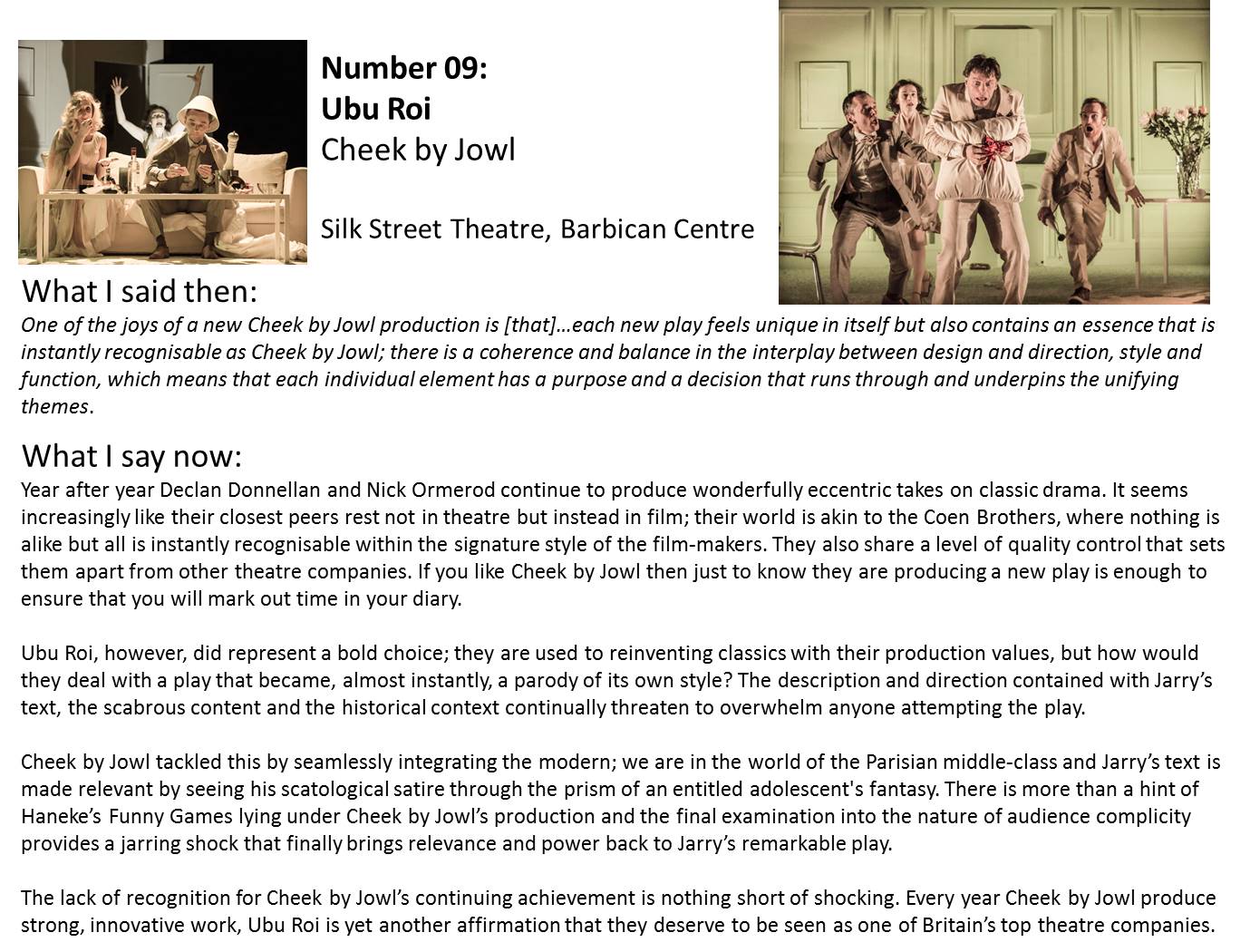
Link to the original review of Ubu Roi
Well the plays have been revisited, the little grey cells put back into action and the oracle consulted. In short and without further ado, Civilian Theatre is proud to present the runners and riders in the inaugural shortlist for The Civil Awards. [Cue much fanfare, fireworks and underhand, dirty trick campaigns].
Bribes, whilst having little effect on the outcome, will still be gratefully received. Your comments and opinions are also welcomed.
Winners will revealed next week following a countdown of the Top 10 plays of 2013.
Best Actor – Male
Best Actor – Female
Best Supporting Actor
Best Director
Theatre / Theatre Company of the Year
Surprise of the Year
Best thing to happen in theatre in 2013
Biggest disappointment of the year
Worse thing to happen in theatre in 2013
Given the sheer amount of theatre available it is not difficult to find plays that were fantastic, moving and challenging but reflecting on what Civilian Theatre has been to see across the year (and the expectations that had built up in advance), it does not feel that 2013 was a vintage year for theatre.
It would be easy to equate the drop-off in quality with the cuts to Arts Council funding; the first cracks beginning to appear as the money begins to run out. However this only tells one half of the story – and if anything 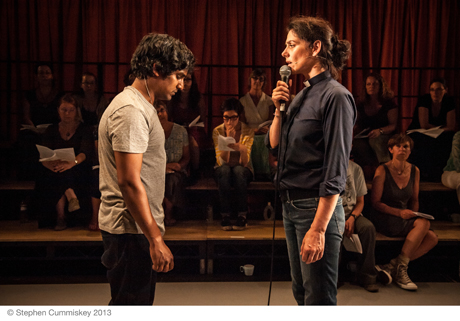 much of the best of the year’s theatre occurred in unexpected locations and in new voices that are beginning to emerge. Good theatre does not big budgets or big stars, it needs ideas and the willingness to take risks; in very different ways The Events and Fleabag proved this point.
Indeed the drop in quality, if anywhere, appeared at the top-end. The gap between bloggers and newspaper critics never appeared wider than in the debate around the Michael Grandage season. Routinely given 4/5* reviews in the press, the majority of the programme provoked the ire of seasoned bloggers who felt it promised much and then failed to deliver.
Civilian Theatre lauds elements of the programme: a West End season that was committed to drama and even included a new play; the sheer number of £10 seats, which if booked early enough didn’t have to be back of the balcony where the most pressing concern is not seeing the stage but rather calculating the risks of deep-vein thrombosis. However the dull production and conservative directions produced lifeless and leaden work that challenged the audience’s endurance rather than their intellect.
One rarely looks to the West End for intellectual challenge and radical drama but the publically-subsidised sectors also appeared more unfocused than usual. It is a transitory time in British Theatre and whilst this may bear fruit in the coming years, it felt that many people were still finding their feet. An honourable exception goes to the Almeida who – in snagging Rupert Goold – may have pulled off the biggest coup of all, and also managed a season that gave audiences, successively, Chimerica, Ghosts and American Psycho at non-West End prices.
 Josie Rourke’s tenure at the Donmar Warehouse has so far produced interesting plays in isolation but there has been little sense of coherence in the overall scheduling, and some productions that were just hard work full stop;Trelawny of the Wells proving that just because a play is forgotten doesn’t necessarily make it a classic in waiting.
That the National Theatre had an uneven year was unsurprising given all the speculation around the top job. Rufus Norris is a bold choice and one that is likely to bring a very different feel to the National and perhaps reshape to more accurately reflect a modern British theatre. He, like audiences, should benefit from the development of The Shed, particularly if its early inventive and innovative programming continues into 2014.
Outside of London, (or into the hinterland for this blog), the argument about funding distribution continues unabated. There was more change at the top as the National Theatre of Scotland lost Vicky Featherstone to the Royal Court (a canny move to breathe fresh, non-London-centric life into an organisation that is always at the risk of being subsumed by the voice of the metropolitan middle-class).
The other powerhouse, the RSC, have crafted a seamless transfer into handing the reigns to Gregory Doran. The RSC seem reinvigorated and scored a big hit with David Tennant in Richard II, and Doran seems to be keen to move through the history cycle as Henry IV Parts I and II are planned for 2014, which mark both the return of Antony Sher to the RSC and the continuance of a partnership with the Barbican that will seem them return as part of a 3-year deal.

ccc
ccc
As 2013 moves towards its conclusion, Civilian Theatre has delved into the back of the cupboard for some last little snippets for the year. There was no intention to see quite so many plays last year – and certainly not to end up writing up quite so many – it just ended up working out that way. It is only when there is time to sit back and reflect does one begin to find the surprising nature of what does/doesn’t make a post popular, and the fact that people may come from all over the world to read them. It was surprising to discover that Shakespeare made up only 17% of the plays that I saw this year – and only just holds off musicals (although Kiss Me, Kate is an adaptation of The Taming of the Shrew so it is 50:50). I also had to check that over a 1/3 of plays were new works, as these always seem as if they pass Civilian Theatre by. Less surprising but slightly depressing is that only six could be claimed to be pretty much entirely original texts.
Judy Dench, arguably one of the greatest female actors Britain has produced, and Ben Wishaw, spellbinding in the BBC’s Richard II, joining forces to take on the real-life counterparts of two of literature’s most enduring and imaginative childhood creations. It should have been perfect. It wasn’t.
2. Sweeny Todd / WAG: The Musical
Proving once again that bad publicity is better than no publicity at all, and Civilian Theatre’s first experience of having a review filleted for *ahem* unrepresentative quotes. WAG: The Musical is the unwanted gift that keeps on giving.
3. Mojo
Ben Wishaw (again), Rupert Grint, Colin Morgan, That guy off Downton Abbey, Daniel Mays (something for the theatre fans). I cannot guess why this made it into the top 3. I did also learn not to underestimate the twitter power of Colin Morgan fans.
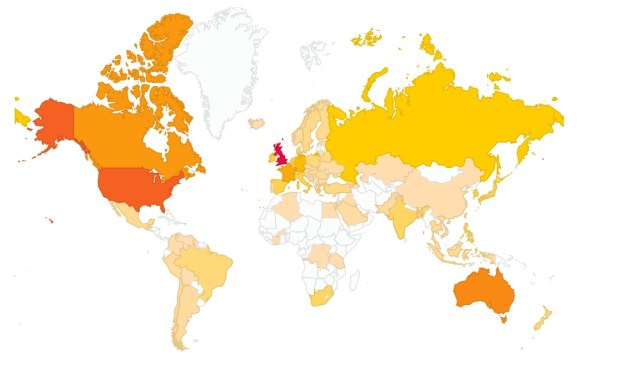
The worldwide reach of Civilian Theatre
Not reviewed (at least not yet)
As 2013 draws to close it seems appropriate that Civilian Theatre takes the time to reflect on another year of blogging. Having made it out to see 47 plays this year – and with over 40 of them given review space – then a conservative estimate of words published makes it up to 30,000.
That is an incredible number – far more than we would have thought possible when we started – but has there been any point to all that activity. Have we learned anything and is the blog getting any better as a result?
The freedom of the internet has allowed a great many people to write a great many blogs. The quality is variable and we hold our hands up and admit that, despite our best intentions, Civilian Theatre’s articles are not always free from the whiff of pretension.
However we have always deliberately tried to provide something that is a little different from what is already out there – carving out our own little niche in what is already a rather niche field for bloggers. The challenge has always been the immediate nature of theatre, which presents a number of problems not necessarily faced by those writing music or film blogs.
If you haven’t seen a play then what can you take from its review? Once a production has ended then it is as if it never existed to those who didn’t see it. Music can exist in a digital world – through Spotify or iTunes. Even gigs often have a permanent record stored on YouTube through shaky camera phone footage and officially-sanctioned tour DVDs. Film has always existed in a repeatable medium.
As a result the critical process for film and music is far more alive and engaging for the reader. They can share that experience with the critic, and later critics can revisit and challenge earlier opinions. Whilst more plays are being committed to film – one of the most positive and yet most unsung changes of 2013 is the continued roll-out of the preservation of performances, and thanks to Digital Theatre and NT Live for this – it is still a tiny proportion of the whole.
Where does theatrical criticism fit into this world? How does a review capture something that retains relevance outside of a production’s lifespan, or to a person who is interested in theatre but cannot afford to go?
This is of course what makes theatre such a live medium and what makes it so fascinating for audiences. A production of a play will always be unique; the Chicago of Ute Lemper cannot be said to be same as the Chicago that provided employment for numerous ex-soap stars for over a decade despite the production remaining exactly the same.
Civilian Theatre decided early on that there was little point trying to ape the theatre critics on the national papers. A lifetime’s worth of theatre is not going to be caught up on overnight. What value is there in knowing whether an unknown blog thinks a play is worth three rather than four stars?
We thought, and still do, that the best articles leave the reader knowing whether or not to see something by the time they reached its end – and it is these that we have tried to replicate. We have always tried to write articles that are a halfway house between an essay and a review.
Reviving the essay may be a Sisyphean task in a world where learning seems to be viewed with suspicion but the best productions are not necessarily those that are the best produced but are those that act as a jumping off point for the imagination. This is what Civilian Theatre has tried to capture in its writing.
Where we hope to add illumination is in our love of narratives and what they mean for society. We have always been most interested in why people tell stories in the manner that they tell them, and why people continue to go back to stories written centuries previously to find new meaning and purpose? This may explain why many of our articles tend to focus on the playwright and the director rather than the actors.
We do not pretend to be scholars and we are not professional theatre folk. In our own small corner of the world we look to draw on the thoughts of those with the time and intelligence to examine these issues in much greater depth and turn them into articles that can be understood by everybody. They are written for interested amateurs by well-intentioned and reasonably well-informed amateurs.
And with that Civilian Theatre signs-off for the year with thanks to all of those who visited in 2013, and hopes that at least some of you return for more musings in 2014.
Civilian Theatre x
As usual, if you have any questions for Civilian Theatre or are interested in contributing to the blog then please do email us on civiliantheatre@gmail.com
a blog about theatre and performance // @rcurtis0914
a forum for critical analysis and cross-discplinary dialogue
Finding meaning through understanding
The labyrinth where night is blind.
by Eda Nacar
#AreTheyIn - The Absent Reviewer
theatre • arts • culture • london
Grouchy. Witty. Informed.
Just a few thoughts
 Civilian Theatre