The making of a king

Richard III – Trafalgar Studios (01 July – 27 September 2014)

Richard III, as proved by his miraculous reappearance in a car park in Leicester, is someone who will not stay dead. In the last three years we had already seen three major productions, including turns from the cream of both stage and screen; Mark Rylance and Kevin Spacey. It is a brave performer who follows in those footsteps and even braver one who takes it despite minimal recent stage experience and a screen persona that has been fine-tuned to be the polar opposite of the larger-than-life, charismatic king.

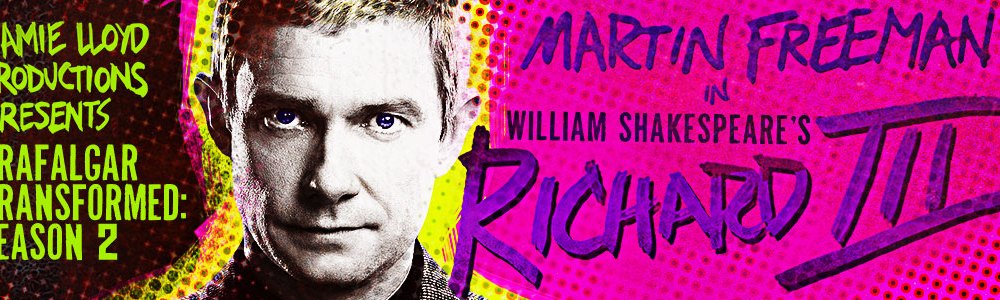
However Jamie Lloyd has been using the opportunity presented by Trafalgar Transformed to revitalise the space with high octane productions cast with performers that have been carefully chosen to appeal to a younger Martin Freeman as Richard IIIdemographic without destroying the vitality of Shakespeare’s language.
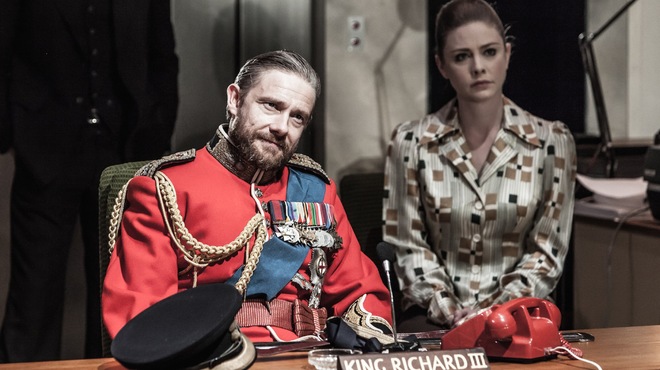
Richard III, and last year’s superb Macbeth with James McAvoy, blurs the lines between cinematic and theatrical expectations. It is reasonable to quibble with the handling of the language but it is wrong to deny they contain a thrilling visceral energy that may counter the preconceived notions of those whose only experience of theatre is via how drama is taught in schools.

There has been criticism in how Martin Freeman approached the text and it is true the verse of the famous opening monologue is all but destroyed through his delivery. However this is less marked in the rest of the play and often the iambic meter is fluid and complete. He may not have the rounded tones of a natural stage actor but this may be a combination of lack of experience and also the directorial decisions underpinning the play.
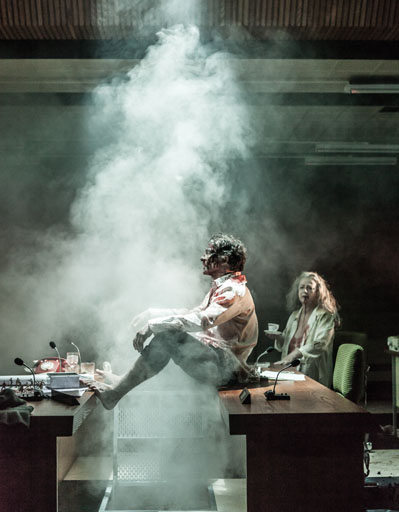
Richard III JLC PROD-1522The decision to tackle ‘Now is the winter of our discontent…’ in that way would not have been taken lightly and, on balance, the production gets away with it because it is being delivered as an address to the nation. If we accept the opening premise that changes it from a traditional monologue to a public speech then it is logically justifiable to deliver it in the clipped rhetorical tones of a politician rather than in the fluid verse of someone expressing their inner-thoughts.

Whilst changing the tone of one of Shakespeare’s greatest speeches is controversial, it does allow a wonderful moment that would not otherwise be delivered. To use the language of cinema there is a brilliant smash-cut at ‘But I, that am not shaped for sportive tricks’; Freeman’s Richard switches instantly from the exterior to the interior, from the public to the private. We see clearly the calculating nature of his public persona and the private contempt of others.

For an audience less literate in the convoluted back story of the play it also makes it easier to recognise the inappropriateness of the good humour he shows to Clarence as he is being sent to the tower. We have already been shown the duplicity of Richard and his ability to – use the jargon of modern politics in which it is set – ‘work the room’. Here with Clarence we witness this as a fine art; understanding, consoling and, naturally, mastering the double-speak that contains no lies – ‘well, your imprisonment shall not be long’.

If this Richard has one overriding trait it is that of the small-man syndrome writ on a national scale. This is most clearly witnessed in the wooing of Lady Anne; a scene that demonstrates both the driving force of this Richard, along with a sense of what makes the production ultimately problematic.
<<Continue to full review>>

A Streetcar Named Despair (Wait, hang on a second – ed.)

A Streetcar Named Desire – Young Vic, until 19 September 2014 (Tickets) (NT Live Performance Info)

It is only fair to begin with a disclaimer: this reviewer does not like Tennessee Williams. It is not for want of trying and it is also appreciated that Civilian Theatre is very much in the minority with Williams being held in the highest esteem by a great many people who know a great deal more about the theatre.

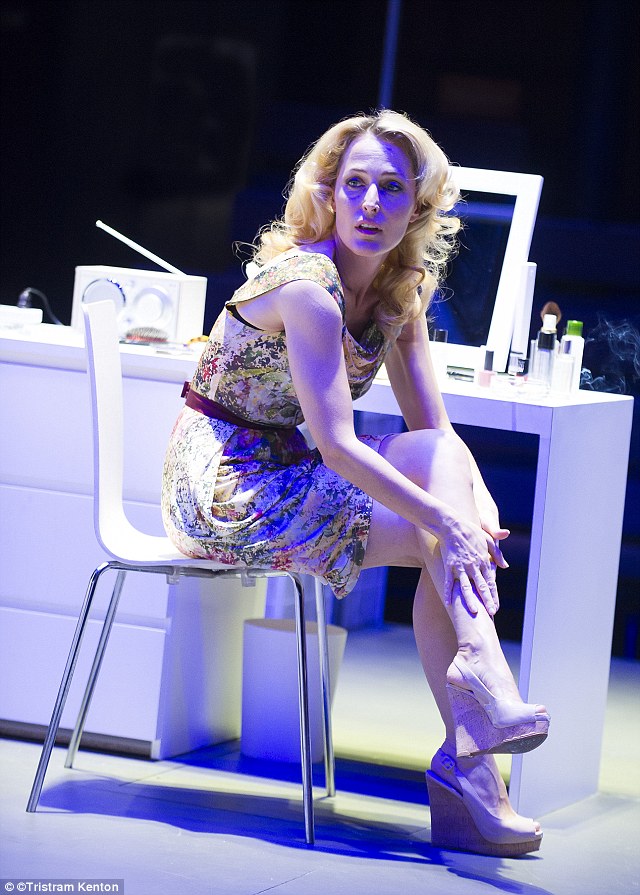
However the point stands and after spending close to three and a half hours watching the Young Vic’s current production of A Streetcar Named Desire, and quite a bit longer letting opinions slowly ferment in the darkest Gillian Anderson as Blanche DuBois in Streetcar at the Young Vicrecesses of the brain, it can only be concluded that we are faced with a conundrum – and that is how far a production can be even-handedly reviewed when the play itself is not personally held in particularly high regard.

Benedict Andrews’ stunningly visual and sumptuously performed version of Tennessee Williams’ most famous (and possibly greatest) play wonderful demonstrates the edge that theatre has over other narrative mediums; for in general every piece of cinema is seen as a new piece of cinema, even when a character – such as Frankenstein – is returned to we do not recognise it as the same film produced differently.

Perhaps only, outside of films that began life as stage plays, Gus Van Sant’s almost shot-for-shot remake of Psycho could be considered a genuine replica, and a 37% Rotten Tomatoes rating tells a story all of its own. Literature, that other narrative medium, is tied to its form and could never bear complete repetition of language even as it continually retraces its steps over stories passed down across generations.

It is only theatre where audiences are satisfied by directors going back to the same well – to Shakespeare, to Euripides, to Chekhov, to Williams – and seeing what can be made from the same materials. This desire allows a director to try and breathe new life into familiar conceits and allows the audience to revisit their favourite plays or continually challenge themselves against work that doesn’t appeal to them.

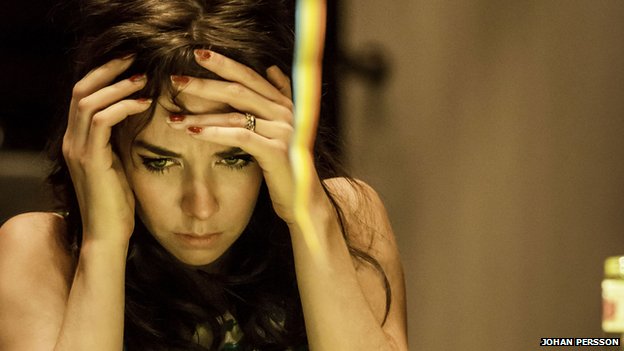
76596630_vanessa-kirbyAnd so begins Civilian Theatre’s obsession with Tennessee Williams (and was there a more appropriate playwright to develop an obsession about?) Regarded as one of the great American dramatists, and with an undoubted flair for writing memorable characters, Williams’ stock is such that he is part of a very small band of playwrights that the commercial West End will take a chance on. As a result over the years this reviewer has watched (or perhaps endured) Night of the Iguana, Cat on a Hot Tin Roof, Baby Doll, The Glass Menagerie, The Fat Man’s Wife and now, finally, A Streetcar Named Desire. With the exception of The Glass Menagerie they have proved mainly dispiriting affairs where the southern melodrama successfully manages to match the ripeness of the language with equally ripe performances.

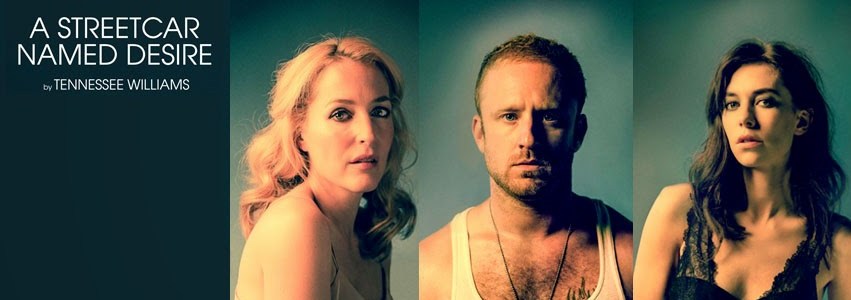
That production of The Glass Menagerie, at the Young Vic in 2010, was built on the back of an exciting new director in Joe Hill-Gibbins, two breakout performances from rising stars, Kyle Soller and Sinead Matthews (everything from Master and Margarita, The Changeling to Blurred Lines in the last couple of years) and a wonderful score. It demonstrated that no matter what you think of a playwright, or his style of writing, it is possible to extract excellence; for even the biggest critics of Tennessee Williams would never deny that the man could write (unfortunately he writes so well he sometimes seems to forget to know when to stop).As it happens A Streetcar Named Desire not only has an exciting director in Benedict Andrews, two breakout performances from Ben Foster and Vanessa Kirby (brilliantly taking more than she was given as Isabella in Edward II, and doing a similar job with Stella in Streetcar), and an interesting musical score. It also gives us an ingenious set design and a crackerjack lead performance from Gillian Anderson as Blanche DuBois.

<<Continue to full review>>

Billie Piper bikini pics: Click-baiting and the other skills you need to be a 21st century journalist

Great Britain – Lyttelton Theatre @ National Theatre, until 23 August (transferring to the Theatre Royal Haymarket from 10 September)

Leaving aside any judgement on the qualities of Richard Bean’s Great Britain, we must first applaud those involved for what the play attempts – an immediate response to the biggest domestic news story since cash for questions – and how – in the world of social media – they managed to keep it under wraps to pretty much everyone.

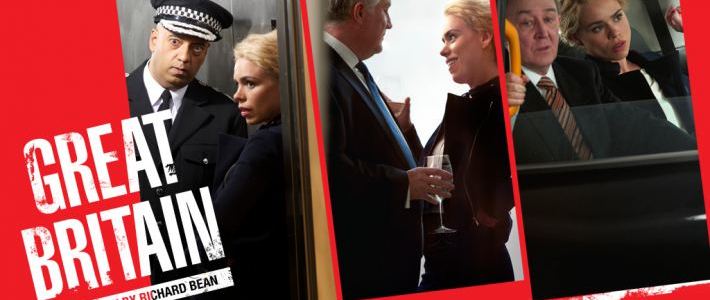
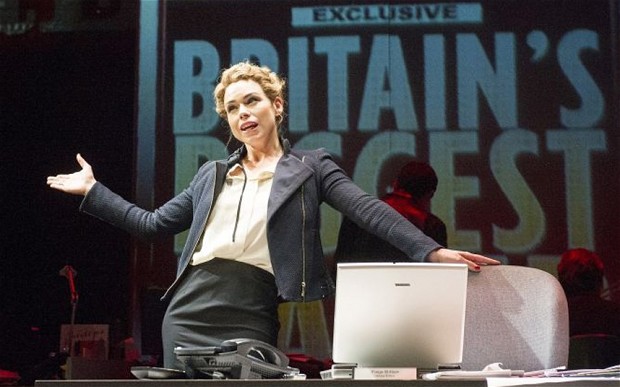
There is a certain irony in a play entirely focused on leaks, hacking and exposure being kept secret right up into previews – and that it was achieved by the country’s biggest theatre company, with a lead who has been Great_Britain091.jpgforced to grow-up under the bright glare of the tabloids’ flashbulbs is a remarkable achievement.

Richard Bean proved with his artfully balanced adaptation of Goldoni’s One Man, Two Guvnors that he is capable of broad comedy that captures the public imagination. The play operated as traditional British farce whilst simultaneously deconstructing the genre by breaking through the fourth wall and toying with the audience’s expectations. That it was a success was probably to be expected – with James Cordon reconfirming his exceptional comic talents after a series of mediocre moves in TV and film – but the fact it has become a global mega-smash was not predicted and must have placed an awful lot of pressure on Bean for what he would come up with next.

That his response was to attempt something as ambitious as Great Britain demonstrates he is a man clearly up for a challenge, and it is pleasing to see how admirably he has risen to it. With Great Britain he tries another form of alchemy in attempting to blend the mechanics that drive farce with an attempt to explain a highly complex and incredibly serious series of events that do not deserve to be treated lightly. It is as if Bean was attempting to create the lovechild of Michael Frayn’s Noises Off and Democracy.

Bean doesn’t succeed in what may have always been an impossible proposition but it is undeniably great fun to see him try. There are an awful of laughs in the show and they come from all angles; from the wonderful faked headlines of the papers – right up to the Guardian’s tagline of ‘we think so you don’t have to’ – to the ribald language of the tabloid’s newsroom, which masks an amazing felicity of expression among the journalists.

The play takes a number of sacred cows and turns them into hamburgers, and as a result the air is thick with gasps followed by laughter. Taking these jokes right to the edge of acceptability is absolutely necessary for the play and it should create an interesting, and uncomfortable, tension for the middle-class, liberal audience members busy reading the Independent on their smartphones, whilst pretending that they are not keeping one eye on the Daily Mail’s sidebar of shame.

<<Continue to full review>>

Where are your god’s now?

Medea – Olivier @ National Theatre, until 04 September (Tickets)

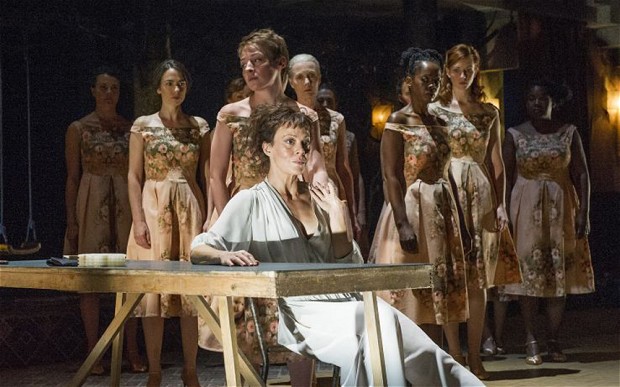
One of the most shocking things about this production of Euripides’ Medea is the discovery that it’s the first time that the National Theatre has staged it in its 50 year history; a startling omission, and all the more appalling MEDEA_2982115bwhen you consider the legion of fine female actors that have graced the stage in that time.

When you consider the paucity of roles for women in pre-20th century playwriting then to ignore one of the great tragedies is astonishing. Medea, more than many of the surviving plays of ancient Greece, has retained its relevance to the modern era as it can rely as much on an understanding of human psychology as it does on the intervention of the Gods.

That it was never picked by the National to ‘inspire debate’, if for no other reason, during the height of the fight for gender equality; it seems an obvious candidate, although a firm hand is needed to steer Medea away from a conspicuously Congreve-inspired ‘…hell a fury like a woman scorned’ and closer to Shakespeare Lear who saw himself as ‘...More sinn’d against than sinning’.

It is a crucial distinction; it is difficult to separate Medea’s anger at Jason’s actions from her anger at her own impotence, but it is essential to make this seperation if Medea is going to be humanised as a tragic figure in her own right. It is like Lear in the storm; we may not fully believe in his argument or in his call for the gods to execute justice on his behalf but we have to believe that his raging is at least partially justified.

Carrie Cracknell clearly believes it would have relevance in the past having seemingly set the play in the 1970s; the period was a boom-time for psychoanalysis and self-discovery, and Helen McCrory’s Medea approach and understanding to her problems is often as someone who has spent time assessing themselves on the couch. The era is reinforced by Tom Scutt’s beautiful design and immediately recognisable period furniture. The plate glass window and minimal lines could come as easily from a Mediterranean villa as they could from a southern Californian hillside.

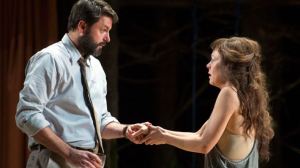
Dominic Rowan as AegusOver 2014 Cracknell has directed three plays and, along with the A Doll’s House at the Young Vic in 2012, there are clearly thematic links between them. She seems fascinated in the fragility of the individual and particularly those who deliberately set themselves against the grain. A Doll’s House, Birdland and Medea all contain protagonists who must bear the weight of societal pressure to conform; these people are not, in themselves, naturally heroic but find that they cannot bring themselves to act in any other way.
The third play – her collaborative effort with Nick Payne – was Blurred Lines highlighted another theme central to her work; an interest in women and the position they are held in by wider society. Blurred Lines was a painfully powerful expression of real lives, a melange of stories, thoughts and opinions that traversed the spectrum from bleak and melancholy to humorous and life-affirming. A Doll’s House is an established genre-defining work and Medea, well for Medea to work it needs to show the internal complexity that can push a woman to commit what continues to be one of society’s most horrifying taboos.

Helen McCrory is an actress more than capable of producing the subtleties necessary for the role. At 5’4 and with a face that has a pixyish quality McCroy is perhaps not the Medea of the imagination – all strident, astringent anger and physically domineering as the fury whips up around her – and against Danny Sapani’s burly Jason it is apparent that she is never going to go toe-to-toe with him.

<<Continue to full review>>


Watch the trailer


Ex-dwarf and witches combine to create a potent brew at a transformed Old Vic

The Crucible – The Old Vic, until 13 September

It is unclear whether London is enjoying an Arthur Miller renaissance or whether he is one of those playwrights, like Ibsen or Chekhov, who is bankable enough and with enough star roles in the canon that he will always hover on the fringes ready for a new production. Either way, David Suchet and Zoe Wanamaker combined in a pretty much perfect, highly traditional, All My Sons back in 2010, whilst earlier this year Ivo van Hove gave us a radically stripped back A View From A Bridge built around an absolutely blistering performance by Mark Strong.Richard Amitage as John Proctor

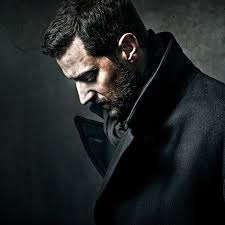
Now, just metres down the road from where Strong put in a decent early bid for performance of the year, we have Miller’s The Crucible; a play that is audacious enough to not just have one Eddie Carbone role but several. It is Richard Armitage, playing John Proctor, who dominates the posters – one presumes Hobbit-y fame and a suitably jawline is the primary reason for this but it is a rather misleading image; Proctor may be a central figure, but this is a play that revels in a large cast and in the searching light that Miller casts across the residents of Salem.

That minor quibble aside, a mark of the power of this production is that the audience sat rapt for 3½ hours on the hottest day of the year whilst being subjected to periodic blasts of burning herbs and smoke effects. As good as Miller’s writing may by, those conditions did have the potential to induce a most literal understanding of the play’s title to the poor, sweltering audience members.

It is to the full credit of Yaël Farber that the long running time rarely seems like a drain and the action, simply staged but highly evocative of the period, speeds along building an inexorable momentum through to the third act climax before the sudden transition to a final act of quiet, where the heady atmosphere that has propelled the trials disappears with the disappearance of Abigail and space is given to reflection, on both spiritual and human levels. This is the much-needed calm after the storm and the reflection is for both Miller’s characters and for the audience who are suddenly pulled back out of the manic paranoia of the town.

Farber was responsible for the wildly successful Mies Julie – a South African-set re-examining of Strindberg’s classic – and given the contemporary allegories can be seen as strong now as they were when Miller wrote the play in the long shadow of McCarthyism, it must of have been tempting to look for a way to pin The Crucible to the modern world.

However Farber plays it straight and lets the parallels speak for themselves. It is Miller’s ability to create characters that are of their time but are yet clearly visible in the 21s century that makes The Crucible such an enduring work. The manipulations of Abigail, the fallibility of John Proctor and the hypocrisy of Judge Danforth are traits that are, and will remain, commonplace for as long as there are still humans walking the earth.

The characters in The Crucible may talk in terms of the soul but Miller’s writing is concerned about the psyche. There may be much talk about God and the Devil but it is human emotion that drives much of the action and Farber conjures up periods of quiet amid the maelstrom that allows the audience a moment to glance into the hidden frailties of the characters.

<<Continue to full review>>

To keep your voice while all around you are losing theirs…

Dumbstruck – Fine Chisel @ Battersea Arts Centre, until 19 July

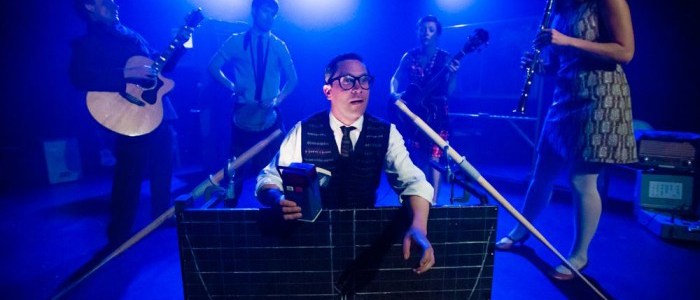
You really would have to be a rather hard-hearted soul to dislike Fine Chisel, the theatre company behind Dumbstruck; under Tom Spencer’s artistic directorship they create effortlessly charming work that belies the graft Robin McLoughlin as Ted, Dumbstruck at BACneeded to generate such lightness of touch. Dumbstruck may not be without flaws but it is rarely far from raising a smile when the talented cast of five – switching fluidly between roles that require them to be multi-instrumentalists, singers, dancers and actors – are in full flow.

Fine Chisel settled on an intriguing premise – that of the loneliest whale in the world – and crafted a multi-stranded story around it. It is a good starting point for such a musically-inflected company as whales are indelibly linked in the imagination with the slightly dreamy idea of the whale song. They communicate through a form of music and are a natural fit for a company like Fine Chisel, who often seem closer to integrating theatre into their music than music into their theatre.

Carolyn Goodwin in Fine Chisel's Dumbstruck 9Dumbstruck has a lovely opening, with instruments played in unexpected ways to create a sense of the oceanic wild and the strangely alien sounds of the whale. It is an engaging start and as the play widens its focus into the Alaskan wilderness and Ted’s research station it shows huge promise as an aural existential fantasy; an ode to isolation, conducted through music, seen through man and through the great unknowable, unseen presence of the whale.

However as it opens out to reveal Ted’s journey and introduces the figures of Fiona and Mal, who both wrestle with their own increasing sense of loss, it is unable to sustain its focus on this initial premise. At times the production seems to suffer from a lack of confidence in itself; it lacks stillness and has a forced busyness as it flits from idea to idea with little time to settle. The performers are talented enough, in particular Robin McLoughlin’s Ted and Holly Beasley-Garrigan’s Fiona, that you wish they would slow down and allow their presence to wash over the audience.

Underpinning it all is the music and here Fine Chisel can do no wrong. The sound is gorgeous throughout, from the lovingly created ocean-scape to the finely rendered pastiches of 1960’s pop and folk, whilst even the
transition scenes are underscored by a wonderfully jazzy sound that seems to channel the finger-snapping funk of Charlie Mingus.

<<Continue to full review>>