Hiddleston’s impresses as Hal but Eyre’s Henry can’t quite match Goold’s Richard

Henry IV part I: The Hollow Crown – BBC 2  / BBC HD

Following the rapturous reception received by Goold’s treatment of Richard II was always going to be a challenge; the highly experienced Richard Eyre was assigned the task of continuing The Hollow Crown through Henry IV parts I and II, and on last night’s offering is set to deliver a textually inventive if slightly visually austere riposte.

Overall The Hollow Crown concept has been left a little exposed – clever and audience-enticing as it may be – as the stylistic dissimilarities mean that, other than the continuation of history, there is little in Henry IV part I that audiences would recognise from the filmic vistas of Goold’s Richard II.

Fortunately Shakespeare is not constrained by the straightjacket of slick BBC publishing. Henry IV part I is a play that needs no extra gloss; it contains his most-loved character in Falstaff and gives the audience, as Simon Schama pointed to in his recent documentary, a view of England from the bottom-up. This is in direct contrast to a Richard II that inhabited the world of kings and noble elites.

It’s also a play in which Shakespeare sketches out, in Prince Hal, the images that he would shade in later in one of his greatest creations, Hamlet – complete with two fathers (Falstaff and Henry IV pre-empting Claudius and the Ghost) and a play within a play (the great Act II Scene IV where Hal, in the guise of his Father, banishes Falstaff).

There is a seismic shift in language between Richard II and Henry IV. The world of Richard’s verse has been replaced by the more naturalistic prose of Henry Bolingbroke, now Henry IV. It serves to emphasise the working people that inhabit the play; the phrasing and speech reflects the way people actually talk to one another. It reflects a changing England; the shattering of Richard’s divine right and replaced by a, now frail and ill, Henry IV paranoid to the threat of conspirators. There is no place in this landscape for the playful verse that marked Richard II. This point is rammed home by Shakespeare through Harry Percy who ridicules and undercuts the fanciful imagery put forward by Glendower about his birth.

The core of Henry IV is not, of course, the King but his son, Prince Hal. Falstaff may steal the show but he is not the heart; the heart is the relationship of Hal to his two fathers, the King and the Fool, and the inevitable renunciation of the latter in order to safeguard the former.

In this production Eyre appears to have taken a very deliberate step to recast Hal and Falstaff’s relationship away from the loving underpinnings with which it is normally shown. It is usual to show a warmth and affection in Hal when he undercuts Falstaff’s numerous embellishments but here there is coldness in Tom Hiddleston’s Hal. This is introduced from the very opening scenes of the play and Hal’s speech where he talks of renouncing his way of life; it is delivered in voiceover and there is an added potency to lines like ‘So when this loose behaviour I throw off’ [I.ii] given out in contemptuous manner at the same time as Hiddleston’s Hal strides through the Boar’s Head. Outwardly he is smiling, winking, interacting, whilst his interior monologue makes clear he understands that he is just playing a part that will be discarded.
<<Continue to full review>>

BBC PR Fails No.2840

I  have much love for the BBC and will loudly and belligerently defend the licence fee against all the nay-sayers who seem to believe that if a multi-channel 24hr/365-day service isn’t absolutely dedicated  to their interests then the whole corporation should be abolished. Personally I think the £140 is a pittance for the level of service they provide and the BBC is one of the last remaining areas of British society in which we can be truly proud and that commands huge respect across the world.

However they really do not do themselves any favours.  Just a week after getting critical and commercial praise for its superb Richard II adaptation – which hugely increased the the interest in the whole cycle of their filmed versions of Shakespeare’s history plays – they have managed to unpick all of that good work with hugely incompetent scheduling made worse by a complete lack of communication to its audience that rivals banks and mobile phone customers in its disregard for its customers.

Now Wimbledon takes place every year and so it should perhaps have crossed the minds of schedulers that the finals may overrun. Perhaps if that is the case then contingency plans might have been put in place to manage the situation. Instead people tuning in to watch Henry IV part I – with A-grade stars Tom Hiddlestone, Simon Russell Beale and Jeremy Irons + a whole host more – were given no information as the Men’s Doubles came to an end.  Not even ‘the scheduled programme has been delayed, more information to come’. Given we were on the verge of a first British success since 1936 I can’t really complain about sticking with the tennis.

But seriously continuing with the tennis on BBC2 for the Ladies Doubles – what is the point of the red button if not for putting minor sport onto that?  And what did people tuning into the BBC’s flagship summer broadcasting get – about 40 minutes late we had John Inverdale haplessly stating that the production ‘may be on later, we’re not sure’ – well thanks John, that really cleared it up for us. Also why the hell was Casualty on BBC1? It may get higher audience ratings but surely it could get bumped for one week? One can only imagine what Lord Reith would have had to say about the way the Beeb have prioritised their  scheduling.

So BBC – by some miracle you had turned Shakespeare into watercooler TV and within a week you have already managed to shaft your own success through the general incompetence, poor management and dire communication that you have become famed for. I am sure your heir-apparent Director-General, George Entwhistle, who was responsible for the Shakespeare cycle must be absolutely delighted with your handling of this one.

For those who want to catch-up with Henry IV part I – it will apparently air on BBC4 tonight at 21.00 (no word on whether it will also be on either BBC HD channels)

Much more on the BBC’s Shakespeare Unlocked Season.

Masterful Richard II proves the BBC does ‘do’ Shakespeare

Richard II – BBC2 and BBC HD, until late July 2012

Settling into watching Richard II in glorious HD on the BBC last night it was difficult to ignore the Beeb’s previous ill-fated attempts to engage with ‘the Bard’. Whilst Civilian Theatre has a better opinion than most of the BBC’s attempt to film all the Shakespeare plays; where else could we see an Othello with Anthony Hopkins and Bob Hoskins as the leads, or a young Helen Mirren playing Rosalind in As You Like It and Imogen in Cymbeline – it is still hard to avoid the criticisms of wobbly sets and at times really duff stage-to-screen acting.

However the BBC’s reputation has been pulled significantly out of the mire after their last two adaptations of acclaimed stage productions – Tennant’s Hamlet and Stewart’s Macbeth- received sensitive transitions. Goold’s Macbeth in particular had a visual style that was magnificently assured given his background as a stage director. So hearing that he had been tasked with opening proceedings with Richard II did a lot to calm the nerves.

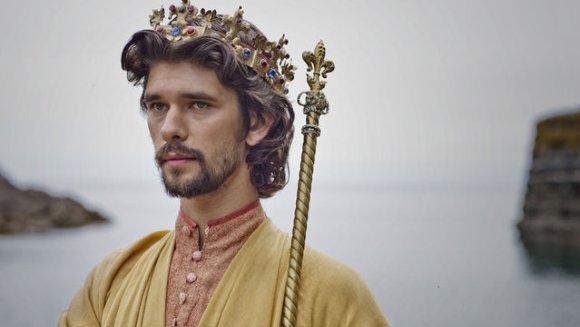
This calm was only reinforced by the sweeping shot across Richard II’s court; Ben Wishaw as Richard; Patrick Stewart as John of Gaunt; Rory Kinnear as his son, Bolingbroke; the two David’s – Suchet and Morrisey – as father and son of York; and James Purefroy, steaming under armour as Mowbray. It goes without saying that once such accomplished actors are placed in position then there is little left to do but let them unfurl Shakespeare’s glorious language.

Richard II, compared to the rest of the history plays, is difficult. It has less of the cartoonish villain that makes Richard III such a crowd-pleaser; it lacks a comic core of Falstaff or the jingoism of Henry V. It is a wordy play about a poor king and bitter nobles. To make it worse Shakespeare, as a stylistic tic, vastly increases the amount of rhyming verse. For those untrained in plays of the era the language is often perceived to be a barrier – and Richard II does risk encapsulating everything that people think they dislike about Shakespeare – it is difficult, unnatural and can be hard to follow.

Goold and the cast respond to this challenge magnificently. For perhaps the first time we see that TV could have the edge of stage productions in some aspects. The history plays, far more than the tragedies and comedies, are complex, difficult and rely on a certain level of prior-knowledge that Shakespeare contemporaries would have had but that current audiences, for the most part, lack.

The ability to zoom-in, jump-cut and provide proper location filming – sweeping landscapes and equisite interiors that provide a true sense of time and place – thus provides an essential element in driving the plot. No longer must we scan the faces of a court scene to decide who Richard is castigating, the camera does this for us. Some may cry foul but this is both good TV – no-one needs completely static shots – and also good for accessibility. It is a period location but that does not mean that modern stylistic devices shouldn’t be used.

Goold deserves a huge amount of credit. This, and his Macbeth, were excellent adaptations that demonstrated he has a natural eye for balance and an assured touch. He may well work alongside a mighty fine cinematographer but having seen a number of his plays staged, it is clear that he has an innate understanding of composition and brings to the theatre filmic elements and here he proves he can work his artistry in reverse.

<<READ ON FOR THE FULL REVIEW>>

Musical Theatre: Comparing old with new

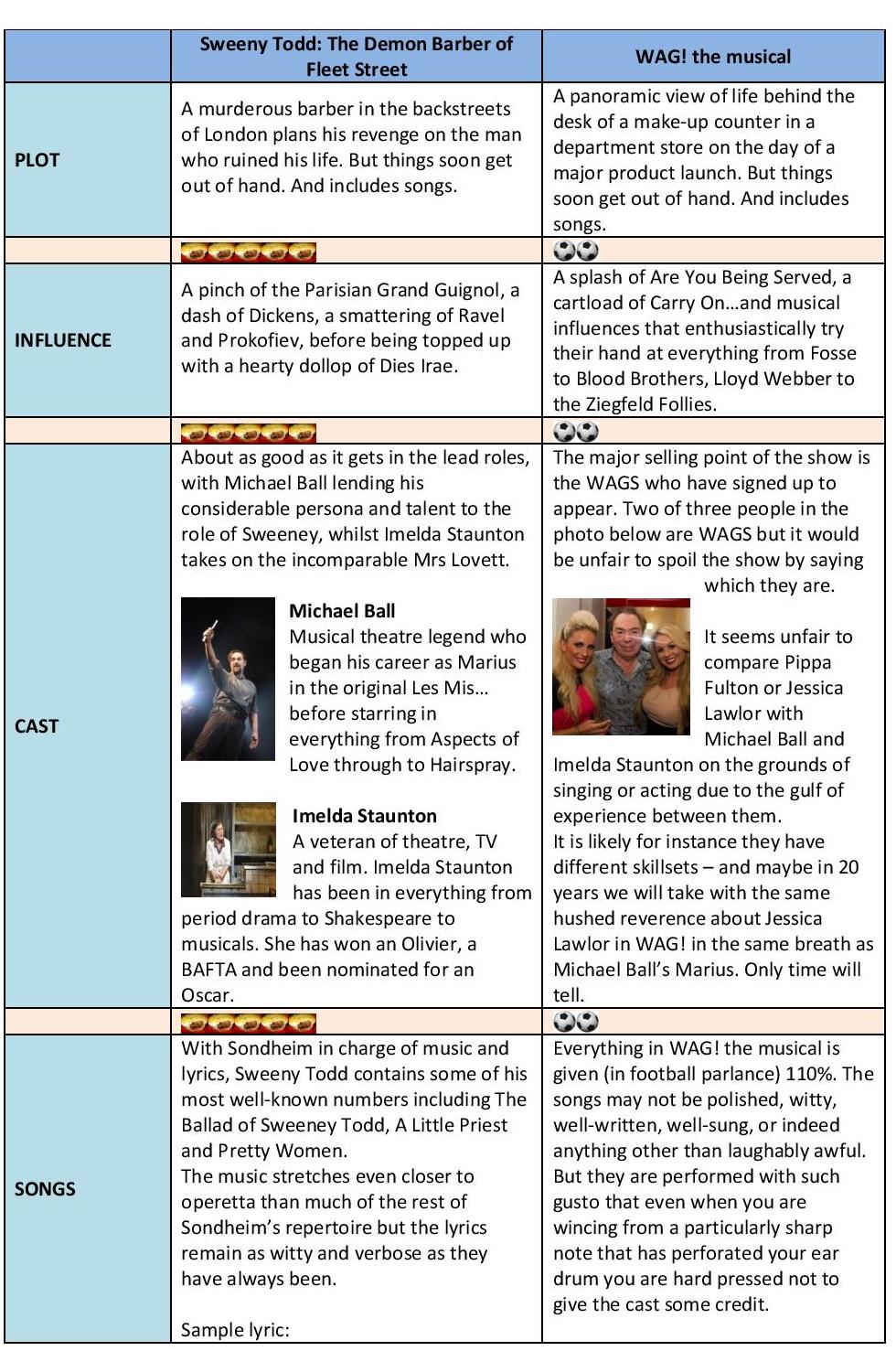
Last week I had the somewhat dubious pleasure of sampling two musicals. One is a scathing social satire on contemporary values whereas the other is a gruesome tale of revenge that ends in a bloodbath for all concerned. One is a complex work that draws on recurring classical motifs whilst the other takes a magpie approach to the classic styles of twentieth century musicals. One is regarded as one of the great musicals by a legend in his field. The other has been championed by Lorraine Kelly. But are we letting reputations get ahead of us?

In the interests of fairness, Civilian Theatre has assessed the merits of both shows to see whether Sweeney Todd: The Demon Barber of Fleet Street, the perennially popular Stephen Sondheim musical that won rave reviews at the Chichester Festival last year and has since transferred to the West End, is really any better than WAG! The Musical, which was enjoying its world premiere at the Ye Olde Rose and Crown in Walthamstow.

So there you have it, a win for the WAGS. The colossus of Broadway has been brought to his knees by some upstart wives of footballers. As any sportsman knows – the stats don’t lie. WAG! the musical has proved itself every inch the equal of Sweeney Todd and Sondheim (lyricist for West Side Story, Academy Award Winner, Pulitzer Prize Winner, Winner of 8 Tony’s, 8 Grammy’s and 6 Olivier Awards and with a theatre named after him) clearly has been humbled by a new challenger for the crown.

See more here:

WAG!

Sweeney Todd

Editors Note: Apologies to Mr Sondheim for the misspelt Sweeney in the above article. If I hadn’t been moved close to despair by uploading gremlins then the amendment would have been made.

Advance Notice – Highlights of the Autumn Season 2012

In recent days we have had announcements from both the Royal Court and Michael Grandage of their upcoming seasons. Representing the very different ends of the theatrical experience for audiences; the small intimately thrilling Royal Court where so many of our great playwrights were given a space to write and the cavernous and wallet-sapping Noel Coward Theatre, the name alone indicative of its West End heritage. It is heartening to think of Grandage’s past as Artistic Director of The Crucible and a ten-year stint at the Donmar and realise that it is still possible to trace a line from the heart of regional theatre all the way to the money-making centre of the British stage.

One might grumble about the prices of Grandage’s plays but it cannot be denied that a West End line-up containing two Shakespeare’s, a McDonagh and a new play by John Loga, whilst, maybe not groundbreaking, provides rather more interest than the usual fare of rehashed musicals, Coward revivals and vehicles for ageing American celebrities. Ticket prices may be steep at the top end but, as I have commented elsewhere, the £10 tickets actually undercut the National’s Travellex offer and, if star power is what you are after, provide fantastic value for money. Whilst advertised as ‘moderately restricted view’ I have found the seats to be absolutely adequate and you would miss virtually none of the action. Given they are available in both the Royal and Upper Circles they arguably offer better value for money than the Gallery tickets that are the next cheapest but are  already edging towards an uncomfortable £27.50 for seats right up in the gods.

With information about the National Theatre and the Barbican already available we can see that the upcoming months look very rosy indeed. And as a public service, Civilian Theatre is very happy to provide you with a month-by-month guide to the most interesting plays over the coming months (a growing requirement as it is becoming more and more evident that theatre is going the same way as gigs and stand-up comedy and selling its major events anything up to 18 months in advance – Jude Law in Hamlet in November 2013 anyone? Not busy I hope?)

___________________________________________________________________ 

September 2012

London Road (National)

This may be a last chance to catch one of the most interesting and innovative musicals in recent years. It sadly had the misfortune to go up against the Matilda juggernaut in all the major award ceremonies and as a result came home empty-handed but this tale, based on documentary footage taken from Ipswich in the aftermath of the discovery of five bodies in 2006 and put to music by Adam Cork, is one of the most complex and affecting new musicals in a long time. A real slow-burn hit, its success can be seen in the major summer revival it was given by the National just a year after it was first introduced. September is possibly the last time you will be seeing it in quite a while so go while you can.

Mademoiselle Julie (Barbican)

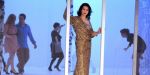
Hopefully not setting myself up for a fall after the general disappointment of Cate Blanchett in Big and Small – where the size of the play failed to meet the stature of the actor – we see Juliette Binoche meet Strindberg as another entry in the Barbican’s generally excellent international programming. Binoche is one of the deserved greats of French acting; an actress capable of turning down Spielberg’s Jurassic Park for a role in Kieslowski’s Three Colours: Blue (now that is range). The set photos are fascinating and suggest a radical take on a work famed for its naturalistic excellence:

love and information (Royal Court)

Whilst not to everyone’s tastes, a new play by Caryl Churchill is certainly not something to be ignored. One of Britain’s leading playwrights over the last 40 years and an icon for the current generation of female writers who grew up on Top Girls and Cloud 9, Churchill returns to the Royal Court with a new play, love and information. Details are scarce other but it looks likely that it will be a continuation of Churchill’s abiding fascination with non-linear story-telling and the use of the less naturalistic elements of theatre, as she creates a panoramic landscape of over 100 characters.

Hamlet (Queen Elizabeth Hall)

In what was very high up Civilian Theatre’s ‘Must Watch’ list was this import from Denmark – The Tiger Lillies performing Hamlet. Unfortunately recent news tells us that it has been cancelled for ‘scheduling issues’ but if they can find a slot for it in 2013 then I urge all to go and see it. The Tiger Lillies describe their own music as Brechtian street opera and are instantly memorable for all of those who had the fortune to see their version of Shockheaded Peter many moons ago. For those who have missed their vaudevillian morality tales then here is a performance of a song from Shockheaded Peter:

___________________________________________________________________

For more on the Autumn Season, including highlights from October and November then please click through for more.

Watch out George R. R. Martin, Shakespeare’s coming

The BBC certainly seem to have taken a leaf out of HBO’s book with their new preview trailer for their Shakespeare Unlocked series. Right down to the title ‘The Hollow Crown’ – a fabulously fantasy touch – they have gone out of their way to draw on the huge water-cooler success of Game of Thrones.

With season 2 drawing to a close on Sky Atlantic, it seems like the perfect opportunity to launch The Hollow Crown – four successive history plays from Richard II through to Henry V. The cast looks suitably stellar as every high-profile actor going has put themselves forward for some high profile thesping. The limited casting released on the BBC Website hints at the quality – Rory Kinnear, Tom Hiddlestone, Ben Wishaw and the mighty Patrick Stewart (getting the rights to one of Shakespeare’s most well known speeches in ‘this royal throne of kings, this scepter’d isle…’). 

And the trailer? Well isn’t this just mouthwatering.