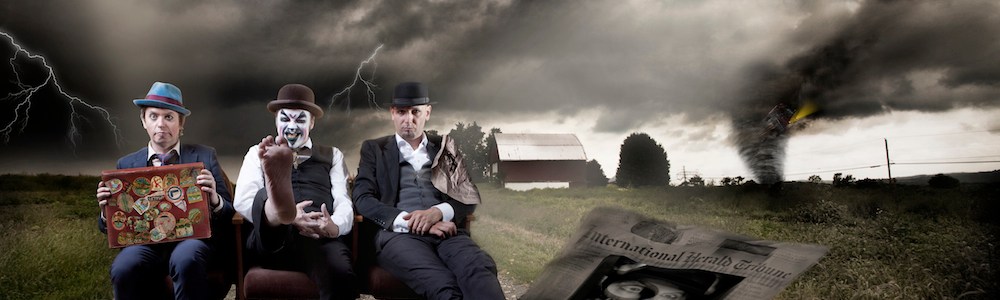
The war poets find their voice with The Tiger Lillies

Micro-review: A Dream Turned Sour – The Tiger Lillies @ Battersea Arts Centre

It remains questionable whether A Dream Turned Sour can be considered as theatre but since it acts as one of the closing shows of the 2014 LIFT Festival, and has otherwise been ignored by the massed ranks of music critics who are clearly more enamoured by the potential for a dream collaboration between Dolly and Metallica at Glastonbury than in writing about this warped, reimagining of the celebrated poetry of the first world war, it is up to Civilian Theatre to share its thoughts.
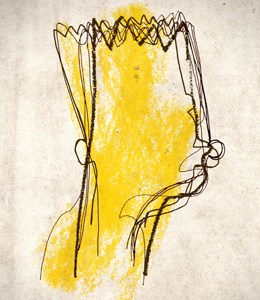
Tiger LilliesTo those not experienced in The Tiger Lillies it is a forbidding opening – ‘Death’ repeated over and over in a gravelly, atonal voice that oppressively (and impressively) fills the great space of the Battersea Arts Centre main hall. It is the start of a performance (and with The Tiger Lillies it most certainly is a performance) by a band at complete ease with what they do – and so they should be having successfully mined the furrow of alternative cabaret for over two decades.

Their strange mix of Kurt Weill-esque cabaret, gypsy, gothic humour, and operating in a register that veers between the rasp of Tom Waits and a startling falsetto underpinned by a ferocious operatic power is quite unlike anyone else. It is certainly hard to imagine another band undercutting the reflexive conservative styling that we tend to put on the work of the war poets with quite such vigour and zeal.

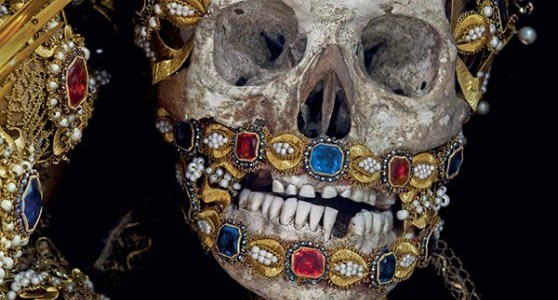
The Tiger Lillies have reclaimed the bitterness and the hatred, the terror and the contempt for the generals back home, that often gets lost amongst the plaudits and the GCSE-syllabus analysis. There is a black humour in their renderings of ‘Rendezvous With Death’ and ‘God How I Hate You’ that forces you to go back to the original readings to realise the horror that the lines contain.

Others, like Wilfred Owen’s ‘Nothing Ever Happens’, sound so at ease in their new home it is hard to imagine them in any other way. However the disgust never goes away and the venom builds to such a furious, glorious crescendo of disgust at those most famous lines ‘Dulce et decorum est / Pro patria mori’ that the audience must nearly cower at the assault.

Despite the most curious style of delivery, there is great articulacy in the delivery by frontman, Martyn Jacques. Each poem has been carefully thought through to maximise the impact through presentation and the words are never lost despite the cacophony of noise coming from the three piece.

Fans of The Tiger Lillies can be assured they have not dampened their natural tendencies as a sop to the serious subject matter, and fans of the war poets can be assured that the poems have been treated with the care and intelligence the power of the writing deserves.

Listen to Dulce et Decorum Est by The Tiger Lillies
More about The Tiger Lillies

More about Lift Festival 2014

Adler and Gibb

Bafflingly brilliant Adler & Gibb presents a conceptual challenge

Adler & Gibb – Royal Court, until 05 July 2014 (tickets)

There is no way, easy or otherwise, to describe Tim Crouch’s latest play, Adler & Gibb, so that it makes sense to the reader. Despite seeing more than 100 plays over the last three years I cannot recall another production that feels so elusive that I am left suggesting that the only way to understand it is to experience it. As a play it is defiantly high-concept, deliberately infuriating and fully aware of the challenge it makes of its audience. Having roundly trashed Mr Burns for pretty much identical reasons it suddenly becomes apparent how fine the margins between success and failure really are.

Denise Gough and Brian Ferguson in Adler and Gibb at the Royal Court, LondonNot only is it difficult to describe, it is hard even to talk about it in a way that doesn’t make it sound like the most appallingly self-indulgent piece of pretentious, beard-stroking metropolitan claptrap. If it sounds to readers that I damning Adler & Gibb with this review then I can only echo Shakespeare’s Mark Anthony eulogy and the dubious claim that he comes ‘[… ] to bury Caesar, not to praise him’.

Tim Crouch does not tend to make plays with easy answers. In Adler & Gibb he has made a play without easy questions. Like a magician he lays subtle clues with one hand – a neat reference to the Maine lion that gives a hint to the identity of the actor – whilst at the same time misdirecting with the other – the changing story behind the napkin.

Yet the crucial factor is that despite arriving at the interval with a general sense of befuddlement and feeling close to displeasure at the opaqueness of the first half, Crouch has still built an atmosphere of trust; that this a play worth persisting with. It has an intangible quality that nags away at the back of the mind that you are on cusp of something quite special, and that if does fail then at least it will fail spectacularly.

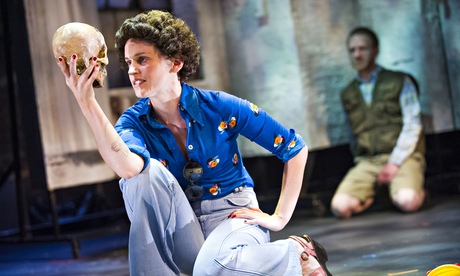
To start with a description; Adler & Gibb is about a conceptual artist, her relationship with Gibb, their retreat from the world and what happened after. Or Adler & Gibb is about a student looking for scholarship funding through a study of Adler and Gibb. Or Adler & Gibb is about an actor who used to be a student who is making a film about Adler and Gibb. Or Adler & Gibb is about an actor playing Adler who meets Gibb, who tells us the story of Adler and Gibb. Or it is about different mediums of art, the tones they employ and how it affects the narratives they tell and the stories heard by the audience.  Or it is about all of this and none of this.

To start at the beginning; the play opens with a presentation from a student about Adler and Gibb. She is eager, passionate and delightfully gauche; instantly recognisable as someone who has been inspired but lacks the articulacy and the knowledge to present her views as we might expect. She tells us the story of Adler and Gibb but through it is digressive, fractured and jarringly myopic.

<<Continue to full review>>

Love, (near) death, fake weddings, singing and Albanians – Cosi fan Tutte has it all

Cosi fan Tutte – Popup Opera @ The Whip, Mayfair – Playing at selected venues this summer

Earlier this year Civilian Theatre found itself in the stifling surroundings of Eat, Pray, Love Drink, Shop & Do to see Popup Opera perform Le Docteur Miracle; a marvellous little piece that lingered in the memory more for the quality of singing and the near brute-force goodwill on display than for a venue so cloyingly twee that a Zooey Deschanel guest appearance didn’t seem out of the question.

A similar proposition in the height of summer did leave cause for concern but this was almost immediately offset by The Whip; a period cocktail bar that may be painfully on-trend but at least it is dedicated to rehabilitating thatPop-Up Opera, Cosi, Summer Season 2014 (courtesy Richard Davenport) 010 forgotten classic – the Mint Julep; a more appropriately summery concoction it would be hard to think of.

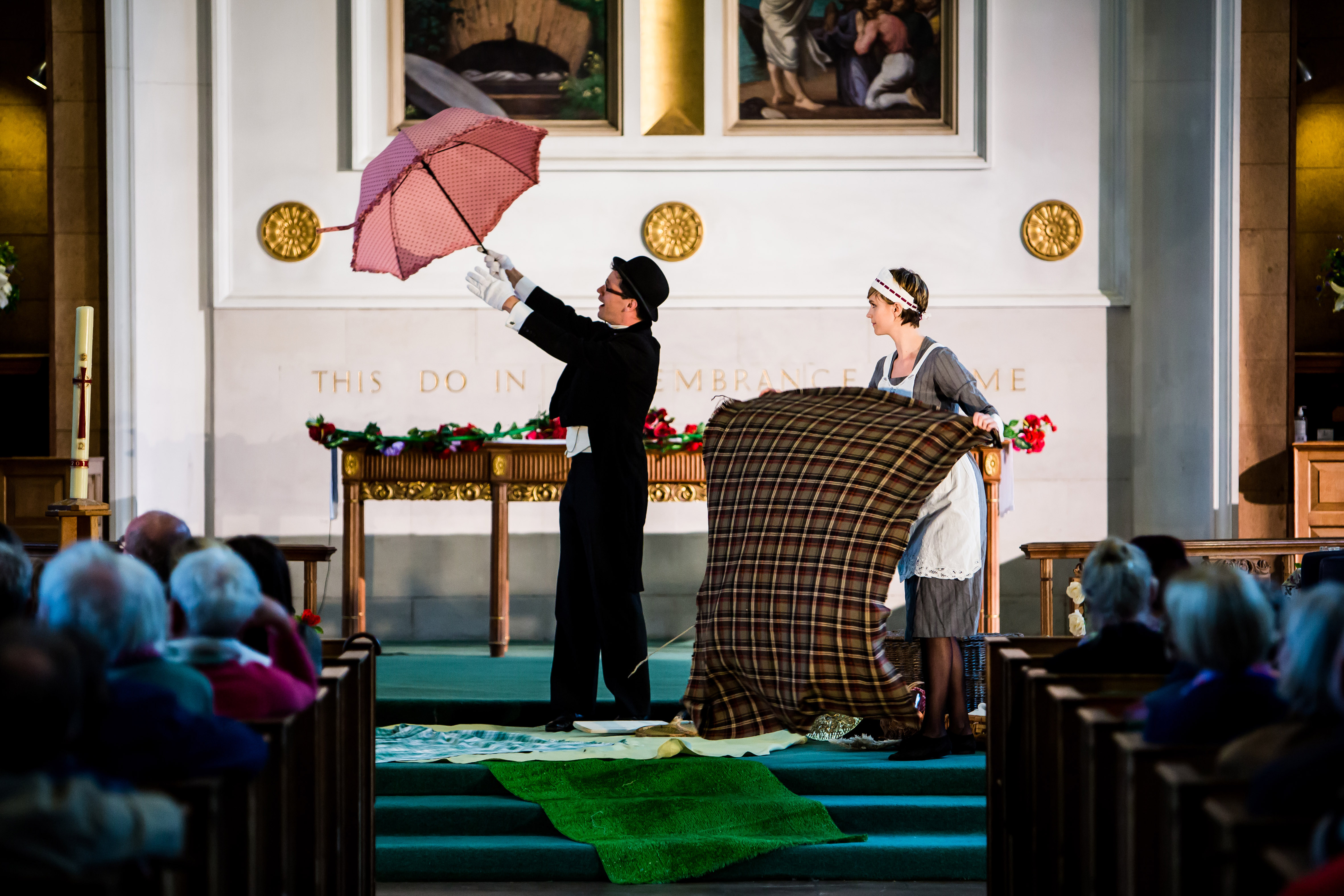
Julep in one hand, Mozart programme in the other. It is easy to begin to feel like being part of a world long left behind. The limited seating and period furniture gives the event even more of the sensation of being part of an audience invited to an Edwardian stately home for a summer party rather than to a room above a pub in Mayfair.

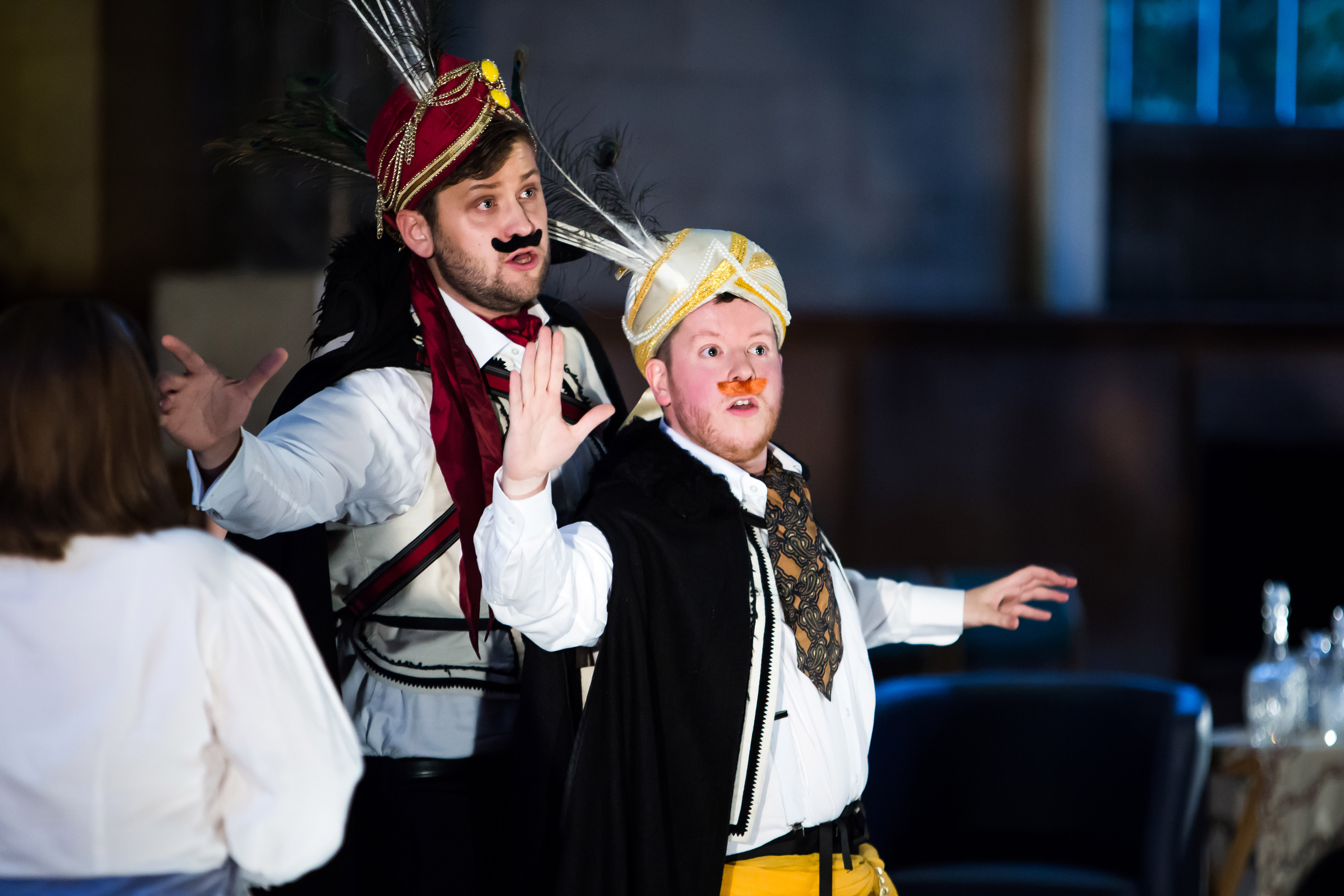
It is this toAdam Torrance (Ferrando) and Oskar McCarthy (Guglielmo), Pop-Up Opera, Cosi, Summer Season 2014 (courtesy Richard Davenport) ngue-in-cheek nod to refined gentility that Popup Opera are so good at selling. Even Harry Percival’s avuncular presence before and after the show comes across as a charmingly pleasant Hooray Henry hypeman.

One of the more appealing things elements of a Popup Opera show is their inventiveness towards setting. They clearly recognise the constraints of the limited space and the need for a touring production to be highly adaptable, and there is a wonderful malleability that is carried across in a very carefully managed shonkyness to proceedings. This is testament to the quality of Darren Royston’s direction and the skill of a cast forced to combine the ability to perform Mozart’s score with a sense for comic timing and knack for audience management. It is a far more demanding performance than it may first appear.

Not being remotely qualified to comment on the technical quality of the singing, I can only say that a layman only requires two things from opera; to enjoy the singing and to understand what is going on. The cast are excellent on both counts. From the start you feel that you are in safe hands, with particular standout performances from Adam Torrance (Ferrando), Eve Daniell (Fiordiligi) and Clementine Lovell as the scene-stealing Despina.

<<Continue to full review>>

A two and three quarter hour play based on a 20 minute cartoon – that sounds like a great id…D’oh.

Mr Burns – Almeida Theatre, until 26 July 2014

Regular visitors to the blog will have noticed that Civilian Theatre is often as, if not more, interested in exploring what leads a director to stage a production in the style they have chosen or why a playwright has written the
play they have, than in the quality of acting or the production itself.

As such the idea of Anne Washburn’s Mr Burns is appealing. The available synopsis suggests that we are going to witness an exploration of these very topics, an insight into how myths arise and the form that mythic creations arising out of our modern cultural legacy may take. Just as Homer would have drawn on the collective memory passed down through generations of oral story-tellers to leave us with the Iliad and the Odyssey; with its world containing the larger-than-life figures of Achilles and Ajax, Paris and Hector, Washburn promises to delve into how a very different Homer will be built into the mythos of a future civilisation.

TMr Burns_10his is really interesting stuff, and the concept of three standalone acts that appear to echo the cultural development of storytelling is intriguing. The cast begins around a campfire – an updated version of those first ancient people telling each other stories round a fire, repeating them so often that they become fixed as an early truth. The second act, seven years later, has seen them morph into travelling players, spreading knowledge and culture across a divided and disparate society, before the third act, 75 years later, sees the performance fully embedded in the prevailing culture, taking on aspects of religious tradition, characters becoming symbols of good and evil, with Mr Burns emerging as a figure within modern folklore; a demonic embodiment of the dangers of nuclear power and its destructive influence.
It is the kind of play that signifies its intent early, and the signs that title each act may as well have written on them that this is a ‘big play’ tackling ‘big themes’. We know it is important because it is two and three quarter hours long and contains two intervals. Only big important plays get to have two intervals.

It is definitely an opinion-splitter and will almost certainly be championed by the kind of metropolitan hipster who carries around a well-thumbed but mainly unread copy of Infinite Jest and idolizes Douglas Copeland. For everyone else I fear it will prove to be a remarkably unentertaining evening; for it is quite a feat to develop a production that has so many interesting ideas, inspired costumes and high-concept set-pieces that returns so few engaging moments.

<<Continue to full review>>

Poking the Russian Bear

Opus No 7Moscow School of Dramatic Art Theatre (Dmitry Krymov Lab) @ Barbican Theatre, until 14 June 2014

We are in the middle of LIFT 2014; the annual festival that is both glorious celebration of international theatre and sober reminder of the staid and conservative nature of so many Anglo-American creations.

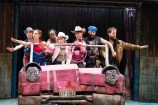
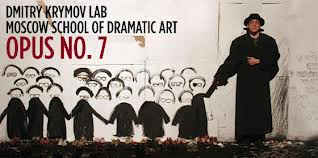
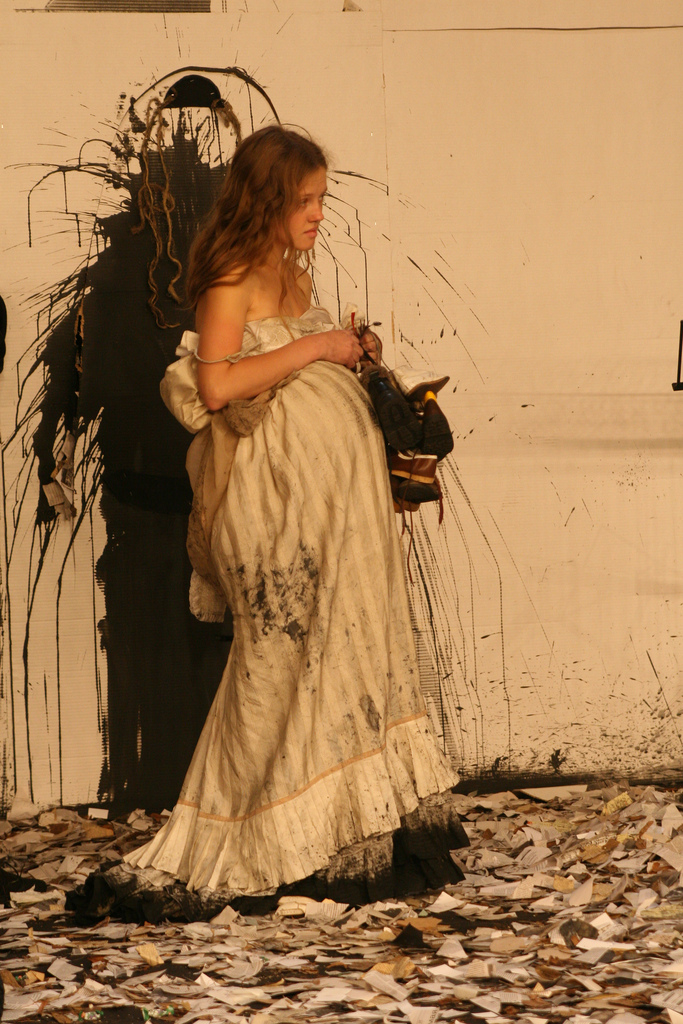
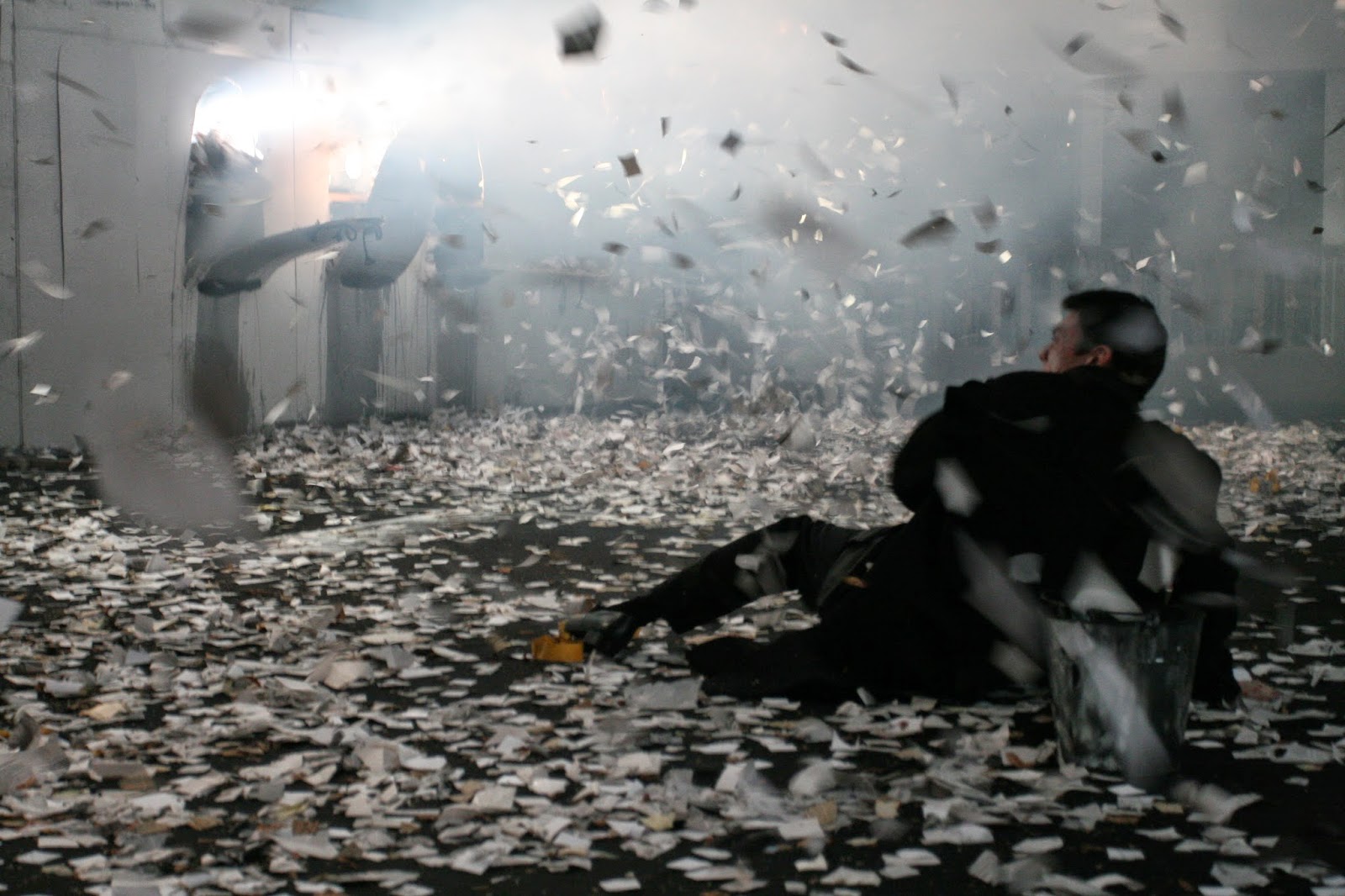
This can rarely be seen as starkly as in the spell-binding Opus No 7; concocted by the Dmitry Krymov Laboratory, it 13467788355_dbe5f9fa69_bcombines sublime beauty with haunting imagery to create a remarkable balance that allows a curiously harmonious co-existence of opacity and clarity. As it overwhelms the senses one is left with the impression that this is a performance that could not have been conceived of in this country let alone created here.

Watching Opus No 7 is like working through a cryptic crossword clue. The explanation of the image is always tantalisingly close but remains impenetrable until resolved. There are no easy answers but one holds on to the images as they morph fluidly from one startling creation to another with faith that a narrative will emerge.

OpusNo7Images coalesce until they suggest an idea. The piece is often without dialogue and usually underscored with the lightest of musical notes, faintly directing and reacting to the action. The first half is titled ‘Genealogy’ and tells the tale of the Jews in the second world war but with continually hints to the wider narrative of Jewish history and their earliest beginnings. Biblical reference points abound and their cast have a childish innocence that harks back to the earliest days of God’s children.

They are nameless figures who slowly wander through their past claiming fragments – taking the form of letters, photos and memories – to shape their lost identity. They seem scattered to the wind, lost as individuals but finding each other as one finds ones community. They exist in a hinterland reminiscent of Beckett and the image of Krapp winding through his old tapes comes to mind as they pore through scraps of books becoming intrigued by the unfamiliar words, the sounds and shapes of names that no longer mean anything to them.

<<Continue to full review>>

Spotlight on Spacey

Clarence Darrow – Old Vic Theatre, until 15 June 2014 (Day Seats and Returns only)

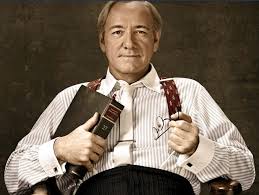
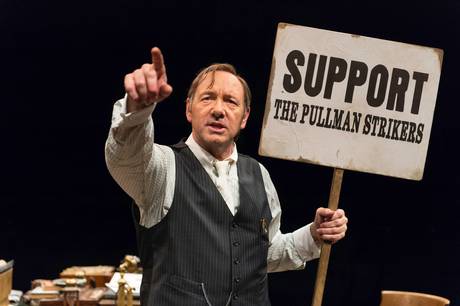
And so here we are, eleven years after the decision to hand the keys to one of London’s oldest theatres to one of Hollywood’s most complex faces, Kevin Spacey stars in, what one presumes, is his final turn on the Old Vic
stage. Bringing in an actor to run a major theatre is a wonderfully archaic notion in the cut and thrust of West End economics, but Spacey has stayed the course and quietly become an integral part of the London theatre scene. He has helped bring grandeur back to the theatre and can surely take some credit for the current golden age of performance in the West End (even if writing and directing often remains troublingly conservaKevin-Spaceystrikertive).

Clarence Darrow is the curtain call that Spacey richly deserves. The reviews have been predictably close to hagiography for a performance piece that feels every bit of its 45 years old. Critics are studiously not reviewing the play but instead reviewing the performance. The audience rose as one to acclaim him, over 90% giving a standing ovation both for this role and as a thank you for the last decade.

And indeed why not? This is a moment to loosen the tie, unbutton the shirt and just relax into the company of one of the most charismatic actors to grace the stage. There are very few actors on either side of the Atlantic who I would rather spend 90 minutes in the company of. Even from up in the gods and with almost half of the stage out of sight (although this is not the time to unleash my opinions on the Old Vic’s definition of ‘restricted view) the charisma of the man intoxicates.

Spacey has maintained a visual presence outside of the theatre and Frank Underwood may become his defining role – and one cannot imagine anyone more perfect for the part – but his career has always been marked by the ability to create gloriously ambiguous characters that blur the lines of moral judgement.

While his Richard III may not have been technically perfect it was a gloriously enjoyable performance, the theatrical equivalent of going to see the latest summer blockbuster. With Spacey as Richard it was not hard to see how this crippled hunchback would have so little problem with Lady Anne despite the difficulties of “was ever woman in this humour wooed?” The potency of Spacey’s Richard was more than enough to make us detest and admire him in equal measure.  

He is the kind of actor who has the self-confidence to disappear entirely into the role. So often we see a performance but with Spacey we always see the person. He acts without it being entirely clear that he is doing so, and by so inhabiting the part that there is no space left for the actor. You could pick any of his roles but perhaps it is in Glengarry Glen Ross, American Beauty and, of course, as Verbal Kint in The Usual Suspects that we see Spacey giving us real people – actual beings, bringing the darkness and the light together – rather than just characters.

The figure of Clarence Darrow is the perfect sign-off role; at a glance his impeccably liberal views may make him seen a rather anodyne figure but Darrow is essentially a small-town boy turned big-city lawyer in Chicago and no-one does that at the turn of the 20th century without a confidence that is born out of one part ferocious intelligence, one part moral purpose and about five parts barn-storming hucksterism.

<<Continue to full review>>