Transforming a classic of Victorian gothic horror

Jekyll and Hyde – Flipping the Bird & Red Shift @ Maltings Art Centre, 25 July 2013 (and at the Assembly Roxy Downstairs from 31 July to 25 August 2013)

The Edinburgh preview trail winds its way onto St Albans and possibly the first time visiting a town that so defiantly tries to hide its arts centre away from anyone with the slightest interest in culture (and for anyone going you can find it in the Mall, located on the 2nd floor between the library and the car park). Still this is not the time for London snobbery even if the venue is rather unbecoming of one of the grandest of Victorian gothic horrors.

On the menu was Robert Louis Stevenson’s The Strange Case of Dr Jekyll & Mr Hyde; an endlessly adaptable work and if the creation doesn’t quite sit in popular consciousness as easily as his natural bed-fellows, Dracula and Frankenstein, then the suggestion is that it is because in Jekyll/Hyde Stevenson created a horror that lives as much in our own mind as in our external experiences.

Jekyll & Hyde might be prefigured by James Hogg’s too oft-forgotten, The Private Memoirs and Confessions of a Justified Sinner, but Stevenson’s work remains the more relevant because it strips out much of the religion and leaves behind something that could have come straight out of a Freudian handbook. The concept continues to have a huge influence in one of the most lasting forms of pulp fiction; the comic book. Hulk and Two-Face are two characters centred around the Jekyll/Hyde idea but the idea of a character leading a duel-existence is a fundamental to the mythos of the comic book universe.
jekyll-and-hyde

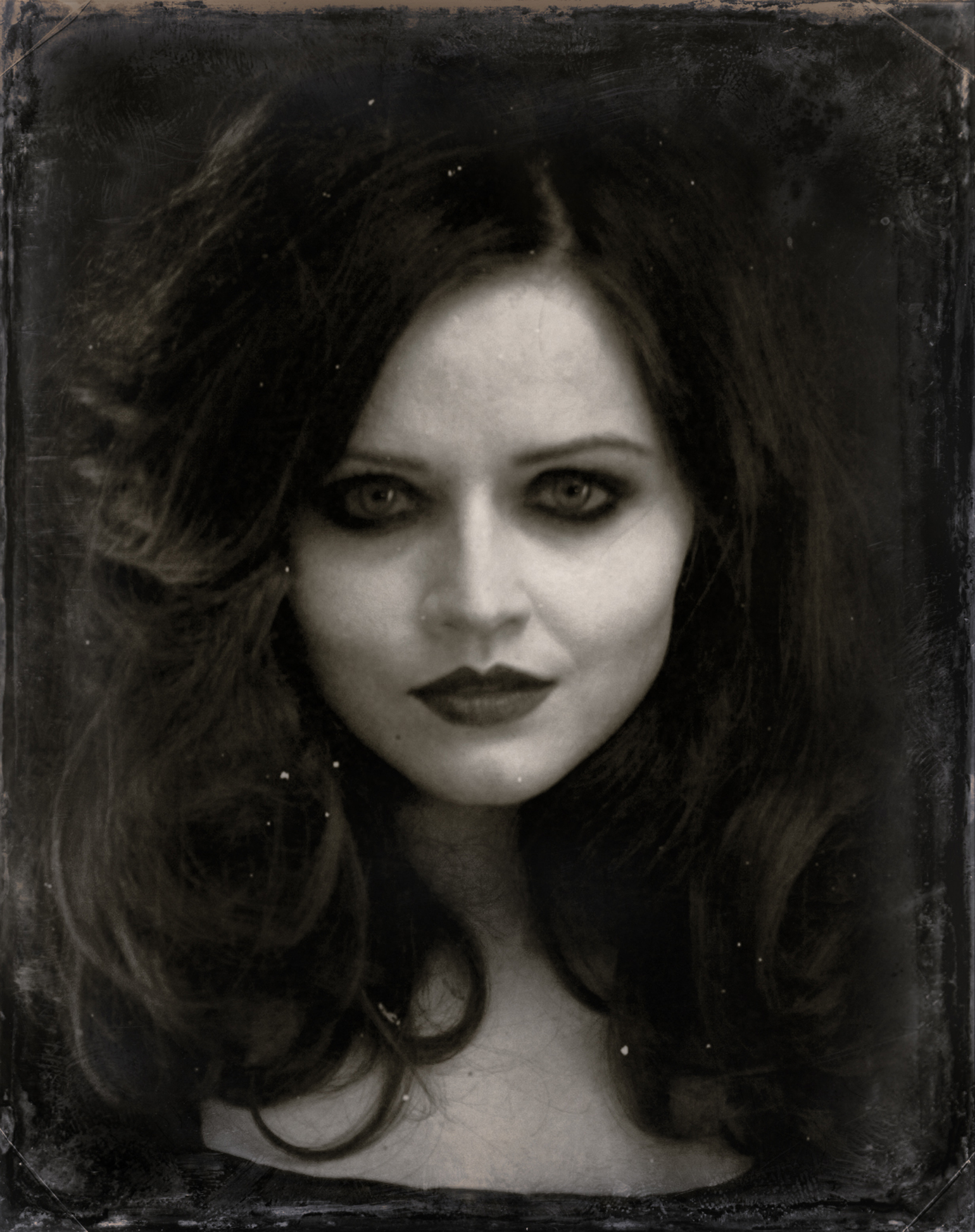
The question for any company is how you add something fresh to the equation; Flipping the Bird and Red Shift have approached the task by drafting in Jonathan Holloway to adapt it for the stage and have placed gender identity centre stage. It is a neat way to breathe life into a well-known story, meaning that fun can be had with Victorian gender politics and more importantly allowing a relationship to develop between Utterson and Jekyll that transforms the traditional end of the story.

The production is bolstered by the addition of an onstage music accompaniment from the narrator and the potential buyer of the story. If the style is overly reminiscent of The Tiger Lillies accompaniment to the hugely influential ‘junk opera’ Shockheaded Peter, the originality of the music and the coherence it has with the narrative means that it refuses to disappoint and is an effective way to work through scene transitions.
<<Continue to full review>>

Exploring new worlds in Battersea

Where The White Stops – ANTLER @ Battersea Arts Centre, 23 July 2013

Sitting inside a stiflingly hot and airless bar-cum-theatre at the Battersea Arts Centre watching the emerging ANTLER theatre company dressed head-to-toe in arctic-ready furs it was hard to resist summoning up that most over-used of precious theatrical clichés; performers that suffer for their art. Despite unbuttoning my shirt to a level that would certainly raise eyebrows at the Royal Opera House I couldn’t help but think that on this occasion the audience had got it relatively easy.

Visiting an Edinburgh preview show is always a refreshing experience. So often going to the theatre carries the expectation of seeing a product in its finished form, and it is pleasant to be occasionally reminded of the process that goesWhere the White Stops into getting to that stage. This is particularly true of a show like Where the White Stops, which has the feel of a piece that has been born out of collaborative improvisation. ANTLER, founded last year, is a young company and they retain a freshness of ideas that is an invigorating contrast to the staid conservatism of much of the West End.

Their production of Where the White Stops balances a sense of surrealist whimsy with a faintly disorientating emotional depth that gives rise to the slightly strange feeling of being trapped inside Bjork’s superb video for Wanderlust. They employ a mixture of physical theatre and polyphonic singing to create a vividly original vision of a fantastical frozen world.

If at times the whimsy can veer uncomfortably close the more navel gazing elements of The Mighty Boosh then it is not long before ANTLER bring it back on course through a tightly written narrative arc that suggests that below the improvisational, physical surface is a keen sense of the importance of the traditional story.

The story is of the modern fairytale; a heroine going on a journey to discover the world, and within it, herself. The key to the freshness of these stories – understood by everyone from Suzanne Collin’s Hunger Games trilogy to Hayao Miyazaki’s work at Studio Ghibli, and in particular Spirited Away – is in the development of a carefully designed world where flights of fancy can be accommodated within the dreamlike logic of the set-up.

<<Continue to full review>>

American am-dram gets an undeserved A-list treatment

Circle Mirror Transformation – Royal Court @ The Rose Lipman Community Centre, until 03 August 2013

There is a moment, possibly at the almost exact halfway mark, when Lauren (Shannon Tarbet) asks Marty (Imelda Staunton), ‘When do we do any real acting?’ Having watched this two hour, no interval production in stifling temperatures whilst sat in brutally unforgiving seats, it is a question that the audience may feel inclined to agree with. For all the virtues of bringing together a Grade A cast, one cannot escape the fact that this is Grade C play.

Circle Mirror Transformation - Imelda Staunton (credit and copyright Stephen Cummiskey, 2013)Annie Baker’s ‘Circle Mirror Transformation’ is set in a Vermont community acting class but it brings with it the self-empowered yippie culture of 1970’s west coast America. Marty, in her wool knit and chunky jewellery, is the very embodiment of the self-actualised individual. Schultz’s (Toby Jones) gift of a dream catcher is perhaps the most apt moment of the play, as there is little that sums up the vacuous, self-obsessed, false spirituality of the new age drama teacher than the appropriation of a native American child’s mobile.

Another Annie looms large over the production; for those lucky enough to have caught Annie Griffin’s (The Book Group) Coming Soon, this play pales in the face of the bleak, biting satire of the am-dram scene. Griffin has a talent for making you watch deeply unsympathetic character and feel real emotion at their travails.

Baker on the other hand cannot resist softening out the production and removing the acidity built out of competition that runs through am-dram up and down the country. It feels that Baker cannot let go of the baby boomer, new age, west coast inspired warmth. She introduces flawed characters and plot lines that create tension and division but doesn’t seem able to let them run naturally, and instead the guiding hand of the playwright is far to evident.

Criticisms of the play aside it must be stated that with a cast this good it really is hard to stop watching. The cast don’t just lift the play, they are the play and they are, in the most literal drama sense, at play. For anyone who has experienced the hermetically sealed world of amateur theatre there is an undeniable pleasure in watching professional actors go through the same exercises that you will have done many times over.

<<Continue to full review>>

Britten: Mann and Boy

Death in Venice – English National Opera, Colliseum

English National Opera’s revival of Deborah Warner’s exquisite production of Benjamin Death in Venice - English National OperaBritten’s final opera is a masterclass in creating something accessible out of source material that can only be described as forbidding. A number of references have made reference to the austerity of Britten’s score but Edward Gardner’s conducting, allied to Warne’s vision, gives the piece a lightness of touch that it is impossible to avoid being drawn in to Britten’s deft recasting of Thomas Mann’s novella.

Whilst Death in Venice would be seen as something for Britten aficionado’s only, the sheer excellence of the production again casts into question the reasoning behind booking the revival for so few performances. If the ENO truly wants to widen its audience base, and encourage people to see operas outside of their comfort zone, then they have to allow people the chance to roll-up on the basis of reviews. However once again when the reviews went to print there were less than five performances remaining; it seems unlikely a hit will rarely cross over into the mainstream with this kind of scheduling.

It was ever thus, and carping should not distract from the magnificence of the production. Aschenbach is a demanding lead; on-stage for almost the entire running time and with the lion share of the libretto there is little scope for variation in tone. However, John Graham-Hall holds the stage with an acutely painful performance of an author dragged from an ascetic dedication to his craft as he becomes increasingly besotted with Tadzio, the son of a Polish family who shares his hotel.

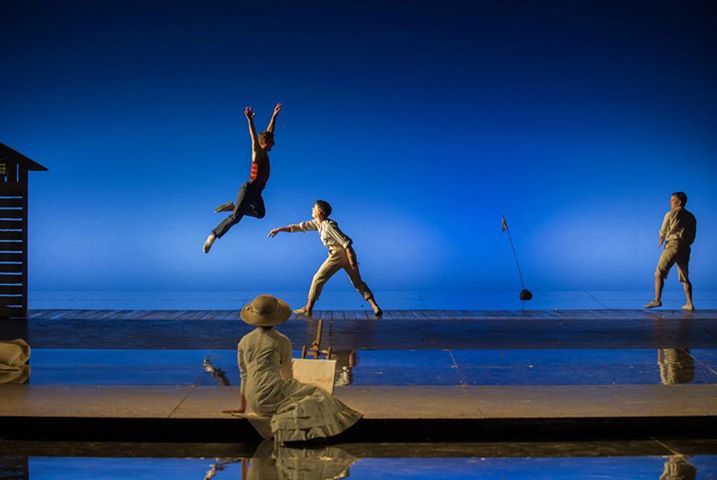
Sam Zaldivar’s Tadzio gives a silent performance of extreme sensual grace and beauty. Kim Brandstrup’s choreography allows Zaldivar to imbue Tadzio with a lithe naturalness that flows through the character and counterbalances Aschenbach’s increasingly halting vocal. Zaldivar has a fluidity of motion that conveys a come hither playfulness that never fully escapes a sense of the mocking. For Graham-Hall’s Aschenbach, this noxious combination, reflected in the increasingly unhealthy Venetian air, comes to a head with the explosive ‘I love you’ that brings the interval on a wonderfully dramatic high.

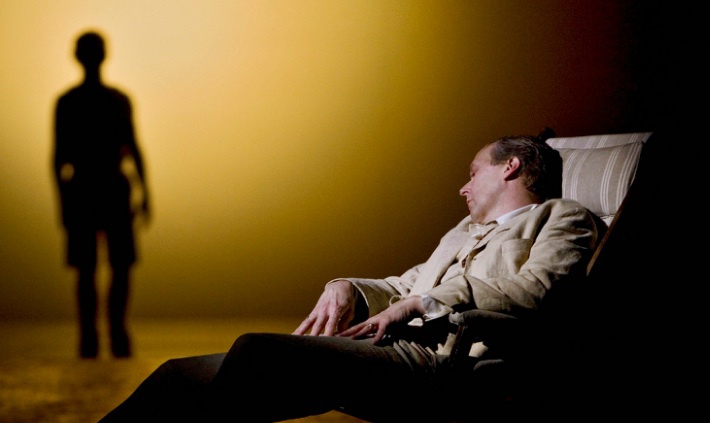
The Pan-like Tadzio in Death in VeniceFor inspiration Warner appears to have sprinkled the fairy dust of Peter Pan over Tadzio. This is most evident in the final image of the play – with Aschenbach sprawled on the stage, Tadzio is seen in silhouette framed against a huge moon. It is a most fertile avenue for Warner to explore, as Mann’s novella explores the relationship of an author’s increasing obsession, chaste or otherwise, with a young boy. Written in 1912 and based on a real life child, it is hard not to think of J.M Barrie’s creation of Peter and Wendy in 1904, and his own questionable attachment to the Llewellyn Davies children.

Britten himself cannot have been unaware by the allusion when writing the opera. It is his final piece and one that wrestles with questions that, to his biographers, Britten had been troubled with for much of his life. It is a story that does not attempt to paint its lead as hero or anti-hero, but rather as a flawed human that is worthy of, at best, pity.

Death in Venice is a story of how obsession leads to tragedy, but even in this it is an indirect tragedy. Aschenbach dies not because of Tadzio – it is not a recasting of the Narcissus and Echo myth– but because his obsession blinds him to the wider danger of the foul air. Peter Pan is an appropriate representation as he is emblematic of an intoxicating sense of the eternal. However this eternality can never be shared and those around him – no matter how they chase it – are destined to grow old and eventually die. .

Peter Pan naturally echoes Pan, the Greek god. It is unclear whether Barrie overtly acknowledged the reference point but Pan had been revived by the Romantics by the time that Peter Pan was created. They share a mischievous spirit born out of a desire to play that can transcend into a darker malevolence; it is something that we see in Pan’s actions of those that refuse his love, and it is echoed in Peter’s attempt to make Wendy believe that her family have forgotten her.

<<Continue to full review>>

Mission: Accomplished

Mission Drift – The Shed, National Theatre, until 28 June (some tickets available)

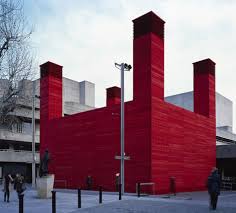
You can’t fail to notice the The Shed, the National Theatre’s striking addition to London’s Southbank. It looks a little like a student’s upturned IKEA table. In bright red. Walking into this new temporary venue, which on the inside is somewhat reminiscent of The Young Vic, is quite an adventure in itself; the smell of new wood, a wonderfully up close and personal stage area, visible stage management and technical. I like it already.

The Shed or Battersea Power Station after an elaborate student prankThe idea behind The Shed is for The National Theatre to celebrate original, ambitious and unexpected new theatre in an excitingly small venue. And on this level, boy does Mission Drift deliver.

Created by New York based The TEAM, Mission Drift is a stunning, well-crafted and inventive musical, yes it’s a musical, which takes us on a whirlwind journey through the American dream. From Las Vegas to New Amsterdam, covering 400 years of political and economic history (atomic bombs, economic downturns, slavery, prospecting, gambling; it’s all here), we follow two couples on their pioneering adventures.

In the world we recognise is Joan; a cocktail waitress laid off from her job and alienated from Las Vegas – the city she once lived for. Joan’s life is changed by the arrival of a mysterious and beguiling

Mission Drift's take on Americana

stranger who offers her a way out of everything she knows. And loves. This is equated to the mythical journey undertaken by two 14 year olds, Catalina and Joris, setting sail from Europe with the Dutch West India Company to start a new dream, in a land where space, as well as life, is cheap.

All of this is overseen by Miss Atomic (Heather Christian), an all at once alluring and repulsive figure who epitomises the best and worst of American capitalism. Her narration is funny, sleazy and engaging – a clever way of holding this bubbling pot of ideas together. She has a voice that grabs you by the balls and dominates the space. I wish her character could have been more intertwined with the two couples but it was a stunning and strong performance that captured the fragility of the American Dream perfectly.

<<Continue to full review>>

Radcliffe crippled by burden of expectation

The Cripple of Inishmaan – Noel Coward Theatre, until 31 August (some tickets available)

It is the website that gives it away. Alight on Michael Grandage Company and it is all too clear that this play is less about the ‘Company’ and very much about a certain Daniel Radcliffe. This is not in itself a criticism of Michael Grandage or Daniel Radcliffe. One must swallow the bitter pill of realism when it comes to the financial dynamics of the West End, which is, if you want to stage a play like The Cripple of Inishmaan for 12 weeks in one of the larger theatres of the West End then you must have an ace up your sleeve to get the audiences in.

Daniel Radcliffe is quite an ace, and paired with Martin McDonagh – notably of In Brugges and, rather less notably, Seven Psychopaths fame – the evening is set for quite a potent mix. The problem is that at times it feels that Michael Grandage has been so keen to find an edgy, modern play to entice a young actor looking to mould his career that he has failed to notice that he has chosen one of McDonagh’s weakest plays.

In Brugges had some incredibly dark scenes but was leavened by its acute sense of place and the fish-out-of-water verbal sparring of its two leads. The Lieutenant of Inishmore looks for black comedy and manages to eventually locate it in something the colour of pitch; a breathtakingly offensive yet hilarious play about the troubles of an Irish torturer considered too mad for the IRA.

McDonagh’s first play – The Beauty Queen of Leeane – won four Tony Awards and has a plot that marvellously manages to deceive its audience at every turn. It is rightly revered as a near-classic and a stunning achievement from the then-25 year old. Unfortunately the Young Vic revived it in a celebrated production less than two years ago and there are certainly no Radcliffe-shaped parts in it.

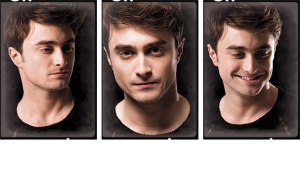
Daniel Radcliffe - STAR (not pictured: other actors)

The Cripple of Inishmaan is not a bad play and it follows McDonagh’s other plays in exploring an Ireland that seems to exist out of time. Eventually it can be placed temporally in the mid-1930’s but realistically it could be anytime from 1780 to 1980. On these rural islands the sense is that life continues much as it has always done; roles are fixed and nicknames determine character rather than other way. The arrival of the film crew on a nearby island is the jolt that throws the island off its axis – it acts as the classic outsider who engenders change on the local and drives the actions of the play.

Daniel Radcliffe plays Cripplebilly – a young man cursed with a limp and a name that he cannot shake. He sees the arrival of a film crew as his chance off the island and Hollywood as a place where his disability can be, if not accepted, at least overlooked.

It is another undeniably smart decision in the post-Potter career for Radcliffe. He deserves a great deal of credit for tackling Equus – a difficult play and a difficult part – and so far he has broadly eschewed the Hollywood-fodder that would seem so tempting. The lead in a reasonably intelligent The Women In Black and acting alongside Jon Hamm in ‘A Young Doctor’s Notebook’ on Sky Arts are the only real mainstream exposure he has received in a post-Potter universe. If the adaptation of Bulgakov’s short stories was a bit of a mixed bag it still represents a remarkably leftfield step for someone with the choice of pretty much any script.

<<Continue to full review>>