Feasting on justifed anger

Trash Cuisine –Belarus Free Theatre @ Young Vic, booking until 15 June

Sitting on the Victoria Line as the tube wound its way towards the end of the line, two women, well-dressed and weighed down with bags, were busy working out their frustrations over the complexity of French employment law when it came to hiring locals to work in their second home. One of the pair wondered whether their 20-year old daughter was old enough to live alone in London.
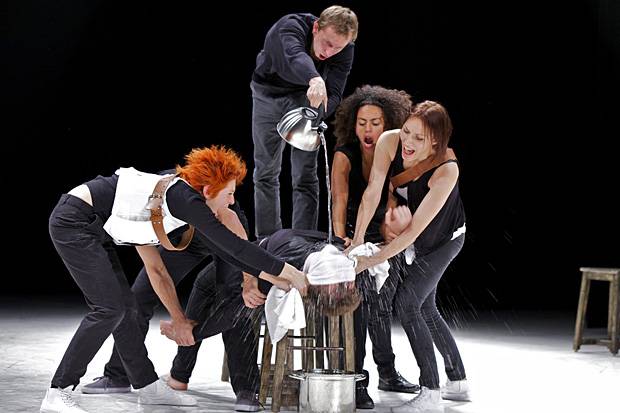
Trash CusineAs I sat and listened, I found it hard not to imagine Liam Holden. Liam Holden? I hadn’t heard of Liam Holden until about two hours earlier. On the 21 June 2002 Liam Holden conviction for murdering a British soldier in Belfast was quashed. In 1989 he had been released from prison having spent 17 years in jail. During his interrogation at Black Mountain Primary School he was waterboarded 6 times, he was stretched up against a wall and beaten for 2 minutes. He had a gun put to his head and told if he didn’t confess he would be shot and have it blamed on the loyalists. By 2002 he had spent almost 70% of his life accused of the murder of Frank Bell, the British paratrooper. Liam Holden was 18 when he was convicted of murder.

I thought to myself that twenty is probably old enough to live alone in London.

Belarus Free Theatre should need no introduction. They are a banned theatre company in Europe’s last dictatorship. Having said that they need no introduction it is likely to be depressing to find out the percentage of people who do not know that Europe still has a functional dictatorship. That a country in Europe still has the death penalty. That theatre companies can still be banned.

Their theatre is raw, angry and political but it avoids polemics and comes alive in its contradictory nature. Trash Cuisine does not have a narrative but it tells many stories. Stories that are intensely local but have a global reach. Stories that are not new but that you have not heard before. Stories that tell of human action but not of humanity.

This could easily sink into the theatre of the righteous. Sub-par Brecht that preaches to the converted and ends with a self-satisfied slap on the back. Belarus Free Theatre has too much at stake and too much talent to allow this to happen. With no state funding they are, in the most literal sense, singing for their supper. With this hunger comes a razor sharp sense of purpose.

They spin steel into their silken storytelling. Scenes unwind into absurdity and farcical slapstick but their messages slice through the levity. Want to hear impressions of different types of death penalty? Well the impression of an electric chair – two minutes of screaming with a ten second break – is an impressive counterpunch.

As the stories unspool one after another like tapes in a broken recorder, each finds a way of piecing together its own meaning. Throughout they mix together a playful sense of the unexpected with a reality that is brutally grounded by the horrors of the language.
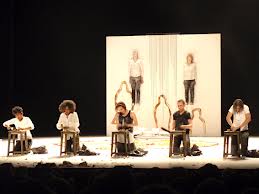
Belarus Free TheatreThe story of Nicky Ingram told through the inhabitants of an American nightclub is a beautiful juxtaposition of the everyday lives of American liberals with the final hours of Nicky Ingram, an inmate on death row. Nicky Ingram was one of Clive Stafford-Smith’s very few failures. 300 death row case and a 97% success rate. Nicky Ingram is one of the unlucky ones. For not getting off, and for being born in one of the very few western democracies that routinely kills adults under the auspices of its legal system.

Belarus Free Theatre is never going to win the Audience Choice award. Trash Cuisine is without doubt a harrowing experience but could it be anything less? For the play to succeed it should fill the audience with a sense of outrage that can’t be quelled in the bar after the show. Not every element is entirely successful. Meaning can’t be gleaned from every tableau but as the performances unfold, the company’s idiosyncratic style overwhelms all and beneath the discordant surface an underlying structure reveals itself.

And that structure is built of anger. Anger at the deaths of Vladislav Kovalyov and Dmitry Konovalov, both 26, both executed in Belarus last year, both protesting their innocence. Anger that the death penalty remains in use in 94 countries across the world. Anger that the state-sanctioned violence can lead to a situation like Nyarubuye in Rwanda where 28,000 people were killed by their fellow citizens. Nyarubuye, where it is said only six people survived. That is something everyone can get angry about, and rightly so.

Merrily we roll out of the theatre

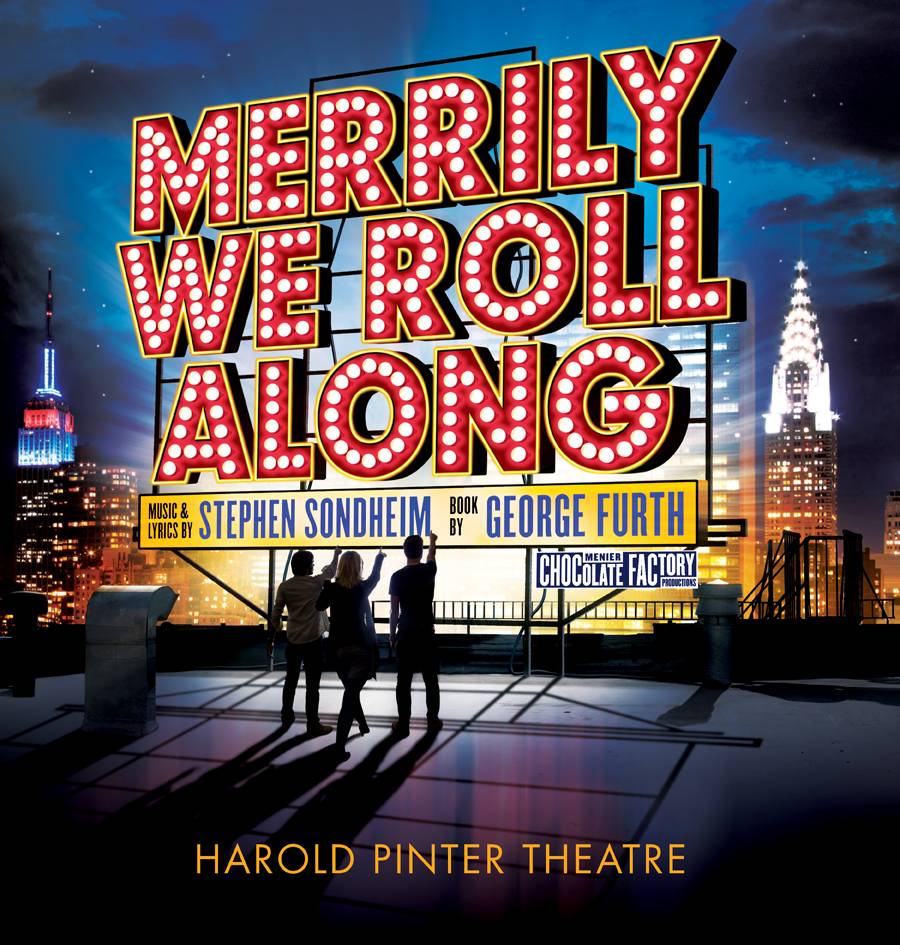
Merrily We Roll Along – Harold Pinter Theatrebooking until 27 July 2013

Among otherwise level-headed people musical theatre remains a peculiarly divisive form of popular culture. There are many of who would happily sit through two and a half hours of magic-soaked love stories in the forests Merrily We Roll Along - Harold Pinter Theatreoutside of Thebes, or will extol the merits of a Turner-prize winner whose contribution to the artistic world is to create soundscapes under Glaswegian bridges.

However present them with a Pulitzer Prize winner who has written musicals as diverse as an examination of the life of pointillist painter, George Seurat; or the gore-spattered grand guignol of the demon barber of Fleet Street; or even an unpicking of the psychological darkness at the heart of the Grimm Brothers’ fairytales, and they will raise their eyebrows and silently mouth the words ‘jazz hands’.

Watching productions like Merrily We Roll Along act as a constant reminder why such narrow-minded viewpoints need to be challenged. Certainly the landscape of musical theatre has changed markedly since Stephen Sondheim made his career by writing the lyrics for Bernstein’s West Side Story. The rise of Andrew Lloyd-Webber that introduced pop-sensibilities and extravagant staging to Broadway couldn’t be further away from the nuanced lyrics and subtle melodies that encapsulate the magic of Sondheim.

The divide only got greater in the last two decades, as the rise of the mega-musical from Mamma Mia! to We Will Rock You saw a new way for theatre producers to cash-in; tapping into the recognition factor of proper bands set against a licence to perform them in a sub-par way with a witless plot under the banner of ‘musical theatre’ – surely as lowest common denominator entertainment goes these productions are right up there with ‘X-Factor’ and ‘Britain’s Got Talent’.

Merrily We Roll Along Trio

The Menier Chocolate Factory must be applauded for setting itself against the tide and producing a string of Sondheim revivals that remind us that there are people out there who see no distinction in artistic merit between a ‘play’ and a ‘musical’. In bringing us A Little Night Music, Sunday in the Park with George and now Merrily We Roll Along – transferred to the West End – the Menier has proved time and again that there is a space for intelligent, difficult musicals that can be both commercial and critical hits.

Merrily We Roll Along, a notorious flop when it opened, has taken two decades to gain similar levels of acclaim to what are seen as Sondheim’s masterpieces. However the intervening years have only served to increase its relevance to the audience. Charlie’s bitterness at Franklyn’s desire to follow the money and to leave ‘proper’ writing behind him only seems more familiar to a theatre-scene where, despite writing the lyrics for the commercial smash-hit of Matilda, Tim Minchin finds it difficult to raise any funding for a musical that isn’t based on an existing concept.

<<Continue to full review>>

Democracy under the microscope in Ibsen reworking

Public Enemy – Young Vic Theatrebooking until 08 June

Continuing from where he left off with Gogol’s The Government Inspector, Richard Jones’ production of a Public Enemy at the Young Vic delves deeper into small town communities and how the introduction of an outside force – be it the arrival of a government official or a report of a contaminated water supply – inexorably leads to the exposure of the venality and hypocrisy of those in positions of responsibility, and those who are able to exercise power.

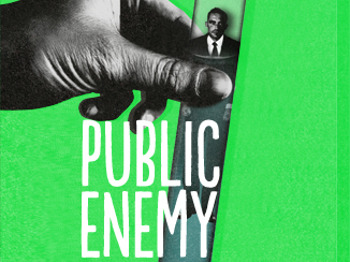
Running at a brisk 100 minutes and dispensing with the interval in order to allow the play to build towards a frenetic and frenzied conclusion, David Harrower’s updated text reworks Ibsen’s Enemy of the People into a 1970’s Public Enemy logosetting. In this he is aided by a superb set design from Miriam Buether and costumes from Nicky Gillibrand that immediately places the location in a Scandinavia of the 1970s.

Updating Enemy of the People has an advantage of other Ibsen plays in that the central plot device feels as relevant today as when it was written. The tainting of the water supply is something that doesn’t seem so unlikely to a society who has seen the Yangtze River turned the colour of blood and minor earthquakes hit Blackpool following adventures in fracking.

Jones’ Public Enemy reminds us once again of Ibsen’s skill of placing characters in the most exquisite of personal dilemmas – forced into positions that expose their venality and corruption to the world. Each passes under the lens of his microscope, and each ultimately fails to take the action that would potentially redeem them.

<<Continue to full review>>

Radical naturalism in haunting reinvention of a classic

Fraulein Julie – Barbican, until 04 May

Strindberg’s Miss Julie never seems to quite fall out of fashion but even by its standards, London has been awash with the play. This is the third major version in less than a year, and it has been only six months since audiences at the Barbican were left underwhelmed by the high-profile casting of art-house favourite Juliette Binoche in the title role, whilst those who saw Mies Julie were rather more  thrilled by the South African reinvention and the Young Vic took it upon themselves to revive Patrick Marber’s After Miss Julie.

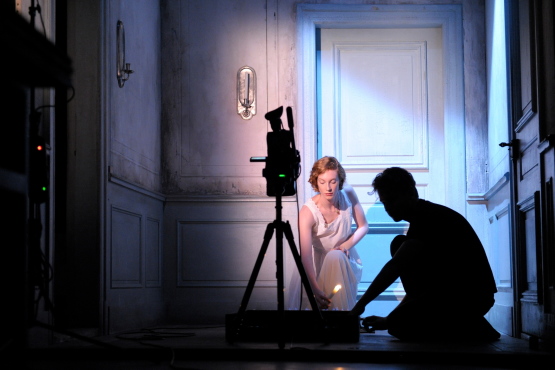
For all the different qualities these productions brought to Strindberg’s original they must be regarded to be drifting in the wake of Katie Mitchell’s exceptional production, which contains a lacerating truthfulness that Fraulein Julie in Katie Mitchell's radical reinventionmakes it almost unbearable to watch. The most remarkable element of the exposure of the truth in this most naturalistic of plays is that Mitchell’s deliberately subverts audience expectations of naturalism by introducing many layers of artifice in order to produce a dislocating, alienating experience.

Fraulein Julie contains all of the directorial tics of a Katie Mitchell production; television cameras are used almost continuously alongside the action, a set creates physical barriers between audience and actors, sound booths overlay conversation and Foley artists provide live sounds effects. The audience are left in the position of watching both the back of a TV studio at the same time as watching a radical reinvention of the Strindberg play – and yet despite all this feel no dissonance as the events unfold.

These traits in Mitchell seem appropriate – in so far as there are auteurs in theatre, it is hard to imagine many British directors fitting the bill better. Her natural reference points seem to be from Russian cinema – with the slightly woozy quality of Sokurov’s The Sun and its obsessive focus on Hirohito being particularly reminiscent in the utter focuus on one character even as events of more dramatic significance happen external to the action. .

It is not that Mitchell has a filmic quality to her work but that she has the auteur’s passion for pursing a singular vision with seemingly little regard for the enjoyment of the audience. It expresses a confidence in her own belief, and that if the belief is proved correct then the audience will be taken with her. Fraulein Julie is an experience and rarely a particularly pleasant one; it is draining, august and defiant in its lack of concession to those watching. It seems a rare person who can increase the level of austerity attached to Strindberg but this is what Mitchell has achieved.

A day after performance it is still impossible to attach a sense of how ‘good’ it was – even in tragedy there is usually a way to qualify enjoyment, be it through plot, character or performance. Here the plot is stripped away to focus entirely on one character, but the character is provided with very little interior life and the performances themselves are muted through their heightened naturalism.

However there is something about the whole affair that is undoubtedly brilliant and possibly makes it the most genuinely ground-breaking production of the year. In Mitchell’s previous work there has been an attempt to force her ideas onto plays that are not best suited to the technique. With Fraulein Julie, Mitchell has found the content to harmonise with form.

<<Continue to full review>>

McAvoy shines through a dank and dirty Macbeth

Macbeth – Trafalgar Studios, until 27 April 2013

Macbeth, by virtue of its perennial presence on the national curriculum and its pulpy plot that might just possibly hold the attention of recalcitrant teenagers who would rather be playing Call of Duty than sitting in a darkened theatre listening to verse-speaking for over two hours, is a Shakespeare play that never seems far from reach. It also has the added advantage of lead role that can be tailored to actors as apart in their careers as Kenneth Branagh and James McAvoy.

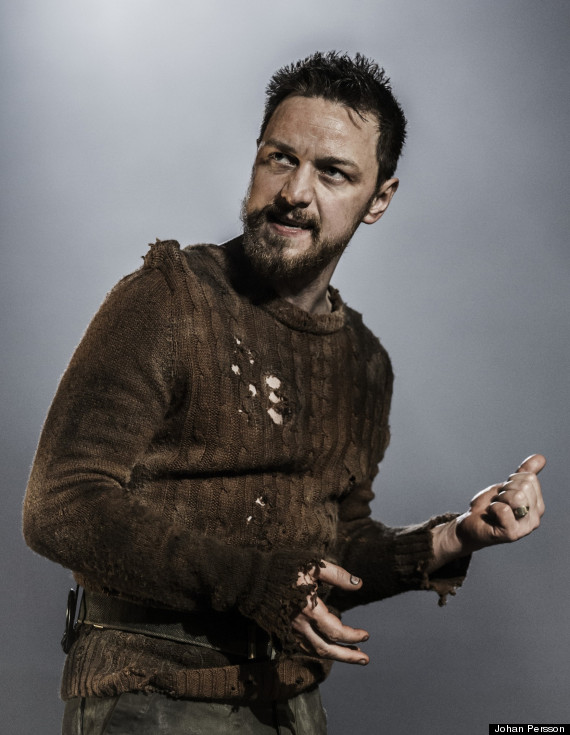
This sense of over-familiarity has harmed the play’s standing in the canon of Shakespearian tragedy, where it is rarely considered to be on the same level as Hamlet and King Lear. This distinction is hard to deny if the sole value for the tragedies is driven by the psychological complexity of its lead characters. However in Macbeth, which post-dates both plays, Shakespeare seem less interested in this then it exploring man as a primal force of nature. Where Hamlet ruminates on the moral legitMACBETH by Shakespeare,   Credit: Johan Persson - www.perssonphotography.com /imacy of his actions and the imperatives that drive him, Macbeth is driven by the emotion that eventually subsumes him – the tragedy lies precisely in this lack of reflection.

One of the joys of Macbeth for a director is that it provides an appealingly blank canvas; the landscape is sketched out as roughly as the country it is set in, and the setting is not tied to any significant fixed points in history. The result allows freedom for the director to overlay an idea onto the play without destroying the sheer enjoyment of Macbeth’s whirlwind central performance.

Jamie Lloyd’s production embraces the wild and primitive nature of the text – it is a Macbeth that lives and breathes the visceral and savage world in which it is set. There is no re-imagining Macbeth as a modern-day dictator or gangland crime boss; this is a Macbeth of history but a history that is rarely seen – when kings were a long way from assuming a divine right and living in a world of pomp and pageantry. In this Macbeth, you are king in so far as you assert a brutal right to supremacy. You are king of what you can hold and no further.

At its heart is Hobbes’ maxim that life without a settled community is a life of ‘continual fear, and danger of violent death, and the life of man, solitary, poor, nasty, brutish and short’.The set could be described as post-apocalyptic, post-climate change, post-fall of civilisation but it could easily reflect the nature of Britain prior to the establishment of a settled state. It is dank, dirty and decaying, and suits the purposes of those rule it. From the outset it is clear that these hard men living in hard times; when Duncan exclaims ‘what bloody man is that?’ [I.ii] it is not out of concern for his condition but out of wariness over his allegiance. Until Malcolm confirms that he is the Sargent he is welcomed only by the barrel of a rifle.

Similarly when Duncan reaches Glamis it seems more in keeping with a temporary base of a raging civil war; people sit on fold-up chairs and the ‘throne’, in a playful twist, is a toilet. The castle stands as a base of operations and nothing further. These men embody thec tribes forced north of the wall centuries earlier by the Romans than the contrasting civilisation of southern England. A point made by Lloyd as he bathes the set in an almost spiritual light during the play’s foray south of the border to hear Macduff and Malcolm debate the values of kingship.

This imagined world revolves around Spinoza’s belief that ‘peace is not the absence of war, but a virtue based on strength of character’. The play begins as war is concluded and the opportunity for peace to descend, yet it appears inevitable that it will only act as a temporary cessation of hostilities. It is so embedded that Macduff, who represents the forces of moral legitimacy, ultimately fails to demonstrate the virtues that can allow peace to flourish. The stark imagery of Macduff lifting Macbeth’s severed head above his own, face slowly covered by the blood of the defeated King, resembles the savagery of all that was fought against than the kingly virtues that Malcolm extols.

It is essential to understand that McAvoy’s Macbeth exists against this backdrop, as it is an explanation to the question of why Macbeth cannot turn away once he has achieved everything that was promised to him. Even before the Witches’ promise him the title of King it seems apparent that this Macbeth would not have been satisfied with his lot. Like those around him, he is a man of war and his achievements breed an emptiness rather than satisfaction.

<<Continue to full review>>

Cheek by Jowl remove excess fat from aburdist Ubu

Ubu Roi – Cheek by Jowl @ Barbican, until 20 April 2013

It is easy to imagine that many directors view Jarry’s Ubu Roi as the poisoned chalice of theatre. It is a play whose own history has overwhelmed any value the original content may have had. A play that managed to start a riot after just one word of dialogue had been spoken. A play that managed to get itself outlawed from the stage after just one performance. How can a play with that much power ever be resisted for long?

However power relies on content and context, and even directors blinded by its potential must realise that theatre audiences of the 21st century are not going to tear up the stalls upon the utterance of a single swearword. So the question always remains over how to make Ubu relevant whilst maintaining its sense of absurdity; this must be the prerequisite of any company attempting to refresh the play.

So then we must be glad that it is Cheek by Jowl who are the latest in a long line of companies to have picked up the gauntlet, as it is questionable whether there are more potent re-interpreters working in theatre today than the formidable pairing of Declan Donnellan and Nick Ormerod.Ubu Split -Christophe Gregoire Photo -Johan Persson

Over the last few years they have put their unique design and directorial decisions to plays as unfashionable as Troilus and Cressida and Racine’s Andromaque. They have also delivered stylish but substantial productions of The Tempest, Macbeth and Tis Pity She’s A Whore. Most impressively of all, this has been achieved whilst working across three languages, using British, French or Russian almost on a whim.

One of the joys of a new Cheek by Jowl production is the anticipation of what you are going to get. Each new play feels unique in itself but also contains an essence that is instantly recognisable as Cheek by Jowl; there is a coherence and balance in the interplay between design and direction, style and function, which means that each individual element has a purpose and a decision that runs through and underpins the unifying themes. This ability is particularly noticeable in Ubu Roi where the need to produce unnaturally large characters means that there is a constant tension that they could overwhelm the play as a whole.

<<Continue to full review>>