What we leave behind

The Return of the Soldier – Jermyn Street Theatre, until 20 September 2014 (Tickets)

The Return of the Soldier is one of a number of WW1-themed productions out this year that, if nothing else, proves that theatre land is not entirely unaware of events in the outside world. Having always been a sucker for a new musical and with source material that gives voice to the rarely heard, it was one of the few that intrigued Civilian Theatre enough to be filled with a genuine sense of anticipation.

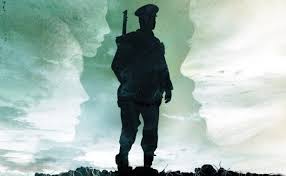
The production adapts Rebecca West’s novel about a shell-shocked captain who returns from war and turns the lives of the three female protagonists upside down. The original novel is remarkable for its frankness in tacklingThe Return of the Soldier, Tristan Bates Theatre, Laura Pitt-Pulford and Stewart Clarke, 2014. Courtesy Darren Bell these issues before the war had even ended and presents an openness to issues of class and gender that reflects a Britain on the cusp of a series of social revolutions that ultimately were as important as the war in ushering in a post-Edwardian modern era.
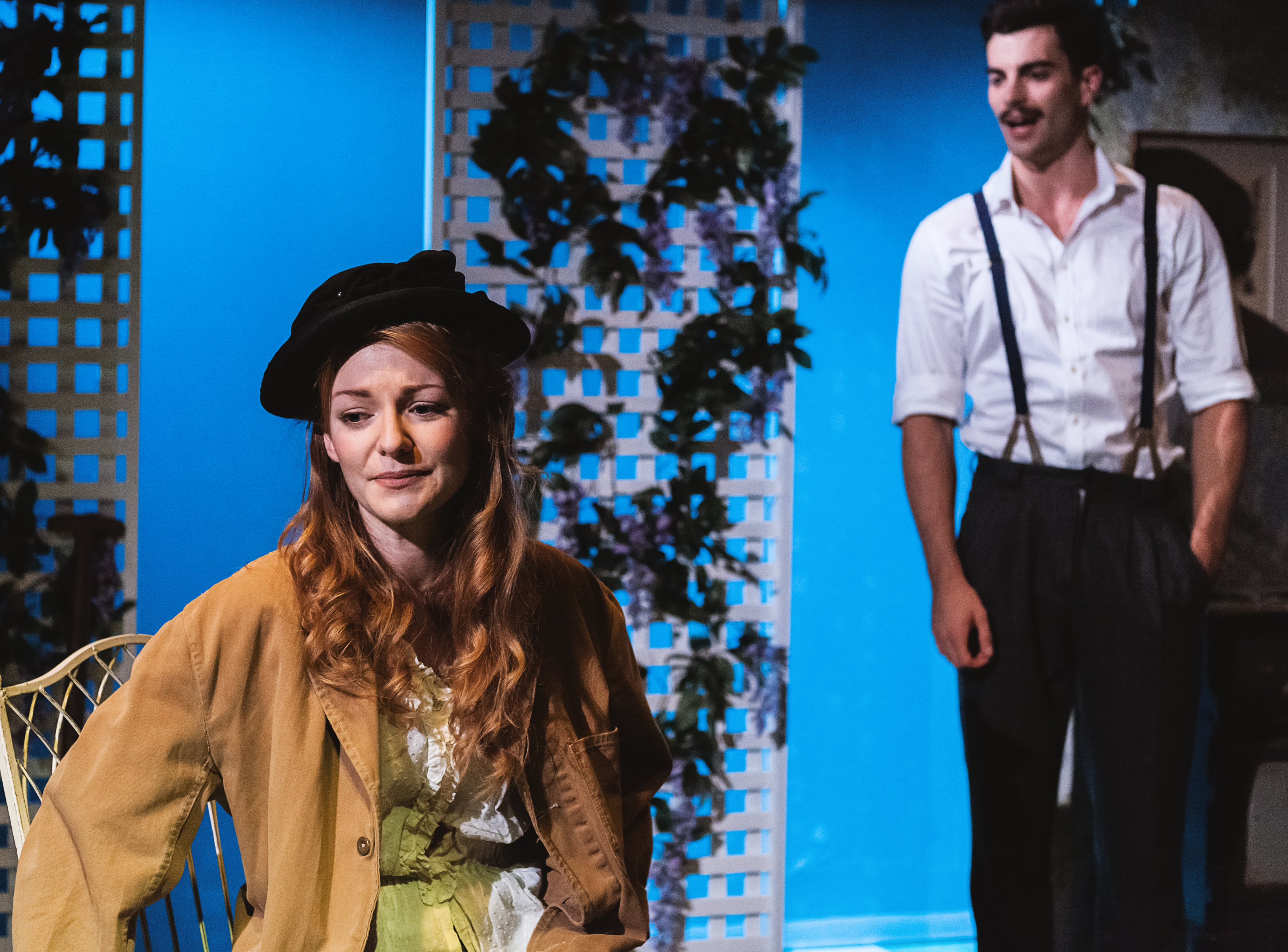
The plot is simple enough but contains a refreshing moral ambiguity that makes it difficult to take sides with the characters. The damaged captain cannot remember his wife and instead has eyes only for his young love, a lower class girl he met years ago on Monkey Island. Now both married, they find themselves caught in the rapture of the life they could have had. Yet it is Margaret who must carry the burden of unfaithfulness and remember they are trapped within a fantasy of his creating. Eventually they must re-engage with the real world and he must face the trauma that stops him connecting with the present.
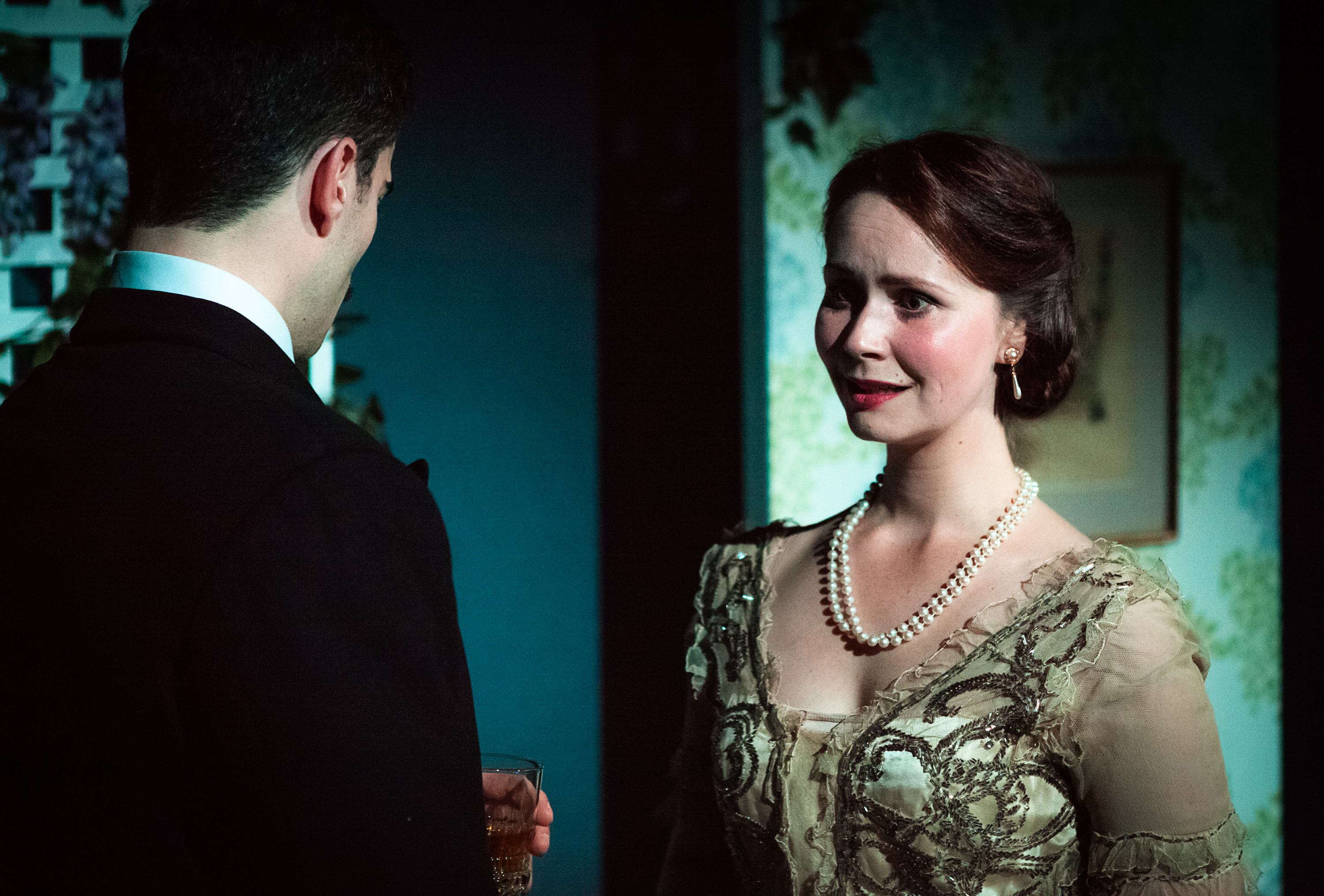
The Return of the Soldier, Tristan Bates Theatre, Zoe Rainey and Stewart Clarke, 2014. Courtesy Darren BellThe war looms as a dark presence unmentioned in the background as he recuperates, and the unspoken knowledge that to be ‘cured’ means an expectation of a return to the frontline. The ‘return’ of the title has a multiplicity of meanings; it leads to the return home, the return to first love, the return to normality and, finally, the return to the front line.

The decision to turn it into a musical is a curious one and the limited space at Jermyn Street necessitates a chamber approach; it would be difficult enough to swing a cat in the space and it is a credit to Matthew Cole’s dextrous choreography that there were at least a couple of items that could be called dance numbers. This fluidity was generally matched in Charlotte Westenra’s direction that stopped the cast from tripping over one another, and managed to create two very distinct worlds on one very small stage.

The cast and musicians also deserve praise for modulating delivery to match their surroundings. One of the biggest criticisms reserved for Dessa Rose, a similar ‘big theme-little venue’ chamber musical at the Trafalgar Studios, was that it seemed to be produced with one eye on a larger theatre and during the bigger numbers the audience were subjected to a sonic assault. The Return of the Soldier was beautifully delivered, at exactly the right volume. Delivery matched the style and crucially it recognised that lyrically clarity does not necessarily equate to maximum volume.

<<Continue to full review>>


Have a listen:

If life gives you lemons, make monologues

The Me Plays – The Old Red Lion Theatre, until 20 September 2014 (Tickets)

Filed by our roving reviewer, Emily Howe

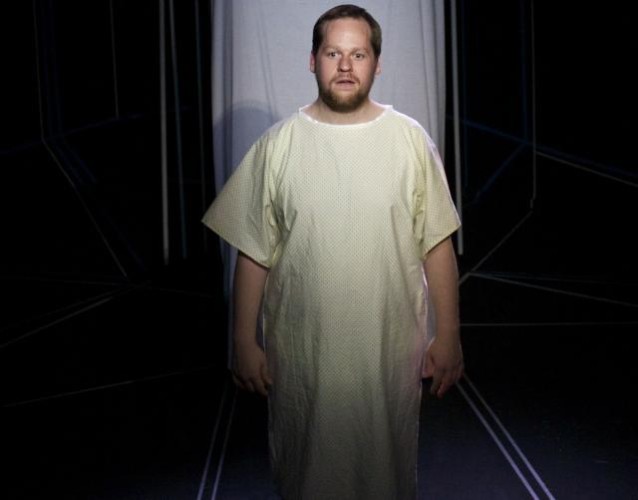
Written and performed by Andrew Maddock, The Me Plays are a couple of self-penned, semi-autobiographical monologues, currently showing at The Old Red Lion. The space is perfect for the piece; intimate yet with a buzz to it, and it certainly helps that this little theatre is sold-out for tonight’s show.

Maddock is bursting with energy and self-deprecating humour. Both of his monologues are directly addressed to the audience in a brave performance where (although I don’t know with any surety how much of the content wasAndrew Maddock, photo by Hannah Ellis Photography true or how much fiction) it feels like he is opening his life up for us to see.

The first of the two pieces, “Junkie”, describes Me’s modern life in the digital-age, and seems to be aimed more towards the men in the audience. Covering Tinder, internet-porn, facebook and pill-popping, its message is that there is a declining need in us to make real connections with the rest of humanity, as we can so easily find what we need online. Me is comforted by the safe, virtual atmosphere of the internet which allows him to switch off when he gets bored, and where there is no chance of rejection and pain.

In the second play of the evening, “Hi Life, I Win”, Me is in hospital and is nostalgically re-living his formative years for us; reminiscing about his school-life, discovering weed for the first-time, being shipped off to a Catholic camp, and the death of his beloved grandad, amongst other very personal moments. Interspersed with his present-day situation in hospital, this is a much more personal journey than “Junkie”, but the experiences that Maddox shares with us, although engaging, were too unique to the writer for me to be able to wholly relate to.

The direction in the first play was clear and consistent; nice use was made of the interesting set and lighting, and the audience believed in the different scenes that were played out in various locations of the set. The second play seemed less slick and was perhaps too static for a stage performance. Although some of the emotional instances were a bit clunky and overly sign-posted, there were also some lovely, subtly-nuanced melancholic moments, particularly during the end of the first play.

<<Continue to full review>>

Onto the West End

With the Almeida Theatre putting out a trailer advertising its West End transfer of the fabulously entertaining King Charles III, and with what appears to be most of the original cast intact – including, crucially, Tim Pigott-Smith as Charles, Oliver Cris as William and Lydia Wilson as Kate – it seems a good time to revisit Civilian Theatre’s review from the Almeida run.

Oliver Cris has been pulling double duty on the satire front this year, as he hops back from playing a hapless policeman in the National’s Great Britain into an eerily pitch-perfect William, whilst Lydia Wilson reprises her Lady Macbeth-fuelled Kate. Lydia Wilson also has previous form in such matters, having come to attention of people outside of theatre-land with her role in Charlie Brooker’s most memorable Black Mirror (yes the one where the PM has *ahem* relations with a pig). However for those more conversant with plays, she has also been seen in Cheek by Jowl’s excellent ‘Tis pity she’s a whore and Sarah Kane’s Blasted

<<Read Civilian Theatre’s review of King Charles III>>

Watch the trailer:

<p><a href=”http://vimeo.com/105039584″>King Charles III West End Trailer | Almeida Theatre, London</a> from <a href=”http://vimeo.com/almeidatheatrelondon”>Almeida Theatre</a> on <a href=”https://vimeo.com”>Vimeo</a&gt;.</p>

Book tickets here

Paved with good intentions

Autobahn – The King’s Head Theatre, until  20 September 2014

Filed by our roving reviewer, Emily Howe

Currently running at the Kings Head Theatre in London, Savio(u)r presents the professional UK premiere of Neil LaBute’s Autobahn. Set on the highways of America, this is a series of seven vignettes, each taking place in the front seats of a car. A combination of monologues and duologues, the scenes are unrelated to each other in their narratives and characters, but where they overlap is in their structure. With each, the audience must autobahn 1spend a few minutes detecting what relationship the characters bear to each other and what situation we are intruding on; then as the scene plays out, we see the layers gradually unfold, and slowly realise that – in many of the scenes – the situation is not quite as clear-cut as it may initially have seemed.

Zoe Swenson-Graham, Tom Slatter, Henry Everett and Sharon Maughan in Autobahn, King's Head Theatre - (c) Scott RylanderAll seven scenes were performed by just four actors, so there was a fair amount of multi-roling. This worked very well, and I enjoyed seeing the same faces tackle vastly different characters and styles. In a play of this style – where movement is minimal and the actors are facing out to the audience for the duration of the scenes – the challenge for the actors is that there is nowhere for them to hide, as we can identify every thought-change that crosses their faces. Therefore, the performances, character development, and clarity of sub-text need to be spot-on. All of the actors rose to this challenge and the performances were truthful, engaging, and often darkly funny. Particular mention should go to Zoë Swenson-Graham who shone in each of her four very different characters.

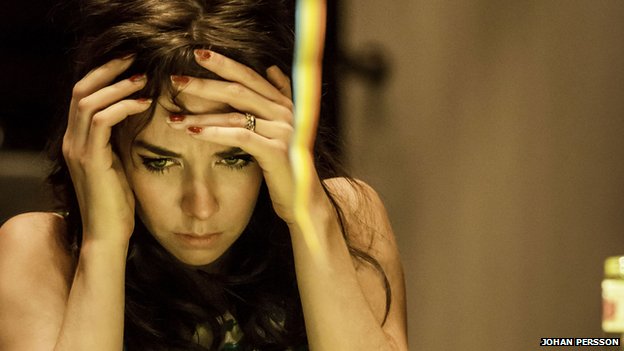
The staging was simple but effective. The front half of a car was the main focus on stage, with a large screen behind showing a film of the varying roads and views where the scenes were taking place. A soundscape during each scene added to the atmosphere.

<<Continue to full review>>

A Streetcar Named Despair (Wait, hang on a second – ed.)

A Streetcar Named Desire – Young Vic, until 19 September 2014 (Tickets) (NT Live Performance Info)

It is only fair to begin with a disclaimer: this reviewer does not like Tennessee Williams. It is not for want of trying and it is also appreciated that Civilian Theatre is very much in the minority with Williams being held in the highest esteem by a great many people who know a great deal more about the theatre.

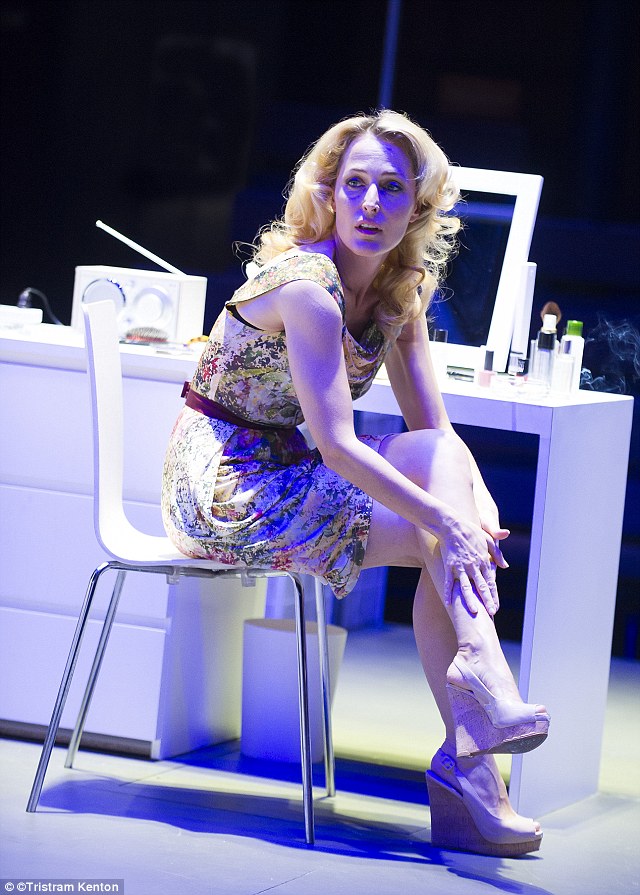
However the point stands and after spending close to three and a half hours watching the Young Vic’s current production of A Streetcar Named Desire, and quite a bit longer letting opinions slowly ferment in the darkest Gillian Anderson as Blanche DuBois in Streetcar at the Young Vicrecesses of the brain, it can only be concluded that we are faced with a conundrum – and that is how far a production can be even-handedly reviewed when the play itself is not personally held in particularly high regard.

Benedict Andrews’ stunningly visual and sumptuously performed version of Tennessee Williams’ most famous (and possibly greatest) play wonderful demonstrates the edge that theatre has over other narrative mediums; for in general every piece of cinema is seen as a new piece of cinema, even when a character – such as Frankenstein – is returned to we do not recognise it as the same film produced differently.

Perhaps only, outside of films that began life as stage plays, Gus Van Sant’s almost shot-for-shot remake of Psycho could be considered a genuine replica, and a 37% Rotten Tomatoes rating tells a story all of its own. Literature, that other narrative medium, is tied to its form and could never bear complete repetition of language even as it continually retraces its steps over stories passed down across generations.

It is only theatre where audiences are satisfied by directors going back to the same well – to Shakespeare, to Euripides, to Chekhov, to Williams – and seeing what can be made from the same materials. This desire allows a director to try and breathe new life into familiar conceits and allows the audience to revisit their favourite plays or continually challenge themselves against work that doesn’t appeal to them.

76596630_vanessa-kirbyAnd so begins Civilian Theatre’s obsession with Tennessee Williams (and was there a more appropriate playwright to develop an obsession about?) Regarded as one of the great American dramatists, and with an undoubted flair for writing memorable characters, Williams’ stock is such that he is part of a very small band of playwrights that the commercial West End will take a chance on. As a result over the years this reviewer has watched (or perhaps endured) Night of the Iguana, Cat on a Hot Tin Roof, Baby Doll, The Glass Menagerie, The Fat Man’s Wife and now, finally, A Streetcar Named Desire. With the exception of The Glass Menagerie they have proved mainly dispiriting affairs where the southern melodrama successfully manages to match the ripeness of the language with equally ripe performances.

That production of The Glass Menagerie, at the Young Vic in 2010, was built on the back of an exciting new director in Joe Hill-Gibbins, two breakout performances from rising stars, Kyle Soller and Sinead Matthews (everything from Master and Margarita, The Changeling to Blurred Lines in the last couple of years) and a wonderful score. It demonstrated that no matter what you think of a playwright, or his style of writing, it is possible to extract excellence; for even the biggest critics of Tennessee Williams would never deny that the man could write (unfortunately he writes so well he sometimes seems to forget to know when to stop).As it happens A Streetcar Named Desire not only has an exciting director in Benedict Andrews, two breakout performances from Ben Foster and Vanessa Kirby (brilliantly taking more than she was given as Isabella in Edward II, and doing a similar job with Stella in Streetcar), and an interesting musical score. It also gives us an ingenious set design and a crackerjack lead performance from Gillian Anderson as Blanche DuBois.

<<Continue to full review>>

Billie Piper bikini pics: Click-baiting and the other skills you need to be a 21st century journalist

Great Britain – Lyttelton Theatre @ National Theatre, until 23 August (transferring to the Theatre Royal Haymarket from 10 September)

Leaving aside any judgement on the qualities of Richard Bean’s Great Britain, we must first applaud those involved for what the play attempts – an immediate response to the biggest domestic news story since cash for questions – and how – in the world of social media – they managed to keep it under wraps to pretty much everyone.

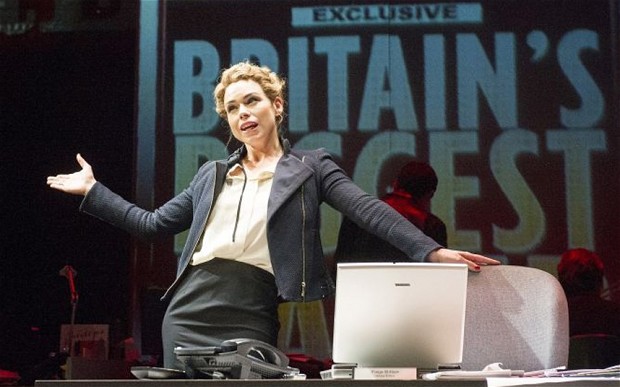
There is a certain irony in a play entirely focused on leaks, hacking and exposure being kept secret right up into previews – and that it was achieved by the country’s biggest theatre company, with a lead who has been Great_Britain091.jpgforced to grow-up under the bright glare of the tabloids’ flashbulbs is a remarkable achievement.

Richard Bean proved with his artfully balanced adaptation of Goldoni’s One Man, Two Guvnors that he is capable of broad comedy that captures the public imagination. The play operated as traditional British farce whilst simultaneously deconstructing the genre by breaking through the fourth wall and toying with the audience’s expectations. That it was a success was probably to be expected – with James Cordon reconfirming his exceptional comic talents after a series of mediocre moves in TV and film – but the fact it has become a global mega-smash was not predicted and must have placed an awful lot of pressure on Bean for what he would come up with next.

That his response was to attempt something as ambitious as Great Britain demonstrates he is a man clearly up for a challenge, and it is pleasing to see how admirably he has risen to it. With Great Britain he tries another form of alchemy in attempting to blend the mechanics that drive farce with an attempt to explain a highly complex and incredibly serious series of events that do not deserve to be treated lightly. It is as if Bean was attempting to create the lovechild of Michael Frayn’s Noises Off and Democracy.

Bean doesn’t succeed in what may have always been an impossible proposition but it is undeniably great fun to see him try. There are an awful of laughs in the show and they come from all angles; from the wonderful faked headlines of the papers – right up to the Guardian’s tagline of ‘we think so you don’t have to’ – to the ribald language of the tabloid’s newsroom, which masks an amazing felicity of expression among the journalists.

The play takes a number of sacred cows and turns them into hamburgers, and as a result the air is thick with gasps followed by laughter. Taking these jokes right to the edge of acceptability is absolutely necessary for the play and it should create an interesting, and uncomfortable, tension for the middle-class, liberal audience members busy reading the Independent on their smartphones, whilst pretending that they are not keeping one eye on the Daily Mail’s sidebar of shame.

<<Continue to full review>>