2013: The facts and figures

As 2013 moves towards its conclusion, Civilian Theatre has delved into the back of the cupboard for some last little snippets for the year. There was no intention to see quite so many plays last year – and certainly not to end up writing up quite so many – it just ended up working out that way. It is only when there is time to sit back and reflect does one begin to find the surprising nature of what does/doesn’t make a post popular, and the fact that people may come from all over the world to read them. It was surprising to discover that Shakespeare made up only 17% of the plays that I saw this year – and only just holds off musicals (although Kiss Me, Kate is an adaptation of The Taming of the Shrew so it is 50:50). I also had to check that over a 1/3 of plays were new works, as these always seem as if they pass Civilian Theatre by. Less surprising but slightly depressing is that only six could be claimed to be pretty much entirely original texts.

47: Plays Seen      

38: Plays Reviewed

This includes:
8 Shakespeare Plays (17%)
7 Musicals (15%) + 1 Opera
17 were new works (36%), of which 6 were not based in existing literature or historical events (13%)
4 were in a foreign language (8%)


Most popular posts of 2013

1. Peter and Alice

Judy Dench, arguably one of the greatest female actors Britain has produced, and Ben Wishaw, spellbinding in the BBC’s Richard II, joining forces to take on the real-life counterparts of two of literature’s most enduring and imaginative childhood creations. It should have been perfect. It wasn’t.

2. Sweeny Todd / WAG: The Musical

Proving once again that bad publicity is better than no publicity at all, and Civilian Theatre’s first experience of having a review filleted for *ahem* unrepresentative quotes. WAG: The Musical is the unwanted gift that keeps on giving.

3. Mojo

Ben Wishaw (again), Rupert Grint, Colin Morgan, That guy off Downton Abbey, Daniel Mays (something for the theatre fans). I cannot guess why this made it into the top 3. I did also learn not to underestimate the twitter power of Colin Morgan fans.


Top 10 Countries by Visitors (thanks guys!)

  1. United Kingdom
  2. United States
  3. Australia
  4. Canada
  5. France
  6. Germany
  7. Russian Federation
  8. Belgium
  9. Republic of Korea
  10. Ireland
  • Civilian Theatre was visited by people from 87 countries in 2013.  This represents 45% of all countries recognised by the United Nations.
  • However 20 countries only visited a single time. This includes China, which has an estimated population of 1.35 billion. So clearly room for improvement there.
  • Other countries with just a single visit include the Democratic Republic of Congo,  Kazakhstan and Guatemala,

The worldwide reach of Civilian Theatre
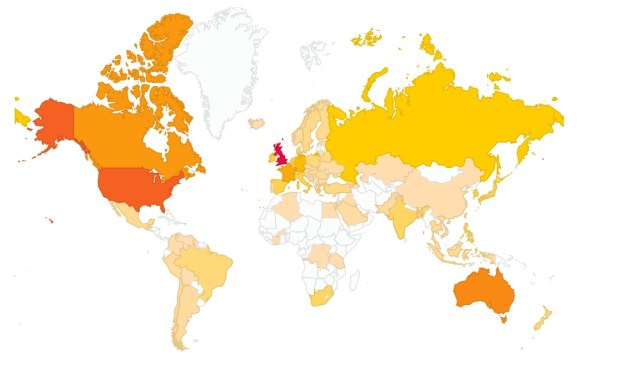
Visitors 2013

The 2013 playlist

  1. The El Train – Hoxton Hall, December
  2. The Shape of Things – Arcola Theatre, December
  3. Henry V – Noel Coward Theatre, November
  4. The Scottsboro Boys – Young Vic, November
  5. Passing By – Tristan Bates Theatre, November
  6. Mojo – Harold Pinter Theatre, October
  7. The Events – Maria Room @ Young Vic, October
  8. Hamlet de los Andes – The Barbican Pit, October
  9. The Resistible Rise of Arturo Ui – Duchess Theatre, September
  10. Edward II – National Theatre, September
  11. Fleabag – DryWrite @ Soho Theatre, September
  12. The Secret Agent – Theatre O @ the Young Vic, September
  13. All’s Well That Ends Well – Royal Shakespeare Company, Stratford, August
  14. The Same Deep Water As Me – Donmar Warehouse, August
  15. Jekyll & Hyde – Red Shift & Flipping the Bird @ Maltings Art Centre, July
  16. Where the White Stops – ANTLER @ Battersea Arts Centre, July
  17. Circle Mirror Transformation – Royal Court @ Rose Lipman Community Centre, July
  18. Death in Venice – English National Opera @ Coliseum, June
  19. Mission Drift – The Shed @ National Theatre, June
  20. The Cripple of Inishmaan – Noel Coward Theatre, June
  21. Trash Cuisine – Belarus Free Theatre @ Young Vic, June
  22. Merrily We Roll Along – Harold Pinter Theatre, May
  23. Public Enemy – Young Vic Theatre, May
  24. Orpheus – Little Bulb Theatre @ Battersea Arts Centre, May
  25. Fraulein Julie – Barbican, April
  26. Macbeth – Trafalgar Studios, April
  27. Ubu Roi – Cheek by Jowl @ the Barbican, April
  28. Gibraltar – Arcola Theatre, March
  29. This House – National Theatre, March
  30. Peter and Alice – Noel Coward Theatre, March
  31. Watt – Gate Theatre Dublin @ the Barbican, March
  32. Mydidae – Trafalgar Studios, March
  33. In The Beginning Was The End – dreamthinkspeak @ National Theatre, February
  34. Rhinoceros – Théâtre de la Ville–Paris @ the Barbican, February
  35. Old Times – Harold Pinter Theatre, January
  36. Julius Caesar – Donmar Warehouse, January
  37. The human being’s guide to not being a dick about religion – Matt Thomas at the Canal Cafe Theatre, January
  38. Kiss Me, Kate – The Old Vic, January

Not reviewed (at least not yet)

  1. American Psycho – Almeida Theatre
  2. Richard II – Barbican
  3. Coriolanus – Donmar Warehouse
  4. Othello – Olivier @ National Theatre
  5. Candide – The Swan @ Royal Shakespeare Company
  6. Metamorphosis – Lyric Hammersmith
  7. Matilda: The Musical – Cambridge Theatre
  8. The Hot House – Trafalgar Studios
  9. Seven Brides for Seven Brothers – Wimbledon Theatre
For all the 2013 reviews click here

Bold, bravura Bolivian brilliance

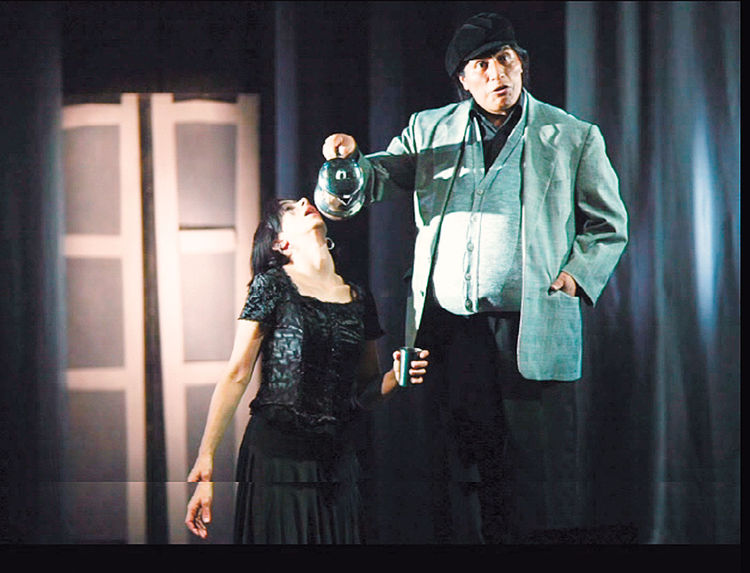
Hamlet de los Andes – Teatro de los Andes @ The Barbican Pitpart of the CASA Latin American Festival

If my knowledge of Bolivia is shockingly limited then it is fair to suggest that my knowledge of Bolivian theatre is equally lacking. However if Teatro de los Andes’ breath-taking reimagining of Shakespeare’s Hamlet is any measure of the quality of the Bolivian arts scene then it is an area that needs considerable investigation.

Fast-paced and full of vitality, Teatro de los Andes’ production finds new energy for a play whose radicalness has become blunted by its well-worn familiarity. In the fore-knowledge of its famous quotations and its prototype of Ophelia and Poloniusthe tragic hero, it is telling that it has taken a non-English language company to develop a radical approach that plays with both text and content. In recent years its closest parallel on the English stage has been Thomas Ostermeier’s German production but whereas Ostermeier’s production seems to revel in its willfully abstruse nature, the direction and purpose of Teatro de los Andes is clear throughout.

Hamlet of the Andes

There is nothing deliberately complicated about this production. It may be performed in Bolivian with just three actors and a musician. It may have taken a hatchet to the text, rewriting most of the dialogue and weaving altered quotations throughout, cut half the characters and reduced the length to under two hours.

However it also provides a chillingly clear indictment of the politico-military instability that ripped apart Bolivian society throughout the latter-half of the 20th century, which is told through the lens of the paranoia and madness that infects not just Hamlet but the whole household.

Writing in the Guardian, ahead of the publication of The Hamlet Doctrine, Simon Critchley and Jamieson Webster argue that we have either forgotten or misunderstood the true nature of Hamlet and that productions too often focus on safe interpretations; they argue that we should look to the likes of Lacan and Nietzche who took analysis of Hamlet’s character beyond the basic Freudian Oedipal model, and offered far more radical implications for society.

This production demonstrates a fault of Critchley and Webster’s argument, and of many recent audience-friendly versions of the play, which is that it continually focuses Hamlet the play on Hamlet the man. They clearly understand the motivation that affects Hamlet as an individual but ignore the idea that Hamlet is a free agent, and that he operates in a political world full of other free agents; each with their own motivation that exist independently of Hamlet’s actions.


<<Continue to the full review>>

Radical naturalism in haunting reinvention of a classic

Fraulein Julie – Barbican, until 04 May

Strindberg’s Miss Julie never seems to quite fall out of fashion but even by its standards, London has been awash with the play. This is the third major version in less than a year, and it has been only six months since audiences at the Barbican were left underwhelmed by the high-profile casting of art-house favourite Juliette Binoche in the title role, whilst those who saw Mies Julie were rather more  thrilled by the South African reinvention and the Young Vic took it upon themselves to revive Patrick Marber’s After Miss Julie.

For all the different qualities these productions brought to Strindberg’s original they must be regarded to be drifting in the wake of Katie Mitchell’s exceptional production, which contains a lacerating truthfulness that Fraulein Julie in Katie Mitchell's radical reinventionmakes it almost unbearable to watch. The most remarkable element of the exposure of the truth in this most naturalistic of plays is that Mitchell’s deliberately subverts audience expectations of naturalism by introducing many layers of artifice in order to produce a dislocating, alienating experience.

Fraulein Julie contains all of the directorial tics of a Katie Mitchell production; television cameras are used almost continuously alongside the action, a set creates physical barriers between audience and actors, sound booths overlay conversation and Foley artists provide live sounds effects. The audience are left in the position of watching both the back of a TV studio at the same time as watching a radical reinvention of the Strindberg play – and yet despite all this feel no dissonance as the events unfold.

These traits in Mitchell seem appropriate – in so far as there are auteurs in theatre, it is hard to imagine many British directors fitting the bill better. Her natural reference points seem to be from Russian cinema – with the slightly woozy quality of Sokurov’s The Sun and its obsessive focus on Hirohito being particularly reminiscent in the utter focuus on one character even as events of more dramatic significance happen external to the action. .

It is not that Mitchell has a filmic quality to her work but that she has the auteur’s passion for pursing a singular vision with seemingly little regard for the enjoyment of the audience. It expresses a confidence in her own belief, and that if the belief is proved correct then the audience will be taken with her. Fraulein Julie is an experience and rarely a particularly pleasant one; it is draining, august and defiant in its lack of concession to those watching. It seems a rare person who can increase the level of austerity attached to Strindberg but this is what Mitchell has achieved.

A day after performance it is still impossible to attach a sense of how ‘good’ it was – even in tragedy there is usually a way to qualify enjoyment, be it through plot, character or performance. Here the plot is stripped away to focus entirely on one character, but the character is provided with very little interior life and the performances themselves are muted through their heightened naturalism.

However there is something about the whole affair that is undoubtedly brilliant and possibly makes it the most genuinely ground-breaking production of the year. In Mitchell’s previous work there has been an attempt to force her ideas onto plays that are not best suited to the technique. With Fraulein Julie, Mitchell has found the content to harmonise with form.

<<Continue to full review>>

Cheek by Jowl remove excess fat from aburdist Ubu

Ubu Roi – Cheek by Jowl @ Barbican, until 20 April 2013

It is easy to imagine that many directors view Jarry’s Ubu Roi as the poisoned chalice of theatre. It is a play whose own history has overwhelmed any value the original content may have had. A play that managed to start a riot after just one word of dialogue had been spoken. A play that managed to get itself outlawed from the stage after just one performance. How can a play with that much power ever be resisted for long?

However power relies on content and context, and even directors blinded by its potential must realise that theatre audiences of the 21st century are not going to tear up the stalls upon the utterance of a single swearword. So the question always remains over how to make Ubu relevant whilst maintaining its sense of absurdity; this must be the prerequisite of any company attempting to refresh the play.

So then we must be glad that it is Cheek by Jowl who are the latest in a long line of companies to have picked up the gauntlet, as it is questionable whether there are more potent re-interpreters working in theatre today than the formidable pairing of Declan Donnellan and Nick Ormerod.Ubu Split -Christophe Gregoire Photo -Johan Persson

Over the last few years they have put their unique design and directorial decisions to plays as unfashionable as Troilus and Cressida and Racine’s Andromaque. They have also delivered stylish but substantial productions of The Tempest, Macbeth and Tis Pity She’s A Whore. Most impressively of all, this has been achieved whilst working across three languages, using British, French or Russian almost on a whim.

One of the joys of a new Cheek by Jowl production is the anticipation of what you are going to get. Each new play feels unique in itself but also contains an essence that is instantly recognisable as Cheek by Jowl; there is a coherence and balance in the interplay between design and direction, style and function, which means that each individual element has a purpose and a decision that runs through and underpins the unifying themes. This ability is particularly noticeable in Ubu Roi where the need to produce unnaturally large characters means that there is a constant tension that they could overwhelm the play as a whole.

<<Continue to full review>>

Watt? Beckett for the wary

Watt – Gate Theatre Dublin @ Barbican, until 16 March

The Gate Theatre Dublin’s production of Watt, currently residing in the Barbican’s Pit Theatre, is an intimate affair that will certainly draw interest from Beckett’s usual fan-base but one that also reaches out to those who may find the aura of austerity that surrounds Nobel-winning writer a little forbidding.

Watt+Barbican+Barry+McGovernCollated from selected extracts from Beckett’s original novel, Barry McGovern has skilfully reassembled a pathway through the deliberately tangled narration so that the monologue (free-flowing, inconsequential and seemingly aimless as it may be) lets us gaze upon the curious Watt.

In doing so McGovern has made accessible Beckett’s wonderful evocative use of language and shone a light on the absurdist comedy that so often counterpoints the undercurrent of melancholia. Nowhere is this better seen than in McGovern’s description of Watt’s amorous dealings with Mrs Gorman, one of a number of occasions where Beckett’s faculty with language allows a third-person narrated monologue to bring the scene into life as easily any Michael Frayn farce.

It is the preciseness of Beckett’s language that never fails to impress. Every word has its place and no other place, and no other order of words, would seem to suffice. His description of Watt kissing ‘Mrs Gorman on or about the mouth’ tells us more about the man Watt is than the most perfect casting could achieve.

McGovern works hard to bring a sense of the visual absurdity that is clearly there in the original text. His physical re-enactment of Watt’s peculiar walk brings to life a description whose vitality must have been bursting off the page. It is a comic’s dream and, by virtue of being the narrator, McGovern has license to fully exaggerate Watt’s absurdity. It is a splendid scene and a necessary injection of energy in a show that always run the risk of being swallowed whole by the dense richness of the lanBarry McGovern as Wattguage.

This problem is evaded throughout by making full use of changes of pace to keep the audience engaged. The description of the mixed choir is augmented by the sound of it. McGovern is such a skilful storyteller that the audience listen’s with him through two full choruses – the comic tension increasing each time chorus disappears further off-key.

McGovern’s lugubrious tones emerging from the unnamed narrator, a man appearing to be straining to retain the last vestiges of a more grand life cannot help but remind of Beckett’s most famous creations, Vladimir and Estragon, and the play retains much of the vaudevillian that is so closely associated with Waiting for Godot.

Beckett can be the most intense of authors and some of his monologues, no matter how skilful, are to be endured as much as enjoyed. ‘Not I’, a gruelling 17-minute work that was filmed with Julianne Moore as part of a Channel 4 season dedicated to Beckett, may be brilliant but it cannot be described as an easy experience. The language, powerful as it may be, is fired staccato with the audience picking up fragments, jumbled narratives, falling into one another until it finally emerges into a semblance of clarity.

The joy of this production of Watt is that the 50 minute show fairly races by and, in so doing, delivers a Beckett whose gift for language retains an accessibility that can be lost when exposed to the full range of modernist tricks that were employed to make him such an influential, if unforgiving , figure of 20th Century writing.

An absurd masterpiece or a masterpiece of the absurd

Rhinoceros – Théâtre de la Ville–Paris, Barbican

Théâtre de la Ville–Paris’ production of Ionesco’s Rhinoceros is practically faultless and it is with considerable surprise to discover that it has taken nearly nine years for it to have crossed the Channel; it is very rare for a near-decade old show to appear to contain so much vitality. It is an evening at the theatre that manages to achieve that rarest of blends – an exquisite play meeting an exceptional production. Over the last five years I can think of just two other productions that could lay claim to being of a similar calibre; Jez Butterworth’s Jerusalem anchored by Mark Rylance’s ‘Rooster’ Byron and Rupert Goold’s production of Macbeth with Patrick Stewart and Kate Fleetwood.

We are clearly operating in exulted company and it is perhaps telling that despite barriers of style, language and time the three productions share common traits. They all rely on a strong central male character who across the course of the narrative embarks on what we might recognise as an existential crisis that leads them to stand against the forces of change and modernity. To a greater or lesser extent they are the architects of their own downfall, as they each retain a strong moral code that is a major driver for action and embeds a sense of duty that can seem inexplicable to others, and that will cause them to follow a path that can only lead to isolation and destruction.

Each of the productions also share a perfectly pitched casting for its lead character; there is not one moment where Rylance doesn’t fully convince as Rooster, a man whose self-important sense of being part of a grander element of England’s narrative blinds him – metaphorically and eventually all too literally – to the modern culture of the nation. Stewart, as I have written before, captures the transition of Macbeth from the brutally effective soldier to his existential crisis point and onwards to an acceptance of predetermined resolution.

Serge Maggiani as Berenger

In Théâtre de la Ville–Paris’ production we have a central character of equally moral and dramatic weight. Serge Maggiani wonderfully captures the crumpled, unassuming and apathetic Bérenger; a paradoxical figure who is both an everyman and of such inconsequence that his friend, Dudard, feels mindful to provide him with a tie and gives him stern lectures on his social habits. Ionesco has caught in Bérenger a figure that everyone will recognise; the amiable friend who like a drink, and likes an argument alongside it.

Maggiani manages to bring alive a character that is by turns infuriating and charming, capable of great erudition but also a boorish drunk. There is weariness in his actions, a perpetual shrug on his shoulders as he lets life pass him by with a seemingly chronic disregard for the social conventions of those around him. Often striking a rather pathetic figure in sober company, his transformation is a reflection of Kantian virtue as it goes against our sense of his natural manner; where those around him, be they of stronger moral purpose or following a rationalistic instinct, choose to join the Rhinoceroses, Bérenger doggedly becomes the contrarian and rejects the easy path of transformation in favour of humanity.

<<Continue to full review>>