The best and worst of experimental theatre

Ring – Fuel @ Battersea Arts Centre, until 11 October 2014

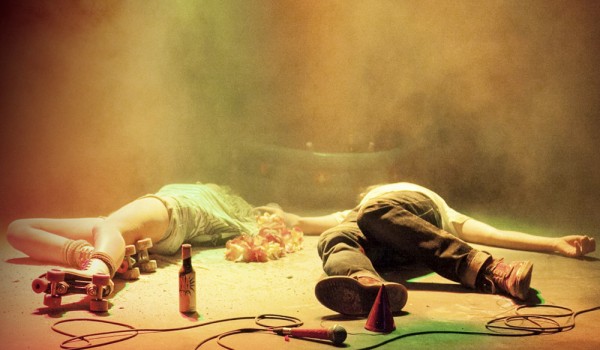
Karaoke – Sleepwalk Collective @ Battersea Arts Centre, until 18 October 2014

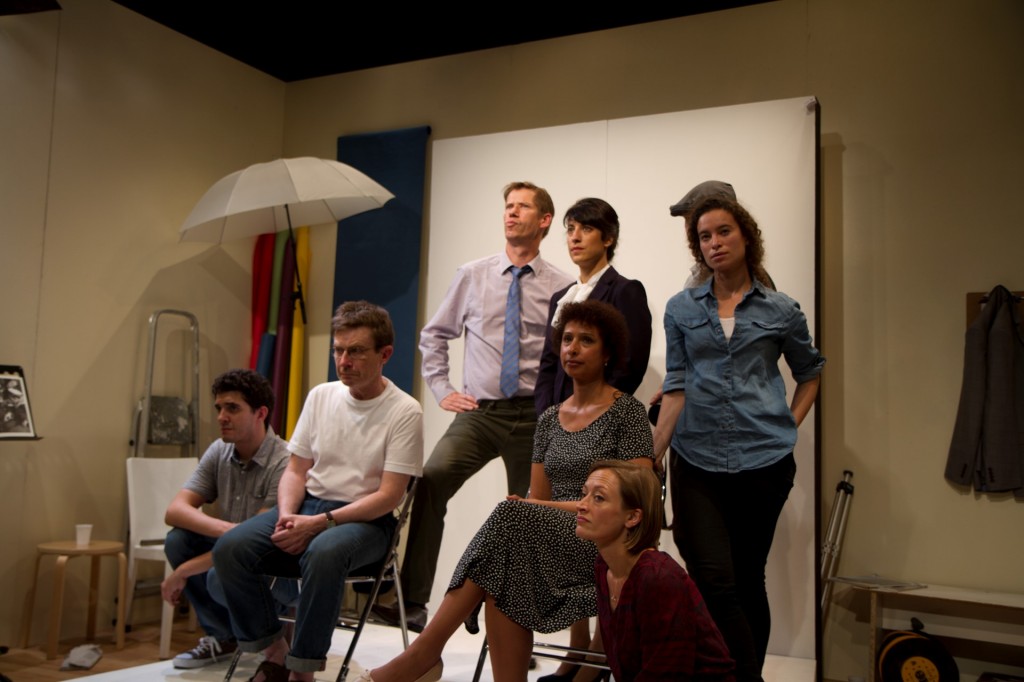
It is presumably with a sense of playful creativity that Battersea Arts Centre has paired Ring and Karaoke as an unofficial double-bill, meaning the adventurous theatre-goer can head straight from Fuel’s Ring in the Council Chamber in time to catch the start of Sleepwalk Collective’s Karaoke in the Staff Recreation Room.Ring_NEWWEB
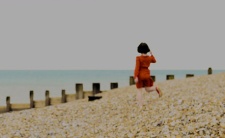
Even the anodyne room names, a hangover from the BAC’s municipal past and a world away from the bright lights of the West End, are appropriate for two shows that, in very different ways, explore the nature of theatre as performance. For Spanish-English company, Sleepwalk Collective, this exploration is at the very heart of its show but for Fuel it is a by-product of their production.

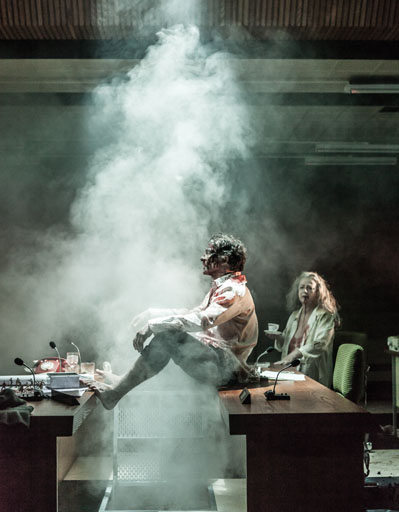
David Rosenberg and Glen Neath worked with neuroscientists at the UCL Ear Institute in order to grasp how the human brain manages to map the location of sound and have put their learning to good effect in Ring. Set in complete darkness and told to the audience through a pre-recorded audio track via headphones, there is no live performance but we are a long way from the world of the Radio 4 afternoon play. The sound design is very impressive and, in the darkness, through the headphones, you get a fully-rounded 360 degree performance that could easily be mistaken for live action.
KARAOKE-Sleepwalk-Collective-600x350The darkness is integral to the plot and so there is not a disconnect with the fact you are sitting in a room with the lights off. The functional surroundings are also important because for the concept to work people need to forget they are an audience member and believe that they could be part of the story. Dwelling on this would spoil the experience but the play hinges on ideas about group therapy and what people may share in the anonymity that darkness provides.

There is a creeping menace within the action that plays on the best type of horror – not one of shocks but a genuine psychological unease. It is that moment of quiet realisation that can be terrifying; the end of The Vanishing or the rich seam of Japanese psychological horrors through the late 90’s. You become, it seems, a central player in the story; it revolves around you and the room itself becomes alive with an action that you know can’t be there but that becomes real through the connections the brain will force you to make.

Ultimately Ring will work to the degree that the individual invests in the concept, any feeling of unease will only come from your own mind. The words and sounds are played directly into your head, and whilst everyone is listening to the same story they are listening to it within their own world. As the narrative unfolds, and scenes are played out, it is still only a sketch, it is the responsibility of the audience to colour the picture in. The success with which you do so will determine how successful you find the show.
<<Continue to full review>>

Knocking down the Berlin (fourth) Wall

An Enemy of the People – Schaubühne Berlin @ Barbican (24 – 28 September 2014)

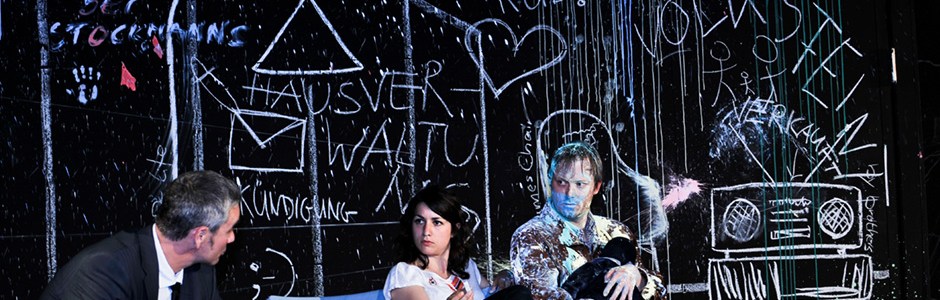
They don’t make many like they make Thomas Ostermeier. That he is not on the tip of the tongue of British theatre-goers says more about the appallingly low number of productions that make it across the channel and the limited tours when if the even get here. An Enemy of the People was sold out for its five performances at the Barbican and I am certain if there was the bravery to finance a small tour then people would come. How can people71c4ddf9-d738-459e-9cb0-b6f09f73e98d-460x276 learn what they like if they never get the chance to see anything different?

The glorious thing about watching an Ostermeier production is that while you may not know quite what you will get, you know it will still be a quintessentially Ostermeier affair. For, yes, we are back in the realm of the director as  auteur. Cue much huffing and puffing from the comment boards and cue rapturous, and occasionally unthinking, applause from everyone else. An Enemy of the People is the latest to hit the Barbican and follows on from a radical Hamlet that tore down almost every Shakespearian convention and reinvented the play from the grave up.

T1Ostermeier seems to be a man who will be anything but be dull. He brings his own hyperactivity to the text and energises performances far past what audiences should find comfortable; Hamlet clocked in at 168 minutes without an interval, and An Enemy of the People doesn’t fall far short at 150. Yet the quality can be seen that, despite the ridiculous running time, the audience sat in rare rapt attention, with not a rustle or toilet break to be seen disrupting the action.
An Enemy of the People is not without flaws and there is a nagging suspicion that Florian Borchmeyer commits serious logical fallacies in trying to bridge his adaptation of Ibsen’s text with a modern element that draws on the anonymous 2007 paper, The Coming Insurrection. However these flaws don’t destroy the integrity of the play and should be placed in the context of the vitality of the production and the creation of a theatrical experience that genuinely led to an enforced, and welcome, assessment of my own political values.

That the modern element fails is a shame due to the fact that Ibsen’s own play is so strangely contemporary that it barely needs updating to maintain its resonance. The idea of the small, righteous man standing up against a society that does not want to hear his truth has never gone out of fashion and has grown in stature in recent years, with the Young Vic staging a 1970’s set version last year.

<<Continue to full review>>

The making of a king

Richard III – Trafalgar Studios (01 July – 27 September 2014)

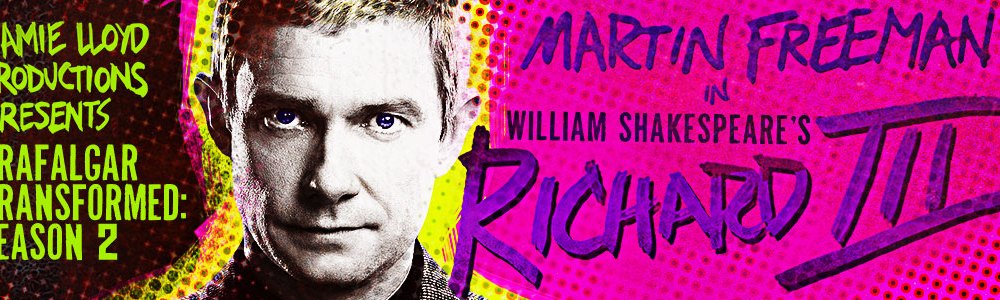
Richard III, as proved by his miraculous reappearance in a car park in Leicester, is someone who will not stay dead. In the last three years we had already seen three major productions, including turns from the cream of both stage and screen; Mark Rylance and Kevin Spacey. It is a brave performer who follows in those footsteps and even braver one who takes it despite minimal recent stage experience and a screen persona that has been fine-tuned to be the polar opposite of the larger-than-life, charismatic king.

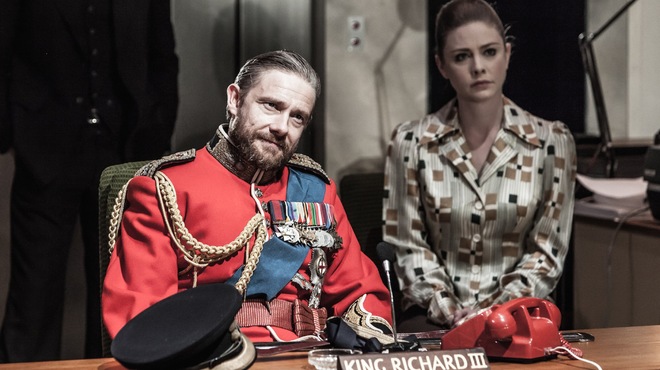
However Jamie Lloyd has been using the opportunity presented by Trafalgar Transformed to revitalise the space with high octane productions cast with performers that have been carefully chosen to appeal to a younger Martin Freeman as Richard IIIdemographic without destroying the vitality of Shakespeare’s language.

Richard III, and last year’s superb Macbeth with James McAvoy, blurs the lines between cinematic and theatrical expectations. It is reasonable to quibble with the handling of the language but it is wrong to deny they contain a thrilling visceral energy that may counter the preconceived notions of those whose only experience of theatre is via how drama is taught in schools.

There has been criticism in how Martin Freeman approached the text and it is true the verse of the famous opening monologue is all but destroyed through his delivery. However this is less marked in the rest of the play and often the iambic meter is fluid and complete. He may not have the rounded tones of a natural stage actor but this may be a combination of lack of experience and also the directorial decisions underpinning the play.

Richard III JLC PROD-1522The decision to tackle ‘Now is the winter of our discontent…’ in that way would not have been taken lightly and, on balance, the production gets away with it because it is being delivered as an address to the nation. If we accept the opening premise that changes it from a traditional monologue to a public speech then it is logically justifiable to deliver it in the clipped rhetorical tones of a politician rather than in the fluid verse of someone expressing their inner-thoughts.

Whilst changing the tone of one of Shakespeare’s greatest speeches is controversial, it does allow a wonderful moment that would not otherwise be delivered. To use the language of cinema there is a brilliant smash-cut at ‘But I, that am not shaped for sportive tricks’; Freeman’s Richard switches instantly from the exterior to the interior, from the public to the private. We see clearly the calculating nature of his public persona and the private contempt of others.

For an audience less literate in the convoluted back story of the play it also makes it easier to recognise the inappropriateness of the good humour he shows to Clarence as he is being sent to the tower. We have already been shown the duplicity of Richard and his ability to – use the jargon of modern politics in which it is set – ‘work the room’. Here with Clarence we witness this as a fine art; understanding, consoling and, naturally, mastering the double-speak that contains no lies – ‘well, your imprisonment shall not be long’.

If this Richard has one overriding trait it is that of the small-man syndrome writ on a national scale. This is most clearly witnessed in the wooing of Lady Anne; a scene that demonstrates both the driving force of this Richard, along with a sense of what makes the production ultimately problematic.

<<Continue to full review>>

High-energy/High-concept

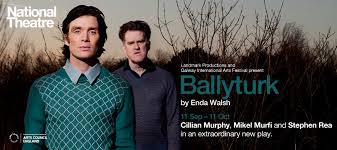
BallyturkLyttelton @ National Theatre, until 11 October 2014 (Tickets)

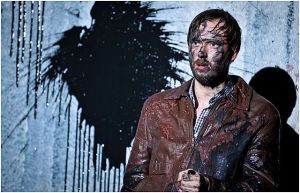
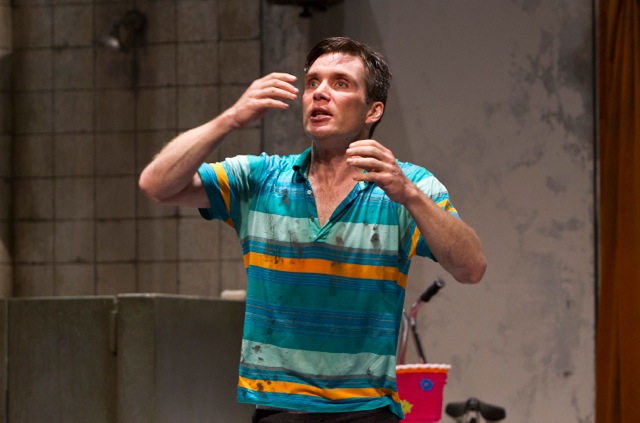
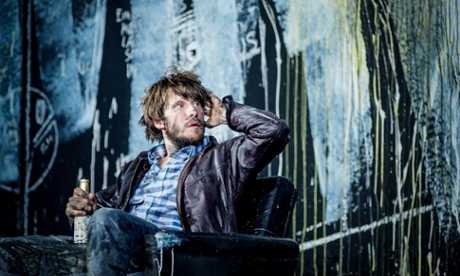
The pull quote for The Telegraph’s review for Edna Walsh’s Ballyturk is simply ‘hard to fathom’ – well, they got right. Twice I have been pulled into the Lyttelton for a Cillian Murphy / Edna Walsh collaboration and twice I have left frustrated with the outcome. The high points have remained the same and they lie in the wonderful sets created by Jamie Vartan and in the virtuoso performances by the cast.Cillian Murphy Ballyturk

In Misterman, Vartan turned the Lyttelton’s stage into a cavernous warehouse that seemed to stretch endlessly into the distance, whilst Murphy was magnificent in a performance of spectacular energy and verbal dexterity. My main reservation was the play seemed to operate under the illusion that it was a far more complex than it really was. The ending, presented as a big reveal, was something that could be seen a mile away.

Well in Ballyturk, Vartan creates another ingenious set and Murphy gives another high-energy performance. This time he is joined by Mikel Murfi, who is given every chance to showcase the benefits of a Jacques Le Coq schooling as he is jumps nimbly into the shoes of an entire Irish village’s worth of characters, and also by Stephen Rea, playing a languid, louche Stephen Rea-character.

The cast are all excellent in what they are asked to do. There are issues with the clarity of their speeches but this feels more of a studied directorial decision to give the play a frenetic feel in order to keep the audience off-balance at all times. Played on the edge of mania it is exhausting just to watch; The sudden explosions of music, the high-octane performances, the rapid fire dialogue, the conversational tics and character changes ensures that the 90 minutes is a mental strain.

<<Continue to full review>>


Watch the trailer:

Woe, the humanity!

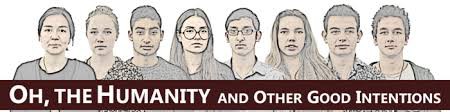
Oh, the Humanity and Other Good IntentionsTabard Theatre, until 20 September 2014 (tickets)

Will Eno has been nominated for a Pulitzer Prize, Lynn Gardener called him a ‘supreme monologist’ and was described in the New York Times as ‘Samuel Beckett for the Jon Stewart generation’. On the back of ‘Oh, the Humanity…’ I must admit to being utterly mystified by any of these facts.

Comprising of a series of monologues and duologues, Oh, the Humanity is primarily a display in the type of vacuous, meaningless pretension that you would be disappointed to see from a student in the first year of a creative Oh-The-Humanity-3-1024x682writing course, let alone an award-winning playwright. It is supremely self-indulgent, remarkably irritating and, for a play that is clearly interested in the fragile connections that exist between people, stunningly lacking in self-awareness.

It is difficult to not feel sorry for the actors – more than one of whom looked genuinely uncomfortable as they delivered lines that fell flat against the stony silence of the audience. One can imagine that discomfort that comes from having to play a semi-comic supremely insensitive PR Rep for an airline company that has just seen one of its planes go down in flames. If timing is everything in comedy then this has butted rather too uncomfortably against reality.

OhtheHumanityNEWframe2I had really wanted to like this production if for no other reason than because I wish End of Moving Walkway every success. Whilst not a habitual attendee on the fringe-scene, I appreciate anyone willing to challenge the existing iniquitous model where access to performing is limited to those with the deepest pockets. End of Moving Walkway have taken the brave step of guaranteeing actors at least minimum wage for rehearsal and performance. It may not be a lot but it is better than expecting actors to exist on a wing and a prayer, and for this the company deserve praise.
One can see the logic of choosing Oh, the Humanity as a first play. A series of monologues means that you can keep rehearsals to a minimum and staging relatively simple. However this has been a year of sensational monologues, and whilst this may have heightened awareness in the form it has also set the bar very high. We have had terrific performances from Fiona Shaw, Juliet Stevenson and Lisa Dwan early in the year. There was Kevin Spacey chewing up the stage in Clarence Darrow and Danny Braverman’s low-key but potent Wot! No Fish? Even now it is up against The Me Plays and, more pertinently, Neil LaBute’s Autobahn.

I have always struggled to like Neil LaBute plays but one has to admire them; his control over his writing, his use of language and the way that words become recurring motifs lead to powerful and impressive work. He is able to grab the audience and hold them in his sway no matter how distasteful the subject. In comparison Will Eno’s work is flabby in content and flaccid in power. In thrall to his own brilliance, he lets his monologues go on and on. Oh, the Humanity clocks in at over 90 minutes for five pieces and does nothing to justify holding the audience’s attention.

<<Continue to full review>>

Forbidden but not forgotten

Forbidden Broadway – Vaudeville Theatre, booking until 22 November 2014

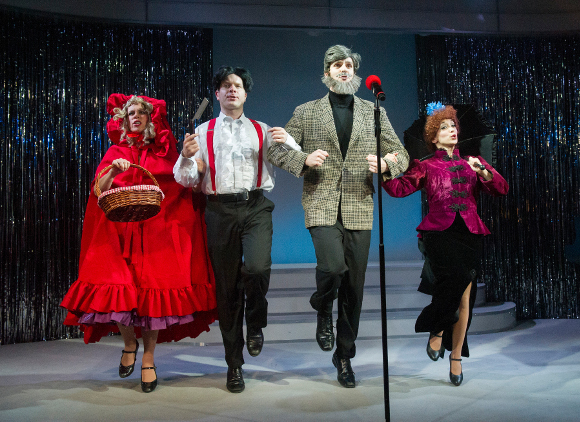
With a song in my heart and a smile on my face, Civilian Theatre came as close he ever will to skipping with joy out of theatre at the end of Forbidden Broadway. This relentlessly silly, endlessly enjoyable show has transferred from the Menier Chocolate Factory to the Vaudeville to a fill a gap in scheduling after the short notice postponement of Rabbit Hole. It is a mark of the show’s fluid nature that a joke about being a ‘late season replacement’ hasanna-jane-casey-damian-humbley-ben-lewis-and-christina-90856 already been shoehorned in.

Forbidden Broadway has been around New York since the early 1980s but the nature of the show allows it to seamlessly weave in new musicals as they appear and as a result it broadly resembles the current West End, with The Book of Mormon and Once coming in for two of the most vicious sketches.

Joining the London cast is Christina Bianco, a star in the Broadway run and perhaps as importantly from the ticket agencies point of view, someone whose Youtube video of Let It Go has racked up more than 5 million hits. A not insignificant number when you have a mainly unknown cast and a West End theatre to fill.

The variety on display is quite startling. There is no plot, not even an attempt at one. This is a musical revue through and through, and the talented performers seem to be enjoying themselves as much as the audience. It reminded, more than anything else, of the Reduced Shakespeare Company – a fixture in London for many years.

The cast, Christina Bianco, Anne-Jane Casey, Damien Humbley and Ben Lewis, are impressively versatile and can switch between musical genres at the drop of a hat. They work well together as an ensemble and there isn’t a weak link among them, but it was Bianco demonstrating a stunning range in her pitch-perfect takedown of Kristin Chenoweth that came closest to bring the house down.

Like all parody shows there are hits and misses. However the ratio is certainly in favour of the hits, and even the misses are well sung. It is a show that does require a pretty good knowledge of musical theatre, and it has been written by people who know the form inside out – something seen in their canny choice of beginning with their take on ‘Fugue For Tinhorns’ from Guys and Dolls; a song that any musical aficionado will know has a fair claim of being the best opening number of any musical.

<<Continue to full review>>


I must thank the good people at Official Theatre for the tickets. Even without this shameless plug, please do check out their website to find out what is going on across the West End; it has links to tickets, venue contact details and bits ‘n bobs about all the theatres – the sort of thing I would do if I wasn’t so damn lazy.  (www.officialtheatre.com)